AI Simulation Game: Play Worlds That Think, Remember, and Adapt (March 2026)
2026-03-29
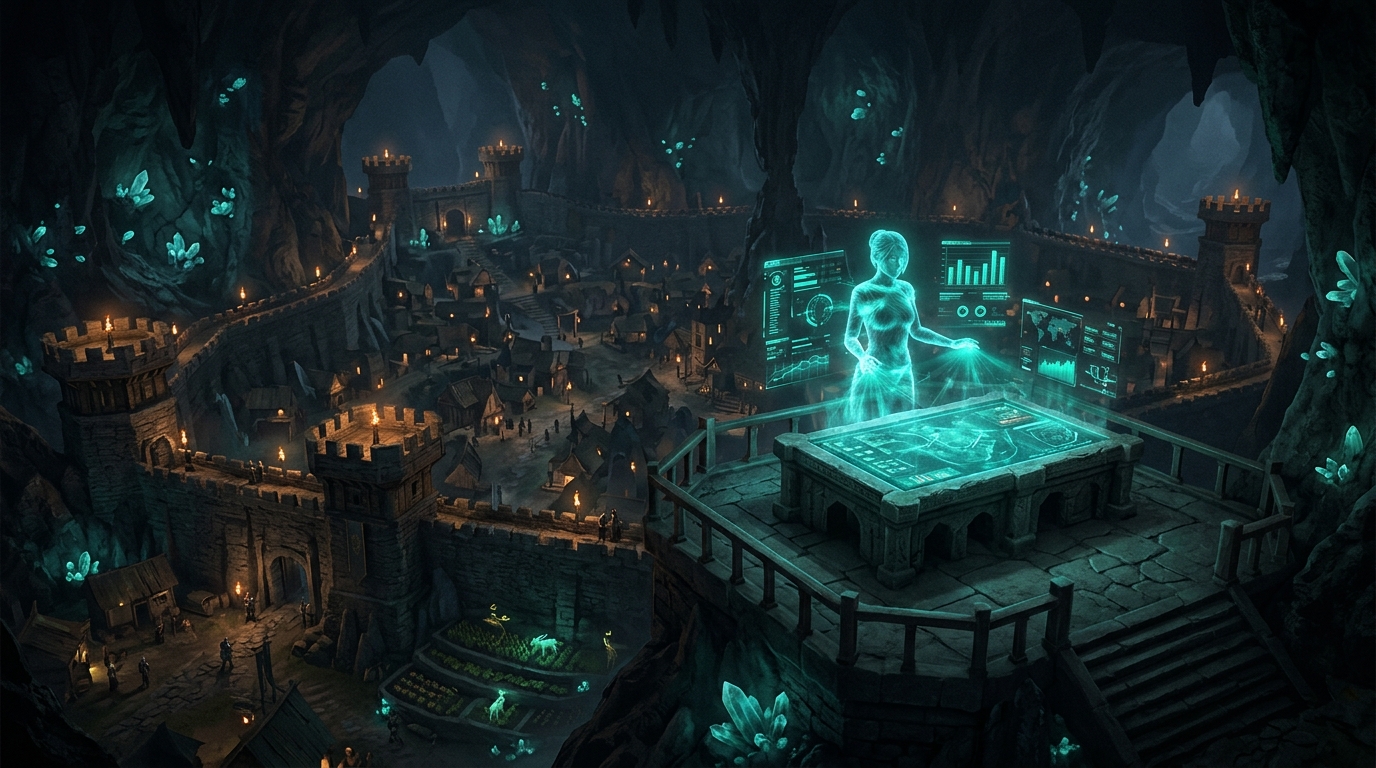
The AI simulation game is no longer a concept — it's the fastest-growing intersection of two massive industries in 2026. The global AI in gaming market is valued at $4.20 billion in 2025 and is projected to reach $66.84 billion by 2035, growing at a 32% CAGR (InsightAce Analytic). Meanwhile, the simulation game market alone was valued at $6.5 billion in 2024 and is projected to reach $9.2 billion by 2033 (Verified Market Reports). Where these two forces converge, a new category of interactive experience is emerging — one where worlds don't just respond to your inputs, but think about them.
Traditional simulation games gave you systems to manage. AI simulation games give you worlds that manage themselves — then react when you intervene.
Jenova is at the center of this shift, offering specialized AI agents that power social simulations, horror investigations, romance dynamics, management scenarios, and open-ended roleplay — all with persistent memory, autonomous NPCs, and frontier language models including GPT-5.4, Claude Opus 4.6, and Gemini 3.1 Pro Preview.
Quick Answer: What Is an AI Simulation Game?
An AI simulation game is an interactive experience where large language models with persistent memory power autonomous characters, emergent narratives, and dynamic world systems — generating content in real-time based on player decisions rather than following pre-scripted paths.
- 🗡️ Roleplay Game Master — Unlimited-memory immersive simulations in any genre, setting, or rule system
- 🏝️ Love Island — Open-world social simulation with eight autonomous AI characters
- 🏚️ The Mansion — Mystery escape simulation with AI-driven environmental storytelling
- 😱 The Asylum — Procedurally generated psychological horror with permanent death
- 🎤 K-Pop Producer — 60-day management simulation with emergent trainee narratives
The Problem: Why Traditional Simulation Games Hit a Ceiling
Despite the genre's popularity, traditional simulation games face structural limitations that AI is uniquely positioned to solve.
Scripted NPCs Break Immersion
The most visible failure in simulation gaming remains NPC behavior. Decades of "Welcome, adventurer" greetings, circular dialogue trees, and behaviorally rigid characters have trained players to see NPCs as mechanical props rather than believable inhabitants. As Forbes reported in February 2026, "AI agents are moving games beyond scripted characters, enabling lifelike NPCs, emergent gameplay, and faster development" (Forbes).
Over 90% of gamers find playing with AI-powered NPCs to be "enjoyable and rewarding." — GamesIndustry.biz
The appetite for intelligent characters is clear. The technology to deliver them at scale is now available.
Finite Content, Diminishing Returns
Even the most acclaimed simulation games operate on finite content. Cities: Skylines II simulates 100,000+ individual citizens, but their behavioral patterns are ultimately bounded by pre-programmed rules. A narrative-driven simulation may deliver 20-40 hours of content before repetition sets in. According to BCG's 2025 Global Gaming Survey, 40% of gamers are consuming more user-generated content than a year prior precisely because static experiences no longer satisfy (BCG).
The Development Bottleneck
Creating high-quality simulation games requires massive investment. AAA titles regularly exceed $300 million in development costs with multi-year production cycles. The 2026 Unity Game Development Report found that 73% of polled studios are now using AI tools for back-end development and planning tasks (Unity) — but the player-facing simulation experience itself remains largely static.
The Gap Between Promise and Reality
The gaming industry's relationship with AI remains complicated. The GDC 2026 State of the Game Industry survey found that only 7% of respondents believe generative AI is having a positive impact on the game industry, down from 13% in 2025 (GDC). Yet as AI and Games founder Dr. Tommy Thompson noted, "Players kick back at AI that is taking away from creativity. But when AI is used to power totally new types of interactive experience, then it's a very different story" (GamesIndustry.biz).
This is exactly what Jenova was built for — not AI that replaces creative work, but AI that enables entirely new categories of simulation experience.
The Jenova Solution: AI-Native Simulation Infrastructure
Where traditional simulation games layer AI on top of pre-built systems, Jenova's approach is fundamentally different: specialized AI agents where the intelligence is the game. Remove the AI and no simulation exists.
| Aspect | Traditional Simulation Games | Jenova AI Simulation Games |
|---|---|---|
| NPC behavior | Pre-programmed state machines, behavior trees | Autonomous decision-making with persistent memory |
| Dialogue | Scripted trees, fixed responses | Dynamically generated, context-aware conversation |
| Content volume | Finite, exhaustible | Near-infinite, procedurally coherent |
| World persistence | Save states, fixed progression | Cross-session memory, compounding consequences |
| Replayability | Diminishing returns after completion | 100% unique — no two sessions identical |
| Creation barrier | Years of development, millions in budget | Natural language setup in minutes |
| Personalization | Difficulty sliders, cosmetic options | Deep behavioral adaptation to player values |
How Frontier Models Power Living Simulations
The convergence of several technical advances makes 2026's AI simulation games possible. Jenova provides unified access to GPT-5.4 (OpenAI), Claude Opus 4.6 (Anthropic), Gemini 3.1 Pro Preview (Google), plus models from xAI and DeepSeek — no vendor lock-in.
- Context windows exceeding 100K tokens allow NPCs to remember entire relationship histories, player decisions, and world states across months of play
- Reasoning improvements enable characters to understand consequences, form plans, and react appropriately to unexpected player actions
- Persistent memory architecture ensures character development and world events remain consistent across unlimited sessions
- Latency reduction to conversational speeds makes real-time dialogue feasible on any device
Competitor Landscape
While platforms like ChatGPT and Gemini can handle basic roleplay through careful prompting, they're not purpose-built for simulation continuity, character psychology, or multi-session world tracking. Jenova's specialized agents are architected specifically for simulation — with domain-specific knowledge, persistent memory, and behavioral frameworks that general-purpose chatbots lack.
Specialized AI Agents for Simulation Gaming
🗡️ Roleplay Game Master
The foundational agent for immersive simulation experiences. Whether you're running a medieval kingdom, a cyberpunk detective story, or a post-apocalyptic survival scenario, the Roleplay Game Master maintains unlimited memory, perfect character consistency, and support for any rule system or homebrew setting.
- Unlimited memory maintaining NPC psychology and world state across years of interaction
- Multi-genre support: fantasy, sci-fi, historical, contemporary, horror, and custom settings
- Autonomous NPC behavior — characters pursue goals, form alliances, and react to player reputation
- Supports any rule system (D&D, GURPS, Fate, homebrew) or freeform narrative
🏝️ Love Island
Open-world social simulation with eight AI characters who have autonomous desires, independent goals, and their own decision-making processes. They pursue romantic interests whether you're involved or not. They experience genuine jealousy when you divide your attention. They remember betrayals and celebrate demonstrated loyalty.
- Affinity scoring across romantic, platonic, rivalry, and alliance dimensions
- Emergent social dynamics — jealousy, alliance formation, and conflict arise organically
- Memory-driven dialogue referencing shared experiences across unlimited sessions
- 100% replayable — no two sessions generate the same social dynamics
😱 The Asylum
Procedurally generated psychological horror set in a shuttered psychiatric institution. Every playthrough generates a unique institution with distinct NPCs, hidden agendas, and narrative secrets. The agent specializes in atmospheric dread, unreliable narration, and psychological tension — adapting scare intensity to individual player responses.
- Procedurally generated institutions with unique layouts, histories, and inhabitants
- Autonomous NPCs with independent agendas and hidden motivations
- Permanent death mechanics with earned endings based on investigation depth
- 100% replayability — each session creates an entirely new horror experience
🏚️ The Mansion
Mystery escape simulation where players wake with no memory in an enigmatic estate. The AI manages environmental storytelling, clue distribution, and escalating tension based on player investigation patterns. Trust-building with other inhabitants unlocks hidden narrative paths.
- AI-driven tension building based on exploration patterns
- Multiple endings determined by discovery depth and relationship choices
- Environmental storytelling through atmospheric detail and procedural clue placement
- Each playthrough generates distinct puzzle configurations and revelations
🎤 K-Pop Producer
Management simulation spanning 60 intense days of trainee selection, skill development, and career shaping. Individual trainees have distinct personalities, secret motivations, and relationship needs that evolve based on your decisions. Group chemistry emerges from demonstrated management style.
- Individual trainee psychology with distinct motivations and hidden secrets
- Group chemistry simulation creating emergent alliance and conflict
- Market dynamics and industry pressure creating strategic trade-offs
- Narrative consequences where relationship choices impact long-term outcomes
✍️ Creative Fiction Writer
Interactive fiction creation where players collaboratively develop narratives with AI assistance — effectively blurring the line between playing a simulation and building one. The agent handles deep research, editorial insight, and polished prose across any genre.
- Collaborative world-building with consistent internal logic
- Character development tracking across complex narrative arcs
- Genre-specific expertise from literary fiction to genre storytelling
- Research-backed historical and cultural accuracy
How It Works: Your First AI Simulation Game
Getting started with AI simulation games on Jenova takes about 30 seconds. Here's how to launch simulation experiences that last weeks, months, or longer.
1. Choose Your Simulation Type
Select the agent that matches your interest:
- Open-world roleplay → Roleplay Game Master
- Social simulation → Love Island
- Horror investigation → The Asylum
- Mystery escape → The Mansion
- Management sim → K-Pop Producer
2. Describe Your Simulation Parameters
Unlike traditional games with fixed starting states, AI simulations begin with collaborative setup. Describe the world you want:
"I want to run a medieval kingdom simulation where I'm a newly crowned ruler inheriting a fractured court. My advisors have competing agendas, neighboring kingdoms are testing my borders, and a drought is threatening the harvest. I want political intrigue, difficult moral choices, and consequences that compound over weeks of play."
The AI processes these constraints, generating appropriate world details, NPC motivations, and narrative threads that will matter throughout the experience.
3. Engage Through Natural Language
No interface learning or button memorization required. Interact as you would with another person:
"I summon my spymaster for a private audience. I want to know which of my advisors has been corresponding with the northern kingdom — but I don't want to reveal that I already suspect Lord Aldric."
The AI evaluates social context, character relationships, world state, and narrative consequences — then responds with immediate outcomes and updated situation awareness.
4. Experience Compounding Consequences
Decisions accumulate across sessions. Your choice to show mercy to a captured spy in week one may yield intelligence in week four. A demonstrated preference for diplomacy over force causes NPCs to approach you differently. Remembered details from session one become relevant in session ten.
5. Play Anywhere, Resume Instantly
With Jenova's mobile app, pick up your ongoing simulation on your phone during a commute, play a quick scene during lunch, and continue on desktop at home. Persistent memory means you never lose progress.
Results & Use Cases
📊 Emergent Social Dynamics
Scenario: A player wants social simulation with genuinely autonomous characters — not scripted relationship meters.
Traditional Approach: Games like The Sims offer personality traits and need-based behavior, but interactions follow predetermined patterns. Relationship progression is mechanical rather than emergent.
Jenova Solution: Love Island features eight characters with autonomous psychologies who form opinions, hold grudges, pursue independent goals, and develop trust based on demonstrated behavior — not selected dialogue options. Over 90% of gamers report finding AI-powered NPCs "enjoyable and rewarding" (GamesIndustry.biz).
💼 Persistent World-Building
Scenario: A player wants to build and manage a complex world over months of play, with NPCs who remember everything and a world that evolves between sessions.
Traditional Approach: City builders and management sims offer deep systems but finite behavioral variety. NPCs follow programmed routines regardless of player history.
Jenova Solution: Roleplay Game Master generates locations with consistent internal logic, narrative significance, and genuine thematic variation. Each discovered location connects to emerging plot threads. NPCs develop relationships with the player and each other across unlimited sessions.
📱 Brief-Session Horror
Scenario: A player wants meaningful horror experiences in 15-20 minute sessions, with genuine tension that builds across multiple play sessions.
Traditional Approach: Horror games require extended play sessions for atmosphere building. Mobile horror games sacrifice depth for accessibility.
Jenova Solution: The Asylum maintains atmospheric continuity across sessions of any length. The AI remembers what you've discovered, which NPCs you trust, and what horrors you've already encountered — building psychological tension that compounds over time rather than resetting.
🎭 Creative Simulation Design
Scenario: A player wants to design their own simulation scenario — a space station crisis, a medieval court, a zombie apocalypse — without programming skills.
Traditional Approach: Creating custom simulation scenarios requires game development expertise, months of work, and significant technical investment.
Jenova Solution: Jenova enables custom agent creation with natural language instructions — no programming required. Describe desired simulation dynamics, NPC psychology, and world rules; the system generates functional agents accessible through the same interface as official offerings. Beyond pre-built agents, users can create entirely new simulation types in minutes.
FAQ: AI Simulation Games in 2026
What makes AI simulation games different from traditional simulation games?
Traditional simulation games operate on pre-programmed rules — NPCs follow behavior trees, economies follow mathematical models, and events trigger from predetermined conditions. AI simulation games generate content dynamically through large language models with persistent memory. Every conversation, relationship development, and world event is created in real-time based on player input and accumulated history. The Roleplay Game Master enables experiences that would be impossible to script manually, with infinite variation rather than finite content.
How big is the AI in gaming market?
The global AI in gaming market is valued at $4.20 billion in 2025 and is projected to reach $66.84 billion by 2035, growing at a 32% CAGR (InsightAce Analytic). Separately, the broader gaming industry reached $197 billion in 2025 (InvestGame), with approximately 50% of studios now actively using AI in development (BCG).
Are AI simulation games free to play?
Yes. Jenova offers a free tier that includes access to all core features, including the Roleplay Game Master, Love Island, The Asylum, The Mansion, and K-Pop Producer. For heavier usage, paid plans start at $20/month (Plus) and scale based on volume. No credit card is required to start.
How does persistent memory work in AI simulation games?
Persistent memory means the AI remembers everything across unlimited sessions — your first conversation with an NPC, promises you made weeks ago, alliances you formed, and betrayals you committed. Characters don't reset between sessions; they evolve. A kingdom you've governed for months carries genuine weight because every decision has compounded. Your data is never used for model training, is encrypted in transit and at rest, and is never sold to advertisers.
Can I create my own AI simulation game?
Yes. Beyond Jenova's pre-built agents, the platform enables custom agent creation with natural language instructions — no programming required. Describe your simulation's world rules, NPC psychology, and interaction patterns; the system generates a functional simulation accessible through the same interface. Whether you want a space station management sim, a medieval court intrigue, or a zombie survival scenario, you can build it in minutes.
How do AI simulation games compare to games like Cities: Skylines or The Sims?
Traditional simulation games like Cities: Skylines II and The Sims 5 excel at visual fidelity and systems-level simulation — traffic patterns, economic models, and physics engines. AI simulation games on Jenova excel at narrative depth, character psychology, and emergent storytelling. They're complementary rather than competitive: Cities: Skylines gives you a city to manage; the Roleplay Game Master gives you a world to inhabit.
Conclusion
The AI simulation game market sits at the intersection of two accelerating forces: a 197 billion gaming industry emerging from its post-pandemic slump ([InvestGame](https://investgame.net/wp-content/uploads/2026/01/2026-01-27-Quo_Vadis_Gaming_2026__Gaming_report_2023-2025.pdf)) and an AI in gaming sector growing at 32% annually toward 66.84 billion by 2035 (InsightAce Analytic). Over 7,300 games on Steam now disclose AI applications, with approximately 50% of studios actively using AI in development (BCG). The demand for intelligent, adaptive simulation experiences has never been higher.
What separates a forgettable simulation from one you'll return to for months comes down to three things: memory, autonomy, and emergence. Traditional games offer systems to manage. AI simulation games offer worlds that think — characters who remember your name from three weeks ago, pursue their own goals when you're not watching, and surprise you with consequences you didn't anticipate.
The Roleplay Game Master, Love Island, The Asylum, and K-Pop Producer represent what simulation gaming becomes when AI isn't a feature — it's the foundation.
Try any AI simulation game on Jenova now — free, no credit card required.