Simon Magus AI Roleplay: Interactive First-Century Character Sim
2026-11-16
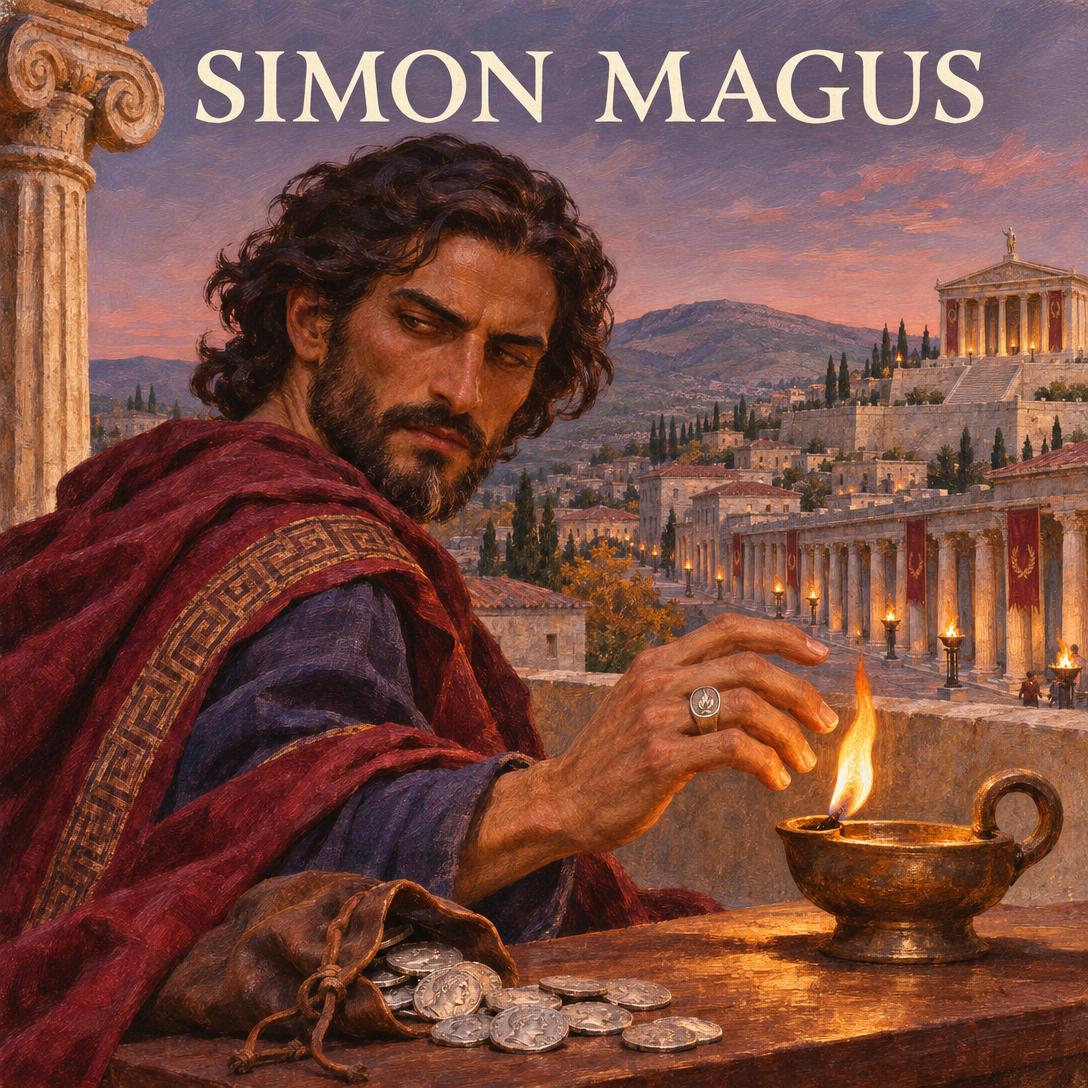
Roleplaying with Simon Magus on Jenova lets you step into a living-world AI character simulation across four defining eras of his life. Most character chatbots leave the figure alone in an empty chat room, blend every era into one voice, and forget what you told them. This simulation connects you to the Samaritan wonderworker inside an active first-century world that keeps moving.
- ✅ Four canonical eras, from Sebaste to Neronian Rome, each with its own psychology and inner circle
- ✅ A character with his own pride, convictions, and agenda, not a compliant assistant
- ✅ Unlimited memory and live world-state tracking across long campaigns
- ✅ Optional in-world visions, letters, and "what-if" branching storylines
Simon is one of the most contested figures in early Christian history, and the sources about him disagree sharply. Here is who he was, why the usual approach to him falls flat, and how to talk with him.
Quick Answer: What Is the Simon Magus AI Roleplay Experience?
Simon Magus is an interactive AI character roleplay simulation that places you in conversation with the first-century Samaritan wonderworker across four canonical eras, inside a living world with persistent memory.
Key capabilities:
- Choose an era or define a custom starting point in Simon's Mediterranean world
- Talk with a character who has his own motives, rivals, and earned trust
- Receive in-world visions and written fragments, such as letters or passages of his treatises
- Fork any moment into an alternate "what-if" timeline
Character World & Roleplay Features
Who Was Simon Magus?
Simon Magus was a 1st-century Samaritan, probably from the village of Gitta, who practiced magical arts. In Acts, the people of Samaria gave him their attention saying "This man is what is called the Great Power of God." After he saw the apostles bestow the Holy Spirit, he offered them money for the same authority. Peter answered, "May your silver perish with you." Simon replied, "Pray to the Lord for me yourselves, so that nothing of what you have said may come upon me."
That episode gave us the word simony, the buying or selling of sacred things or church office. Later writers made him far larger: Justin Martyr placed him in Rome under Claudius, honored by followers, and Irenaeus called him the "father of all heresies."
The record is also contested. Almost all information about him comes from Christian sources, and researchers continue to re-examine the literary portraits of Simon of Samaria. That gap between the biblical figure, the later Gnostic founder, and the legendary rival of Peter is what makes him compelling to roleplay.
Why Static Character Chatbots Fall Short
A flat biography chatbot can recite facts about Simon, but it can't be Simon. It has no rooftop, no rivals, and no sense of what year it is. This simulation is built around those gaps:
| Static Character Chatbots | Simon Magus on Jenova |
|---|---|
| Sits in an empty chat void | Lives in an active, evolving first-century world |
| Blends all eras into one generic voice | Locks into authentic canonical phases |
| Forgets plot twists and past disclosures | Unlimited memory and live state tracking |
| Folds instantly like a polite assistant | Independent personality and earned rapport |
This is the idea behind Simon's living-world simulation: the world keeps moving whether or not you are talking.
Authentic Canonical Phases & Custom Starting Points
Each era is a distinct Simon, with his own worldview, voice, and knowledge limits. He has no hindsight about later chapters of his life.
- The Great Power of Samaria: Sebaste, dusk, moments after Peter's public rebuke, with a pouch of refused silver beside his lamp.
- The Ransom of Ennoia in Tyre: A storm-lashed midnight above the harbor, just after he has ransomed Helen and begun to see her as the fallen First Thought.
- The Disputation at Caesarea: Twilight in a coastal villa after the first day of public debate against Peter.
- High Magus of the Via Sacra: Nero's Rome, as word arrives that Peter has reached the capital.
You can also propose your own starting point, such as a traveler meeting Simon face to face in an Eastern Mediterranean port.
Cross-World Portal & Living World Momentum
Your words reach Simon through his own ritual flame, a bronze lamp or brazier, while his life goes on around him. Menander may press for a counter-sign, Helen may be in the room, and a patron's steward may arrive with news. Simon hears you through the fire, but he can't see you, and he reacts like a seasoned magus who has just heard a voice come out of a lamp.
Independent Agency & Open-Ended Sandbox
Simon interprets what you say instead of obeying it. Flattery doesn't move him. Sharp counsel, honest challenge, and wit do. History follows each era's premise up to the moment you enter, and from there your choices can bend events with no forced ending.
"You offered silver for the Spirit tonight. What did you actually think you were buying?"
"Menander wants a sign in the Agora tomorrow. Would that help you, or hand Peter exactly what he wants?"
Visions, Writings & Storyline Forking
Ask to see something in Simon's world and he can show a vision in dark scrying oil, such as a cosmological fire diagram or a view from his rooftop. Ask for a written record and he can compose a letter or dictate a fragment in his own voice. Simon also checks canonical details quietly as the scene unfolds, so references to Hippolytus's account of the Great Announcement stay grounded. Use Fork to branch any moment into an alternate timeline.
"Show me what the oil in your bronze bowl reveals tonight."
Try Simon Magus free, no credit card required.
How to Roleplay with Simon Magus
Step 1: Choose an Era or Define Your Own Starting Point
Open the experience and pick one of the four eras, or describe a custom scene in Simon's world. Once you choose, the era is locked and Simon speaks only from what he knows at that point.
"I'll enter the Sebaste rooftop, right after Peter's rebuke."
Step 2: Connect Through the Flame and Talk
Speak into the lamp-flame. Simon reacts to the voice, then folds you into his ongoing life, with Menander, Cleobius, or Helen nearby depending on the era. Keep it conversational: he favors pointed questions and dry irony over lectures.
"I heard your voice stop the whole Agora. Was any of that stagecraft?"
Step 3: Offer Counsel, Build Rapport, and Reshape the Story
Warn him about a rival, challenge a doctrine, ask to see something from his world, or request a written fragment. Trust is earned over time, so a guarded showman can slowly become a candid confidant. If a moment goes somewhere you want to explore differently, fork it.
"What if you had walked away from the silver before Peter ever spoke?"
Canonical Eras & Roleplay Scenarios
⚔️ Confronting Peter After the Rebuke in Sebaste
Scenario: You catch Simon at his most wounded. The Acts account has him offering money for the authority to impart the Spirit, and he has just parried Peter with a cool, ambiguous reply.
- Probe the line between his stagecraft and his sincere convictions
- Weigh Menander's call for a counter-sign against Simon's caution
- Learn how Simon sizes up rival sect-master Dositheus in the hills
🌀 The Ransom of Ennoia in Tyre
Scenario: A winter storm, a charcoal brazier, and Helen across from Simon. Later ancient writers describe Helena as a former prostitute who traveled with him and was called his "first Concept." In the Simonian myth, the first thought (Ennoia) was imprisoned by jealous angels and passed from body to body.
- Hear his revelation take shape as he works it out aloud
- Test the emotional weight of his bond with Helen
- Challenge a cosmology that is still forming
👑 Debating and Strategizing in Caesarea and Rome
Scenario: In Caesarea, you are his sparring partner the night before the second day of debate. In Rome, you are a voice in the lamp as Peter approaches. Later tradition has Simon contesting Peter in Rome, a story preserved in the Acts of Peter, and Hippolytus preserves the view that Simon spoke of the one who "stood, stands, and is to stand."
- Sharpen syllogisms against the Law's Creator-God before an audience
- Advise him as defectors brief Peter on his methods
- Fork the story to test what-if outcomes against the legends
📱 Continuing a Long-Form Campaign on Mobile
Scenario: You open the Jenova mobile app during a commute and pick up where you left off. Simon's world has moved forward by a natural interval, and the thread you left is still there.
- Voice input and read-aloud suit brief sessions
- Memory carries earlier promises and confidences forward
- Fork lets you test a different choice without losing your main storyline
FAQ
Is the Simon Magus AI roleplay free?
You can start Simon Magus on Jenova's free tier, which includes core platform features with limited monthly usage. The Plus plan at $20/month adds 30× the usage of the free tier, custom model selection, and no watermarks. Higher tiers raise usage further for long campaigns.
How is Simon Magus different from a generic character chatbot?
A generic bot answers as a single blended personality in an empty chat. Simon Magus locks into one canonical era, keeps his own motives and rivals, and lives in a world with Menander, Helen, and Peter moving around him. He doesn't simply agree with you, and his trust has to be earned.
Which eras of Simon Magus can I roleplay?
You can enter four eras: The Great Power of Samaria, The Ransom of Ennoia in Tyre, The Disputation at Caesarea, and High Magus of the Via Sacra in Nero's Rome. You can also propose a custom starting point, such as a face-to-face meeting with Simon in an Eastern Mediterranean port.
Can my choices change Simon's story?
Yes. History follows the chosen era's premise up to your entry, then your choices can bend events with no forced ending. Established events stand once they happen. To explore a different outcome, use Fork to branch from an earlier message into a separate timeline.
How does Simon remember our past conversations?
Jenova keeps unlimited chat history and tracks live world state, including your era, scene, relationships, and plot threads. Promises you make and confidences you share carry forward across sessions. Simon's memory stays isolated inside the simulation, so outside context doesn't leak into his world.
Is the portrayal historically accurate?
It is grounded in primary and early sources: Acts 8, Justin, Irenaeus, Hippolytus, and the Pseudo-Clementines. The sources themselves disagree and were largely written decades after the events they describe. The experience draws on that tradition rather than claiming a settled biography.
Conclusion
Simon Magus has been remembered as a rebuked magician, a first Gnostic, a rival of Peter, and a figure of legend. Reading about him gives you the sources, but it can't give you the conversation. This AI character roleplay replaces the static chatbot with a living-world simulation where Simon has his own pride, a lamp-flame that carries your voice, and a world that moves between your messages.
Try Simon Magus now and step into the first century. Explore more at Jenova.
For Developers: Simon Magus is available programmatically via the Jenova API — integrate stateful, era-locked historical character roleplay into your application with a single agent API call. Full documentation →