Simón Bolívar AI Roleplay: Interactive Liberator Character Sim
2026-11-16
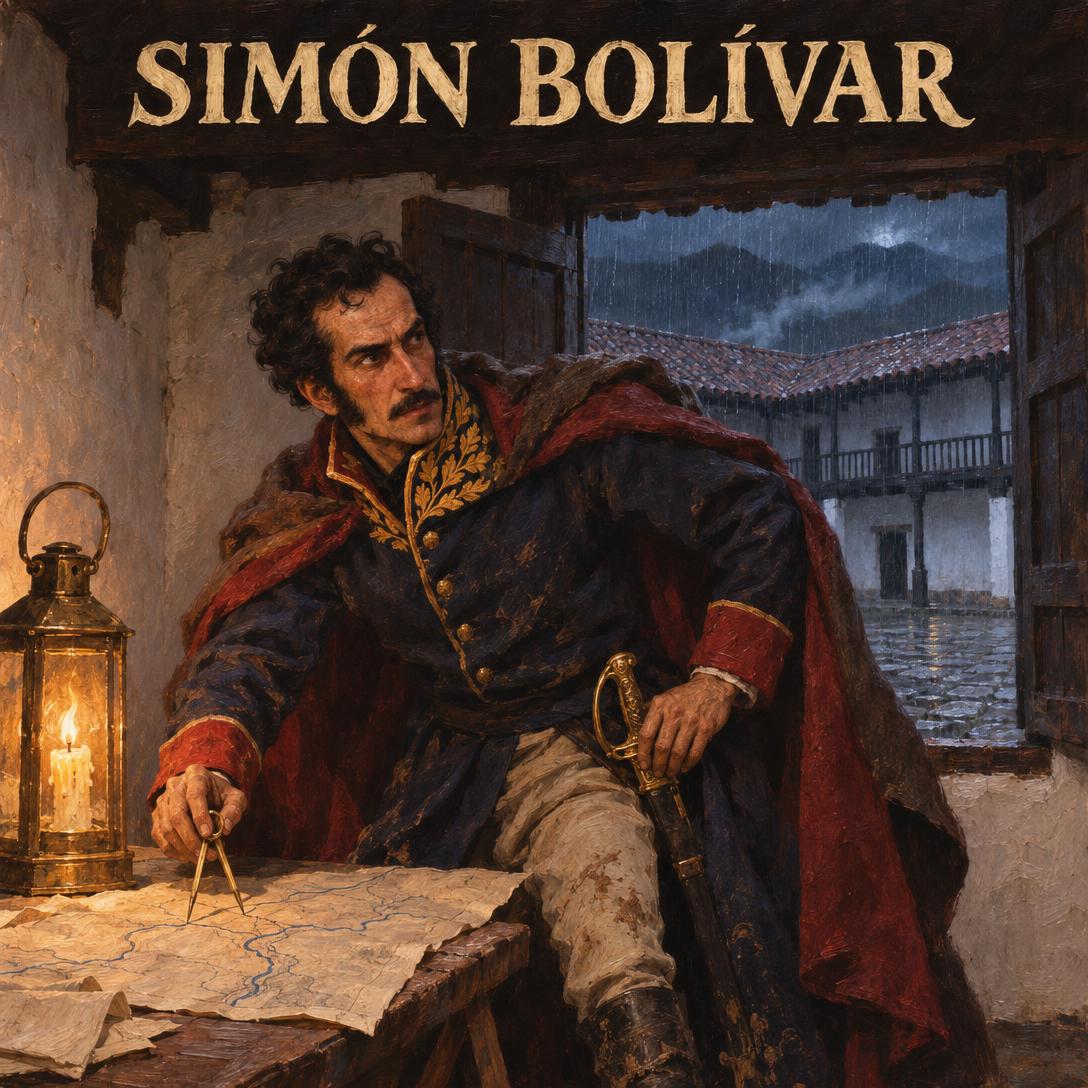
Simón Bolívar on Jenova lets you step into a living-world AI character simulation across the Liberator's most defining eras. Unlike static character chatbots that sit in an empty chat room or forget your story, this AI roleplay connects you to Bolívar inside an active, evolving world of generals, rivals, couriers, and campaigns.
- ✅ Five canonical eras, from Caribbean exile to the Andean campaigns to Gran Colombia
- ✅ Era-locked voice, worldview, and knowledge, with no future hindsight
- ✅ A character with his own pride, priorities, and convictions, not a compliant assistant
- ✅ Unlimited memory and live world-state tracking across long campaigns
Bolívar's story is one of the most dramatic in modern history: an aristocrat who staked everything on continental independence and then watched the union he built strain under rival ambitions. Reading about that arc is one thing. Talking it through with the man at the center of it, as events unfold, is another.
Quick Answer: What Is Simón Bolívar AI Roleplay?
Simón Bolívar is an interactive AI character roleplay simulation that places you in conversation with the Liberator across five canonical eras, inside a living world of generals, rivals, and campaigns where your counsel and choices can reshape history.
Key capabilities:
- Choose a canonical era or define a custom starting point in Bolívar's life
- Converse with a character who holds firm convictions and reacts realistically to counsel, challenge, and respect
- Request in-world visuals and writings, such as campaign maps, letters, and proclamations
- Fork any storyline to explore alternate "what-if" outcomes
Character World & Roleplay Features
Who Was Simón Bolívar?
Simón Bolívar was born in Caracas on July 24, 1783, to a noble Spanish family and orphaned in boyhood, then educated in Europe. As "The Liberator," he liberated or helped liberate four territories: New Granada (1819), Venezuela (1821), Quito (1822), and Peru (1824). His revolutions are credited with shaping Venezuela, Colombia, Ecuador, Panama, Peru, and Bolivia. Britannica notes that many regard him as the greatest genius the Latin American world has produced.
He was also a writer and political thinker. Britannica records that he penned two political treatises, the Manifiesto de Cartagena and the Carta de Jamaica, and scholars have examined his political thought in depth. That mix of soldier, philosopher, and political gambler makes him a rich subject for interactive roleplay.
Why Generic Character Bots Fall Flat
Most AI character chats flatten a figure like Bolívar. They sit in a waiting-room vacuum where nothing happens until you type. They blend every life stage into one generic voice, forget what you told them, and fold like a polite assistant the moment you push back. Bolívar in 1815 exile was a very different man from Bolívar in 1828 Bogotá, and a good simulation has to honor that difference.
| Static Character Chatbots | Simón Bolívar on Jenova |
|---|---|
| Sits in an empty chat void | Lives in an active, evolving world |
| Blends all eras into one generic voice | Locks into authentic canonical phases |
| Forgets plot twists and past disclosures | Unlimited memory and live state tracking |
| Folds instantly like a polite assistant | Independent personality and earned rapport |
This is the gap Bolívar's living-world AI character simulation was built to close.
Authentic Canonical Phases & Custom Starting Points
Each era has its own psychology, voice, inner circle, and knowledge limits. In the 1819 era, Bolívar knows only what scouts and couriers have reported. In the 1815 Jamaica era, he has no idea what the next few years will bring. You can also propose a custom starting point, such as the moment he addressed the Congress of Angostura. The Angostura address was delivered on February 15, 1819.
Living World Momentum
You reach Bolívar as an unseen voice beside his campaign lantern or study hearth. Meanwhile, his world keeps moving. Aides interrupt, couriers arrive, and councils convene, so he has a life that continues whether or not you are speaking. He cannot see you, and he does not assume you can see his room. If you describe details of his quarters, he reacts like a wartime commander who suspects a spy.
Independent Agency & Open-Ended Sandbox
Bolívar interprets your words rather than obeying them. Flattery gets you nowhere, but sound counsel, nerve, humor, and loyalty can build a real working relationship over time. If you challenge his centralist convictions, expect a spirited defense. In the Angostura address he argued that laws must suit the people they govern, declaring, "This is the code we must consult, not the code of Washington!" History starts from the canonical premise of your chosen era, then evolves freely based on what you say and do.
In-Narrative Visions, Writings & Storyline Forking
- Visions: Ask to see what lies before him, such as a mountain pass, a candlelit map table, or a view from a palace gallery.
- Writings: Request an in-world letter, dispatch, or proclamation in his own voice.
- Fork: Branch any moment into an alternate timeline without losing your original storyline.
Example roleplay prompts:
"General, your scouts say the river is swollen. What would it cost you to wait one more day?"
"You wrote that long-serving rulers become dangerous to republics. How do you hold that belief and still keep supreme authority?"
"Dictate me a short proclamation to your soldiers before the crossing."
How to Roleplay with Simón Bolívar
Step 1: Choose an Era or Define Your Own Starting Point Pick one of the five canonical phases, such as the Jamaica exile, the Andean campaign, or the Quito triumph. Or describe a moment of your own, including a face-to-face meeting as a traveler or envoy.
"I'd like to enter the New Granada campaign."
Step 2: Connect and Converse as His World Unfolds Speak naturally. Bolívar answers in his own voice while the scene continues around him: a sentry outside, an aide with a dispatch, rain on the shutters. Ask about strategy, republicanism, or his doubts.
"What worries you most about the crossing?"
Step 3: Offer Counsel, Build Rapport, and Reshape History Share tactical or political advice and see how his world responds. Request visual scenes or written documents. Use Fork to test an alternate decision from an earlier message.
"What if you had accepted a smaller republic instead of Gran Colombia?"
Canonical Eras & Roleplay Scenarios
⚔️ The Andean Gamble: New Granada, 1819
Bolívar's attack on New Granada is considered one of the most daring in military history, carried out by a small army of about 2,500 men. In this scenario you join him at his forward headquarters as he studies hand-drawn valley maps by candlelight.
- Debate river crossings, supply lines, and morale with a commander who gambles on speed
- Meet his inner circle, including Santander, Anzoátegui, and his steward José Palacios
- Test your tactical instincts against the limits of what his scouts can report
✍️ The Exile's Pen: Jamaica, 1815
Here he is shipwrecked in fortune but not in spirit, writing the Jamaica Letter to chart a future for Spanish America. This is a late-night, philosophical scenario.
- Press him on how a divided continent could ever form lasting republics
- Hear a more ironic, sleepless, and searching Bolívar than the triumphant figure of later eras
- Ask him to dictate a letter or manifesto in his own cadence
👑 Laurel & Lightning: Quito, 1822
Bolívar is at the height of his magnetism, entering a liberated capital. The 1822 liberation of Quito is part of the chain of territories he helped free. In this era, courtly charm and steel-edged statecraft sit side by side. Chemistry, rivalry, and political stakes all run high.
- Navigate his gallantry, ambition, and the geopolitical question of the port ahead
- Build a bond with a character who is witty, proud, and difficult to impress
🌀 Plowing the Sea: Bogotá, 1828
The scholarly record describes Gran Colombia's story as one of stellar success and then tragic failure. In this era you meet a Bolívar worn down by years in the saddle and struggling to hold the union together. Critical readers have noted that his Enlightenment vision of freedom also carried an authoritarian tendency, and this scenario puts that tension at the center of the conversation.
📱 Campaigns on Mobile
Because your session history and world state follow you across devices, you can continue a long-form campaign from your phone. Pick up a late-night talk by the brazier during a commute, or fork a "what-if" from an earlier message while waiting in line. Unlimited chat history and live state tracking keep every promise, confession, and plot thread intact.
Ready to try it? You can roleplay with Bolívar on Jenova and start free.
FAQ
Which eras of Simón Bolívar can I roleplay with?
You can choose from five canonical eras: the 1815 Jamaica exile, the 1819 New Granada campaign, the 1822 Quito triumph, the 1828 Bogotá crisis, and a stylized Civilization VI Gran Colombia incarnation. You can also define a custom starting point in his life and campaigns.
Is Simón Bolívar AI roleplay free?
You can start for free with limited monthly usage. Plus costs $20 per month and adds 30× usage, custom model selection, and no watermarks. Higher tiers add more usage, and usage resets monthly on your billing date.
How is this different from generic character chatbots?
Generic bots usually blend eras, forget past conversations, and agree with everything. Here, each era locks Bolívar's voice, knowledge, and inner circle. He has independent opinions and a life of his own, and trust is earned through what you say and do.
Can my choices change Bolívar's story?
Yes. Your starting era follows its canonical premise, then the story evolves based on your counsel and decisions. No endings are forced. You can also use Fork to branch an alternate timeline from any earlier message.
How does Bolívar remember our past conversations?
Conversations keep full history, and live world-state tracking records the active era, scene, relationships, and plot threads. For character simulations, outside global memory is kept separate so unrelated context never bleeds into the immersive world.
Does it work on mobile?
Yes. The simulation works across web, iOS, and Android with synchronized sessions, so you can continue your campaign on any device. Voice input and read-aloud are also available.
Conclusion
Static biographies tell you what Bolívar did. A living-world AI character roleplay lets you ask why, push back, and test alternatives, from the cold Andean crossing of 1819 to the strained union of 1828. Because each era is locked to its own worldview, the conversation feels like meeting a specific man at a specific moment rather than a generic historical mascot.
Try Simón Bolívar now and choose your era. Explore more at Jenova.
For Developers: Simón Bolívar is available programmatically via the Jenova API, so you can integrate a stateful historical character roleplay into your application with a single agent API call. Full documentation →