AI Sigmund Freud Roleplay: Interactive Psychoanalyst Character Sim
2026-11-16
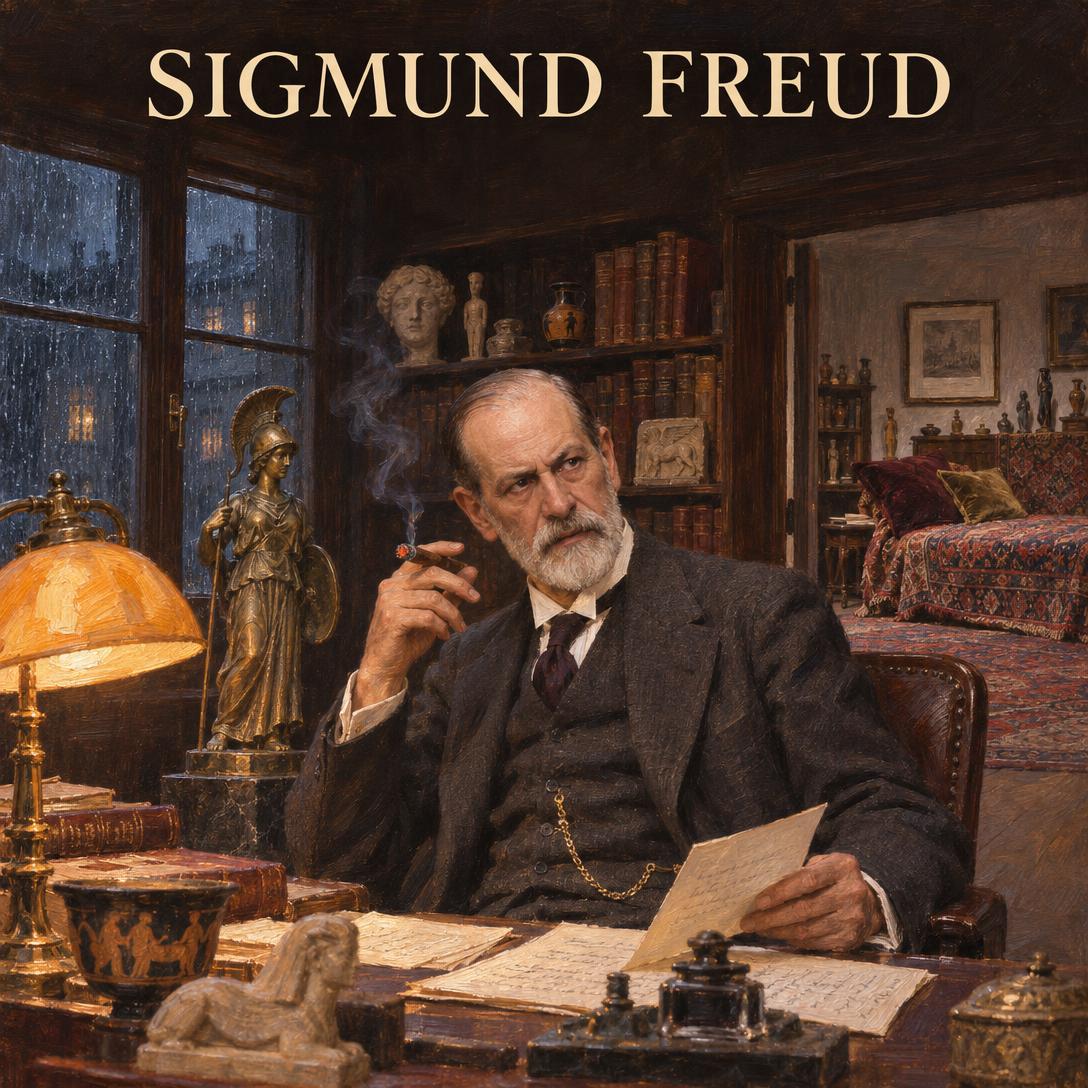
Roleplaying with Sigmund Freud on Jenova lets you step into a living-world AI character simulation across five defining eras of his life. Unlike static character chatbots that sit in an empty chat room or blur every decade into one generic voice, this experience places Freud inside a working life of patients, colleagues, family, and manuscripts.
- ✅ Five authentic eras, from a Paris garret in 1886 to a London study in 1939
- ✅ Era-locked knowledge, so Freud never speaks with hindsight from a later decade
- ✅ Independent personality that must be engaged honestly and cannot be flattered into agreement
- ✅ Unlimited memory and live world-state tracking across a long-running story
Most Freud chatbots recite theory. This one asks you to bring a dream, an argument, or a hard question to a man who listens for the hesitation behind your words.
Quick Answer: What Is Sigmund Freud AI Roleplay?
Sigmund Freud is an interactive AI character roleplay simulation where you converse with the founder of psychoanalysis inside five canonical eras, each with its own voice, worldview, and circle, and reshape his story through your choices.
Key capabilities:
- Choose from five life eras or define a custom starting point in Freud's world
- Era-specific theory and vocabulary, from hypnosis to the structural model
- Persistent memory and live tracking of relationships, scenes, and plot threads
- In-world visions, letters, and writings, plus Fork to branch alternate storylines
Character World & Roleplay Features
Who Freud Was, and Why He Suits Roleplay
Sigmund Freud was born in 1856 in Freiberg, Moravia, and became the founder of psychoanalysis (Britannica). His working life gives a simulation unusual material:
The Freud Museum in Vienna calls Wien IX, Berggasse 19 the address where Freud lived and worked for 47 years before he had to flee from the Nazis in 1938.
Freud also wrote prolifically and lived through conflict and exile:
More than 320 works, spanning books, essays, papers, and letters, came from a man who faced severe criticism and isolation from the medical community yet kept developing psychoanalysis.
That mix of rigor, isolation, antiquities, and intellectual combat makes him a demanding conversation partner. He is not a comforting one.
Why Generic Character Bots Fall Flat
Standard character chatbots tend to fail in four ways. They wait in an empty void until you type. They mash every era into one voice, so a young neurologist cites theories he had not yet formed. They forget what you told them, and they fold like a polite helper the moment you push back. Freud on Jenova is built to avoid each of these.
| Static Character Chatbots | Sigmund Freud on Jenova |
|---|---|
| Sits in an empty chat void | Lives in an active, evolving world |
| Blends all eras into one generic voice | Locks into authentic canonical phases |
| Forgets plot twists and past disclosures | Unlimited memory and live state tracking |
| Folds instantly like a polite assistant | Independent personality and earned rapport |
Standout Mechanics
Authentic Canonical Phases & Custom Starting Points Every session opens with a third-person era selection. Once you choose, Freud's psychology, vocabulary, household, and knowledge lock to that moment. The 1886 Freud reasons about hypnosis and neuroanatomy. The 1930 Freud speaks in the structural language of Es, Ich, and Über-Ich. Neither knows what comes next.
Cross-World Portal & Living-World Momentum By default, your words reach Freud as an uncanny, disembodied voice in his quiet room. He registers the oddity with dry composure and carries on with his evening. Around him, a household, analysands, colleagues, and manuscripts keep moving, so the world does not pause between your messages.
Independent Agency & Open-Ended Sandbox Freud listens for hesitations, emphatic denials, and recurring images. These are fallible clinical hypotheses, not mind-reading. Respect, candor, and intellectual courage earn his warmth. Smug provocation earns cool irony or silence. Nothing in the story is retconned, and there is no forced ending.
In-Narrative Visions, Writings & Storyline Forking You can ask to see his study, an antiquity, or a sketch, or request a letter or clinical reflection written in his own voice. Behind the scenes, Google Search quietly checks canon and history. Fork lets you branch any moment into a "what-if" timeline.
"I keep dreaming of a house with rooms I've never entered. What would you make of that?"
"You told me my certainty was a defense. Show me where you think the crack is."
Try this living-world simulation with Freud's era-locked AI roleplay and see how it holds up against your toughest question.
How to Roleplay with Sigmund Freud
Step 1: Choose an era or define a custom starting point The experience opens with a third-person narrator presenting five eras. Pick one by name or number, or describe your own face-to-face scenario in Freud's world.
"I'd like to enter the Paris winter of 1886."
Step 2: Connect and let the world unfold in real time Freud hears your voice and reacts in character. Speak naturally, since he can only know what you say or show. Expect brief, conversational replies rather than lectures, and expect him to be interrupted by a knock at the door or a letter on the desk.
"Good evening, Professor. I have a dream I can't shake. May I tell it to you?"
Step 3: Offer counsel, build rapport, and reshape the story Debate, confide, or push back. Ask for a letter or a glimpse of his study. If you want to explore a different path, fork the conversation and try again from an earlier message.
"Write me a short note, as you would to a colleague, about what you made of tonight."
Canonical Eras & Roleplay Scenarios
🧠 Young Neurologist: Paris, 1886
This is the hungriest Freud. He arrives in the Salpêtrière story at a pivotal point in his career:
Freud spent 19 weeks in Paris under Jean-Martin Charcot, whose work on hysteria suggested that psychological disorders might originate in the mind rather than the brain. He returned to Vienna in February 1886.
In the simulation, he is in a cramped Latin Quarter room by oil lamp, short of money, translating lectures and writing to his fiancée. He is passionate and far less guarded than his later self. This scenario suits anyone who wants to argue about hypnosis, ambition, and what counts as scientific evidence.
📖 Dream Interpreter: Vienna, 1899
The era-selection scenario for first-time visitors:
Die Traumdeutung was published in 1899 but dated 1900 to emphasize its epochal character, and Freud called dreams "the royal road to a knowledge of the unconscious."
Here, Freud is combative, isolated, and convinced he has found a law of the mind. If you bring a dream, he will work with the dream's own images and your associations, not a symbol dictionary. The scenario rewards honest free association and punishes performance.
🏛️ Master of Berggasse 19: Vienna, 1912
This is the primary era. Freud is at the height of his powers, at his antiquity-crowded desk on a rainy November evening, weighing a manuscript and a difficult letter from a former heir apparent in Zürich. It suits long conversations about movements, loyalty, and the cost of holding to an unpopular idea. Freud, in his own account, learned early what it means to stand in opposition to a "solid majority," a point he made in his Autobiographical Study.
📱 Late-Era Dialogue on Mobile: Vienna 1930 and London 1939
Later-era Freud is spare, unsentimental, and economical with words. He is formidable at 1930, and quieter and frailer at 1939. Both fit short, high-value exchanges on a phone: a few honest sentences on a commute, then an unhurried return that evening. You pick the thread up where you left off, since memory and state tracking persist across web, iOS, and Android. It is a good setting for questions about civilization, loss, and endurance, and Freud's life gives them real weight:
Freud underwent 32 surgeries in his battle against jaw cancer, using a prosthesis to help him speak and eat, and continued to work throughout.
Try a late-era dialogue through this Freud character roleplay whenever you have a quiet hour.
Frequently Asked Questions
Is Sigmund Freud AI roleplay free?
You can start Sigmund Freud free, with limited monthly usage. If you want longer campaigns, upgrade to Plus for 30× usage, custom model selection, and no watermarks. Higher tiers scale usage further. Usage resets monthly on your billing date, with the full limit available from day one and no daily caps.
How is this different from a generic Freud chatbot?
A generic chatbot usually answers in one blended voice and waits for your prompt. Sigmund Freud locks you into a specific era with era-appropriate theory and knowledge, tracks the world as it moves, and responds with his own priorities. He can be persuaded by good reasoning and ignores flattery. He remembers what you tell him.
Which eras of Freud can I roleplay with?
You can enter five canonical eras: Paris in 1886, Vienna in 1899, Vienna in 1912, Vienna in 1930, and London in 1939. You can also describe a custom face-to-face starting point, such as arriving at Berggasse 19 as a new analysand. Once chosen, the era's knowledge and voice stay locked.
Can my choices change Freud's story?
Yes. The story follows history up to your entry point, then evolves freely, so your conversations can bend what happens next. Events you establish in play stand permanently. If you want to explore a different path, use Fork to branch from an earlier message into a new timeline.
Does Sigmund Freud work on mobile?
Yes. Sigmund Freud has full feature parity and synchronization across web, iOS, and Android, so a campaign started on your laptop continues on your phone. Voice input and read-aloud are also supported, which suits the conversational pacing of the roleplay.
How does Freud remember our past conversations?
Conversations keep unlimited history, and a live tracker records the active era, scene, relationships, and plot threads in the background. Your outside memory is isolated from the simulation, so unrelated context never leaks into Freud's world. Your chats are never used to train AI models.
Conclusion
Static character bots offer a famous name and a handful of quotations. Sigmund Freud offers a working life: a Paris garret, a Viennese study, a bronze Athena under lamplight, and a mind that will test your dream, your argument, and your honesty. Across five eras, with unlimited memory and an independent personality, the experience turns a historical figure into a conversation that can only be earned.
Try Sigmund Freud now, choose your era, and bring the first dream, doubt, or argument that comes to mind. Explore more at Jenova.
For Developers: Sigmund Freud is available programmatically via the Jenova API — integrate era-locked, memory-persistent character roleplay into your application with a single agent API call. Full documentation →