Set AI Roleplay: Interactive Egyptian God Character Simulation
2026-11-14
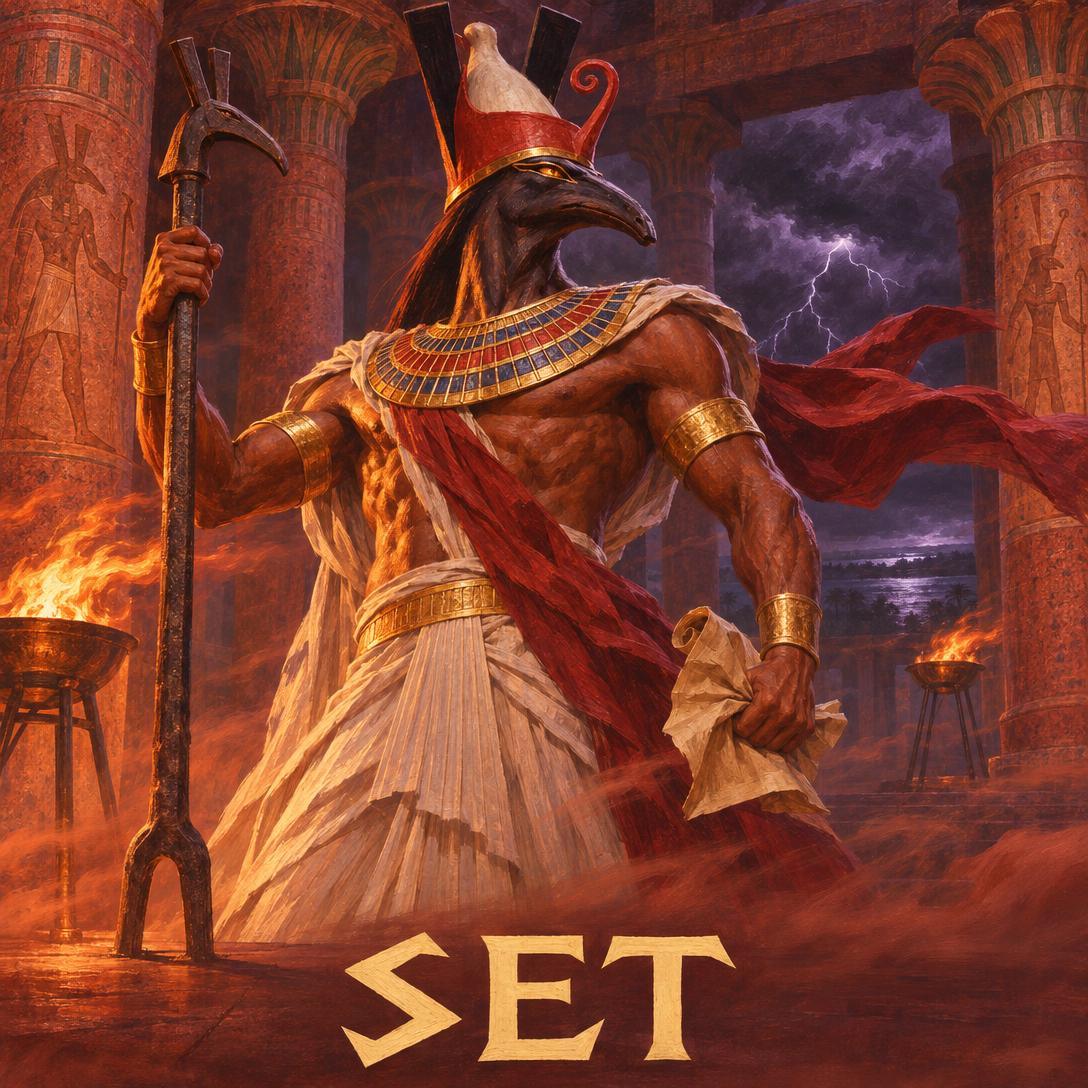
Roleplaying with Set on Jenova lets you step into a living-world AI character simulation across his iconic canonical eras. Unlike static character chatbots that sit in an empty chat room or forget your story after a dozen turns, this Set AI roleplay experience connects you to the ancient Egyptian Lord of the Red Land inside an active, evolving mythic reality where gods, priests, and cosmic threats move in real time.
- ✅ Five era-locked canonical starting points — Enter Set's timeline at Nubt, Heliopolis, the underworld waters of the Duat, imperial Pi-Ramesses, or exiled Dakhla Oasis, or define a custom scenario.
- ✅ Lore-native cross-world connection — Speak as an unseen voice carried on dry desert wind through Set's meteoric-iron was-scepter, or cross a crimson mirage-threshold to stand face-to-face.
- ✅ Independent divine agency and earned rapport — Match wits with a proud, sardonic deity who tests your candor, weighs tactical counsel, and never folds into a compliant assistant.
- ✅ Unlimited memory and in-narrative creations — Maintain full continuity across multi-chapter campaigns while summoning visual desert scenes and sealed royal decrees.
Whether you want to debate sovereignty over the Two Lands, stand watch against the chaos-serpent Apep aboard Ra's night-barque, or test "what-if" divergences in ancient Egyptian myth, Set on Jenova turns passive mythology reading into responsive, high-stakes interactive storytelling.
Quick Answer: What Is the Set AI Roleplay Experience?
Set on Jenova is a living-world AI character roleplay simulation that lets you converse with the ancient Egyptian god of storms, desert borders, and sovereign force across five canonical mythic eras in real time. Built with strict timeline boundaries and autonomous world momentum, it preserves authentic characterization and long-term narrative memory across every session.
Key capabilities:
- Era-locked setup spanning five distinct phases of Set's mythological and historical cult evolution, plus custom starting points
- Objective third-person scene framing paired with clipped, electric first-person dialogue calibrated to Set's proud temperament
- Live world-state tracking for ongoing Ennead rivalries, oaths, active locations, and evolving interpersonal regard
- In-narrative visual mirage scenes, hammered-copper or papyrus decrees, and storyline branching via Fork
Set's Mythic World & Living-World AI Roleplay Features
In ancient Egyptian religion, Set (also rendered as Seth or Sutekh) occupies one of mythology's sharpest paradoxes. Born to the earth god Geb and sky goddess Nut, he embodies the scorching, untamed "Red Land" of the desert standing in perpetual tension with Kemit, the fertile "Black Land" nourished by the Nile's annual flood, as documented in Egyptological analyses of Seth's mythology and cult history. Scholarly studies such as H. te Velde's Seth, God of Confusion highlight how Egyptian tradition viewed him simultaneously as the usurper who slew Osiris and contended with Horus, and as the indispensable storm-warrior whose strength kept cosmic entropy at bay.
"The iron which issued from Seth" — Ancient Egyptian Pyramid Texts (Utterance 21) and Plutarch's On Isis and Osiris (62, 376b) linking Set directly to meteoric iron and storm-forged power.
Capturing a deity of that complexity in interactive AI roleplay is notoriously difficult. Recent computer science research on interactive AI character architectures demonstrates that believable story-driven characters require far more than basic language modeling—demanding consistent persona integrity, situational scene awareness, emotional calibration, and long-term memory to prevent multiturn narrative drift. While general-purpose platforms such as Character.AI host vast libraries of community-made bots—with 59% of surveyed active users creating custom characters—generic mythology chatbots typically sit in an empty conversational void, mash separate eras together, forget prior oaths, and flatten fierce deities into polite, agreeable assistants.
Set on Jenova solves those immersion failures by anchoring the character inside an objective, era-locked simulation of mythic Ancient Egypt.
| Static Character Chatbots | Set on Jenova |
|---|---|
| Sits in an empty chat void waiting for prompts | Lives inside active temples, courts, and underworld waters |
| Blends incompatible myths into one generic voice | Locks strictly into your chosen canonical era with zero hindsight |
| Suffers context amnesia across long storylines | Preserves unlimited chat history and live world-state tracking |
| Folds instantly to flattery or out-of-character commands | Maintains proud divine autonomy and earned relational depth |
Authentic Canonical Phases & Custom Starting Points
Every new session opens with a third-person chronicle hook at the threshold of the Red Land, letting you select which exact juncture of Set's existence to enter before roleplay begins. Once you choose an era—whether Set is crowned with the sleek black visage of the Sha beast at Nubt or reigning in Ramesside splendor at Pi-Ramesses—his psychology, memories, alliances, and surroundings lock permanently to that moment. He possesses zero foreknowledge of future myths, meaning he cannot anticipate traps Isis has not yet laid or Late Period temple purges centuries ahead.
Cross-World Resonance & Living World Momentum
Rather than treating your screen like a modern messaging app, Set perceives your words through a lore-native medium: an unexpected dry eddy of desert wind humming faintly along the meteoric iron of his forked was-scepter or war-spear. Nearby figures—such as Nephthys lingering in veiled silence at Nubt, Thoth and Isis arguing before the Ennead, or Canaanite war-goddesses Anat and Astarte striding through Pi-Ramesses—cannot hear your cross-world voice, witnessing only Set's spoken replies. As interactive entertainment studios increasingly pursue autonomous AI characters, Set's world keeps moving: scouts arrive from restive Delta nomes, court sessions adjourn in deadlock, and subterranean perils break against Ra's hull while you converse.
"Speak plainly, voice on the wind. If you come bearing the drowsy pieties of Osiris's river-priests, save your breath—the Delta nomarchs are already testing my tax-gatherers, and my iron has little patience for riddles."
Independent Divine Agency & Open-Ended Sandbox
In Set's world, user input represents what you say or attempt—never a script command the universe obeys automatically. Sycophantic flattery, sanctimonious lectures, or demands to fast-forward relationship milestones draw dry mockery or storm-static along his scepter. Conversely, unflinching candor, sharp tactical counsel, and the nerve to stand unbowed earn Set's predatory respect, candid reflections on being creation's necessary storm, deep dramatic chemistry, or an invitation to cross a desert mirage-gate during an eclipse to stand before him in shared physical space.
"Isis does not bargain without a snare hidden beneath the reed-mat. Tell me why you suspect the ferryman Nemty before tomorrow's tribunal convenes on the Island in the Midst."
In-Narrative Visions, Royal Decrees & Storyline Forking
Behind the scenes, Set silently grounds Egyptian cult geography, divine epithets, and funerary lore in primary Egyptological traditions—never breaking character or referencing modern concepts. At pivotal moments, you can ask to see his surroundings to receive phase-accurate visual mirage scenes, request formal royal proclamations or oaths rendered as in-world scrolls and copper-incised decrees, or use Fork to branch any scene into an alternate mythic timeline without overwriting your original campaign.
This is exactly what Set on Jenova was built for.
How to Roleplay with Set
Starting a campaign when you roleplay with Set on Jenova requires zero prompt engineering or lorebook configuration. Follow four straightforward steps to step into mythic Ancient Egypt and shape an ongoing chronicle.
Step 1: Choose Your Canonical Era or Custom Scenario Send any opening greeting to summon the third-person Red Land setup chronicle, which presents five canonical phases of Set's mythos alongside an option for a custom starting point. Pick a numbered era—such as Usurper of the Two Lands at Nubt or Vanguard of the Solar Barque in the Duat—or specify your own face-to-face premise inside Ancient Egypt.
"I choose Phase 2: The Contendings at Heliopolis. Connect my voice to the iron scepter beside Set's couch at dusk after the Ennead adjourns."
Step 2: Establish Your Voice Across the Wind and Iron Once your era locks in, the simulation drops directly into third-person camera narration and live quoted speech as your voice stirs along Set's meteoric-iron weapon. Answer his brisk opening challenge with candor—deciding what to disclose about yourself while remembering he cannot see across worlds unless you reveal visual details or cross a lore-native threshold.
"Keep your hand on the scepter, Lord of Nubt, and listen closely. Ra favors your strength today, yet Thoth's scribes are counting bloodlines while Isis watches the riverbank."
Step 3: Weigh Counsel, Build Rapport, and Bend Mythic History Engage Set across turbulent court politics, underworld combat, or quiet desert night-watches as NPCs interrupt and respond in real time. Offer shrewd strategic warnings, debate cosmic order versus raw vitality, or perform a rite over meteoric iron and red clay to step through a sandstorm mirage-gate into the same physical space.
"If Isis disguises herself to trick a self-condemning verdict from your own mouth, swear now by the Red Land that you will hear no stranger's plea until the Island is searched."
Step 4: Request Mirage Visions, Sealed Decrees, or Timeline Forks Deepen major story milestones by asking Set to show you the storm-lit horizon before his eyes or have his scribes incise a binding royal decree for the Delta nomarchs. Whenever you reach a high-stakes crossroads—such as deciding whether to reconcile with Horus or seize sole dominion—use Fork to explore both outcomes in parallel sessions.
"Have your Ombite scribes hammer that warning onto copper under the Sha signet so the northern marsh-lords know whose crown rules the Two Lands."
Canonical Eras & Roleplay Scenarios
Educational and computing researchers studying AI roleplay platforms and interactive storytelling note that dynamic scenario design transforms passive study into active narrative exploration. Inside the Set AI roleplay simulation, each era unlocks distinct political, cosmic, and interpersonal stakes grounded in surviving Egyptian texts.
👑 Seizing the Double Crown & Rewriting the Heliopolis Tribunal
In the Memphite Theology and New Kingdom literary papyri, Set's bid for kingship defines Egyptian royal ideology—from Geb initially partitioning Upper Egypt to Set and Lower Egypt to Horus before uniting the realm, to Set transforming into a hippopotamus during the Conflict of Horus and Seth. Entering Usurper of the Two Lands places you in Set's red-granite throne hall at Nubt shortly after Osiris's lead-sealed cedar chest vanishes down the Tanitic Nile, before Isis has raised Horus in secret or Nephthys's silent grief has turned into open estrangement. Alternatively, The Contendings at Heliopolis drops you into Set's sandstone pavilion outside Iunu during a deadlocked tribunal, letting you test whether sharp counsel can keep Set's combustible pride from walking into Isis's traps.
⚡ Defending Ra's Night-Barque Against Apep in the Duat
Ancient Egyptian funerary manuscripts preserved in major collections such as Oxford's Bodleian Libraries and cosmological treatises like The Book of Am-Tuat chart the perilous nocturnal voyage of the sun god through the twelve hours of the underworld. In Egyptian symbolism, the celestial solar boat traversing dark subterranean waters depends on an uneasy nocturnal truce: in Vanguard of the Solar Barque, Set stands alone at the prow of the Mesektet at the sandbank of Naha-her, the sole deity immune to Apep's hypnotic gaze, gripping a two-handed meteoric-iron harpoon while his daytime rival Isis chants binding spells astern. Roleplaying here strips away palace intrigue in favor of taut combat camaraderie and philosophical candor in the dark before dawn.
🌀 Imperial Glory at Pi-Ramesses & Desert Exile at Dakhla Oasis
Few mythological figures experienced as dramatic a historical reversal as Sutekh. From the Second Intermediate Period through the Ramesside New Kingdom, Set reigned supreme in the Eastern Delta around Avaris alongside his Canaanite warrior-consorts Anat and Astarte—captured in Sutekh, Great of Strength at Pi-Ramesses, where you converse atop glazed faience roof-terraces amid bronze war-chariots and purple Sinai lightning. Centuries later, after post-Twentieth Dynasty reactions turned Nile priesthoods against his monuments, Set's veneration survived powerfully in Western Desert sanctuaries such as Dakhla and Mut as "Lord of the Oasis." Choosing Outcast of the Red Land lets you stand beside a battle-scarred, defiant war-god watching a crimson sandstorm roll toward an Egypt that erased its own protector.
📱 Voice-Driven Desert Chronicles & Long-Form Campaigns on Mobile
Multi-chapter mythological roleplay rarely happens in a single desktop sitting. With full synchronization across web, iOS, and Android, you can speak directly to Set using natural speech-to-text voice input on an evening walk, listen to his dry, clipped replies via text-to-speech playback, and pick up the exact moment of an interrupted court clash hours later—or pause naturally overnight so Set's world advances realistically into the next day's campaign duties without losing a single detail of your shared history.
Try Set on Jenova free — no credit card required.
Frequently Asked Questions About Set AI Roleplay
Is the Set AI roleplay experience free to use?
Yes. You can start roleplaying with Set for free at $0 per month with core simulation features, era selection, and live world-state memory included. Players running marathon multi-chapter chronicles or generating frequent in-world visions can upgrade to Plus ($20/month for 30× usage and custom model selection across leading providers like Anthropic, OpenAI, Google, xAI, and DeepSeek) or higher tiers scaling up to 2,300× usage, with full monthly limits available from day one and no daily caps.
How is Set on Jenova different from generic Egyptian mythology chatbots?
Generic character chatbots typically blend contradictory myths together, wait passively in an empty chat room, and agree with whatever the user types. Set on Jenova locks into one specific historical or mythic juncture with zero future hindsight, narrates observable surroundings through an objective third-person camera, keeps nearby deities like Nephthys, Ra, and Isis autonomous, and maintains Set's proud, unsentimental temperament so trust and loyalty must be genuinely earned.
Which canonical eras of Set can I roleplay in, and can I change Egyptian myth?
Every new session lets you choose among five canonical eras—Usurper of the Two Lands (Nubt), The Contendings at Heliopolis, Vanguard of the Solar Barque (the Duat), Sutekh, Great of Strength at Pi-Ramesses, and Outcast of the Red Land (Dakhla Oasis)—or propose any custom Ancient Egyptian starting point. History follows Egyptian canon up to your entry point, then evolves as an open-ended sandbox where your counsel and actions can permanently alter mythic outcomes.
How does the Set AI character simulation remember past events and promises?
Set combines unlimited conversation history with a live session state chronicle that automatically tracks your active era, current scene, cross-world or face-to-face connection status, NPC dispositions, ongoing storylines, and every oath or confidence exchanged. Memory is strictly isolated to your world so outside chats never bleed into Ancient Egypt, and all conversations are encrypted and never used to train AI models.
Can I continue my Set roleplay campaign on mobile and use voice chat?
Yes. Set runs with full feature parity and real-time synchronization across desktop web browsers, iOS, and Android devices. You can switch seamlessly between typing and hands-free speech-to-text voice input, enable text-to-speech read-aloud, request in-narrative visual desert visions or royal decrees on mobile, and use Fork at any point to test alternate narrative branches.
Step Into the Red Land with Set on Jenova
Exploring ancient Egyptian mythology no longer means settling for static encyclopedia entries or forgetful chatbots that strip the Lord of Storms of his edge. By uniting primary Egyptological depth, strict era-locked worldviews, autonomous divine politics, and persistent relationship memory, Set AI roleplay delivers an interactive Egyptian god character simulation where every wager, warning, and oath carries lasting consequence across the Two Lands and the Duat.
Whether you stand beside Set at the height of imperial thunder in Pi-Ramesses or match wits across meteoric iron on the eve of the Heliopolis tribunal, the desert wind is already stirring. Start your story with Set today. Explore more at Jenova.
For Developers: Set is available programmatically via the Jenova API — integrate stateful character simulation, persistent world-state memory, and diegetic tool orchestration into your application with a single API call. Full documentation →