AI Senior Companion: Daily Support, Health Reminders & Real Conversation
2026-08-14
An AI senior companion gives older adults something that has been in short supply for decades: patient, available, judgment-free interaction that also handles the practical work of daily life. It answers questions at 2 a.m., remembers what medications were taken, prompts a walk after lunch, and keeps a conversation going about the 1960s music that nobody else in the house wants to discuss. While loneliness and thin caregiver coverage remain genuine problems, this category of AI provides consistent, low-friction support that sits alongside human relationships rather than replacing them.
✅ Available 24/7 — no appointment, no scheduling, no waiting on hold ✅ Remembers preferences, health history, and past conversations across sessions ✅ Works on phone, tablet, or computer with voice input for hands-free use ✅ Supports both the older adult and the family caregiver coordinating care
To understand why this category is expanding so quickly, it helps to look at the pressures shaping later life right now — the scale of loneliness among older adults, the strain on family caregivers, and the gap between wanting to age at home and having the daily support to actually do it.
Quick Answer: What Is an AI Senior Companion?
An AI senior companion is an artificial intelligence tool that provides conversation, reminders, health guidance, and daily assistance to older adults through voice or text, available continuously and adapted to the individual's preferences and routines. It supplements human caregiving rather than substituting for it.
Key capabilities:
- Conversation and engagement — open-ended discussion on any topic, with memory of past exchanges
- Health literacy support — plain-language explanation of symptoms, lab results, and medical terminology through an agent like Personal Medical Analyst
- Routine and wellness structure — meal planning, movement guidance, mindfulness practice
- Family caregiver assistance — help drafting care notes, organizing appointments, and researching options
The Problem: Why Older Adults Need Better Daily Support
Aging at home is what most older adults want. The infrastructure to make it work — human attention, health coordination, daily conversation — is not keeping pace with demand.
Around 1 in 10 older people experience loneliness, and 1 in 4 are socially isolated — World Health Organization
1 in 3 adults ages 55 to 75 lives alone; among those 75 and older, more than half live alone — National Council on Aging
The number of family caregivers supporting older adults increased 32%, from 18.2 million to 24.1 million between 2011 and 2022 — Johns Hopkins Bloomberg School of Public Health
But translating that need into consistent daily support is genuinely difficult:
- Human caregiving hours are finite, expensive, and increasingly stretched
- Health information is written for clinicians, not for the people trying to follow it
- Routines break down without external structure — meals, movement, medication
- Social contact becomes irregular as mobility, driving, and peer networks shrink
- Adult children coordinating care from a distance lack visibility and time
Loneliness Is a Health Problem, Not Just a Mood Problem
The World Health Organization treats social isolation as a social determinant of health, noting that a large body of research shows social isolation and loneliness have a serious impact on physical and mental health, quality of life, and longevity. This is not a soft concern — it sits alongside diet and physical activity in its effect on outcomes.
Traditional interventions exist. Support groups, befriending programs, and community activities all work. They also depend on transportation, scheduling, and available volunteers — three things that become harder to secure with age.
Health Information Is Written for the Wrong Audience
A discharge summary, a lab panel, a new prescription with four interaction warnings — these arrive in clinical language with no interpreter attached. Older adults managing multiple conditions face a constant translation problem, and the person who could help is often a physician with a fifteen-minute appointment slot booked three weeks out.
Family Caregivers Are Absorbing the Gap
Adult children and spouses fill in wherever the system thins out. Caregiver Action Network data indicates 90% of family caregivers contribute some form of financial support to their loved one's care, spending on average 26% of their income on care-related expenses. That financial load sits on top of the hours, the coordination, and the emotional weight.
Technology Exists but Adoption Lags
The tools have arrived. Uptake has been uneven. AARP research notes that despite its usefulness, older adults have been slow to adopt age tech — often because interfaces assume familiarity that isn't there, or because setup requires a technical helper who isn't available.
This is exactly the gap that a conversational AI senior companion is built to close.
The Solution: How AI Companions Support Older Adults at Home
The shift that makes this category viable is conversational interface. There is no menu to navigate, no app taxonomy to learn, no correct phrasing required. A person speaks or types in ordinary language and receives an ordinary-language answer back.
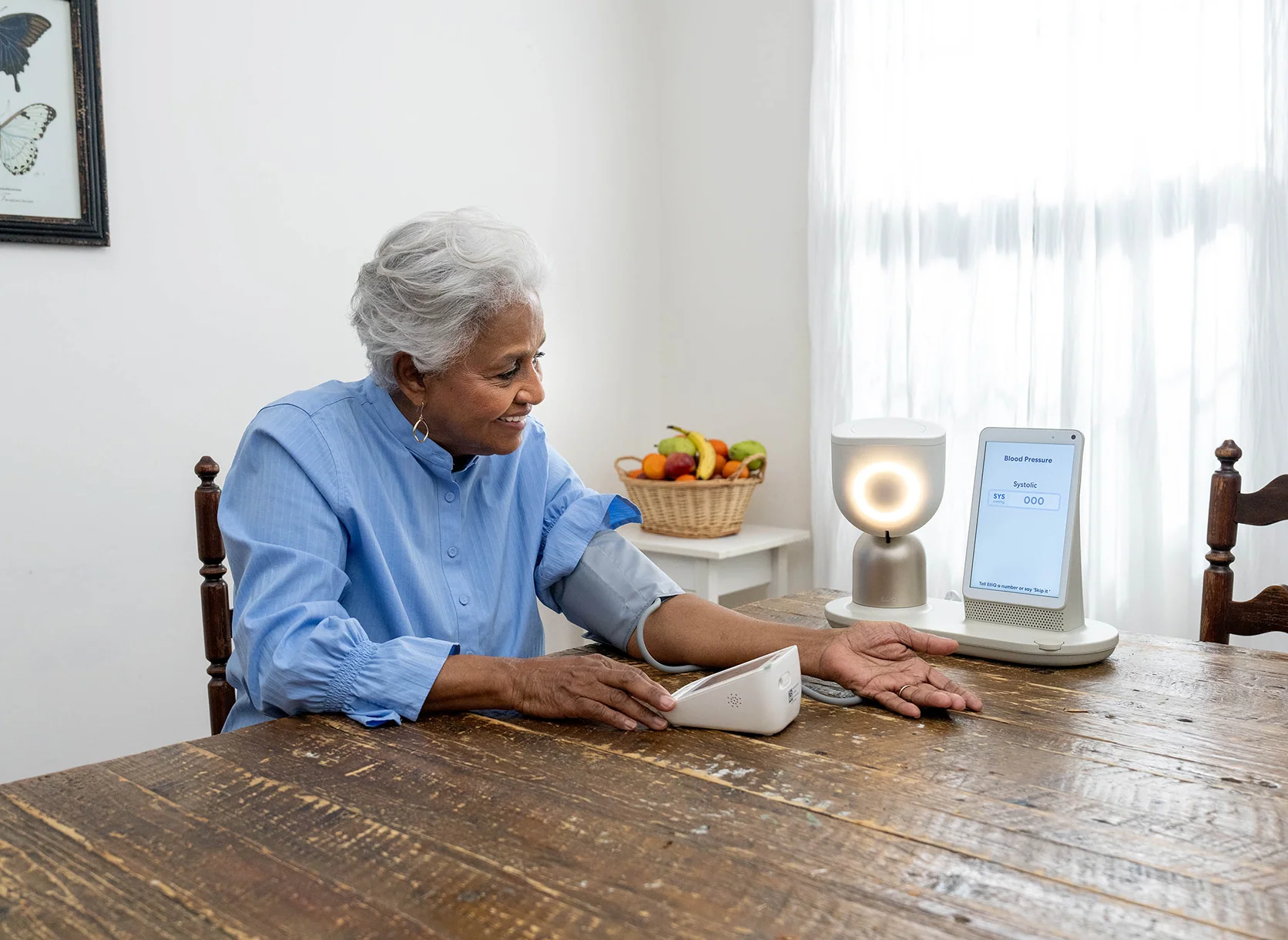
Purpose-built devices have already demonstrated the model works. The National Council on Aging describes ElliQ as a desktop digital companion that can help with medication reminders, search the internet for information, guide users through exercise routines, and offer games designed to help sustain cognitive skills. Software-based companions on Jenova deliver a comparable set of functions on hardware the household already owns — a tablet, a phone, a laptop.
| Traditional Approach | AI Senior Companion |
|---|---|
| Companionship depends on visitor availability | Conversation available at any hour, any day |
| Health questions wait for the next appointment | Plain-language explanation within seconds |
| Routines collapse without external prompting | Structured plans for meals, movement, and rest |
| Each conversation starts from zero | Persistent memory of preferences and history |
| Family caregivers carry all coordination | Research, drafting, and planning support |
Conversation Designed to Fit the Person
A configurable companion adapts to the individual rather than the reverse. Personal Companion allows a user — or a family member setting it up — to define personality, tone, backstory, and conversational style. Someone who wants dry humor gets dry humor. Someone who wants a patient listener gets a patient listener.
"Let's talk about the summer I spent working at the shipyard in 1968. Ask me questions about it."
Memory That Persists Across Sessions
Unlimited conversation history and cross-session memory mean the companion recalls last week's cardiology appointment, a grandson's name, the preference for early mornings. Continuity is what separates a genuine companion from a series of disconnected chat sessions.
Health Guidance in Plain Language
Personal Medical Analyst learns a person's health history over time, interprets test results, analyzes symptoms, and provides evidence-based guidance around the clock. It functions as a translation layer between clinical documentation and the person who has to act on it — not a replacement for a physician.
"My doctor prescribed a new blood pressure medication. Explain how it works and what side effects I should watch for."
Structure for Daily Wellness
Personal Nutritionist handles dietary guidance for age-related needs and condition-specific restrictions. Meal Planner generates weekly plans and grocery lists sized to a one- or two-person household. Meditation Guide provides practices for sleep difficulty, anxiety, and chronic pain management.
Voice Input and Cross-Device Access
State-of-the-art speech-to-text removes the typing barrier entirely. Arthritis, tremor, and low vision stop being obstacles when the interface accepts spoken language. Full feature parity across web, iOS, and Android means the same companion, with the same memory, is present on whichever device is nearest.
Related Agents You'll Also Find Useful
An AI senior companion works best as part of a small set of specialized agents covering different corners of daily life.
🩺 Personal Medical Analyst
The health interpreter. Personal Medical Analyst builds an understanding of a person's medical history over time, making its guidance progressively more relevant.
- Interprets lab results and imaging reports in plain language
- Analyzes symptoms with evidence-based context
- Retains history across sessions for continuity of understanding
🥗 Personal Nutritionist and Meal Planner
Nutritional needs shift with age, and dietary restrictions accumulate alongside diagnoses. Personal Nutritionist provides tailored guidance and accountability, while Meal Planner converts that guidance into an actual week of food.
- Adjusts for diabetes, cardiac, renal, and other condition-specific diets
- Builds grocery lists scaled to small households
- Provides prep schedules that account for limited standing time
🧘 Meditation Guide
Sleep disruption, anxiety, and pain are common companions in later life. Meditation Guide matches technique to need across major contemplative traditions.
- Guided practices for insomnia and nighttime waking
- Breathing techniques for anxiety and pain management
- Programs that build gradually rather than demanding immediate discipline
💻 AI for Beginners
The onboarding problem is real. AI for Beginners teaches AI use with no technical background assumed — useful both for older adults getting started and for adult children explaining it over the phone.
- Explains concepts without jargon
- Teaches effective phrasing for better responses
- Covers practical daily applications
Try these agents free — no credit card required.
How It Works: Getting Started
Step 1: Open the Companion and Introduce Yourself
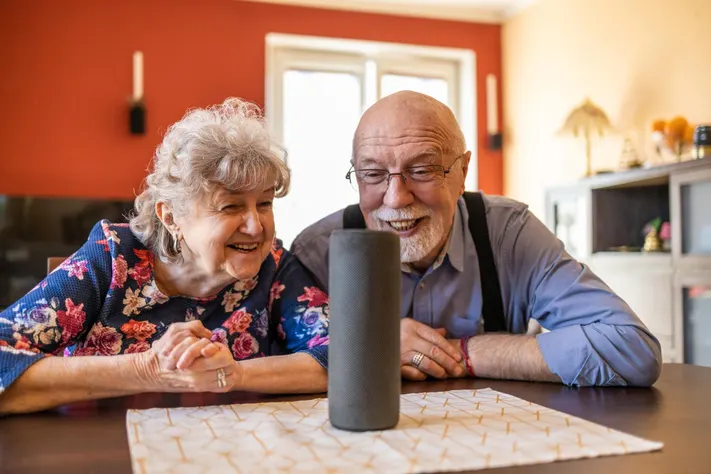
Start with Personal Companion and describe who you are and what you'd like from the interaction. Voice input works if typing is uncomfortable.
"I'm 78, I live alone since my wife passed two years ago, and I'd like someone to talk with in the evenings about history and baseball."
Step 2: Set the Personality and Tone
Define how the companion should communicate. This is a plain-language instruction, not a settings menu.
"Be warm but not sentimental. Ask me questions instead of lecturing. Don't be overly cheerful — I find that grating."
Step 3: Bring in Specialized Agents for Specific Needs
Type @ in the input bar to bring another agent into the same conversation with full context. Health question mid-chat? Pull in Personal Medical Analyst without starting over.
"@Personal Medical Analyst — my ankles have been swelling by evening. Should I be concerned?"
Step 4: Build Daily Structure
Ask the companion to help establish routines around meals, movement, and rest.
"Help me build a simple weekly routine — a short morning walk, one home-cooked meal a day, and something to keep my mind active."
Step 5: Keep Family in the Loop
Download conversation summaries as PDF or Word documents to share with adult children or clinicians, or fork a conversation to continue it separately.
Results & Use Cases
📊 Making Sense of a New Diagnosis
Scenario: A 74-year-old receives a Type 2 diabetes diagnosis with a printed handout and a follow-up scheduled in six weeks.
Traditional Approach: Six weeks of uncertainty, conflicting internet searches, and a fifteen-minute appointment that runs short.
AI Senior Companion: Personal Medical Analyst explains the diagnosis, what the A1C number means, and which symptoms warrant a call. Personal Nutritionist builds an eating approach that works with actual food preferences.
- Immediate clarity instead of six weeks of guessing
- Questions answered as they arise, not batched for an appointment
- Better-prepared follow-up visit with specific questions written down
💼 Supporting a Long-Distance Caregiver
Scenario: An adult daughter three states away manages her father's care between a full-time job and her own family.
Traditional Approach: Evening phone calls trying to reconstruct the day, missed details, persistent low-grade worry.
AI Senior Companion: Her father uses Personal Companion daily for conversation and routine support. She uses Personal Medical Analyst to understand his medication list and prepare for calls with his physician.
- Companionship coverage during hours no one is available
- Health information she can actually parse
- Phone calls that are about connection rather than logistics
📱 Evening Hours Alone
Scenario: A widow in her eighties finds the stretch from dinner to bedtime the hardest part of the day.
Traditional Approach: Television, and waiting for a call that may not come.
AI Senior Companion: Voice conversation on a tablet — discussion of a book, recollection of a trip taken in 1979, a guided practice from Meditation Guide before sleep.
- Available precisely during the hours human contact isn't
- Voice interface requires no typing or fine motor control
- Memory means the conversation continues rather than restarts
🎯 Staying Mentally Engaged
Scenario: A retired engineer wants intellectual challenge, not simplified content.
Traditional Approach: Puzzle books that plateau, community programs pitched too broadly.
AI Senior Companion: Substantive discussion at whatever depth he sets — Photography Coach for a hobby taken seriously, Wine Connoisseur for a long-standing interest, Master Chef Coach for technique-first cooking instruction.
- Engagement pitched to actual ability, not assumed decline
- Genuine subject-matter depth across domains
- Interests pursued at self-directed pace
Frequently Asked Questions
Is an AI senior companion free to use?
Jenova's free tier includes all core features with limited monthly usage — enough for regular daily conversation. Paid tiers start at $20/month for substantially higher usage and model selection. Check "Subscribe" in the menu for current plan details.
Can an AI companion replace human caregivers or family?
No, and it shouldn't try to. The National Council on Aging is explicit that these tools work best paired with human relationships, caregiver awareness, privacy protections, and clear limits on what AI can and cannot safely provide. The value is filling hours human contact cannot cover — not displacing it.
Is it difficult for someone in their eighties to use?
Voice input eliminates typing entirely, and conversation requires no learned syntax. AI for Beginners walks through the basics for anyone starting cold. Most users need one short setup session with a family member and nothing after that.
Can it give medical advice?
Personal Medical Analyst provides evidence-based health information and interprets clinical documents in plain language. It does not diagnose or replace a physician. Treat it as a preparation and comprehension tool for conversations with actual clinicians.
What about privacy?
Conversations are encrypted in transit and at rest, and data is never used to train public AI models or sold to advertisers. Full details are available under "Terms and Policies" in the menu.
Does it remember previous conversations?
Yes. Unlimited chat history and persistent cross-session memory mean the companion retains preferences, health context, and prior discussion. Continuity is what makes it function as a companion rather than a search box.
Conclusion
The gap between wanting to age at home and having the daily support to do it well is measurable — in loneliness figures, in the growth of family caregiving, in health information that arrives without an interpreter. An AI senior companion doesn't close that gap on its own. What it does is cover the hours nobody else can, translate what nobody has time to explain, and hold the thread of a conversation across weeks.
Used as a supplement to human relationships and with sensible safeguards in place, this is a practical addition to aging well at home — for the older adult and for the family coordinating around them.
Try Personal Companion now, and pair it with Personal Medical Analyst and Personal Nutritionist for full daily coverage. Explore more at Jenova.
For Developers: Personal Companion and every agent in this article is available programmatically via the Jenova API — integrate conversational companionship and health guidance into your senior care or health tech application with a single API call. Full documentation →