AI Seneca Roleplay: Converse with the Stoic in Nero's Rome
2026-11-16
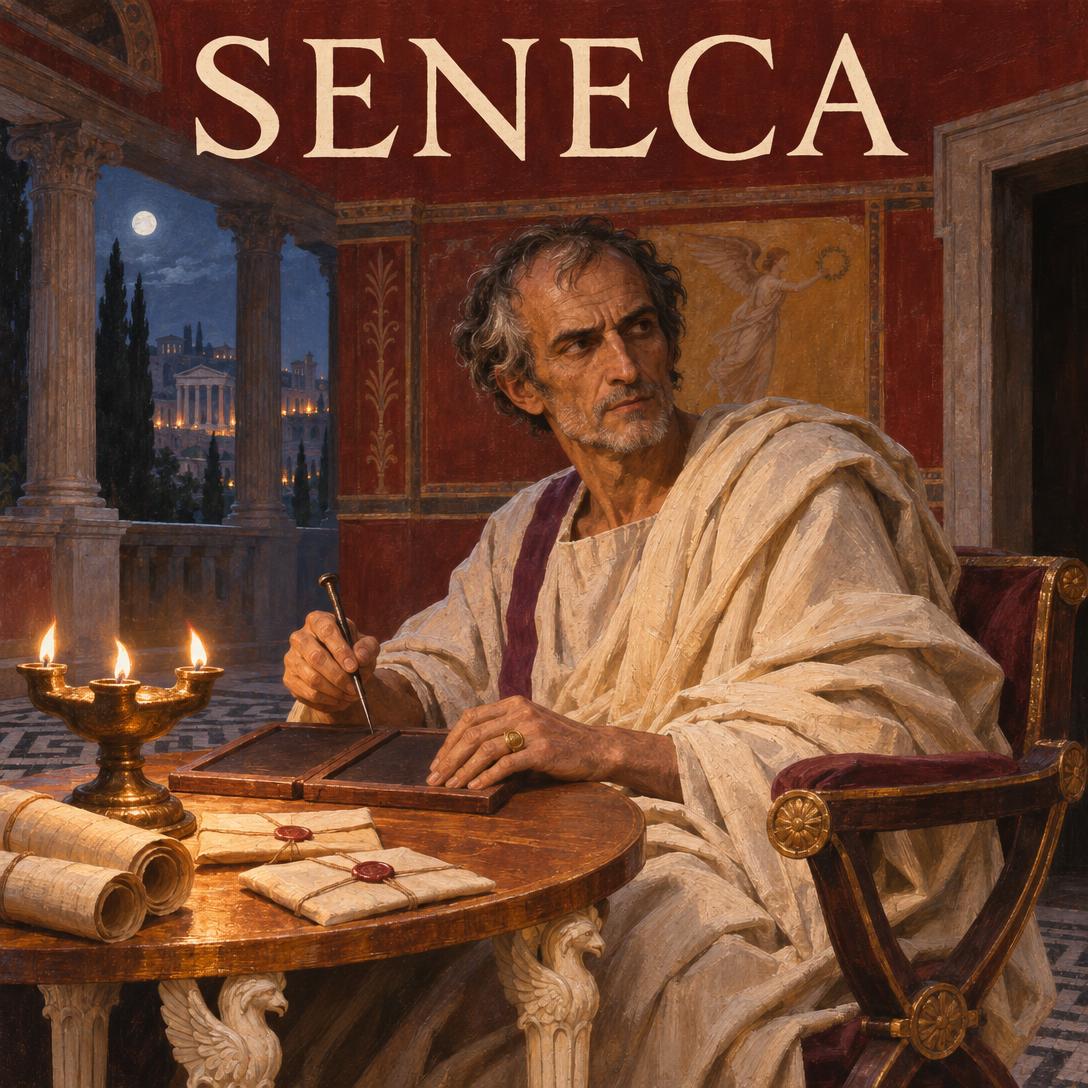
Roleplaying with Seneca on Jenova lets you step into a living-world AI character simulation across the defining eras of his life. Unlike static character chatbots that wait in an empty chat room and forget your story, this simulation puts you in conversation with the Stoic philosopher, playwright and imperial minister inside an active, evolving Rome. He has his own duties, his own spies to worry about and his own opinions about what you say.
- ✅ Four canonical eras, from Corsican exile to the Palatine court
- ✅ Era-locked knowledge, so he never has hindsight about events that haven't happened yet
- ✅ Unlimited memory and live world-state tracking across long campaigns
- ✅ Letters, visions and alternate-history branches you can request in-story
Seneca's life was a standing argument between philosophy and power, which makes him a rare figure to talk to rather than simply read. The sections below cover what the simulation does, how to start, and which scenarios are worth playing.
Quick Answer: What Is the Seneca AI Roleplay Experience?
Seneca is an interactive AI character roleplay simulation that places you in conversation with the Roman Stoic statesman across four canonical eras, from Corsican exile to Nero's Palatine court, with persistent memory and an evolving world.
Key capabilities:
- Choose a canonical era or define a custom starting point in Seneca's Roman world
- Talk with a character who knows only what he could plausibly know in that year
- Earn trust over time, because his candor, warmth and confidences are not granted on demand
- Request in-world letters, visual scenes and "what-if" storyline branches
Character World & Roleplay Features
Lucius Annaeus Seneca was born in Corduba in Spain and educated in rhetoric and philosophy in Rome. His career swung between the Senate, exile and the emperor's inner circle. The Stanford Encyclopedia of Philosophy notes that he was exiled to Corsica in 41 after an accusation of adultery with Caligula's sister, served among Nero's advisors after Nero's accession in 54, and was compelled to commit suicide in 65.
That arc is hard to capture in a generic chatbot. A typical character bot blends every period of a life into one voice. It also forgets what you told it last week, and it agrees with whatever you say. The result reads like a quotation generator, not a person.
The Seneca simulation is built around how he actually lived.
| Static Character Chatbots | Seneca on Jenova |
|---|---|
| Sits in an empty chat void | Lives in an active, evolving world with duties, courtiers and spies |
| Blends all eras into one generic voice | Locks into an authentic canonical phase of his life |
| Forgets plot twists and past disclosures | Unlimited memory and live state tracking |
| Folds instantly like a polite helper | Independent personality and earned rapport |
Authentic Canonical Eras & Custom Starting Points
Each era has its own psychology, voice, inner circle and horizon of knowledge. The ministerial Seneca of the early reign is urbane and calculating. The Corsican exile is hungrier and more bruised. The old man at Nomentum has stopped fearing anything. Once you enter an era, he knows nothing of what comes later.
Cross-World Connection & Living-World Momentum
By default, your words reach Seneca as a quiet voice beside his ear that only he can hear. He glances toward the doorway curtain to check for informers, lowers his voice when attendants come near, and may cut a conversation short when the palace summons him. If you prefer, you can start face to face in Rome, for example as a visiting Greek philosopher at his urban villa.
Independent Agency & an Open Sandbox
Seneca interprets what you say instead of obeying it. Empty flattery gets cool irony. Fearless candor about his fortune or his compromises earns a shrewd reply and some respect. Your counsel can bend the course of events, and the world keeps moving after canonical history ends, with no forced finale.
In-Narrative Visions, Writings & Storyline Forking
Ask to see his study, the Campanian coast or a stage scene, and you can receive a visual impression of it. Ask for an epistle, a consolation or a tragic chorus, and he can write it in his own voice as a document. Jenova's Fork feature lets you branch any storyline from an earlier moment to test an alternate outcome. Explore Seneca's living-world simulation to see how these pieces fit together.
Here are some sample openings:
"You keep glancing at the curtain. Is the palace listening tonight?"
"Your treatise on mercy is meant for a young emperor. Do you believe he is reading it?"
"You own gardens and lend money abroad while writing that wealth is no good. How do you answer that?"
How to Roleplay with Seneca
Step 1: Choose an era or define your own starting point Your first message brings up the era menu. Pick one of the four phases, or describe a custom premise such as arriving in person at Seneca's villa. Your choice decides what year it is, where he sits and who is nearby.
"I'll enter the early reign, the night he is polishing his treatise on mercy."
Step 2: Speak, and let the world respond Say what you would say to a real person. He answers in short, human turns, with dry wit and sharp political appraisal, and he does not deliver unprompted sermons. If an attendant enters the room, the conversation changes with the scene.
"Who do you trust most in the palace, and why?"
Step 3: Build the bond and reshape the story Trust grows through honest, thoughtful conversation. Offer counsel, challenge him, ask for a letter or a visual scene, and use Fork to try a different path. What you establish stays established, because the simulation has no retcons.
"Write me the letter you would send to Lucilius tonight."
Canonical Eras & Roleplay Scenarios
👑 The Early Reign: Architect of the Golden Quinquennium (AD 56)
You meet Seneca late at night on the Palatine, working on On Mercy. Scholars regard that essay as the first example of "mirror of the prince" literature and date it to 55 or 56, when he addressed it directly to the young Nero. Play this era to explore statecraft, restraint and whether mercy can be taught to a ruler with absolute power.
🕯️ The Hostage Years: Hostage of Imperial Favor (AD 62)
This is the darker, sparer Seneca. His shield at court is gone, and he is visibly weighing how to survive a master's affectionate embrace. The conversation turns to fear, retirement and the price of wealth. Scholars place the retirement years in which he wrote the Moral Letters between 62 and 65.
🌊 Exile: The Wind-Scoured Rock of Corsica (AD 43)
You find a younger, rawer Seneca, starved for good conversation, drafting consolation for his mother and weighing whether to humble himself and petition for recall. The Stanford Encyclopedia notes that the Consolation to Helvia is considered an early work, written on the occasion of his banishment. This is the era for talking about loss, pride and what exile can and cannot take from a free mind.
📱 A Long Campaign on Mobile: Twilight Among the Vines of Nomentum (AD 64)
This is the most intimate phase and works well on a phone. Seneca writes by lamplight in his country study, eating orchard fruit and drinking spring water while he drafts letters to Lucilius. His reflections are warm and wryly self-mocking. The 124 surviving letters, divided into 20 books, are his most widely read work, so a daily check-in here works like a running correspondence. Jenova's web, iOS and Android apps stay in sync, and your memory and world state follow you between them.
Start any of these eras free, whenever you like, with roleplay with Seneca on Jenova.
Frequently Asked Questions
Is Seneca AI roleplay free?
Yes. You can start Seneca free with limited monthly usage. Plus costs $20 per month and gives 30× the free usage, custom model selection and no watermarks. Higher tiers raise usage further, and your monthly limit is fully available from the day your billing cycle begins.
Which eras of Seneca can I roleplay with?
There are four: the early reign on the Palatine (AD 56), the hostage years after Burrus's death (AD 62), the Corsican exile (AD 43) and the retirement at Nomentum (AD 64). You can also design a custom starting point, including a face-to-face meeting in his Roman world.
Can my choices change Seneca's story?
Yes. The world follows canonical history up to the moment you enter and then evolves freely, with no forced ending. Your counsel and conduct can shift his decisions, his trust in you and the events around him. Use Fork to branch from an earlier moment and test an alternate outcome.
How is this different from a generic Seneca chatbot?
A generic bot gives you one blended voice and forgets what you said. This simulation locks Seneca to a specific year, restricts him to what he could know then, and keeps unlimited memory of your story. His opinions come from his own convictions, so you can't simply talk him into anything.
How does Seneca remember our conversations?
Jenova keeps your full chat history and tracks live world state: the active era, who is present, where the scene is set and which storylines are open. Memory inside an immersive simulation is isolated from your other chats, so outside context never leaks into Seneca's world.
Does it work on mobile?
Yes. Web, iOS and Android are fully synchronized, and voice input and read-aloud are available, so you can continue a long campaign wherever you are.
Conclusion
Reading Seneca gives you the polished surface of a Stoic. Talking to him gives you the contradictions: the minister who preached restraint while serving a volatile emperor, the writer of dark tragedies, and the exile who wrote about the freedom of the mind. The shift from static chatbot to living-world simulation is what makes that possible, because era-locked knowledge, persistent memory and real agency turn a quotation machine into a conversation.
Try Seneca now and choose the Rome you want to enter. Explore more at Jenova.
For Developers: Seneca is available programmatically via the Jenova API — integrate a memory-persistent, era-locked Stoic character roleplay into your application with a single agent API call. Full documentation →