AI Self-Care Planner: Build a Wellness Routine That Actually Sticks
2026-08-16
An AI self-care planner helps you design and sustain a personalized wellness routine by turning vague intentions like "rest more" into specific, scheduled, trackable actions. Most people know what self-care should look like — sleep, movement, nutrition, stillness, boundaries — but translating that knowledge into a routine that survives a busy week is where it collapses. This is where an AI planner changes the equation: it builds the plan, adapts it when your week goes sideways, and keeps the thread across sessions instead of restarting from zero each time.
✅ Personalized routines built around your actual schedule, energy, and constraints ✅ Adapts in real time when you're sick, traveling, or overloaded ✅ Covers the full self-care stack — sleep, nutrition, movement, mindfulness, and rest ✅ Free to start, available across web, iOS, and Android
To understand why a planner matters more than another checklist, it helps to look at why self-care routines fail in the first place. The problem is rarely motivation — it's the design of the routine itself, and the absence of anything that adjusts when real life interferes.
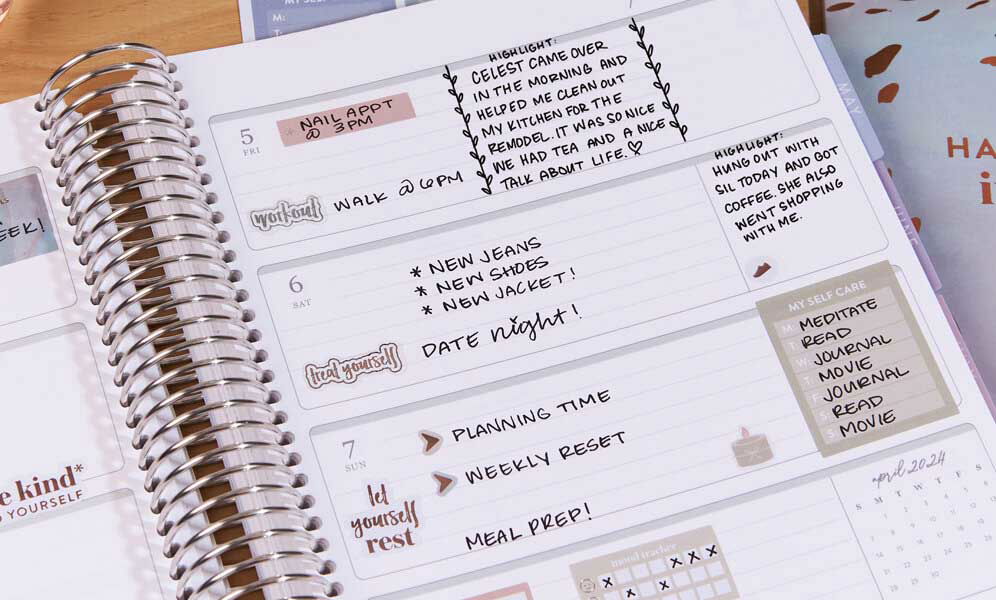
Quick Answer: What Is an AI Self-Care Planner?
An AI self-care planner is a conversational tool that builds a personalized wellness routine, schedules it around your real life, and adjusts it as your energy, health, and commitments change. Unlike a static template, it responds to context — what you did yesterday, what's on your calendar tomorrow, and how you're actually feeling right now.
Key capabilities:
- Builds daily and weekly self-care routines matched to your schedule and energy levels
- Plans the practical layer — meals, workouts, sleep windows, rest blocks
- Provides guided mindfulness and meditation practice tailored to your experience level
- Tracks patterns over time and adjusts recommendations as your circumstances shift
- Remembers your preferences, constraints, and history across every session
The Problem: Why Self-Care Routines Collapse
Self-care isn't a soft nice-to-have. The research base is substantial: self-care decreases stress, promotes coping, and improves mental health, according to analysis published in ScienceDirect. The National Institute of Mental Health is direct about it too — even small acts of self-care in your daily life can have a big impact, helping manage stress, lower illness risk, and increase energy.
And people are trying. Consumer data shows real commitment:
67% of Americans currently practice mental and emotional self-care — Circana Health & Wellness Market Trends
55% of consumers are willing to spend over $100 a month on better nutrition, self-care, and physical and mental health — NIQ 2025 Global Health & Wellness Report
Wellness grew 6.5% annually from 2013–2024 while global GDP grew 3.2% — Global Wellness Institute
But intention and spend don't equal a routine that holds. Here's where it breaks down:
- Generic templates ignore your actual schedule, energy patterns, and constraints
- Static plans have no answer for sick weeks, deadline crunches, or travel
- Self-care spans too many domains to manage with a single tool
- Tracking apps collect data but rarely translate it into what to do differently
- Restarting from scratch after every disruption burns motivation fast
Generic Templates Don't Fit Real Lives
A printable self-care checklist assumes a standard week. Yours isn't standard. A parent working shift hours, a graduate student in exam season, and someone recovering from illness need fundamentally different plans — not the same twelve boxes with different fonts. Templates prescribe; they don't adapt.
No Mechanism for Disruption
The week you most need self-care is the week your plan breaks. You get sick. A project blows up. You travel. A rigid routine offers two options: follow it badly or abandon it. Neither builds the habit. What's missing is something that can say this week, cut the workout to twenty minutes and prioritize sleep — and then say something different next week.
Self-Care Is Multi-Domain, Tools Are Single-Domain
Real self-care isn't one thing. It's sleep hygiene, nutrition, movement, mental stillness, social connection, and boundaries. Most tools handle exactly one slice. You end up running a meal app, a fitness app, a meditation app, and a journal — none of which know the others exist, and none of which can reason about tradeoffs between them.
Data Without Direction
Trackers are good at recording and bad at advising. Knowing you slept 5.5 hours doesn't tell you what to change about tomorrow. The gap between measurement and action is where most wellness tech loses people.
Privacy Is a Legitimate Concern
The American Psychological Association's health advisory notes that AI chatbots and wellness apps collect vast amounts of sensitive data, often with unclear or opaque policies regarding how it's used, stored, or shared. The APA recommends users check privacy policies and in-app settings, and be cautious about what they disclose. This is worth taking seriously when choosing any wellness tool.
A note on scope: the APA advisory is clear that consumer AI tools are not a substitute for licensed clinical care. A planner can help you structure rest, movement, and routine. It is not therapy, and it should not be treated as such. If you're dealing with a mental health condition, work with a qualified provider — and tell them what digital tools you're using.
This is exactly the gap Jenova was built to close.
The Jenova Solution: Specialized Agents Across the Full Self-Care Stack
Instead of one generalist chatbot loosely advising on everything, Jenova provides expert agents built for specific domains — each with deep knowledge in its area, all sharing persistent memory across your sessions. Your self-care plan stops being a document you maintain and becomes a conversation that continues.
| Traditional Approach | Jenova |
|---|---|
| Static printable template | Routine built around your actual week |
| Restart planning after every disruption | Plan adapts to illness, travel, workload |
| Separate app per wellness domain | Expert agents across every domain, one platform |
| Re-explain your context every session | Persistent memory of preferences and history |
| Tracking with no guidance | Patterns translated into specific next actions |
| Desktop-only or mobile-only | Full feature parity on web, iOS, and Android |
Persistent Memory Means No Restarting
This is the single biggest difference from a chatbot conversation. Jenova agents retain unlimited chat history and cross-session memory. Tell the Meditation Guide once that you can't sit still for more than eight minutes and that body scans work better for you than breath focus — it holds. Three weeks later, the practice it suggests reflects that.
Multi-Model Access Without Vendor Lock-In
Jenova provides always-current access to the newest models from OpenAI, Anthropic, Google, DeepSeek, xAI, and others. You're never stuck with one provider's limitations or waiting for a single vendor to catch up.
Tool Integration for Real Scheduling
Built on Model Context Protocol, Jenova connects to Google Calendar, Gmail, Drive, Search, and other services. A self-care plan that can see your actual calendar is meaningfully different from one that guesses at your availability.
Try Example Prompts
"Build me a weekly self-care routine. I work 9–6, have two kids under five, and I'm exhausted by Wednesday. Be realistic about what fits."
"I'm recovering from being sick last week and back at work. Scale my routine down to something sustainable and rebuild over two weeks."
Specialized AI Agents for Self-Care Planning
Self-care spans domains. Here are the agents that cover them — each linked and ready to use.
🧘 Mental Stillness and Mindfulness
Meditation Guide — Deeply trained across every major contemplative tradition. It matches technique to your temperament rather than defaulting to generic breathwork, and builds structured practice programs instead of one-off sessions.
- Technique matching based on your experience and goals
- Custom guided meditation scripts and multi-week practice programs
- Troubleshooting for restlessness, sleepiness, and adverse effects
Dream Interpreter — For anyone who journals dreams as part of a reflective practice. Draws on Jungian, Freudian, cognitive science, and cultural frameworks rather than a single lens.
- Multi-framework interpretation of recurring imagery and themes
- Pattern recognition across your dream log over time
- Complements journaling and morning reflection routines
🏃 Movement and Physical Care
Fitness & Workout Coach — Builds custom programs for any level, with real-time session coaching and form guidance including video demos.
- Programs scaled to your available time, equipment, and current fitness
- Form correction and technique guidance during sessions
- Progress tracking that informs how the program evolves
🥗 Nutrition and Meals
Personal Nutritionist — Evidence-based nutrition guidance personalized to your goals, lifestyle, and preferences, with ongoing accountability rather than a one-time plan.
- Personalized guidance grounded in evidence, not fad frameworks
- Accountability and check-ins across your health journey
- Adjusts as your goals and circumstances change
Meal Planner — Removes the single biggest daily friction point in self-care: deciding what to eat when you're already depleted.
- Weekly plans optimized for your household, budget, and diet
- Smart grocery lists organized for efficient shopping
- Prep schedules that batch work into the time you actually have
Master Chef Coach — For when cooking is the self-care, not the chore. Technique-first teaching across every culinary tradition.
- Real-time guidance while you cook
- Skill-building across techniques and cuisines
- Turns meal prep from obligation into practice
✍️ Reflection and Expression
Writing Assistant — Journaling is one of the most consistently recommended self-care practices, and this agent adapts to any format or voice.
- Journaling prompts calibrated to what you're working through
- Helps articulate thoughts you're circling but can't name
- Sounds like you, not like a template
🏡 Environment and Surroundings
Feng Shui Advisor — Your physical space shapes your mental state. Spatial analysis and practical remedies for homes and offices across all classical schools.
- Room-by-room analysis of layout and flow
- Practical, low-cost adjustments for rest and focus spaces
- Guidance for creating a dedicated calm zone at home
🐾 Care and Connection
Pet Care Advisor — Caring for an animal is a documented source of routine and connection. Practical guidance on health, nutrition, training, and daily care.
- Daily care routines that anchor your own schedule
- Health, nutrition, and behavior guidance for any species
- Playtime and enrichment ideas that get you moving too
Fashion Consultant and Beauty Consultant — Presentation care is legitimate self-care. Wardrobe building, outfit evaluation, skincare routines, and grooming guidance.
- Skincare routines built around your skin type and time budget
- Wardrobe systems that reduce daily decision fatigue
📅 Life Structure and Boundaries
Business Co-Pilot — For self-employed people and business owners, burnout usually originates in operations, not in insufficient bubble baths. Strategic and operational guidance that addresses the actual source.
- Operational planning that creates room in your week
- Strategic clarity that reduces low-grade constant stress
Date Planner — Relationship maintenance is part of the self-care stack. Intent-driven plans with real local research.
- Concrete date plans, not vague suggestions
- Venue research grounded in current, local information
Try Jenova free — no credit card required.
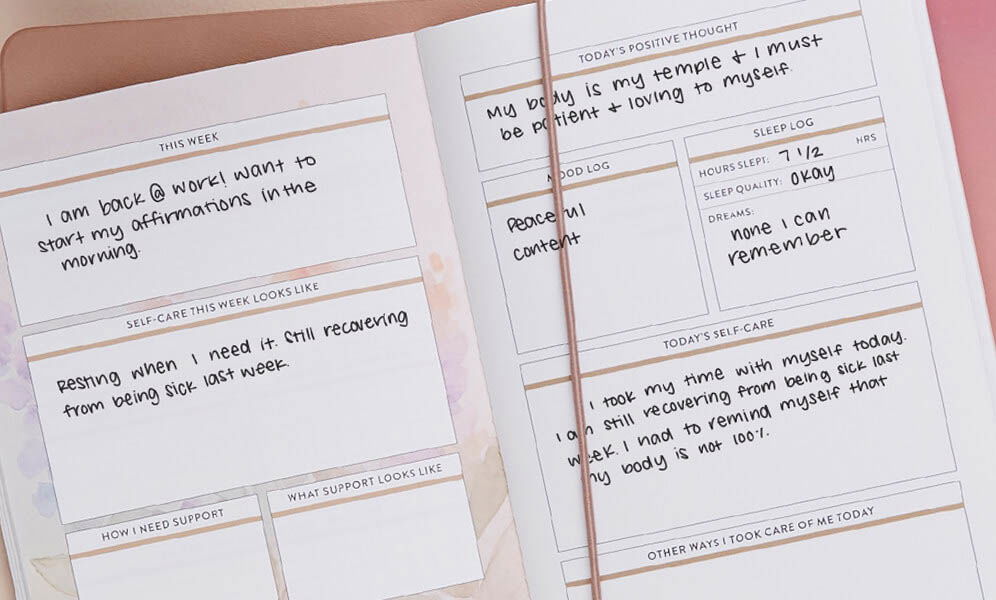
How an AI Self-Care Planner Works
Step 1: Describe Your Actual Life, Not Your Ideal One
Start with constraints, not aspirations. Your work hours, your commute, your caregiving load, your energy pattern, your current health. Precision here determines whether the plan is usable.
"I'm a nurse on rotating shifts — three 12-hour days, then four off. My sleep is wrecked and I skip meals on shift days. Build something that works with this pattern, not against it."
Step 2: Build the Weekly Structure
Ask for a weekly frame before daily detail. What goes on shift days versus off days. Where movement fits. Which day handles meal prep. Where the non-negotiable rest block sits.
"Give me a weekly self-care structure with different versions for shift days and off days. Mark the two things I should protect no matter what."
Step 3: Layer in Domain Depth
Once the frame exists, bring in specialists. Send the meal component to the Meal Planner for a full plan and grocery list. Send the movement component to the Fitness & Workout Coach. Use the @ mention to pull another agent into the same conversation with full context — no re-explaining.
"@Meal Planner — using the shift schedule above, build a week of meals I can prep Sunday and eat cold or reheated on shift days."
Step 4: Check In and Adapt Weekly
This is the step that separates a planner from a template. End each week with a short review. What held, what didn't, and why. The plan updates from there.
"Week one review: hit the sleep window four out of seven nights, skipped both workouts, meal prep worked well. Adjust next week — cut workout ambition, keep meals, add one small thing for the days I skip."
Step 5: Let Memory Compound
Over weeks, the agents accumulate a real model of what works for you. Patterns surface that you'd never catch manually — that you always skip Thursday movement, that meal prep collapses when Sunday is busy, that your best sleep follows evening walks. Recommendations get sharper because the history is there.
Results & Use Cases
📊 Rebuilding After Illness
Scenario: You're back at work after a week sick, still at 70% capacity, and every previous routine feels impossible.
Traditional Approach: Abandon the old plan, feel guilty, restart from zero weeks later when motivation returns.
Jenova: A graduated two-week ramp. Week one protects sleep and nutrition only, with movement limited to short walks. Week two reintroduces structure at reduced intensity. The Personal Nutritionist adjusts for recovery-appropriate nutrition.
- Explicit permission to operate at reduced capacity
- No decision fatigue about what to cut
- A defined path back rather than an indefinite gap
💼 High-Pressure Work Seasons
Scenario: Quarter-end. Sixty-hour weeks for three weeks. Self-care is the first thing to go.
Traditional Approach: Total collapse of routine, followed by burnout recovery that costs more time than the routine would have.
Jenova: A stripped-down "survival protocol" — three non-negotiables instead of twelve nice-to-haves. Sleep window, one real meal daily, ten minutes of stillness. The Meditation Guide supplies short practices designed for high-stress conditions.
- Minimum viable routine instead of all-or-nothing
- Prep-ahead meals that eliminate mid-week decisions
- Automatic ramp back to full routine post-crunch
📱 Mobile Self-Care in the Gaps
Scenario: Your day has no thirty-minute block. It has a fifteen-minute commute gap, a ten-minute wait, and five minutes before bed.
Traditional Approach: Wait for a block that never comes. Do nothing.
Jenova: Full feature parity across iOS and Android with state-of-the-art speech-to-text means you can voice-journal during a walk, get a five-minute practice while waiting, and log your day from bed. Everything syncs across devices.
- Micro-practices sized to the gaps you actually have
- Voice input when typing isn't possible
- Same context and memory on every device
🎯 Caregivers and Parents
Scenario: You're managing a household, small children, and work. Self-care advice assumes free time you don't have.
Traditional Approach: Guilt about not doing self-care, layered on top of the exhaustion.
Jenova: Care embedded into existing obligations rather than added on top. The Meal Planner builds family meals that also meet your nutrition needs. The Pet Care Advisor turns the daily dog walk into your movement block. The Fitness & Workout Coach designs ten-minute sessions that work with kids in the room.
- Integrated into existing routines, not competing with them
- Realistic time budgets — five to fifteen minutes
- Household-level planning that serves everyone at once
🌙 Sleep and Evening Wind-Down
Scenario: You're exhausted but scrolling until 1 AM, then dragging through the next day.
Traditional Approach: Generic sleep hygiene advice you already know and don't follow.
Jenova: A specific wind-down sequence timed backward from your target sleep time. The Meditation Guide provides body scan practices designed for sleep onset. The Dream Interpreter gives morning reflection a purpose, which reinforces consistent wake times.
- A sequence, not a list of principles
- Practices matched to what actually helps you disengage
- Sleep pattern tracking that informs weekly adjustments
Frequently Asked Questions
Is an AI self-care planner free?
Yes. Jenova offers a free tier with all core features and limited usage — no credit card required. Every agent mentioned here is accessible on the free plan. Paid tiers start at $20/month and increase usage limits substantially while adding custom model selection. Check "Subscribe" in the menu for current plan details.
How is this different from a self-care app or printable planner?
A printable planner is static — it can't respond when your week changes. Most apps cover one domain and don't share context. An AI self-care planner builds the routine around your specific constraints, adapts when circumstances shift, and retains memory of what has and hasn't worked for you across every session.
Can an AI self-care planner replace therapy?
No. The American Psychological Association is explicit that consumer AI tools are not designed to provide clinical treatment and lack the training, ethical obligations, and regulatory oversight of licensed providers. A planner helps structure routine, meals, movement, and rest. For a mental health condition, work with a qualified professional — and the APA recommends telling your provider which digital tools you're using.
What about my privacy and sensitive data?
A legitimate concern the APA flags directly, recommending users check privacy policies and limit sensitive disclosures. Jenova's position: your data is never used to train public AI models, it's encrypted in transit and at rest, and it isn't sold or shared with advertisers. Full details are under "Terms and Policies" in the menu.
Does it work on my phone?
Yes — full feature parity across web, iOS, and Android, with state-of-the-art speech-to-text and settings that sync across all devices. This matters for self-care specifically, since the moments you most need support rarely happen at a desk.
Which agent should I start with?
Depends on your weakest link. Chronically under-slept or overwhelmed, start with the Meditation Guide. Skipping meals, start with the Meal Planner. Sedentary, start with the Fitness & Workout Coach. Pick one, get it stable for two weeks, then add the next.
Conclusion
The evidence supporting self-care is solid — research consistently links it to reduced stress, better coping, and improved mental health. The failure point has never been the concept. It's been the absence of anything that adapts a routine to a real, messy, unpredictable life.
An AI self-care planner closes that gap. Instead of a template you fail to follow, you get a wellness routine built around your actual schedule, adjusted when your week breaks, and informed by everything the system has learned about what works for you. Instead of four disconnected apps, you get expert agents across meditation, nutrition, fitness, meal planning, reflection, and environment — sharing context and memory in one place.
Start with one domain. Build the habit. Let it compound.
Explore the full agent library at Jenova — free to start, no credit card required.
For Developers: Every agent in this article is available programmatically via the Jenova API — build AI-powered wellness and planning features into your application with a single integration. Full documentation →