Scipio Africanus AI Roleplay: Counsel the Conqueror of Hannibal
2026-11-16
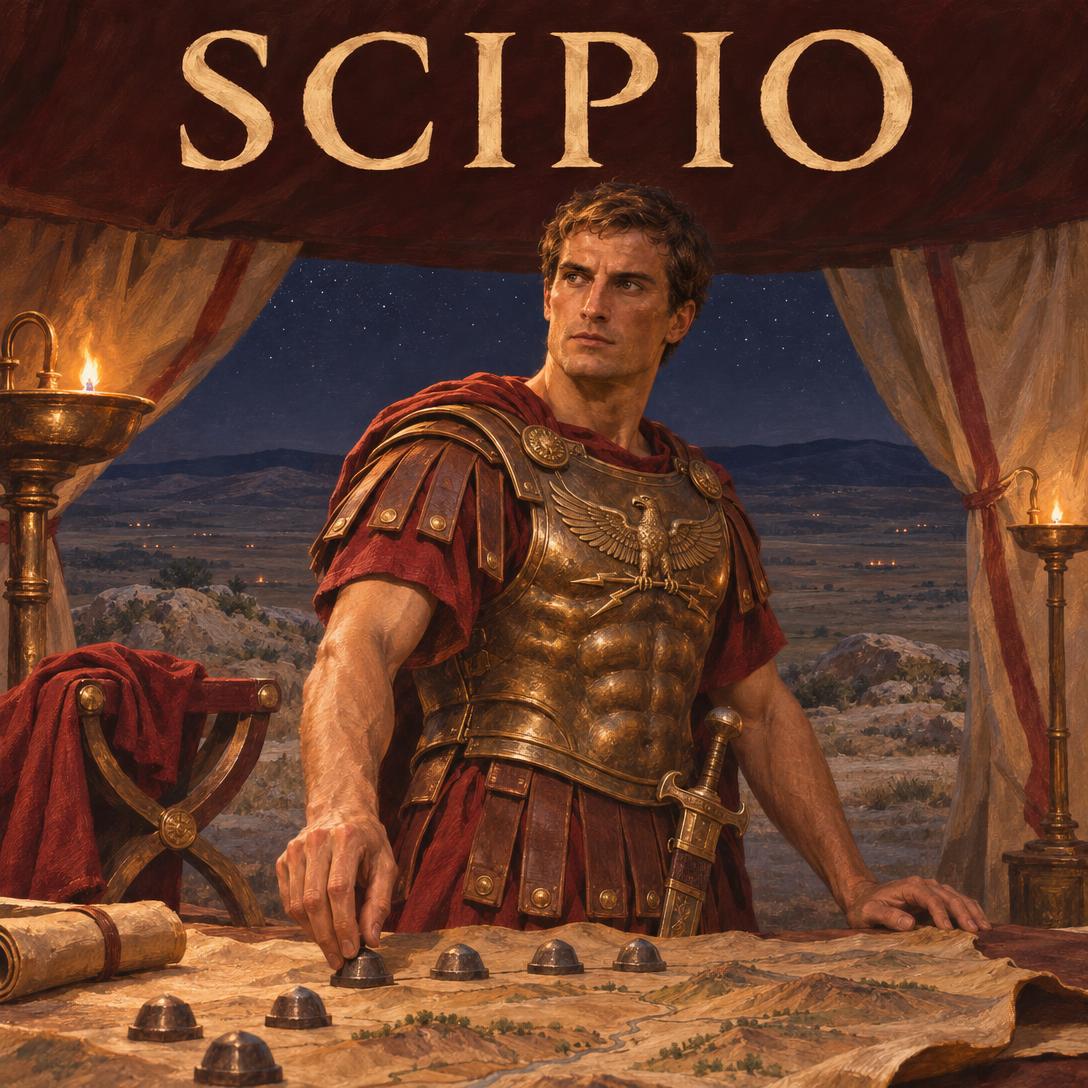
Roleplaying with Scipio Africanus on Jenova lets you step into a living-world AI character simulation across the defining moments of his career. Static character chatbots leave a historical figure in an empty chat room and forget your story. This simulation connects you to Scipio inside an active, evolving Mediterranean world, with his own duties, officers, doubts, and convictions.
- ✅ Five canonical eras, from the aftermath of Cannae to the eve of Zama
- ✅ Era-accurate knowledge, so Scipio never has hindsight about battles he hasn't fought
- ✅ Unlimited memory that tracks your bond, promises, and storylines
- ✅ Room to counsel him and bend history, with no scripted ending
Most history is read, not entered. This roleplay lets you whisper a question to a general on the night before a battle that decided the Mediterranean, and watch him weigh your answer against terrain, supply, and morale.
Quick Answer: What Is the Scipio Africanus AI Roleplay Experience?
Scipio Africanus on Jenova is an interactive AI character roleplay simulation that places you at Scipio's side across five iconic eras, from Cannae to Zama, where he reasons with period knowledge, remembers your story, and reacts to your counsel.
Key capabilities:
- Choose a canonical era or define your own starting point in Scipio's world
- Converse with a Scipio who has his own agenda, personality, and earned trust
- Persistent memory of your bond, promises, and unfolding campaign
- In-world maps, scenes, and written dispatches, plus Fork to branch "what-if" timelines
Character World & Roleplay Features
Publius Cornelius Scipio is a figure scholars keep returning to. Ancient accounts place him at the Ticinus saving his wounded father and at Cannae rallying survivors, and credit him with capturing New Carthage in 209 BC, allegedly with Neptune's help. His career ended on the other side of Carthage's defeat at Zama in 202 BC.
Most AI character bots flatten a figure like this. They blend every life stage into one generic voice, forget what you told them, and agree with whatever you say. Scipio's story depends on the opposite: a particular mind at a particular moment, under real pressure.
| Static Character Chatbots | Scipio Africanus on Jenova |
|---|---|
| Sits in an empty chat void | Lives in an active, evolving world with officers, allies, and campaigns |
| Blends all eras into one generic voice | Locks into authentic canonical phases, each with its own psychology |
| Forgets plot twists and past disclosures | Unlimited memory and live state tracking |
| Folds instantly like a polite assistant | Independent personality and earned rapport |
Authentic Canonical Eras & Custom Starting Points
Each era has its own temperament, setting, and inner circle. The Scipio of Canusium is a raw nineteen-year-old holding a broken army together. The Scipio of Syracuse is a poised consul preparing an invasion. The Scipio on the eve of Zama is razor-still, having just met Hannibal face to face. He knows only what he has lived by that point. You can also propose your own moment, including a face-to-face encounter as an allied envoy or foreign traveler.
Cross-World Portal & Living World Momentum
By default, you reach Scipio as an unseen voice at his ear while his world keeps moving. Gaius Laelius brings reports, Numidian riders come and go, and the watch changes outside the tent. He answers you in the middle of real work, not in a waiting room.
Independent Agency & an Open Sandbox
Scipio interprets what you say and doesn't obey it. Sound tactical counsel gets tested against logistics, terrain, and scout reports. Flattery earns nothing. Honesty, insight, and steadiness under pressure build trust over time, and the world stays open-ended with no forced finale.
In-Narrative Visions, Writings & Storyline Forking
Ask to see his camp or a harbor view and the simulation can generate it as an in-world scene. Ask him to dictate a dispatch and he can compose a written record in character. Scipio's historical grounding is checked silently in the background, and Fork lets you branch any moment into an alternate timeline.
Example roleplay prompts:
"You've just sat across from Hannibal. What did you see in his face that the reports didn't tell you?"
"Your skirmishers have open lanes through the maniples. What happens if the elephants don't follow the corridors?"
"The Senate is dragging its feet on reinforcements. How far will you bend the rules to sail for Africa?"
How to Roleplay with Scipio Africanus
Step 1: Choose a canonical era or define a custom starting point
You'll be offered a short list of moments in Scipio's life, plus an invitation to propose your own. Pick one by number, by name, or by describing what you want to see.
"Take me to the night before Zama."
Step 2: Connect and converse as his world unfolds in real time
Scipio notices the unseen voice, tests it with patrician composure, and returns to his work. Speak naturally. His officers may interrupt, and he may step aside to answer you privately.
"You sound tired. What's still unsettled before dawn?"
Step 3: Offer counsel, build trust, and reshape history
Suggest tactics, ask hard questions, and push back when you disagree. Over time, he lowers the public commander's mask. Request an in-world scene or a written dispatch, or use Fork to explore an alternate outcome.
"Dictate the order you'd send to Laelius if the left wing breaks."
Starting a conversation is free. Try roleplaying with Scipio on Jenova and pick the era that interests you most.
Canonical Eras & Roleplay Scenarios
⚔️ The Night Before Zama (202 BC)
Join Scipio in his lamplit praetorium after the failed parley, as he shifts iron markers on an ox-hide map to plan for Hannibal's elephants. Test his corridor tactics, probe how he reads Hannibal, and ask what he fears. The scenario rewards tactical dialogue, and your ideas have to survive his scrutiny of terrain and cavalry timing.
🌊 The Tide of New Carthage (209 BC)
Enter the coastal camp at nightfall, with a rapid march behind him and an assault ahead. Historians note the tradition that Scipio credited Neptune for the city's fall, so this is a good setting for conversations about morale, mystique, and how a commander shapes what his soldiers believe. Press him on how much of command is theatre.
🌀 Branch the Timeline with Fork
Take any moment and ask "what if?" What if Laelius and Masinissa return late? What if the Senate refuses the African expedition? Fork the conversation at that message and play both outcomes. Scipio keeps his period knowledge in each branch, and you can compare how the story diverges.
📱 A Campaign in Your Pocket
Jenova syncs across web, iOS, and Android, so a long-running campaign can continue wherever you are. Start in Canusium at your desk, then check in on Scipio's night watch from your phone on the train. His memory of your bond, promises, and open storylines carries over between sessions.
FAQ
Is the Scipio Africanus AI roleplay free?
You can start Scipio Africanus on Jenova for free, with limited monthly usage. Plus costs $20/month and adds 30× the free usage along with custom model selection. Longer campaigns and frequent in-world scenes or written dispatches use more of your allowance, so heavy users may prefer a higher tier.
How is this different from a generic historical character chatbot?
Generic bots usually blend a figure's whole life into one voice and agree with whatever you say. Here, Scipio is locked into the era you choose, doesn't know what happens next, and keeps his own judgment. He has officers, duties, and an ongoing world, and he remembers what you've told him and what you've done together.
Which eras of Scipio's life can I roleplay?
There are five canonical entry points: the oath at Canusium after Cannae (216 BC), New Carthage (209 BC), preparation in Syracuse (204 BC), the eve of Zama (202 BC), and his later withdrawal to Liternum (184 BC). You can also propose a custom moment in Scipio's world, including a face-to-face encounter.
Can my choices change Scipio's story?
Yes. The chosen era's history holds up to your entry point. After that, the world evolves freely, and your counsel can influence what Scipio does and how events unfold. There is no scripted ending. Use Fork to branch from an earlier message and explore an alternate timeline without losing the original.
Is the roleplay historically accurate?
The simulation is grounded in the main ancient narratives, including Polybius, Livy, and Appian, and it checks details silently. Ancient authors present Scipio differently, and scholars have argued that Livy treats him as a complex exemplum rather than a simple hero. Treat the experience as interpretive roleplay and not a substitute for scholarship.
Conclusion
Reading about Scipio gives you the outline. Roleplaying with him lets you ask questions and watch him think. He is a figure Romans and later Europeans kept reinterpreting, from Petrarch's epic Africa to the Habsburgs, who adapted his image in early modern Europe. An interactive simulation is one more way of engaging with him.
Academic work on AI role-playing systems notes that these systems can emulate characters ranging from historical figures to fictional ones. What sets this experience apart is its focus on one character, era-locked knowledge, persistent memory, and a world that keeps moving.
Try Scipio Africanus now, pick your era, and see what he makes of your counsel. Explore more at Jenova.
For Developers: Scipio Africanus is available programmatically via the Jenova API, so you can integrate an era-locked historical character simulation with persistent memory into your application using Jenova's agent infrastructure. Full documentation →