AI Scholarship Finder: Match Funding to Your Profile Fast
2026-08-19
An AI scholarship finder helps you surface funding you actually qualify for by matching your academic profile, field of study, nationality, and degree level against live scholarship listings — then flagging what still needs verification. While most students burn weeks scrolling through generic databases and never apply, the College Admissions Consultant on Jenova turns that search into a structured, profile-driven shortlist with deadlines, award amounts, and eligibility notes attached.
✅ Matches awards to your GPA, major, degree level, and citizenship ✅ Returns real, source-linked opportunities — not recycled listicles ✅ Flags missing eligibility details instead of guessing ✅ Builds an application timeline around each deadline
To understand why this matters, it helps to look at how much scholarship money is actually on the table each year — and how few students ever claim it.
Quick Answer: What Is an AI Scholarship Finder?
An AI scholarship finder is a tool that matches your academic and personal profile against scholarship listings, ranks results by fit, and surfaces deadlines, award amounts, and eligibility requirements so you apply only where you genuinely qualify.
Key capabilities:
- Profile-based matching across GPA, major, degree level, origin country, and financial need
- Ranked results with confidence scoring and source links for verification
- Deadline tracking and application timeline planning
- Eligibility gap detection — flagging what the source page does not confirm
- Essay and application strategy support through agents like the College Admissions Consultant
The Problem: Billions Available, Few Students Reached
The money exists. The matching does not.
Over 1.8 million private scholarships are awarded annually, yet only 11% of college students receive one — Education Data Initiative
Over $100 billion in grant and scholarship money is awarded annually including government sources — Education Data Initiative
$4.4 billion in Pell Grant money went unclaimed in 2024 because 47% of high school students did not complete a FAFSA — Education Data Initiative
Over 24,000 scholarship programs, totaling more than $1.5 billion yearly, sit in a single public database — College Board BigFuture
But turning that pool into an actual award list is frustratingly difficult:
- Databases return thousands of results with no meaningful ranking
- Eligibility criteria are buried, vague, or contradict the listing page
- Deadlines are inconsistently published — many say only "rolling"
- International and graduate students get filtered out by US-centric tools
- Scam listings mimic legitimate awards convincingly
Volume Without Relevance
Search "scholarships for computer science master's" and you get a wall. Most tools filter on two or three fields, then dump everything remaining into a list. A Pakistani applicant pursuing a data science master's and a Texas high school junior in biomedical engineering see nearly identical result sets from generic databases — despite having almost nothing in common as candidates.
Eligibility Ambiguity
Listings routinely omit the details that decide whether you can apply at all. Citizenship restrictions, enrollment status, minimum GPA, and whether the award is renewable frequently appear nowhere on the aggregator page. Students discover the disqualifier after drafting the essay.
Deadline Fragmentation
Rolling deadlines, priority deadlines, institution-specific cutoffs, and separate FAFSA dependencies all compete for attention. Without a single tracked timeline, high-value applications get missed by days.
Scam Exposure
The Federal Trade Commission warns that scammers use phrases like "the scholarship is guaranteed or your money back" and "I just need your credit card or bank account number to hold this scholarship." Legitimate providers never guarantee awards and never charge to apply. Whitworth University's financial aid office reports that hundreds of thousands of students are defrauded annually, with losses exceeding $100 million.
Advisor Bandwidth
Human counselors are stretched thin. Inside Higher Ed reports that advisors face rising caseloads from online course growth, more diverse student populations, and expanding curriculum options — with NACADA noting that advisors "spend a disproportionate amount of time working through schedules and not much time working through all the topics they want to."
This is exactly what the College Admissions Consultant was built for.
Why the College Admissions Consultant Works as an AI Scholarship Finder
The College Admissions Consultant treats scholarship discovery as a research task, not a database lookup. You describe your profile once — origin, degree level, field, funding preferences — and it runs live research, ranks what it finds by fit, and tells you explicitly what it could not confirm.
| Traditional Scholarship Search | College Admissions Consultant |
|---|---|
| Keyword filters on 2–3 fields | Full-profile matching across origin, degree, field, and funding type |
| Thousands of unranked results | Ranked shortlist with match confidence per opportunity |
| Silent gaps in eligibility data | Explicit "concerns / missing info" flags per result |
| No source verification | Direct provider links for every listing |
| Static list, no next step | Application timeline, essay strategy, and school-fit guidance |
Profile-Driven Matching
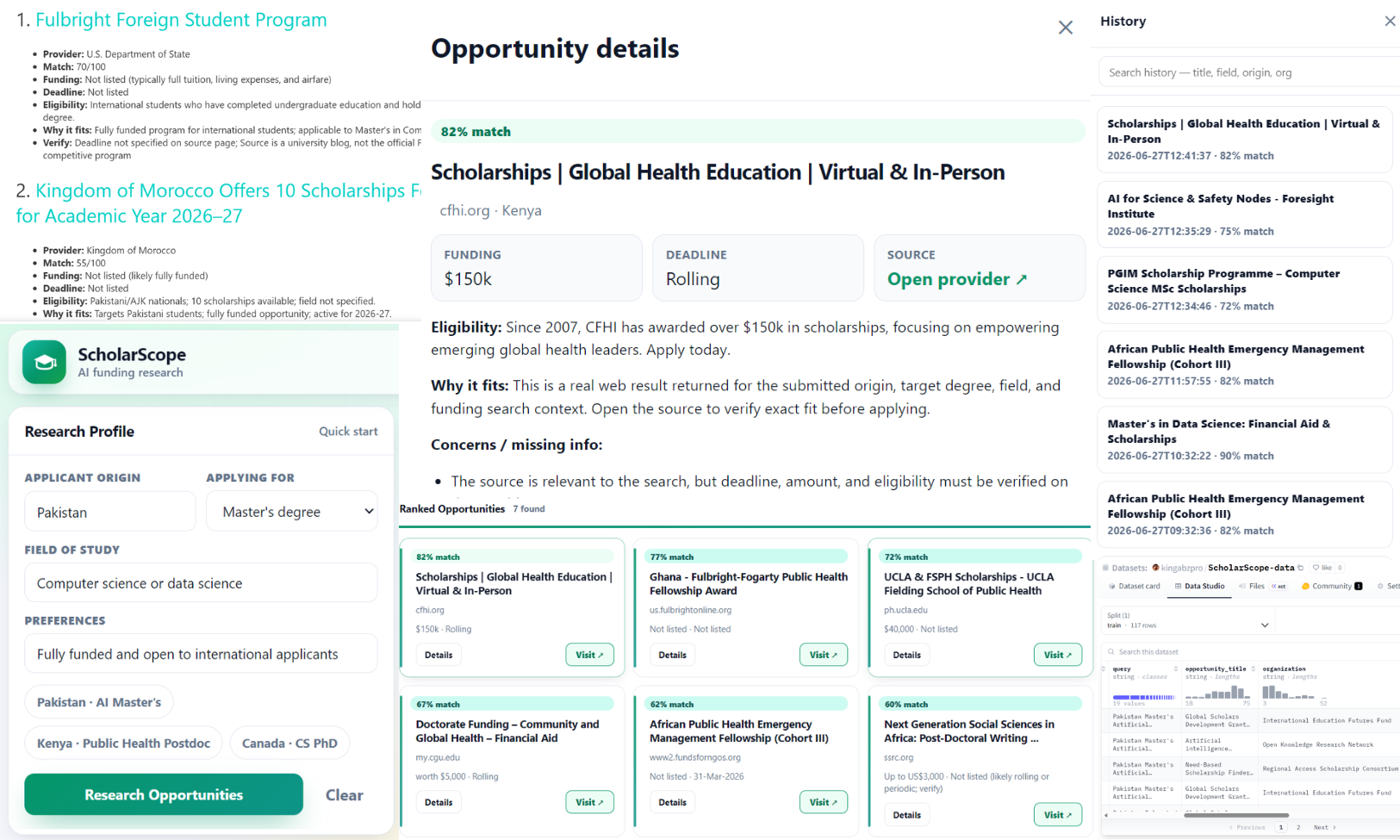
You set the parameters that actually matter: applicant origin, degree sought, field of study, and preferences like "fully funded and open to international applicants." Results reflect that specific combination rather than a generic keyword match.
Ranked Results With Confidence Scores
Each opportunity carries a match percentage, funding figure, deadline status, and source link. An 82% match sits above a 60% match for a reason you can inspect — the detail panel shows eligibility text, why it fits your query, and what remains unverified.
Honest Gap Reporting
The most valuable output is often what the tool refuses to claim. When a source page omits award amount or eligibility criteria, the result says so directly: "The source is relevant to the search, but deadline, amount, and eligibility must be verified." That is the difference between a shortlist you can trust and a list you have to re-research from scratch.
Search History and Iteration
Every search is retained, so you can refine parameters — swap "Master's" for "PhD," change origin country, narrow to a specific field — and compare result sets side by side instead of starting over.
Try prompts like:
"I'm a Pakistani student applying for a Master's in data science. Find fully funded scholarships open to international applicants."
"I'm a US high school junior with a 3.87 GPA and 1420 SAT applying to biomedical engineering programs. What merit scholarships should I target?"
"Compare the eligibility requirements and deadlines for the three scholarships I shortlisted last week."
Related Agents You'll Also Find Useful
Scholarship discovery rarely stands alone. These agents handle the adjacent work that determines whether your applications actually land.
Graduate School Admissions Consultant
If you're applying at the master's level, funding and admissions are the same conversation. This agent evaluates your profile, matches programs, and builds funding strategy alongside your SOP and CV.
- Profile evaluation against target program standards
- SOP and CV development tailored to funding committees
- Recommendation strategy and timeline planning
SAT/ACT Tutor
Merit scholarships often gate on test scores. Moving from a 1420 to a 1500 can change which award tiers you qualify for entirely.
- Adaptive content coaching across all sections
- Target-score planning with realistic timelines
- Test-day strategy and accountability
Immigration & Visa Consultant
International students winning funding still need the visa pathway to work. This agent covers study permits, financial documentation requirements, and post-study options.
- Country-specific student visa pathways
- Financial proof and documentation guidance
- Research-backed, jurisdiction-aware advice
Career Advisor
Funding decisions should follow career logic. Before committing to a program, pressure-test whether the degree actually moves you toward your target role.
- Career exploration and transition frameworks
- Market-specific outcome research
- Direct guidance on program-to-role fit
Try Jenova free — no credit card required.
How It Works: From Profile to Shortlist
Step 1: Define Your Research Profile
Tell the College Admissions Consultant who you are as an applicant — country of origin, degree level, field of study, and what kind of funding you need. Specificity drives result quality.
"Applicant origin: Pakistan. Applying for: Master's degree. Field: computer science or data science. Preference: fully funded and open to international applicants."
Step 2: Run the Search
The agent researches live sources and returns ranked opportunities with funding amounts, deadlines, and provider links. Each result carries a match confidence score you can interrogate.
Step 3: Inspect the Detail Panel
Open any opportunity to see the full eligibility text, the reasoning behind the match, and — critically — the concerns section listing what the source did not confirm.
"Open the details on the CFHI Global Health Education scholarship. What eligibility requirements are unconfirmed, and what should I verify on the provider site?"
Step 4: Verify Before You Apply
Follow the provider link and confirm deadline, amount, and eligibility directly at the source. Cross-check against the FTC's scam warning signs — never pay an application fee, and never share bank details to "hold" an award.
Step 5: Build the Application Timeline
Hand your shortlist back to the agent and ask for a sequenced plan: which essays to draft first, which recommenders to approach when, and which deadlines are hard versus rolling.
"Build me an application timeline for these five scholarships, ordered by deadline, with essay drafting milestones."
Results & Use Cases
🎓 International Master's Applicant Seeking Full Funding
Scenario: A Pakistani computer science graduate needs a fully funded master's abroad and cannot self-finance any portion.
Traditional Approach: Weeks across a dozen aggregators, most of which filter out non-US citizens silently. High false-positive rate; eligibility discovered only after drafting essays.
College Admissions Consultant: A ranked shortlist filtered on origin and international eligibility, with funding figures and unverified fields flagged upfront.
- Origin-aware filtering eliminates ineligible listings before they reach the shortlist
- Award amounts and deadline status surfaced per result
- Pairs naturally with the Immigration & Visa Consultant for the permit pathway
📊 High School Junior Building a Merit Strategy
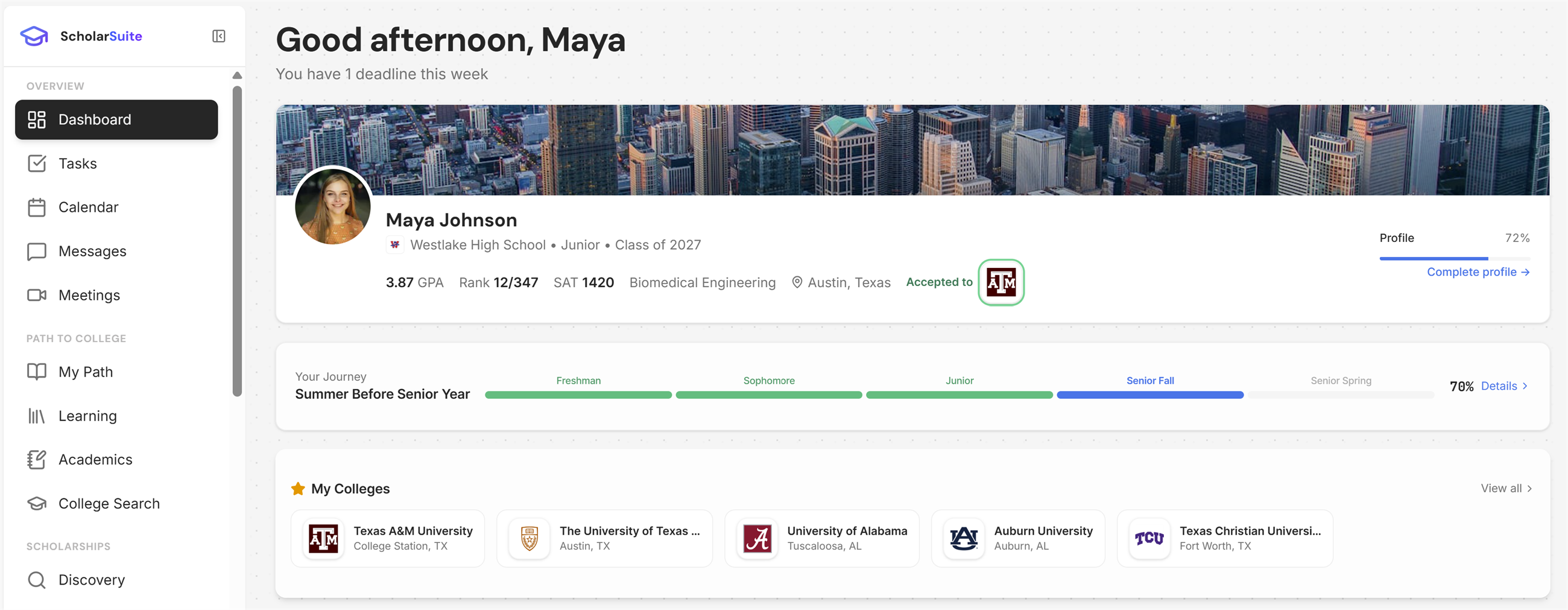
Scenario: A junior with a 3.87 GPA, class rank 12/347, and a 1420 SAT is targeting biomedical engineering across five in-state and regional schools.
Traditional Approach: Guidance counselor time is scarce; institutional merit awards are scattered across five separate financial aid pages with different criteria.
College Admissions Consultant: Profile-matched merit opportunities across the target school list, with score thresholds identified so the student knows exactly where a higher SAT unlocks a larger award.
- Score-gated awards identified early, informing whether more prep with the SAT/ACT Tutor is worth the time
- School-specific merit criteria consolidated in one place
- Deadline sequencing across all five institutions
📱 Deadline Triage on Mobile
Scenario: A student realizes mid-commute that a priority deadline may be days away and needs to know which applications to prioritize tonight.
Traditional Approach: Digging through bookmarked tabs and email confirmations on a phone screen, with no consolidated deadline view.
College Admissions Consultant: Full feature parity on iOS and Android means the same shortlist, deadlines, and history are available anywhere.
- Search history persists across devices
- Ask for the next three deadlines and get an ordered answer immediately
- Voice-to-text input for hands-free queries
🔍 Scam Screening Before Application
Scenario: A student receives an unsolicited email naming them a "finalist" for a $10,000 award requiring a $75 processing fee.
Traditional Approach: No easy way to distinguish a legitimate niche provider from a fraudulent one.
College Admissions Consultant: Cross-reference the provider against research sources and known scam indicators before any money or data changes hands.
- Applies the FTC's documented red flags — guaranteed awards, upfront fees, unsolicited finalist notices
- Verifies whether the provider has a traceable, legitimate presence
- Federal Student Aid guidance reinforced: never share your FSA ID with any third party
Frequently Asked Questions
Is an AI scholarship finder free to use?
You can start with the College Admissions Consultant on Jenova's free tier, which includes all core features with limited monthly usage. Paid tiers scale usage and unlock custom model selection. Separately, never pay to apply for a scholarship itself — the FTC is explicit that legitimate awards never charge processing or redemption fees.
How is an AI scholarship finder different from a scholarship database?
A database filters. An AI scholarship finder reasons. Databases return everything matching a keyword and leave ranking to you. An AI agent weighs your full profile — origin, degree level, field, funding needs — ranks by fit, explains its reasoning, and flags eligibility gaps the listing page left blank.
Can it find scholarships for international students?
Yes. Applicant origin is a primary matching input, not an afterthought filter. Specify your citizenship and the agent prioritizes awards explicitly open to international applicants, flagging any listing where citizenship eligibility is unconfirmed at the source.
How accurate are the match scores?
Match scores reflect how well a listing aligns with your stated profile based on available source data. They are a prioritization signal, not a guarantee of eligibility. Every result includes provider links precisely because the final verification step belongs at the source — a design choice, not a limitation.
Does it work for graduate and doctoral funding?
Yes. Degree level is a core search parameter covering bachelor's, master's, and doctoral funding. For master's applicants specifically, pair it with the Graduate School Admissions Consultant, which handles funding strategy alongside SOP and program selection.
Can I track deadlines and build an application plan?
Yes. Once you have a shortlist, ask the agent to sequence it by deadline and generate drafting milestones. Persistent memory means it retains your profile and shortlist across sessions, so you can return weeks later and pick up where you left off.
Conclusion
More than $100 billion in scholarship and grant funding is awarded every year, yet only about 11% of college students ever receive a private scholarship — and billions in federal aid go unclaimed because the process is too opaque to navigate. The bottleneck was never available money. It was matching, verification, and follow-through.
An AI scholarship finder closes that gap. Instead of scrolling unranked databases and guessing at eligibility, you get a profile-matched shortlist with award amounts, deadlines, source links, and an honest account of what still needs checking. Combined with essay strategy, timeline planning, and scam screening, scholarship search shifts from a weeks-long slog to a focused, verifiable workflow.
Try the College Admissions Consultant now and build your first funding shortlist. Explore more at Jenova.
For Developers: The College Admissions Consultant is available programmatically via the Jenova API — integrate profile-matched scholarship discovery into your edtech application with a single API call. Full documentation →