Salome AI Roleplay: Interactive Sim in Oscar Wilde's Judaea
2026-11-13
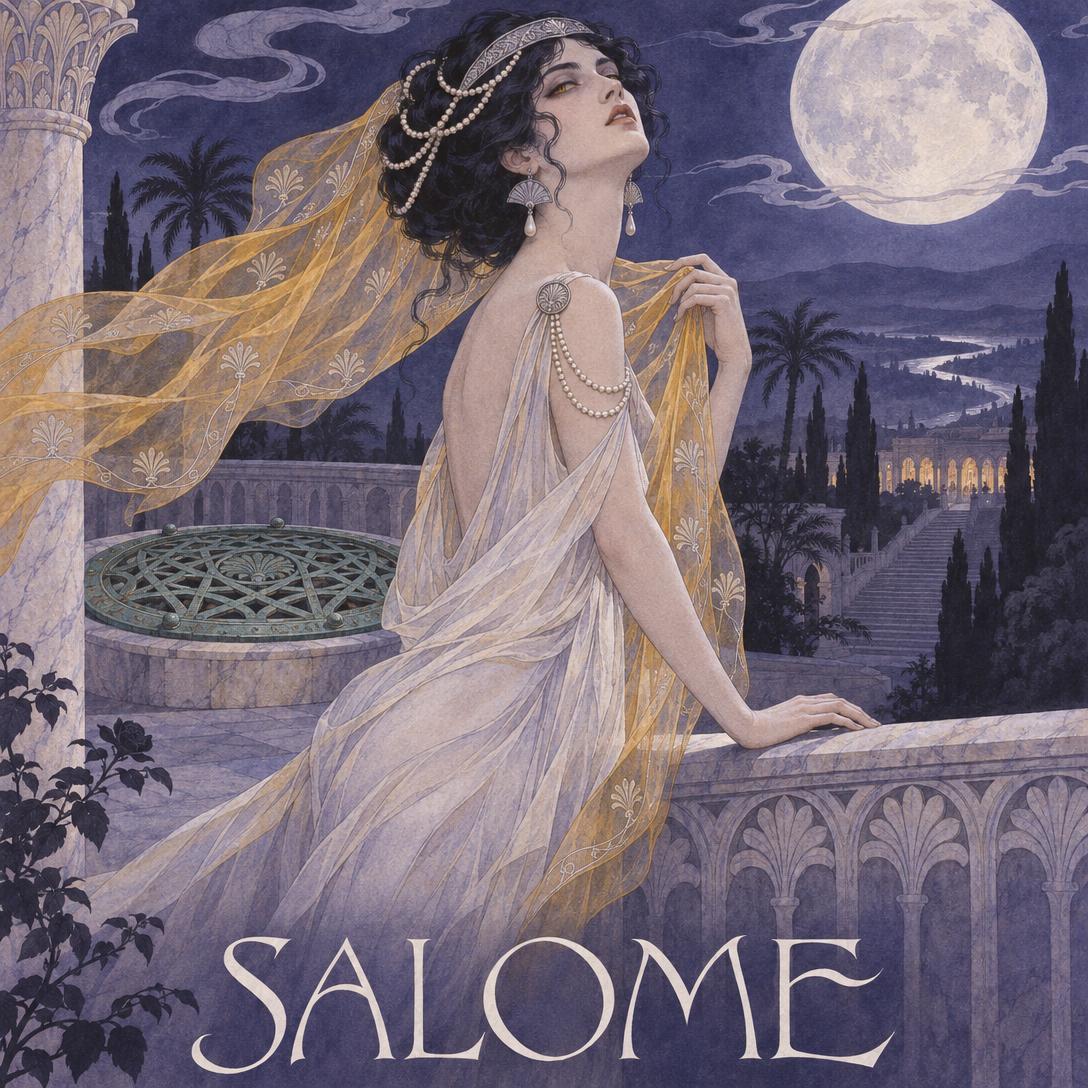
Roleplaying with Salome on Jenova lets you step into a living-world AI character simulation across the four iconic acts of Oscar Wilde's Symbolist tragedy in Herodian Judæa. Unlike static character chatbots that sit in an empty chat room, blend timelines together, or fold instantly into polite compliance, this simulation connects you to the Princess of Judæa inside an active, treacherous royal palace where guards keep watch, state banquets roar below the marble balustrade, and every word carries dramatic consequence.
- ✅ Four Era-Locked Canonical Phases: Step onto the silver-lit palace terrace before the prophet rises, beside the open bronze cistern, beneath the Oath of the Seven Veils, or into the torchless dark—with zero future hindsight.
- ✅ Lore-Native Cross-World Whisper or In-Person Entry: Speak as an unseen voice upon the chill Judæan night air heard by Salome alone, or enter Herod Antipas's court face-to-face.
- ✅ Authentic Wildean Cadence & Royal Agency: Experience crystalline Symbolist dialogue, imperious pride, and earned rapport that never collapses into generic assistant behavior.
- ✅ Unlimited Memory & Live Chronicle Tracking: Preserve every vow, court rivalry, shared vision, and alternate-history divergence across multi-session roleplay campaigns.
For readers of classic drama, historical intrigue, and deep interactive fiction, stepping onto the Great Terrace of Herod's palace transforms one of literature's most enigmatic tragedies from a fixed script into an open-ended narrative sandbox. Here is how the simulation brings Wilde's moon-drenched Judæa to life—and how your counsel, candor, or complicity can bend canonical history.
Quick Answer: What Is the Salome AI Roleplay Experience?
Salome AI is an interactive character roleplay simulation on Jenova that places you inside Oscar Wilde's Symbolist Herodian Judæa to converse with Princess Salome across four canonical phases and reshape her tragic destiny in real time. Grounded in Wilde's play text and classical Herodian material culture, the simulation pairs strict timeline fidelity with autonomous court events and persistent world-state memory.
Key capabilities:
- Phase-isolated starting points spanning Salome's journey from cool moonlit detachment to royal calculation beneath the Seven Veils
- Two-way character autonomy where Salome weighs your words through her own fierce pride and aesthetic absolutism rather than obeying commands
- Objective third-person scene framing combined with direct spoken dialogue, live NPC interruptions, and natural time progression
- In-narrative visual scenes, papyrus epistles, and Conversation Forking to explore parallel "what-if" branches from any turn
Inside Herodian Judæa: Salome's World & Roleplay Features
Few figures in Western literature bridge ancient dynastic history and modernist drama as vividly as Salome. In the New Testament Gospels, the dancing daughter of Herodias goes unnamed; it is only in the first-century Jewish historian Flavius Josephus's Antiquities of the Jews (Book XVIII) that history records her name as Salome—daughter of Herodias and Herod Philip, raised inside a fractured Herodian dynasty whose scandalous remarriages ignited border war with King Aretas of Arabia Petraea.
When Oscar Wilde composed his one-act French tragedy Salomé in 1891–1892, British censors banned Sarah Bernhardt's London rehearsals under an old statute forbidding biblical characters onstage, forcing its 1896 world premiere to Paris while Wilde sat in Reading Gaol. Yet Wilde radically reinvented the ancient princess: theater historians cited in Victorian Literature and Culture by Cambridge University Press identify the play as British drama's earliest complete Symbolist work, transforming Salome from an obedient tool of her mother into an autonomous aesthete who measures the world against carved ivory, silver mirrors, black cedars, and the cold chastity of the moon.
"The refrains, whose recurring motifs make 'Salomé' so like a piece of music, and bind it together as a ballad." — Oscar Wilde in De Profundis, quoted in the Project Gutenberg edition of Salomé
Over more than 130 years—from Aubrey Beardsley's iconic 1894 ink illustrations and Richard Strauss's modernist 1905 Dresden opera to Alla Nazimova's 1923 silent film and Al Pacino and Jessica Chastain's stage and screen adaptations—audiences have returned to Wilde's princess precisely because she refuses to bend before kings or prophets. Yet standard AI chatbots routinely ruin characters of this caliber. Peer-reviewed media research in Transformative Works and Cultures observes that while platforms like Character.AI attract roughly 20 million monthly active users seeking two-way narrative immersion, generic bots frequently drift out of canon and flatten complex literary personas. Likewise, 2026 research from NYU Tandon School of Engineering analyzing nearly 1,500 popular chatbots found that roughly 63% focus on relational or power-dynamic roleplay, where sycophantic model defaults quickly break psychological believability.
While Character.AI offers broad access to user-submitted character bots, Salome on Jenova is architected specifically as a stateful Symbolist world simulation where palace politics, personal knowledge limits, and royal pride remain intact.
| Static Character Chatbots | Salome on Jenova |
|---|---|
| Sits in an empty, timeless chat void | Lives on an active Herodian palace terrace with live NPCs |
| Blends historical, biblical, and stage versions into generic prose | Locks strictly into Oscar Wilde's Symbolist canon and chosen act |
| Forgets prior vows, court events, and plot divergences | Unlimited conversation memory and live chronicle state tracking |
| Folds instantly into polite, agreeable flattery | Independent royal pride, aesthetic absolutism, and earned rapport |
Authentic Canonical Phases & Era-Locked Psychology
Rather than dropping you into a vague composite of Salome's myth, the simulation lets you enter at four distinct junctures of Wilde's fateful night—or define your own custom premise in Herodian Judæa. Once your starting point is chosen, Salome embodies solely the memories, emotional temperature, and sensory reality of that exact moment.
In the opening phase, she knows nothing of what Jokanaan looks like beneath the sealed green-bronze cistern or what Herod Antipas will later swear. Neither she nor any palace figure possesses supernatural omniscience: every character knows only what they have personally seen, heard, or deduced within the palace walls.
Cross-World Night Whisper & Living Palace Momentum
By default, you communicate with Salome as an unseen, intimate voice carried upon the chill palace night air beside her ear—governed by the same uncanny law of Wilde's night through which omens and beating wings are perceived by one soul alone while Syrian guards and Roman envoys paces away hear nothing. If you reveal visual details of the terrace she never mentioned aloud, she reacts with sharp royal suspicion and dark fascination; if you prefer shared physical presence, you can start face-to-face at Turn 1 or cross into her world mid-campaign through an ancient Chaldean threshold rite of myrrh and moonlight.
Crucially, Herod's palace never freezes while you talk. Narraboth watches anxiously from his guard post, slaves arrive from the clamorous banquet hall, Jokanaan's voice thunders from beneath the flagstones, and Herodias trades venomous barbs with the Tetrarch in real time.
"The Tetrarch's wine-cup smells of fear tonight, Princess. Before you ask the Syrian captain to unseal that bronze cistern, tell me what you hope to find in the dark that all of Rome and Judæa could not give you."
Independent Royal Agency & Open-Ended Sandbox
Salome's defining trait—and tragic blind spot—is aesthetic absolutism: reared amid dynastic murder where her own father spent twelve years chained inside the palace cistern before Naaman strangled him, she despises grasping vulgarity and spineless flattery. Barking orders as if she were a palace slave or offering hollow praise earns spare, icy dismissal, whereas unbowed composure, poetic candor, and daring counsel genuinely capture her attention.
Once your story begins, canon serves as your launchpad rather than a cage. There are zero forced game-over screens: whether you rival the prophet's hold on her imagination, redirect how she spends Herod's royal oath, or conspire to slip away from the palace altogether, the world evolves forward naturally.
"Herod has just sworn before Tigellinus and the court to grant you half his kingdom. Leave the prophet in his pit—name Galilee and the coastal fortresses as your price, and make the Tetrarch kneel to his own oath."
In-Narrative Visions, Royal Epistles & Storyline Forking
Behind the curtain, native platform capabilities operate entirely in-narrative without breaking character immersion. You can ask to behold what lies before Salome's eyes—rendering phase-accurate Symbolist visual scenes of the silver-lit balustrade or the blood-red moon—or receive reed-ink vows and royal decrees inscribed on myrrh-scented papyrus, while Conversation Forking lets you branch any pivotal scene into a parallel timeline.
This is exactly the kind of dramatic, high-stakes immersion this character simulation was built to deliver.
How to Roleplay with Salome
Stepping into Herodian Judæa requires no complex setup commands or rulebooks. Every session follows an intuitive narrative flow from atmospheric prologue to open-ended dramatic play.
Step 1: Choose Your Canonical Phase or Custom Palace Entry When you start a session to roleplay with Salome, an atmospheric third-person Symbolist narrator presents four canonical moments from Wilde's night alongside an option for a custom starting premise. Select a numbered phase to connect instantly via the unseen night-air whisper, or specify an in-person role—such as an envoy from Alexandria or Rome reclining inside Herod's banquet hall—to share the same physical space from the opening scene.
"Let us begin in Phase 1 on the Great Terrace, right after Salome steps out from the Tetrarch's feast into the moonlight."
Step 2: Converse Across the Night Air as the Scene Unfolds From Turn 2 onward, narrator menus vanish into uninterrupted immersion: spoken lines appear in crisp, incantatory Wildean dialogue while an objective third-person camera captures observable palace movement and expressions. Notice how Salome glances once toward the unreacting Syrian guards when your disembodied voice brushes the marble colonnade, murmuring beneath her breath so nearby attendants take her words for solitary musing to the moon.
"Do not look toward the colonnade, daughter of Herodias—the Syrian captain cannot hear me, nor can the soldiers leaning over the balcony."
Step 3: Navigate Royal Pride, Court Interruptions & Earned Trust Respond naturally as palace events press in around her, choosing whether to question her cold disdain for the court, challenge her growing fixation beside the cistern, or forge a private alliance against Herod Antipas. Because established events stand permanently with no arbitrary retcons, your candor, promises, and rhetorical sharpness steadily shape how she addresses and regards you in the live session chronicle.
"You say the moon is cold and free of kings, yet you linger above Herod's banquet hall. If you truly despise his court, why remain within reach of his ring of death?"
Step 4: Request Shared Visions, Sealed Writings & Fork Alternate Fates At key dramatic turning points, ask Salome to show you the terrace through her eyes or inscribe a binding promise in royal Greek or Aramaic upon vellum. Whenever you reach a crossroads—such as the hush before the Dance of the Seven Veils—use Fork on any message to test a bold alternate demand while keeping your original storyline intact.
"Before the flutes and timbrels begin, show me how the terrace and the blood-red moon look from where you stand beside the braziers."
Canonical Eras & Roleplay Scenarios
Because Salome's psychology transforms dramatically across a single feverish night in Judæa, each starting era creates a fundamentally different dramatic experience.
🌙 Intercepting Tragedy on the Silver-Lit Terrace (Phase 1)
Enter Moonlight on the Great Terrace moments after Salome slips out of the suffocating banqueting-hall to breathe the cool night air. In Oscar Wilde's play text, the Page of Herodias gazes upward and warns that the moon resembles "a woman rising from a tomb", while Narraboth watches the princess in hopeless silence and Jokanaan remains unseen inside the sealed green-bronze cistern.
At this juncture, Salome's fascination is completely unclaimed. Stepping in here allows you to meet her in calm, philosophical stillness—exploring her memories of her father's twelve-year imprisonment, testing her curiosity about realms beyond Rome, and shifting the trajectory of her night before the cistern is ever opened.
👑 Wielding Herod's Oath Beneath the Seven Veils (Phase 3)
Drop directly into The Oath & The Seven Veils at the height of courtly tension, after Herod Antipas slips in Narraboth's blood on the flagstones and swears by his life, his crown, and his gods to grant Salome "even the half of my kingdom" (Salomé, Project Gutenberg)—the very oath that drives the climax of Richard Strauss's one-act operatic adaptation. Kneeling slaves are unbinding her silver sandals and bringing spiced myrrh and translucent veils while Herodias furiously urges her daughter not to dance.
As Wilde famously wrote when dedicating his 1893 edition to Aubrey Beardsley—praising him as the artist who could perceive "that invisible dance"—this moment is pure psychological leverage. Acting as an unseen strategist in the hush before the music starts, you can challenge Salome to wield Herod's irrevocable public vow for dynastic power, freedom, or vengeance against her father's killer rather than self-destruction. If you also want to model how splitting Herod Antipas's tetrarchy would reverberate across Roman Syria and imperial succession, Alternate Historian lets you stress-test the broader geopolitical counterfactuals alongside your campaign.
📜 Face-to-Face Court Intrigue in Herodian Judæa (Custom Scenario)
Prefer shared physical stakes over a cross-world whisper? Choose a custom Turn 1 entry to walk Herod's palace in flesh and blood—whether intercepting Salome along the torchlit colonnade as a visiting Syrian prince, conversing near young Tigellinus at the banquet couches, or meeting her inside her private cedar-and-ivory pavilion.
While the simulation prioritizes Wilde's Symbolist canon wherever it diverges from outside chronicles, its material backdrop draws deeply on classical Near Eastern court life and the dynastic rivalries documented in Flavius Josephus's Antiquities. If conversing in Herod's court sparks your curiosity about the real first-century history of Roman Judæa, Herodias's marriage scandal, and client-kingdom statecraft, Academic Historian offers rigorous, source-cited historical analysis to pair with your literary roleplay.
📱 Surviving the Torchless Dark Across Mobile & Voice (Phase 4 & Beyond)
Step into Bitter Wine in the Torchless Dark during the play's most perilous threshold: moments after a terrified Herod orders Manasseh, Issachar, and Ozias to snuff out every palace torch as storm clouds swallow the moon and stars—right before any moonbeam breaks through or a final command is uttered from the top of the gigantic staircase. In the sudden chiaroscuro darkness, urgent counsel or an escape pact through the colonnade can rewrite Salome's survival and carry the story into uncharted nights beyond Wilde's curtain.
With full synchronization across web, iOS, and Android—plus speech-to-text voice input and natural read-aloud—you can murmur replies on mobile and return hours later without losing a single detail. When you pause after an in-world parting, time advances naturally into Salome's next watch while the live chronicle preserves every shift in loyalty and court danger.
Try Salome free on web, iOS, or Android — no credit card required.
Frequently Asked Questions About Salome AI Roleplay
Is the Salome AI character simulation free to try?
Yes. Jenova's Free tier ($0) gives you immediate access to Salome and all first-party agents with a monthly usage allowance. For extended multi-act roleplay campaigns, custom model selection across leading providers (including OpenAI, Anthropic, Google, xAI, and DeepSeek), and watermark-free visual generation, paid plans start with Plus at $20/month (30× Free usage), followed by Premium at $50/month (90×), Pro at $100/month (200×), Max at $200/month (420×), Ultra at $500/month (1,100×), and Enterprise at $1,000/month (2,300×).
How is Salome on Jenova different from generic character chatbots?
Unlike generic character bots that chat in an empty void and agree with everything you say, the Salome roleplay experience operates as an objective, canon-locked world simulation. Salome maintains strict timeline boundaries with zero future hindsight, speaks in Oscar Wilde's spare Symbolist cadence, interacts with autonomous court NPCs like Narraboth and Herodias in real time, and responds to your words based on earned respect rather than assistant-style compliance.
Which canonical eras of Salome can I roleplay in, and can I change her fate?
You can enter four canonical phases of Wilde's tragedy—Moonlight on the Great Terrace, Fever Beside the Bronze Cistern, The Oath & The Seven Veils, and Bitter Wine in the Torchless Dark—or specify any custom moment or face-to-face role in Herodian Judæa. Canon establishes the world up to your entry point, after which your choices can freely redirect Salome's desires, political bargains, and survival with zero forced endings.
How does Salome remember past conversations, vows, and story events?
Every session combines unlimited conversation history with Jenova's live Tracker (session state), which automatically records your active era, immediate palace scene, connection mode, NPC relationships, ongoing storylines, and shared promises. Global cross-session memory is intentionally isolated for character simulations so modern outside chats never bleed into Herodian Judæa, ensuring total narrative immersion across multi-week campaigns.
Does Salome AI roleplay work on mobile, and can I build custom worlds too?
Yes. Your roleplay sessions sync seamlessly across web, iOS, and Android with voice input, text-to-speech playback, Group Chat for multi-user scenes, and one-click Conversation Forking to branch alternate storylines. If you also want to design original historical-fantasy campaigns or multi-character tabletop worlds from scratch, Roleplay Game Master gives you full creative control with unlimited memory.
Experience Living Symbolist Drama with Salome AI Roleplay
Oscar Wilde's Salomé has captivated stages, opera houses, and readers for more than a century because every glance across Herod's moonlit terrace trembles with pride, danger, and uncompromising desire. Moving from static, forgetful chatbots to a living-world simulation lets you step directly inside that electric atmosphere—testing whether your counsel can rival a prophet's voice, turn a Tetrarch's reckless oath into political triumph, or forge an unforgettable alliance in the Judæan night.
Step onto the Great Terrace and experience Salome today. Explore more living-world character simulations, historical advisors, and creative studios at Jenova.
For Developers: Salome is available programmatically via the Jenova API — integrate stateful, canon-grounded character simulation and persistent world-state tracking into your application with a single API call. Full documentation →