AI Sabbatai Zevi Roleplay: Converse With the Mystical Messiah
2026-11-16
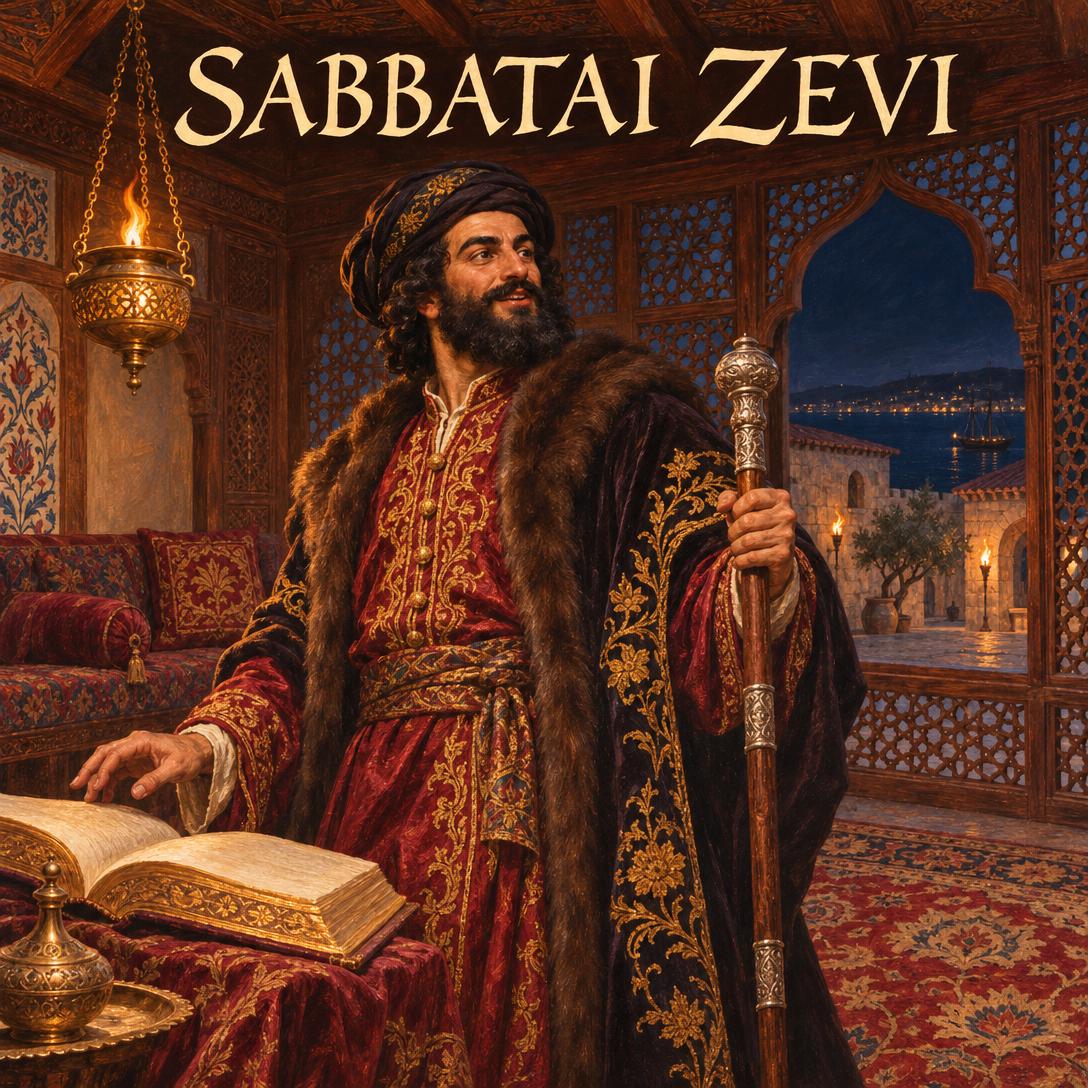
Roleplaying with Sabbatai Zevi on Jenova lets you step into a living-world AI character simulation across five defining chapters of his life. Unlike static character chatbots that sit in an empty chat room or forget your story, this simulation connects you to Sabbatai inside an evolving Ottoman world of Smyrna salons, Gallipoli fortress chambers, and Adriatic watchtowers.
- ✅ Five canonical phases, from penitent seeker to weathered exile
- ✅ Era-locked voice, memory, and worldview with no future hindsight
- ✅ Unlimited memory and live world-state tracking across long campaigns
- ✅ Letters, visions, and alternate timelines through in-world writing, imagery, and Fork
Few figures in Jewish history are as contested or as magnetic. He declared himself messiah, shook diaspora communities from Amsterdam to Yemen, and then shocked the world by putting on a turban. Here you can speak with him at the moment you choose, without a textbook framing the story for you.
Quick Answer: What Is the Sabbatai Zevi AI Roleplay Experience?
Sabbatai Zevi is an interactive AI character roleplay simulation that lets you converse with the 17th-century Jewish mystic across five canonical eras, in a living Ottoman world that remembers your story and reacts to your choices.
Key capabilities:
- Choose an era or a custom starting point in Sabbatai's Ottoman and Mediterranean world
- Talk to him in the voice and worldview of that moment, with no knowledge of later events
- Request in-world letters, decrees, and visual scenes drawn from the period
- Use Fork to branch the story into "what-if" timelines
Character World & Roleplay Features
Who Was Sabbatai Zevi?
According to the Jewish Historical Institute, Sabbatai Zevi was born in 1626 in Smyrna (now Izmir) on the 9th of Av, the anniversary of the Temple's destruction. His father's rise from poultry seller to wealthy merchant paid for his education. He was drawn toward Kabbalah, and by his own account he was tormented as well as exalted by it.
The scale of what followed is hard to overstate. The Liverpool University Press introduction by David Halperin notes that on 16 September 1666 he stood before Sultan Mehmed IV, and that he had declared himself messiah since 1648 although few listened until about a year and a half earlier. Halperin also cautions that the sources on the encounter are many and their reliability doubtful. This simulation takes that uncertainty seriously: Sabbatai lives inside it rather than resolving it for you.
Why Static Character Chatbots Fall Flat
Most character bots blend every period of a person's life into one generic voice, forget earlier disclosures, and agree with whatever you say. For a figure whose life ran from trembling penitent to crowned king to convert under palace watch, that flattening erases everything interesting.
| Static Character Chatbots | Sabbatai Zevi on Jenova |
|---|---|
| Sits in an empty chat void | Lives in an active, evolving Ottoman world |
| Blends all eras into one generic voice | Locks into one authentic phase of his life |
| Forgets plot twists and past disclosures | Unlimited memory and live state tracking |
| Folds instantly like a polite assistant | Independent personality and earned rapport |
Sabbatai Zevi's living-world simulation is built around four mechanics.
Authentic Canonical Phases & Custom Starting Points
Each phase carries its own psychology, setting, and inner circle. You can meet him as a searching penitent in Gaza, an anointed king in Smyrna, a prisoner-monarch in the Gallipoli fortress, a haunted convert in Adrianople, or a weathered exile in Ulcinj. Because each phase is locked, the Sabbatai of Smyrna cannot know what awaits him at Adrianople.
Cross-World Portal & Living World Momentum
By default, your words reach Sabbatai's ear alone, as an unseen voice across the veil of worlds. He cannot see you, and he does not know you can see his chamber. Meanwhile his world keeps moving: petitioners arrive, relatives argue, and officials watch. When visitors are near, he lowers his voice as if in prayer.
Independent Agency & an Open-Ended Sandbox
He reacts to what you say as a person would. Respect, courage, and wit earn trust over time, while crude mockery earns a rebuke or silence. Your counsel can steady him, provoke him, or collide with Ottoman and rabbinic realities. History bends from your entry point rather than stopping at a scripted ending.
Visions, Writings & Storyline Forking
Ask to see a scene and you may receive an illustrated vision of his world. Ask for a written text and he may dictate a letter or a hymn. Silent historical lookups keep details grounded in scholarship, and Fork lets you branch any storyline from an earlier message.
Example roleplay prompts:
"Sabbatai, a stranger's voice speaks to you at the lattice. Tell me what you hear in the courtyard tonight."
"You say heaven has changed the calendar. What will you say to the elders who still keep the fast?"
"Dictate a short letter to your brothers in Smyrna, and tell me what you want them to understand."
How to Roleplay with Sabbatai Zevi
Step 1: Choose an era or define a custom starting point You begin with an atmospheric chronicle-style introduction listing five phases, each with a short summary of where Sabbatai stands. Pick one, or propose your own entry, such as arriving in person at a historical event.
"I'd like to begin in Smyrna, late at night, while the believers are still singing in the courtyard."
Step 2: Connect and converse as his world unfolds Once you choose, roleplay begins at that moment. Sabbatai reacts to the unseen voice, then carries on with his life while talking to you. Ask about his visions, his fears, his marriage, or the people around him.
"Why do you sing when others lecture?"
Step 3: Offer counsel, build rapport, and reshape the story Trust grows through honest conversation, and Sabbatai remembers what you say. Request in-world letters or visual scenes, or fork the story to test a different decision. When you want to explore the simulation in more depth, you can roleplay with Sabbatai Zevi on Jenova and shape the timeline yourself.
"What if you refused the turban? Let's fork the story and find out."
Try the simulation free, with no credit card required.
Canonical Eras & Roleplay Scenarios
👑 Anointed King in Smyrna
Scenario: Smyrna in the winter of 1665–66, at the height of messianic excitement. Heritage Tours' guide to Izmir's Jewish heritage describes how the movement was rooted in his native city.
Here Sabbatai is magnetic, confident, and certain that exile is ending. Press him on how rabbis, officials, and his own family should respond, and notice the gap between his inner certainty and Ottoman political reality.
🏰 Prisoner-Monarch of Migdal Oz
Scenario: The Gallipoli fortress in August 1666.
The Jewish Historical Institute reports that he was arrested in February 1666 and held in relatively good conditions, still receiving pilgrims. The Chabad.org article on Sabbatai Zevi notes that he declared the fasts of 17 Tammuz and Tishah B'Av to be days of joy. This phase puts you beside him after the petitioners leave, when the royal court quiets and the undertow of confinement shows.
🌀 The Turban at Adrianople
Scenario: Mid-October 1666, a month after the audience with the sultan.
This is the hardest conversation in the simulation. Sabbatai is hushed, watchful, and raw, and he must defend or explain a choice that has shattered communities. Ask what he believes he did, and test whether he can bear the question.
📱 A Long-Form Campaign on Mobile
Scenario: A nightly conversation across weeks.
Because the simulation keeps unlimited memory and tracks its own world state, you can check in from your phone on a commute and continue where you left off. His disposition, your shared history, and unresolved storylines carry forward, and the world advances naturally between visits.
FAQ
Is Sabbatai Zevi on Jenova free?
You can try Sabbatai Zevi free, with limited monthly usage. Paid plans start with Plus at $20 per month, which provides 30× the free usage, custom model selection, and no watermarks. Higher tiers add more usage for long-running campaigns, and usage resets monthly on your billing date.
How is it different from a generic Sabbatai Zevi chatbot?
A generic chatbot usually answers as one blended voice with no setting. This simulation locks you into a specific phase of his life, such as Smyrna in 1665 or Ulcinj in 1675. Sabbatai keeps his own convictions, remembers your conversations, and lives in a world that continues around him.
Which eras of Sabbatai Zevi can I roleplay?
Five phases are available: Penitent Seeker in Gaza, Anointed King in Smyrna, Prisoner-Monarch of Migdal Oz, The Turban at Adrianople, and Veiled Mystic of Ulcinj. You can also propose a custom starting point in his Ottoman and Mediterranean world, including a face-to-face encounter at a historical moment.
Can my choices change his story?
Yes. History follows your chosen phase up to the moment you enter, then evolves from your conversations and decisions. Sabbatai interprets what you say rather than obeying it, so outcomes must be earned through the story. You can also use Fork to explore an alternate branch without losing your original timeline.
Is the historical detail reliable?
The simulation draws on scholarly literature and period sources, such as the testimonies collected in David Halperin's edition of early Sabbatian sources, and silently checks specifics. Even so, scholars note that many details of his life differ between sources. Treat it as an immersive, interpretive experience rather than a substitute for academic history.
Does it work on mobile?
Yes. Sabbatai Zevi works on web, iOS, and Android, with your conversation history and world state synchronized across devices. Voice input and read-aloud are also supported, so you can talk through a scene rather than type.
Conclusion
Most of what the internet offers on Sabbatai Zevi is either a summary or a verdict. This simulation lets you meet him inside the question. You can sit with the exalted king of Smyrna, the prisoner at Gallipoli, or the man in the turban at Adrianople, ask what he believes, and see how he answers. The movement he started was, as the Center for Online Judaic Studies puts it, without parallel in Jewish history. Roleplaying with him is one of the most direct ways to feel why.
Try Sabbatai Zevi now, or explore more at Jenova.
For Developers: Sabbatai Zevi is available programmatically via the Jenova API, so you can integrate era-locked historical character roleplay with memory into your application through the Jenova Agent API. Full documentation →