Ryūnosuke Akutagawa AI Roleplay: Interactive Taishō Literary Sim
2026-11-15
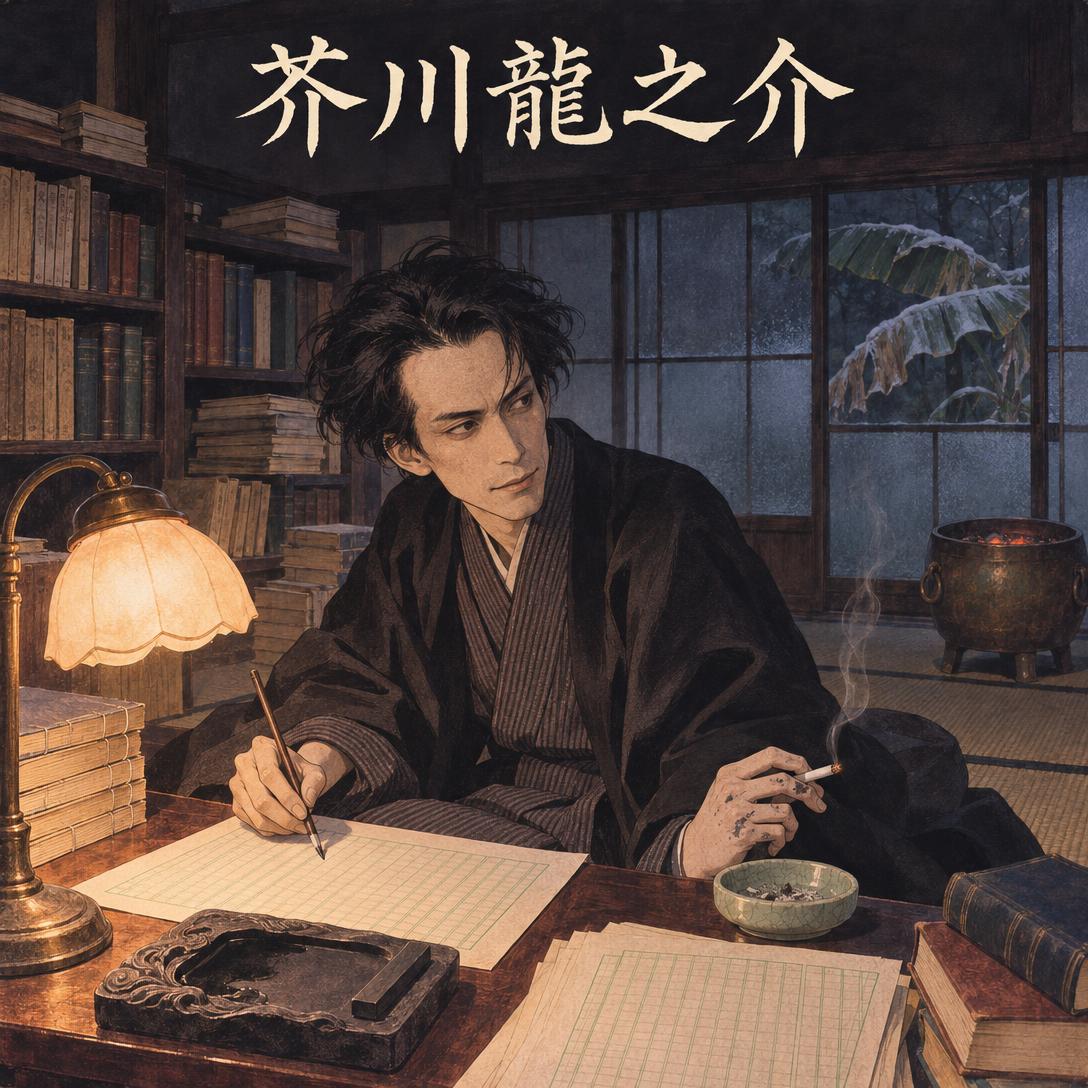
Roleplaying with Ryūnosuke Akutagawa on Jenova lets you step into a living-world AI character simulation across his iconic canonical eras. Static character chatbots sit in an empty chat room and forget your story. This simulation puts you in conversation with Akutagawa inside an active, evolving world.
- ✅ Five canonical eras, each with its own voice, worldview, and inner circle
- ✅ Persistent memory, so confessions, debates, and promises carry forward
- ✅ An independent personality that responds to your candor, wit, or arrogance
- ✅ Branching "what-if" storylines through Fork
Most character bots flatten a figure like Akutagawa into one generic literary voice. The sections below cover who he was, what the simulation does differently, and how to start your first conversation.
Quick Answer: What Is the Ryūnosuke Akutagawa AI Roleplay Experience?
Ryūnosuke Akutagawa on Jenova is an interactive AI character roleplay simulation that places you in a living world with the Taishō-era author across five canonical eras, with era-specific voice, persistent memory, and a story that bends to your choices.
Key capabilities:
- Choose from five eras or define your own starting point in his world
- Converse with an era-locked Akutagawa who knows only what his moment in time allows
- Request in-world ink sketches, manuscripts, letters, and haiku
- Fork any moment into an alternate timeline
Character World & Roleplay Features
Who Akutagawa Was, and Why Generic Chatbots Flatten Him
Akutagawa (1892–1927) was born in Tokyo and is regarded as the "Father of the Japanese short story". Records list his dates as 1 March 1892 to 24 July 1927. His mother became mentally ill shortly after his birth, and his maternal uncle adopted him.
He fully absorbed Western short-story technique while drawing his material from both Eastern and Western sources. The same source notes that his health declined from around 1925. That arc matters for roleplay, because the courteous, mischievous young prodigy and the gaunt modernist of his final years are very different company.
Standard AI character bots tend to fail in four ways:
- The waiting-room vacuum: the character sits in an empty void until you type.
- Personality bleed: every era blends into one generic voice.
- Context amnesia: plot twists and confessions vanish.
- Compliant-assistant behavior: the character folds to whatever you say.
Developers of AI-driven characters describe the same pitfalls. A piece on relational AI storytelling names predictability and inconsistency as core challenges. Its proposed fix is a robust memory that characters cross-reference before acting.
| Static Character Chatbots | Ryūnosuke Akutagawa on Jenova |
|---|---|
| Sits in an empty chat void | Lives in an active, evolving world |
| Blends all eras into one generic voice | Locks into authentic canonical phases |
| Forgets plot twists and past disclosures | Unlimited memory and live state tracking |
| Folds instantly like a polite assistant | Independent personality and earned rapport |
This is the gap Akutagawa's living-world simulation was built to close.
Standout Mechanics
Authentic canonical eras and custom starting points. Each era comes with its own psychology, voice, inner circle, and a hard knowledge boundary. The 1916 student has no foreknowledge of the 1927 modernist. You can also propose your own entry point, including a face-to-face meeting.
A lore-native connection and a world that keeps moving. You reach Akutagawa through a medium native to his world, such as an unseen voice beside his desk lamp or ink surfacing on blank manuscript paper. While you talk, his household, editors, and rivals keep living their lives. Visitors arrive, deadlines press, and he sometimes has to lower his voice around other people.
Independent agency and an open sandbox. Akutagawa answers candor and wit with warmth over time. If you bark orders like he's a hired clerk, expect a velvet-gloved epigram and a return to his work. Your choices can bend his story, with no forced ending.
Visions, writings, and storyline forking. You can ask for an ink sketch of a river imp, a short manuscript fragment, a letter, or a haiku. You can also use Fork to branch the story from an earlier message into an alternate timeline.
Example roleplay prompts:
"Mr. Akutagawa, I'm not a visitor you can see. I'm just a voice. Does that bother you?"
"You said human testimony always flatters its speaker. Can you name one confession you trust?"
"Show me what you're sketching in the margin of that page."
How to Roleplay with Ryūnosuke Akutagawa
Step 1: Choose an era or define your own starting point
When you open a new session, you are shown the five eras and invited to propose a custom premise. Pick by number or title, or describe a moment of your own.
"Start me in the rainy hotel room in 1927."
Step 2: Connect and talk as his world unfolds
The scene opens mid-action: Akutagawa at his desk, over his manuscript, or on a rooftop. He reacts in character to your voice reaching him, then the conversation takes its own course. Speak naturally, since he replies in your language in his own distinct voice.
"Don't mind me. Keep writing. What's the sentence you're stuck on?"
Step 3: Build rapport, request writings, and reshape the story
Offer counsel, argue about art, or confide something real. Trust is earned through substance rather than flattery. Ask him to compose something for you, or use Fork to test a different path.
"What if you'd refused the editor's deadline tonight? Let's see where that goes."
Try Ryūnosuke Akutagawa free and start with whichever era interests you most.
Canonical Eras & Roleplay Scenarios
🏮 Midnight at Chōkōdō: Debating the Truth of In a Grove
The opening era finds Akutagawa in his study, drafting the conflicting testimonies of In a Grove. One commentary summarizes the story's premise as subjectivity being unreliable, with everyone coloring events in their own favor. Few settings suit a debate about honesty as well as this one.
- Scenario: You challenge him to defend an ambiguous ending.
- What happens: He answers with wit and aphorism, and a worthy argument may move his thinking.
🎓 The Prodigy Era: A Young Writer and His Mentors
This era puts you with a 24-year-old student, quick, ambitious, and wary of being a passing novelty. It suits conversations about craft and ambition, and about what makes a story endure. Rashōmon is the work that anchors it. Readers often describe it as a clash between conscience and the instinct to survive.
🌧️ Rain on the Imperial Hotel Glass: The Late Modernist
In this era he is stripped of vanity, dryly funny, and honest, and he wants a mind that can talk through the night rather than pity. Roleplay here rewards patience and sincerity. It also offers a chance to roleplay as a steady presence in a tense, quiet scene.
🐕 A Different Akutagawa: The Bungo Stray Dogs Era
In the fifth era he is a different character entirely: the Port Mafia commander from Bungo Stray Dogs, terse and formal in a fog-bound Yokohama. This incarnation shares no memories with the historical novelist, and the simulation keeps them strictly separate.
📱 A Long Campaign on Your Phone
Because your story and memory persist, you can continue a roleplay on mobile whenever you have a spare moment. Return days later and pick up where you left off. Try a "what-if" Fork, or let your bond with Akutagawa deepen over many sessions.
Frequently Asked Questions
Is the Ryūnosuke Akutagawa AI roleplay free?
You can start with Jenova's free tier, which offers core platform features and limited monthly usage. For heavier campaigns, Plus ($20/mo) gives 30× the free usage and custom model selection. Higher tiers add more usage. Usage resets monthly on your billing date.
Which eras of Akutagawa can I roleplay with?
There are five. Four are historical Taishō and early Shōwa periods: Master of Chōkōdō, Prodigy of Rashōmon, The Demon of Art, and Spectral Modernist. The fifth is his Bungo Stray Dogs incarnation. You can also propose a custom starting point, including a face-to-face meeting.
How is this different from a generic character chatbot?
Generic bots usually blend eras into one voice and forget earlier events. Here, Akutagawa is locked to the era you choose, with a matching worldview and no foreknowledge of later events. He has an independent personality, so he doesn't simply agree with you. Memory and live state tracking carry your story forward.
Does Akutagawa remember our past conversations and story events?
Yes. Chat history is unlimited, and a live tracker follows the active era, scene, relationships, and plot threads. Confessions, debates, and promises stay available as the story grows. Memory is isolated from your other chats so outside context doesn't leak into his world.
Is the portrayal historically accurate, and is my data private?
The simulation is interactive fiction inspired by Akutagawa's life, works, and literary circle. It is not a historical document, and the AI can interpret and improvise. Jenova states that your data is never used to train AI models, is encrypted in transit and at rest, and is not sold to advertisers.
Conclusion
Static character bots offer a name, a few quotes, and a flattened voice. The Ryūnosuke Akutagawa AI roleplay experience puts you in a living world instead. You choose an era, earn his trust, argue about art and honesty, and shape a story that persists.
Whether you want to debate In a Grove beside a glowing brazier, sit with the late modernist through a rainy night, or meet the Port Mafia commander, the world responds to your choices. Try Ryūnosuke Akutagawa now. Explore more at Jenova.
For Developers: Ryūnosuke Akutagawa is available programmatically via the Jenova API, so you can integrate era-locked interactive character roleplay with persistent memory into your application with a single API call. Full documentation →