Rumi AI Roleplay: Converse with Mawlana in a Living Konya Sim
2026-11-16
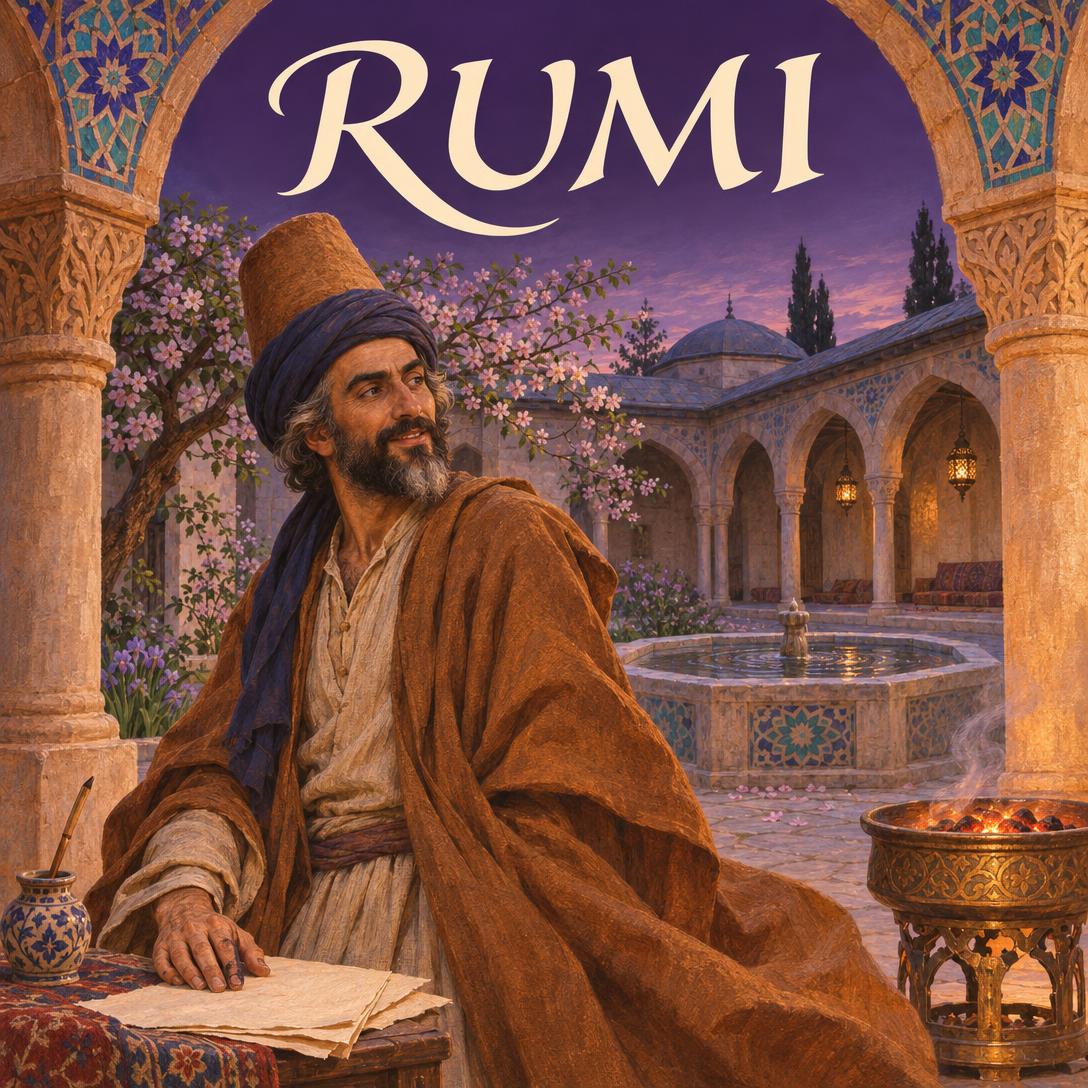
Roleplaying with Rumi on Jenova lets you step into a living-world AI character simulation across the iconic eras of his life. Unlike static character chatbots that sit in an empty chat room, forget your story, or blend every decade into one voice, this simulation connects you to Jalal al-Din Rumi inside an active, evolving thirteenth-century Konya.
- ✅ Four canonical eras, from the sober jurist to the elder dictating the Masnavi
- ✅ An independent personality that reacts to your counsel and respect, not to commands
- ✅ Unlimited memory and live world-state tracking across long campaigns
- ✅ In-world letters, poems, and visions of Konya generated within the story
Most people meet Rumi through quotations. This AI character roleplay lets you meet the man behind them: a trained jurist, a grieving friend, a restless poet, and a storyteller with a sense of humor. The sections below cover how the simulation works, how to begin, and what you can do once you are inside Konya.
Quick Answer: What Is the Rumi AI Roleplay Experience?
Rumi is an interactive AI character roleplay simulation that places you in conversation with thirteenth-century poet and jurist Jalal al-Din Rumi across four canonical eras of his life, inside a living Konya that keeps moving between your messages.
Key capabilities:
- Era-locked conversations with authentic voice, worldview, and inner circle
- A cross-world channel where Rumi alone hears your voice
- Persistent memory, so earlier conversations and story events carry forward
- In-world letters, poems, and scene visuals, plus Fork to branch alternate storylines
Rumi's Living-World Simulation: Features and Roleplay Mechanics
Who Rumi Was, and Why a Static Chatbot Falls Short
Rumi was born in 1207 and died in Konya in 1273, according to Iran's cultural overview of his life. The same source records that he left his homeland in 1219, possibly out of fear of the approaching Mongols, and became a renowned spiritual guide in Konya. Precise birth and death dates (30 September 1207 and 17 November 1273) appear in the Estonian Encyclopaedia entry.
The man's life had distinct chapters. The jurist who taught law was not yet the mystic who composed ecstatic verse, and neither was the elder who later dictated a vast poem. A generic chatbot flattens all of this into one serene, aphorism-ready voice. That is why many "Rumi" bots read like inspirational posters rather than a person.
Medieval Konya was also not a quiet place for contemplation. Scholars have shown that Sufis in medieval Anatolia forged alliances that gave dervish lodges power to alter the layout of cities. Chapter-length research on Sufism and political power in Mongol Anatolia notes that Sufis relied on the financial support of Seljuq and Mongol officials, as Rumi's own correspondence demonstrates. The Rumi simulation builds that texture into its world.
Platforms built for interactive AI character experiences aim for conversational, story-driven interaction with a digital character. Rumi's living-world simulation goes further by giving the character a world with its own momentum.
| Static Character Chatbots | Rumi on Jenova |
|---|---|
| Sits in an empty chat void | Lives in an active, evolving Konya |
| Blends every era into one generic voice | Locks into authentic canonical eras |
| Forgets plot twists and past disclosures | Unlimited memory and live state tracking |
| Folds instantly like a polite assistant | Independent personality and earned rapport |
Authentic Canonical Eras and Custom Starting Points
Every session opens with a short narrated setup that shows where Rumi stands in each era. You then choose one, or propose your own starting point. Once you enter an era, Rumi knows only what belongs to that moment: his memories, his companions, and his worries, with no hindsight about what comes later.
The four built-in eras are:
- Ecstatic Poet of the Divan (Konya, spring 1252): a lyric poet at dusk beside a cooling brazier after an evening sama.
- The Sober Jurist Before the Flame (Konya, November 1244): Konya's revered scholar of religious law, studying by rainy twilight before Shams-i Tabrizi arrives.
- The Crucible of Shams-i Tabrizi (Konya, summer 1245): a rooftop pause during his intense seclusion with Shams, while townsfolk grumble below.
- Master of the Reed Flute & The Masnavi (Meram orchards, October 1264): an elder pacing a moonlit stream as his scribe dozes over fresh pages.
You can also request a custom starting point, even a face-to-face meeting, such as joining him on a winter caravan road or standing in Konya's goldbeaters' bazaar.
Cross-World Portal and Living-World Momentum
By default, you reach Rumi through an unseen resonance that only he can hear, like breath carried across courtyard water. He pauses, looks around, finds no one there, and accepts the marvel with phase-true composure. Disciples, family, and townsfolk hear nothing of you.
Konya keeps moving while you talk. Students arrive, petitioners wait, and Rumi may be interrupted mid-sentence. When you step away and return, his world advances by a natural interval rather than freezing.
Independent Agency and an Open-Ended Sandbox
Rumi interprets what you say and does not simply obey. Sound counsel, honesty, humor, and shared sorrow deepen his regard over time. Arrogance or cruelty earns a sharp turn of logic, a plain rebuke, or silence while he returns to his books. Nothing you declare changes his feelings by decree; rapport is earned through the conversation.
In-Narrative Visions, Writings, and Storyline Forking
When the story calls for it, Rumi can share a view of a courtyard sama or the Meram orchards, or set reed pen to paper for a poem, a letter of intercession, or a transcribed discourse. Silent lookups against historical and textual sources help keep details grounded. Fork lets you branch any moment into an alternate "what-if" timeline.
Example roleplay prompts:
"The courtyard is quiet now. What were you thinking about while the musicians were playing?"
"A weaver owes the emir's bailiffs more than he can pay. Would you write a letter on his behalf?"
"The students are murmuring about the stranger in your house. How do you answer them?"
How to Roleplay with Rumi
Step 1: Choose an era or define your own starting point Read the narrated setup and pick the juncture you want to enter, or describe a custom one. Roleplay begins only after your choice.
"I'd like to enter the evening in 1252, after the sama has ended."
Step 2: Speak across the veil and let Konya unfold Rumi hears your voice, reacts to the surprise of it, and keeps living his scene. Talk to him as you would to a real person with his own priorities, not as a service that answers on demand.
"Forgive the interruption. I could hear the reed flute from a long way off."
Step 3: Offer counsel, build rapport, and reshape the story Bring a question, a grief, an argument, or advice on Konya's affairs. Ask for a poem or a letter, request a view of the scene, or use Fork to explore a different turn of events.
"If the lodge's critics demanded you stop the whirling, what would you say to them?"
Canonical Eras and Roleplay Scenarios
⚖️ The Jurist Who Has Everything but a Reason
Enter in November 1244. Rumi is a disciplined master of law with a reputation no one in Konya questions, and a thirst beneath the mastery that he has not yet named. The historical record notes that his life turned when he met the wandering dervish Shams-i Tabrizi in 1244.
- Question his certainties with a dry, courteous exchange of arguments.
- Watch how measured juridical clarity differs from the raw voice he has later.
- Ask about his late father's notebooks and his sons' studies.
🔥 The Crucible with Shams
Enter in summer 1245, when scandalized townsfolk mutter that a ragged stranger has bewitched their master. Rumi is exhilarated, protective, and walking a razor's edge between devotion and civic hostility.
- Speak with a man who has no patience for pedigree or empty etiquette.
- Offer counsel on the resentment building in his own household.
- Test how an earned bond with a fierce, uncompromising companion shapes his candor.
🌙 The Elder and the Masnavi
Enter in October 1264, past midnight beside a moonlit stream. Sources describe the Masnavi as a poem full of parables; its text includes tales such as a clever hare tricking an elephant at a fountain, and its famous opening Song of the Reed is available in Persian with English translation. In this era Rumi is spacious, slyly funny, and generous with earthy fables.
- Bring him a human knot and see what story he reaches for.
- Ask what the poem is meant to do for a reader.
- Meet his scribe, his son, and the political figures who seek his counsel.
📱 A Long Campaign in Your Pocket
Roleplay works across web, iOS, and Android, with full synchronization. Open the Divan era on your commute, step away, and return that evening to find that Konya has moved on. Unlimited chat history and live tracking of the world state keep promises, confidences, and plot threads intact.
- Continue a multi-session story without recapping.
- Use voice input and read-aloud when your hands are busy.
- Fork a moment you want to replay with a different choice.
If you want to enter one of these scenes now, you can roleplay with Rumi on Jenova.
FAQ
Is Rumi AI roleplay free?
You can start with Rumi on Jenova's free tier, which includes core platform features with limited monthly usage. Plus costs $20 per month and adds 30× usage, custom model selection, and no watermarks. Higher tiers add more usage. Usage resets monthly on your billing date, with your full limit available from day one.
How is Rumi on Jenova different from a generic Rumi chatbot?
A generic chatbot waits in an empty chat and answers in one timeless voice. Rumi on Jenova is built as a living-world simulation: era-locked psychology, an active Konya, independent reactions to your words, and unlimited memory. His personality has to be earned through conversation rather than flattered into agreement.
Which eras of Rumi can I roleplay with?
You can enter four eras: the Ecstatic Poet of the Divan (1252), the Sober Jurist (1244), the Crucible of Shams-i Tabrizi (1245), and the Master of the Reed Flute and the Masnavi (1264). You can also propose a custom starting point in his world, including a face-to-face meeting along the caravan roads.
Can my choices change Rumi's story?
Yes, within the world's laws. History follows the era's premise up to the moment you enter, and then it evolves with your choices and Rumi's own agency. What happens in play stands, with no retcons. If you want to explore a different outcome, use Fork to branch from an earlier message into a new storyline.
How does Rumi remember our past conversations?
Jenova keeps unlimited chat history and tracks the world state, including your bond, promises, people, places, and open storylines. Cross-session global memory is isolated for character simulations, so outside context does not leak into Konya. Your conversations are never used to train AI models.
Is the Rumi roleplay historically accurate?
It is grounded in historical and textual sources, and Rumi speaks within the knowledge of his era. It remains an interpretation, not a primary source. Research on AI role-play cautions about potential cultural misrepresentation and oversimplified social dynamics. Treat the simulation as a creative, exploratory experience, and consult scholarly translations for study.
Conclusion
Static Rumi chatbots offer quotations. The Rumi AI roleplay experience offers a person: a jurist, a mourner, a poet, and an elder storyteller, each living in a Konya that keeps moving. You choose the era, bring your own questions, and earn the rapport that shapes how he answers.
Whether you want a measured legal debate in 1244, the raw intensity of 1245, or a night walk through the Meram orchards in 1264, the simulation gives you a character with his own priorities, a memory of your story, and room to change what happens next. Try Rumi now, and explore more at Jenova.
For Developers: Rumi is available programmatically via the Jenova API, so you can integrate persistent, memory-backed character roleplay into your application with a single agent API call. Full documentation →