AI RPG Quest Failure: Fix Broken Branches & Design Better Fail States
2026-10-22
Game Designer Assistant helps you diagnose and prevent AI RPG quest failure by stress-testing quest logic, mapping every branch, and designing fail states that move the story forward. As of October 2026, more studios and solo creators use language models to generate quests and run campaigns. These systems often produce missions that contradict themselves, forget what the player did, or end with no clear outcome. This AI design partner helps you build quest structures that stay coherent when players take unexpected paths.
- ✅ Branch mapping: Converts loose quest ideas into explicit trees with defined success, partial, and failure end states
- ✅ Systems analysis: Finds unreachable objectives, orphaned flags, and soft locks before players do
- ✅ Fail-forward design: Turns quest failure into new content instead of a reload screen
- ✅ Genre-aware expertise: Applies RPG conventions from CRPGs, tabletop, strategy-RPG hybrids, and mobile titles
Quest failure takes two forms. In the first, the quest itself fails because it breaks, contradicts itself, or traps the player. In the second, the player fails, and the game has nothing meaningful to say about it. AI-generated content makes both problems more common. To see why, it helps to look at how quests are structured and where generative systems tend to lose track.
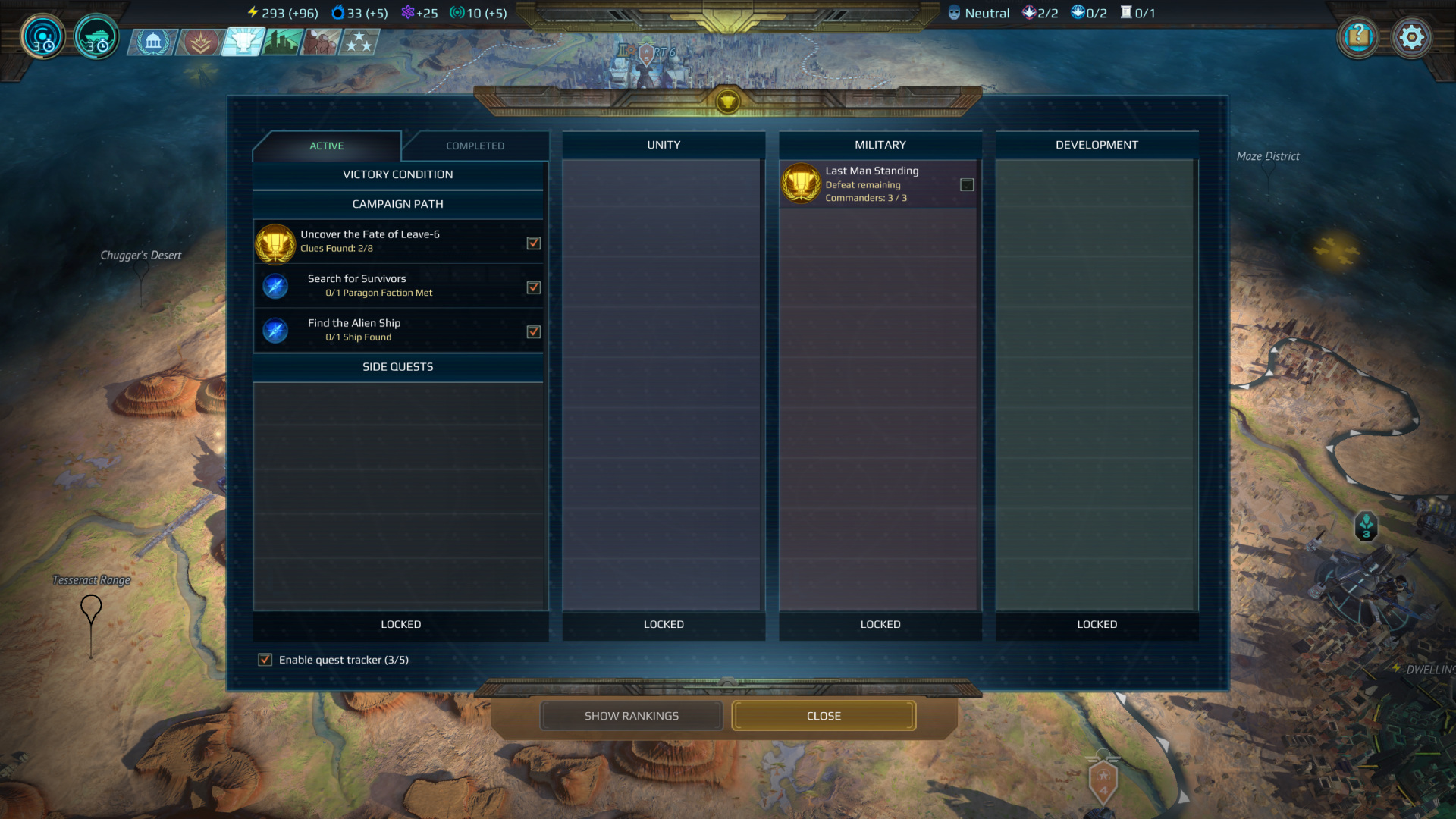
Handcrafted quest logs like this one make state legible. Every objective has a counter, such as "Clues Found: 2/8" or "0/1 Ship Found," and a clear completion condition. AI-generated quests often lose this clarity.
Quick Answer: What Is AI RPG Quest Failure?
AI RPG quest failure is when an AI-generated or AI-run quest breaks its own logic, through contradictions, unreachable objectives, or forgotten state, or when it handles player failure without meaningful consequences. Both problems come from quests that lack explicit structure.
Key capabilities for fixing it with Game Designer Assistant:
- Audit quest designs for logic gaps, soft locks, and contradictory objectives
- Build branching quest trees where every end state, including failure, leads somewhere
- Write quest documentation and state tables that constrain AI narrators and procedural systems
- Balance difficulty, rewards, and failure penalties across a campaign or questline
Why AI-Generated RPG Quests Break
Developers are divided on whether generative AI helps or hurts game quality. Narrative-heavy RPGs are where the risk is most visible. Research on AI-generated game narratives found that poorly generated dialogue or incoherent narrative arcs may disrupt player immersion or actively harm player experience. The same researchers note that quality "can vary unpredictably" even with well-crafted prompts.
Research on LLM-driven quest generation has documented specific failure modes, including nonsensical dialogue patterns and invented details not present in the underlying knowledge graph. Other studies of LLM storytelling report trends toward overly positive or uninspired endings and uneven output quality across sessions.
Getting AI quests to hold together is difficult for four main reasons:
- Lost state: The narrator forgets the player already killed the informant, then sends them to talk to him.
- Unreachable objectives: A quest requires an item or NPC that no branch actually spawns.
- Toothless failure: Models tend toward happy endings, so "failure" quietly turns into success. The bias toward positive endings makes stakes feel fake.
- No defined end states: Without explicit success and failure conditions, quests drift instead of resolving.
Designers building AI game masters have arrived at the same conclusion. One developer on
describes an AI-driven narrative RPG where the AI acts as game master but is constrained by actual game rules. The fix is structure, not better prose.This is exactly what Game Designer Assistant was built for.
Why Game Designer Assistant Solves Quest Failure
Game Designer Assistant approaches quest failure as a systems problem rather than a writing problem. You bring a quest concept, a broken questline, or a transcript where your AI narrator went off the rails. It identifies where state was lost, which branches dead-end, and how to restructure the quest so every outcome is defined.
| Traditional Approach | Game Designer Assistant |
|---|---|
| Manually tracing quest flags across spreadsheets | Generates state tables and branch maps from a plain-language quest description |
| Discovering soft locks during late playtesting | Flags unreachable objectives and missing prerequisites at the design stage |
| Treating failure as "game over, reload" | Designs fail-forward branches that create new quests |
| Hoping an AI narrator stays consistent | Produces structured quest documents that constrain AI generation |
| Expensive narrative consultants for design review | On-demand critique with genre-specific RPG expertise |
Map Every Branch, Including Failure
Academic work on procedural quests suggests a useful model. In the branching quest framework from de Lima et al.'s procedural generation research, a quest's final states each spawn child quests. A quest with three possible outcomes therefore leads to three different continuations.
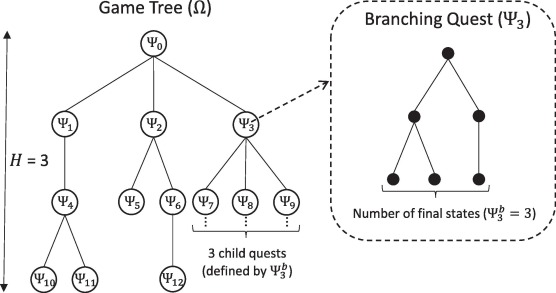
Figure from Procedural generation of branching quests for games. The inset shows that the number of final states in quest Ψ₃ determines how many child quests follow.
In this model, failure is not an exit from the tree. It is one of the final states, and it should seed its own continuation. Game Designer Assistant helps you build quests this way:
"Here's my side quest: rescue the merchant's daughter from bandits. Map every end state, including failing the rescue, and propose a child quest for each one."
Catch Logic Errors Before Players Do
Paste in your quest design or an AI-generated quest. The assistant can then check for:
- Objectives that depend on NPCs or items no branch provides
- Flags that are set but never checked (or checked but never set)
- Branches that converge in contradictory states
- Timers and failure triggers that can fire before the player is told about them
"Audit this questline for soft locks. The player can side with either the Guild or the Crown in Act 2."
Make Failure Meaningful
When failure is designed well, losing becomes part of the story. The assistant helps calibrate consequences such as reputation shifts, lost allies, changed faction control, or harder follow-up encounters. Failure should cost something without ending the run.
"My players keep reloading whenever an escort quest fails. Redesign the failure state so it's worth playing through."
Constrain Your AI Narrator
If you run an LLM-driven RPG or use an AI game master, the assistant can write the quest bible your narrator needs. This includes explicit objectives, completion conditions, failure triggers, and a list of facts the narrator must never contradict.
For a deeper look at the technical side, this GDC talk covers simulation-centric and plot-centric approaches:
https://www.youtube.com/watch?v=k2rgzZ2WXKo
Related Agents You'll Also Find Useful
If you want to playtest your quests interactively, Roleplay Game Master lets you run your scenario as a live session and see how a narrator handles your branches.
- Unlimited memory, so quest state persists across long sessions
- Consistent characters that help you test whether NPCs remember player actions
- Complete creative freedom to run any genre or scenario
If you're grounding your design in research, Deep Research can synthesize academic and industry work on procedural quests, narrative generation, and player psychology.
- Searches hundreds of sources
- Delivers reports with rigorous inline citations
- Useful for GDDs, pitch decks, and design rationale
To study how failure and tension work in AI-driven play, The Mansion is an interactive mystery where every room hides secrets and wrong moves carry real weight. It is a useful reference for how stakes feel from the player's side.
- Exploration-driven mystery with emergent consequences
- Shows how danger and uncertainty sustain engagement
- A quick way to experience player-side quest pressure
Try Game Designer Assistant free. No credit card is required.
How to Fix AI RPG Quest Failure: Step by Step
Step 1: Describe the Quest or Paste the Broken Output
Start with whatever you have, whether that's a one-line concept, a full quest doc, or a transcript of an AI session that broke. Include the genre and any systems involved, such as reputation, timers, or party members.
"Here's a transcript where my AI narrator let the player finish a heist quest even though they'd been caught in the first scene. What went wrong structurally?"
Step 2: Get a Branch Map With Defined End States
Game Designer Assistant restructures the quest into explicit nodes: start conditions, objectives, decision points, and every possible end state. You'll see where branches converge and where failure currently leads nowhere.
"Convert this into a branching quest tree with success, partial success, and failure outcomes. List the world-state changes for each."
Step 3: Audit for Soft Locks and Contradictions
Ask for a systems pass. The assistant traces flags and prerequisites through each path and identifies quests the player can't complete, rewards granted twice, or NPCs referenced after death.
"Trace every quest flag through all branches and list any that are set but never read."
Step 4: Design Fail-Forward Consequences
For each failure state, define what changes in the world and what new quest opens. This step turns failure from a dead end into new content.
"The player fails to stop the ritual. Give me three child quests that follow from that failure, scaled to a level 8 party."
Step 5: Export a Quest Bible for Your AI or Team
Finish by producing a structured document with objectives, counters, failure triggers, and canon facts. Hand it to your AI narrator as constraints, or to your team as spec.
"Write a quest bible for this questline that I can feed to an AI game master, including facts it must never contradict."
Results & Use Cases
🎲 Solo Developer Fixing an LLM-Driven Side Quest
Scenario: An indie dev's AI-generated "find the missing scout" quest sometimes sends players to a scout who already died in an earlier branch.
Traditional Approach: Hours of replaying branches and adding flag checks by trial and error.
Game Designer Assistant: Identifies the missing death-state check, proposes a state table, and rewrites the quest so the "scout is dead" path becomes a new investigation.
- Root cause found at design level, not in QA
- Failure branch converted into fresh content
- Narrator constraints documented for future generation
🗺️ Tabletop GM Designing Fail-Forward Campaigns
Scenario: A GM running a homebrew campaign wants failed quests to reshape the world instead of halting play.
Traditional Approach: Improvising consequences at the table, often inconsistently.
The AI design partner: Builds a campaign quest tree where each failure shifts faction control and unlocks a new arc. The GM then playtests the tree with Roleplay Game Master before the session.
- Consistent consequences across sessions
- Pre-tested branches reduce mid-session improvisation
- Players stop treating failure as a "bad ending"
📱 Designer Auditing Quests on Mobile
Scenario: A narrative designer reviews a teammate's questline on their phone during a commute.
Traditional Approach: Waiting until they're back at a desk with the full design doc open.
Game Designer Assistant on mobile: The designer pastes the quest text and asks for a soft-lock audit. The flagged issues are ready to share by the time they arrive.
- Full feature parity across web, iOS, and Android
- Voice input for quick design notes
- Conversation history syncs to desktop for follow-up
📚 Studio Writing a Design Rationale
Scenario: A small team needs to justify a hybrid approach that combines handcrafted main quests with procedural side quests.
Traditional Approach: Days of reading papers and postmortems.
The workflow: Deep Research compiles cited findings on the trade-off. As one thesis puts it, dynamic quest systems offer scalability while traditional design prioritizes narrative depth. Game Designer Assistant then turns those findings into a concrete quest architecture.
- Evidence-backed design decisions
- Clear split between authored and generated content
- Documentation ready for stakeholders
Frequently Asked Questions
Why do AI-generated RPG quests fail?
AI-generated quests usually fail because they lack explicit structure. Language models can lose track of world state, invent details that contradict earlier events, or drift toward positive endings. Research has documented failure modes like invented details not present in the game's knowledge graph. The most reliable fix is defining objectives, end states, and canon facts before generation.
What is a fail-forward quest design?
Fail-forward design means a failed quest changes the story instead of ending it. When players fail, the world shifts. An ally might be lost, a faction might gain power, or a harder follow-up might open. Game Designer Assistant helps map these consequences so each failure state leads to a child quest rather than a reload.
Is Game Designer Assistant free to use?
Yes. Game Designer Assistant is available on Jenova's free tier with all core features and limited usage. Paid plans start at $20 per month for 30× usage and custom model selection. Usage resets monthly with no daily caps, so you can run long design sessions whenever you need them.
Can AI help prevent soft locks in quest design?
Yes. An AI design assistant can trace quest flags, prerequisites, and item dependencies through every branch to find objectives players can't complete. This is most effective at the design stage, before code is written. AI playtesting tools can stress-test builds quickly, but human playtesters remain important for judging how failure feels.
Does Game Designer Assistant work on mobile?
Yes. It works on iOS, Android, and web with full feature parity. You can paste quest text, attach design documents, or dictate notes using speech-to-text. Your conversation history and settings sync across devices, so an audit started on your phone can continue on your desktop.
How is this different from using a general chatbot for quest design?
General chatbots can brainstorm quest ideas, but they aren't focused on game systems. Game Designer Assistant brings dedicated expertise in systems analysis, documentation, and genre conventions. It also uses persistent memory, so it remembers your world, factions, and existing questlines across sessions.
Conclusion
AI RPG quest failure comes down to missing structure. Quests break when state isn't tracked, objectives aren't reachable, or failure has no defined consequence. The fix is the same whether you're shipping a CRPG, running a tabletop campaign, or building an LLM-driven game: map every branch, define every end state, and make failure a path rather than a wall.
Treat quest failure states as first-class design work and constrain your AI narrator with clear quest documentation. Doing both turns branching quest design from a liability into a source of replayability. Try Game Designer Assistant now to audit your next questline. Explore more at Jenova.
For Developers: Game Designer Assistant is available programmatically via the Jenova API. You can integrate quest auditing and branching design into your game tools or editor pipeline with a single API call. Full documentation →