AI RPG Puzzle Generator: Playable Dungeon Challenges for GMs
2026-09-04
Jenova helps you generate playable RPG puzzles by pairing specialist design, writing, and visual agents with persistent campaign memory. While random tables and generic chatbots spit out a riddle that stalls the session, this AI provides fail-forward apparatus rooms, in-world justifications, and multiple valid solutions you can actually run. In September 2026, that gap still costs game masters a full prep night every time a stone door needs more than a Strength check.
- ✅ Fail-forward dungeon puzzles with more than one valid solution
- ✅ In-world logic so the room belongs to the culture that built it
- ✅ Riddles, boxed text, and apparatus maps in the same workspace
- ✅ Persistent memory so last session's mechanism still exists next week
A puzzle is not a lock with a single key. It is an encounter: information, interaction, time pressure, and a way forward even if the party never “gets it.” To understand why most generators fail that test, it helps to look at how puzzles actually break at the table.
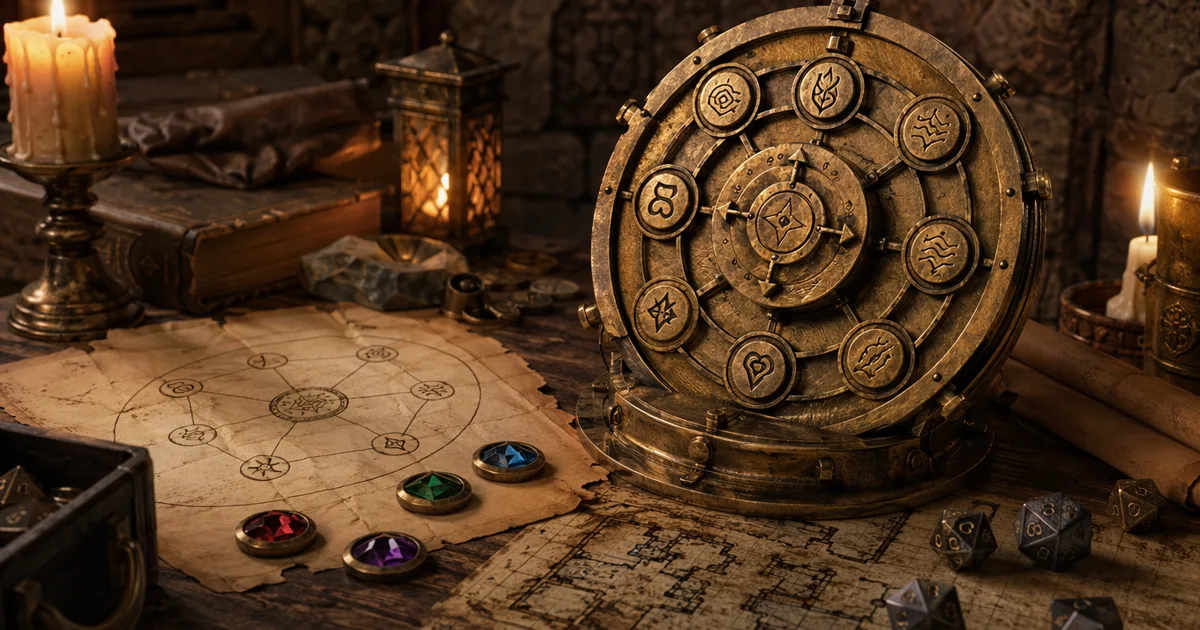
Quick Answer: What Is an RPG Puzzle Generator?
An RPG puzzle generator is a design tool that produces dungeon puzzles, riddles, and apparatus rooms that players can solve through interaction, clues, and character abilities. The useful ones stay playable when the party improvises, fails, or ignores the “intended” answer.
Key capabilities:
- Systems-aware puzzle rooms and fail-forward outcomes with Game Designer Assistant
- In-world riddles, inscriptions, and boxed text with Writing Assistant
- Apparatus maps, gem-and-statue layouts, and player handouts with Graphic Designer
- Set-piece structure so the puzzle has stakes, not just a combination lock
Why Most RPG Puzzle Generators Stall the Table
A good tabletop puzzle does three jobs at once. It can be interacted with using what is in the room. It can be solved more than one way. It still makes sense after the fight is over. That is a high bar for a one-click generator, and it is exactly why so many “riddle doors” turn into twenty silent minutes and a skipped encounter.
The demand for this kind of content is not a niche hobby. The global tabletop role-playing game market is already measured in billions, and the broader tabletop gaming market sits even higher as groups look for immersive, narrative play. Every one of those tables eventually hits a door, a dais, or a sealed vault.
But designing a puzzle that survives contact with players is frustratingly difficult:
- Random generators output a single riddle with one answer and no fail state
- Abstract logic problems yank the table out of the fiction
- Clues hide behind Perception checks the party never makes
- Prep time vanishes into a room that lasts twelve minutes — or forty
- Visuals never match the description, so nobody can picture the apparatus
$2.41 billion — Estimated global TTRPG market size
$21.43 billion — Tabletop gaming market value in the current forecast window, with a 16.3% CAGR through 2030
One-Solution Rooms That Trap the Session
If the only way forward is the answer you wrote on Sunday, the puzzle is a bottleneck, not an encounter. Experienced GMs on D&D Beyond’s dungeon master forums keep returning to the same failure: the party does not see what was obvious in prep, and the session stops. Designers who study dungeon flow argue for other paths forward that do not require solving the puzzle — a side passage, a costly bypass, a clock that advances either way. A generator that cannot produce a fail-forward is not generating an RPG puzzle. It is generating a lock.
Puzzles That Don't Belong in the World
A checkerboard floor with four statues and no story is a board game dropped into a tomb. Forum veterans are blunt: puzzles must serve a purpose or tell a story, or they should not exist. A salt-coast theocracy does not build a Sudoku. A dwarven floodgate might. When the mechanism, the culture, and the threat do not share a reason to be in the same room, players stop roleplaying and start guessing. Video-game puzzle taxonomies — environmental, inventory, mechanic — only help if the type matches who built the dungeon and why they wanted strangers to fail.
Hidden Information and the Three-Clue Problem
What is obvious to the designer is invisible to the table. The practical rule, repeated across GM advice, is the three-clue rule: if the party must notice something to proceed, put that information in three independent places and make it hard to miss. Locking the only hint behind a Perception DC is how you get a silent room.
put it another way: every interactable piece should be easy to use; the challenge is figuring out how the pieces combine, not finding the pieces.Player Brain Versus Character Sheet
The wizard has Intelligence 20. The player just got off a shift. If the puzzle can only be solved by the human at the table, you have designed a quiz, not a roleplaying encounter. Better practice, again from working GMs, is to build puzzles that incorporate character abilities instead of forbidding them: a paladin’s sense for consecrated geometry, a rogue’s tools on a sealed dial, a spell that is useful rather than a skip button. Advice on crafting better RPG puzzles also treats obstacles as something the party’s core mechanics should be able to press against — not a wall that ignores the character sheet.
Prep Time Versus a Single Encounter
Tabletop groups are not a trivial audience. A National Institutes of Health scoping review describes cognitive and psychosocial benefits of TTRPG play, and educators have documented how these games support student development and classroom learning. None of that helps the GM who has forty minutes and still needs a circular dais, four colored stones, a statue that lies, and a consequence if someone yanks the green gem. Prep time is the constraint. Imagination is not.
This is exactly what Jenova was built for.
The Jenova Solution
Jenova is not a random-riddle page. It is a workspace of specialist agents you can point at one encounter: the mechanism, the inscription, the map the players hold, and the scene if they smash the altar. You keep the same conversation, the same documents, and the same memory as the dungeon grows.
| Traditional Approach | Jenova |
|---|---|
| One riddle, one answer, session stall | Fail-forward rooms with two or more valid solutions |
| Abstract logic dropped into a tomb | In-world justification tied to culture and builder |
| Clues locked behind a single check | Three-clue structure written into the room description |
| Hours of map sketching by hand | Apparatus layouts and player handouts in the same thread |
| A different tool for boxed text, art, and systems | One workspace that remembers last week’s dial positions |
Systems-Aware Puzzle Design
Game Designer Assistant treats the puzzle as an encounter, not a poem. You can ask for a circular stone apparatus with gems at the cardinal points, then immediately turn it into a clock, a wrong-statue reading, and a bypass that costs a resource. That is the difference between a generator and a design partner: the room has to survive play. When TTRPGs show up in classrooms, the value is collaboration and problem-solving — your dungeon puzzle should demand the same things on purpose.
Riddles and Boxed Text That Sound Like the World
Writing Assistant is the partner for the words on the wall. High-court liturgy does not sound like a peat-bog grandmother. A floodgate warning should read like an engineer, not a sphinx. You can forbid “speak friend and enter,” demand two interpretations of the same quatrain, and keep the voice consistent across every plaque in the wing. The output is boxed text you can read aloud, not marketing copy in a fake-medieval font.
Visual Apparatus Maps and Player Handouts
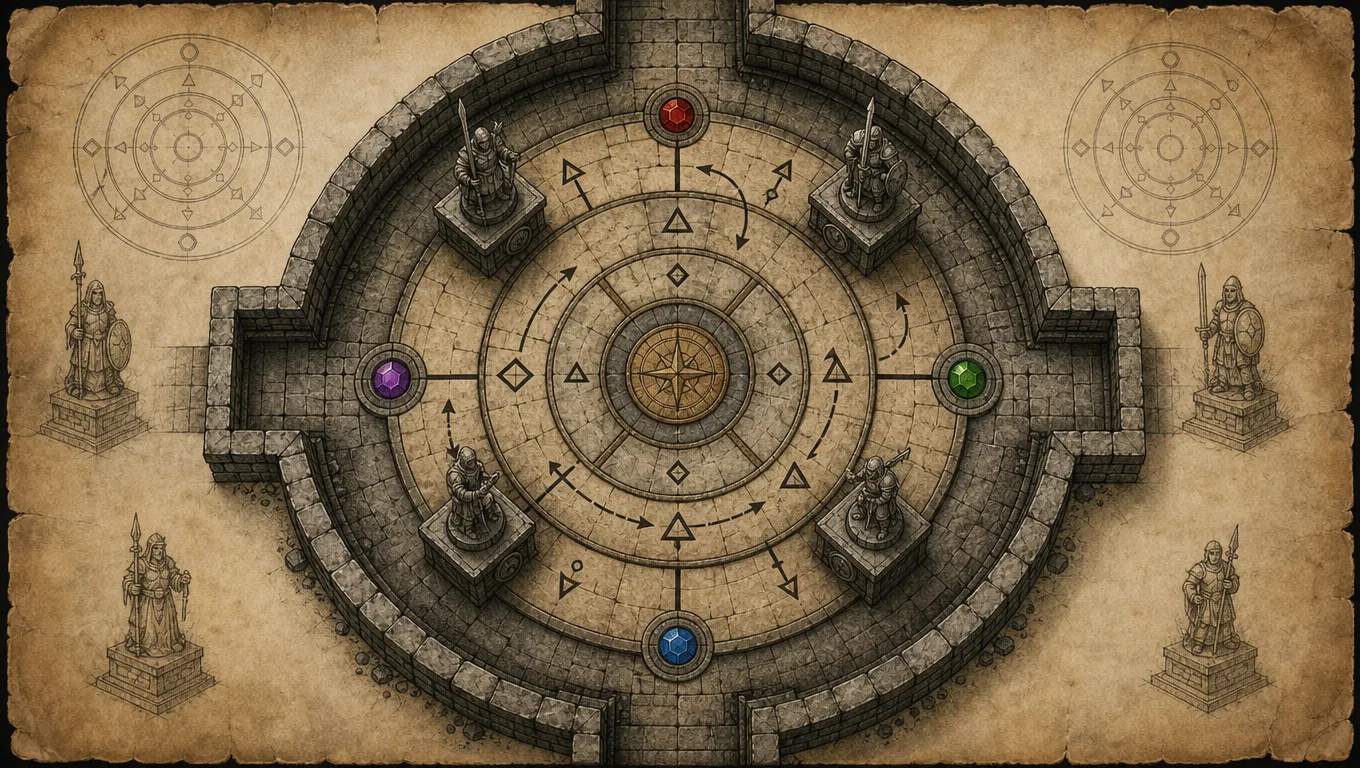
Players cannot solve what they cannot see. Graphic Designer turns the same brief into a top-down dais, a gem-and-statue layout, or a handout you can put in the middle of the table. A compass rose, four colored stones, and knight statues that do not all face the same way are information, not decoration. When the art and the boxed text disagree, the table argues about the picture. When they agree, the argument is about the solution.
Set-Piece Structure Instead of Abstract Logic
Film Screenwriter is useful even if you never shoot a frame. A puzzle that only works as a paragraph of italic lore will die when someone lights the room on fire. Structure — setup, false move, cost, true move — keeps the encounter dramatic instead of combinatorial. You decide what must remain true (the river really will reverse) and what can stay open (who benefits). That is how you avoid both railroads and meaninglessness.
You can also build a custom agent with house rules: no riddle doors, always a smash-through option, never hide the only clue. Jenova keeps that agent, its knowledge base, and its tool configuration so the next room matches the last one.
Specialized AI Agents for RPG Puzzle Design
A dungeon puzzle rarely lives alone. It needs a mechanism, a text, a map, and a later scene that makes the wrong answer look expensive. These agents cover the adjacent work you will do within a month of generating the first room.
Game Designer Assistant
If you run a table, start with the game-design partner. Ask for the apparatus, then keep going: faction reactions, a clock if the party walks away, a fail-forward if they pull the wrong gem.
- Systems-aware brainstorming across tabletop and digital RPGs
- Documentation you can paste into a campaign bible
- Hooks that assume players will improvise or smash the scenery
Writing Assistant
Writing Assistant is easy to underestimate until you have written twelve plaques that all say “the worthy may pass.” Voice, culture, and constraint are the job.
- Inscriptions, riddles, and read-aloud boxed text
- Two interpretations of the same lines on purpose
- House bans on cliché sphinx diction
Graphic Designer
Graphic Designer is the difference between “there are statues” and a handout the rogue can annotate.
- Top-down apparatus maps and gem layouts
- Player-facing diagrams that match the boxed text
- Variants for the solved state, the trapped state, and the smashed state
Comic Creator, Manga Creator, and Webtoon Creator
Comic Creator, Manga Creator, and Webtoon Creator catch formats GMs often skip. A two-page vision of the original ritual can be the three clues. A vertical handout on a phone can show the dais while you describe the grind of stone.
- Sequential reveals instead of a wall of text
- Recurring visual motifs (the left-facing knight, the cracked green gem)
- Format-native drafts you do not have to convert later
Prompt Generator
When you are iterating the same room, Prompt Generator tightens the brief: constraints, forbidden solutions, required interactables, time-to-solve. A better prompt is often the difference between a fortune-cookie riddle and a playable apparatus.
- Reusable briefs for environmental, inventory, and mechanic puzzles
- Constraint lists you can drop into any agent
- Collaborative refinement when the first draft is too cute
Try Jenova free — no credit card required.
How to Generate an RPG Puzzle That Survives Play
Step 1: Name the Builder, the Barrier, and the Bypass Do not start with “write a puzzle.” Start with who built the room, what they were keeping in or out, and what happens if the party never solves it. Concrete builders force concrete mechanisms.
"A salt-coast theocracy built this circular dais to keep land-priests out of a tide archive. If the party fails or walks away, the next high tide floods the lower stacks in three hours of game time. There is a service crawl that costs one rare component."
Step 2: Choose a Puzzle Type and Put Every Piece in Reach Environmental, inventory, or mechanic — pick one primary type so the table is not hunting for hidden genres.
; the challenge is combination, not discovery. Ask your dungeon design agent to list every object the party can touch in the first description."Mechanic puzzle. Central stone ring, four colored gems (red north, green east, blue south, purple west), four knight statues that can be rotated. Nothing is hidden behind a check. Include a three-clue set: floor mosaic, tide hymn on the wall, wear marks on the statues."
Step 3: Demand Multiple Solutions and a Fail-Forward Ask for the intended sequence, a character-ability shortcut, and a smash-through that costs something. That single instruction is what separates an RPG puzzle generator from a crossword.
"Solution A: rotate statues to face the gem of their order. Solution B: a paladin who detects consecration sees the correct facing without rotating anything. Fail-forward: yanking two gems opens the door and starts a collapsing-ring clock. Never require the players to guess a word I did not put in the room."
Step 4: Write the Handout and the Boxed Text in the Same Thread Generate the read-aloud, then the top-down map, then a one-page player handout. If the green gem is east on the map, it is east in the text. Disagreement here is how you lose twenty minutes.
"Write 80 words of boxed text for the dais, then a GM key with statue facings, gem colors, the three clues, and what each wrong combination does. Flag anything that would not be obvious from a top-down sketch."
Step 5: Plant the Payoff and Carry It Across Sessions Decide what remains true later. Maybe the green gem is still missing. Maybe the crawl they used is now a known smuggler route. Persistent memory means you can say “use last week’s dais” instead of rebuilding the room from a screenshot.
Results and Use Cases
🎲 Sunday-Night Dungeon Prep
Scenario: A level 5 party reaches a sealed tide archive in four hours. You need an apparatus, three clues, a priest who is sure he understands it, and a consequence if they pry out the gems.
Traditional Approach: Steal a riddle from a forum, redraw a map, hope nobody asks why a coastal cult built a color-sequence lock.
Jenova: One thread produces the dais, both solutions, the hymn on the wall, and a fail-forward flood clock. The game design agent keeps the encounter playable instead of purely literary.
- Two solutions ready before anyone rolls Investigation
- A bypass that costs a resource, not a skipped scene
- A leftover image (the missing green gem) you can reuse three sessions later
🗺️ Digital RPG Dungeon, One Screen at a Time
Scenario: You are blocking a dungeon for a video RPG. You need environmental puzzles that teach a mechanic, then remix it, without a text dump.
Traditional Approach: Place switches until the room feels like a tutorial, then discover in playtest that nobody understood the rule.
Jenova: Writing Assistant drafts the diegetic signage; Graphic Designer boards the room states (unsolved, partial, trapped, open). You iterate the rule in language the player can see.
- Mechanic introduced in the fiction, not a UI tooltip alone
- State diagrams you can hand to an implementer
- A remix room that uses the same rule under time pressure
📱 Oracle on the Train Before Game Night
Scenario: The group chat asked “what’s in the next room?” You are on a phone, fifteen minutes out.
Traditional Approach: Panic-search “rpg puzzle generator,” paste a sphinx riddle you will regret.
Jenova: Open the same agent on iOS or Android, dictate the builder and the bypass, and get a four-object mechanic puzzle with a fail-forward before you sit down. Feature parity across web and mobile means the campaign memory is already there.
- Voice-to-text for messy, last-minute briefs
- No laptop required for a table-ready apparatus
- The result still matches last month’s cultural voice
🎓 Classroom One-Shot That Has to End on Time
Scenario: You are running a fifty-minute TTRPG one-shot for a writing or STEM club. The puzzle must be collaborative, solvable, and over before the bell.
Traditional Approach: A riddle that either pops in two minutes or eats the period.
Jenova: Film Screenwriter structures the set piece to a clock. Comic Creator or Webtoon Creator produces a single handout. Educators already use TTRPGs to practice collaboration and problem-solving; a bounded, fail-forward puzzle is how you keep that promise.
- A visible timer the whole table can see
- No hidden information, three clues on the handout
- Success and costly success both end the scene on time
FAQ
What is an RPG puzzle generator?
An RPG puzzle generator is a tool that drafts dungeon puzzles, riddles, and apparatus rooms for tabletop or digital games. The difference that matters is whether the output has more than one valid solution, a fail-forward, and clues the party can actually find. Jenova does that work through specialist agents rather than a single generic prompt box.
Is Jenova free to use as an RPG puzzle generator?
Yes. Jenova has a free tier with core features and limited monthly usage, and paid plans increase that usage. You can generate rooms, keep memory, and switch agents without a credit card on the free plan. Heavier campaign bibles are easier on a paid tier, but you can test the workflow immediately.
How is this different from ChatGPT or a random dungeon table?
A random table gives you one image and no second path. A general chatbot can mimic a riddle, but it will not hold your last session’s dial positions, your house ban on riddle doors, and your three-clue rule unless you paste all of that in every time. Jenova keeps specialized agents, documents, and cross-session memory in one place, which is what continuity actually requires.
Can it write D&D and Pathfinder dungeon puzzles?
Yes. That is one of the highest-intent uses. Ask Game Designer Assistant for the apparatus, then for the encounter, the character-ability shortcut, and the clock that advances if the party walks away. You get playable structure, not just a poem to read in a funny voice.
Does an RPG puzzle generator work on mobile?
Jenova runs with full feature parity on web, iOS, and Android. Settings sync. You can dictate a brief on a phone, generate a four-gem dais, and still have the thread waiting on your laptop when you draw the map. For last-minute session prep, that is the difference between using the tool and skipping the room.
How do I keep generated puzzles from stalling the session?
Specify a bypass, a fail-forward, and the three clues in the first prompt. Require that every interactable is in the opening description. If you want a visual check, run the same brief through Graphic Designer and see whether a player could solve from the handout alone. If they could not, the puzzle is not ready.
Build RPG Puzzles Your Table Can Actually Solve
Most RPG puzzle generators fail for the same reason most dungeon rooms fail: they produce a lock that never has to answer to a character sheet, a clock, or a later session. An AI RPG puzzle generator is only worth using if the party can interact, fail, and still move — and if the room still belongs to the people who built it.
Jenova gives you that loop in one workspace — systems design, boxed text, apparatus maps, and set-piece structure — with memory that does not reset when the door opens. Generate the dais. Write the hymn. Draw the gems. Plant the missing stone that will matter three rooms later.
Try the workflow at Jenova. Explore Game Designer Assistant, Writing Assistant, and Graphic Designer, build a custom puzzle agent for your setting, and keep every combination in the same thread until the table is ready to turn the ring.
For Developers: The game-design and writing agents in this article are available programmatically via the Jenova API — integrate RPG puzzle generation and dungeon lore into your application with a single API call. Full documentation →