AI RPG Handout Generator: In-World Letters, Newspapers & Posters
2026-10-24
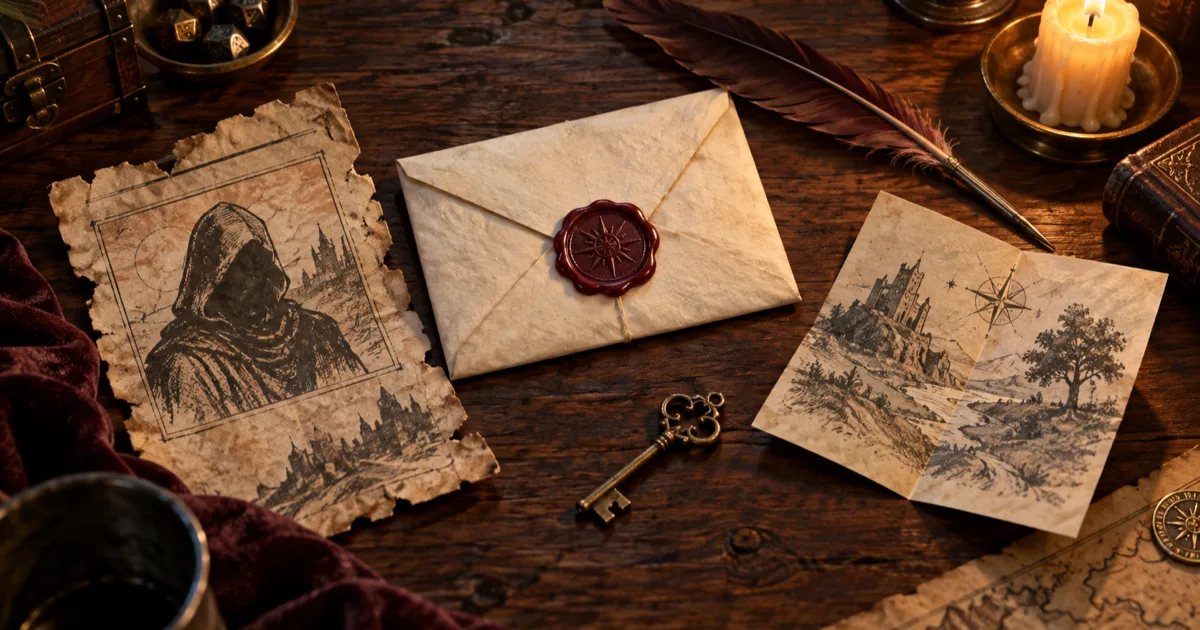
An AI RPG handout generator turns your session notes into documents your players can hold: the bandit's ransom note, the cultist's torn diary page, the duke's sealed proclamation. Jenova combines AI agents that write in-world text with agents that design printable PDFs, posters, flyers, and cards. As of October 2026, handouts remain one of the most effective parts of RPG prep, and one of the most time-consuming. Jenova lets you write, design, and export handouts that match your campaign's tone in one place.
- ✅ In-character writing: Handouts written in the voice of the NPC who "wrote" them, from an illiterate goblin scout to a 1920s newspaper editor
- ✅ Print-ready output: Formatted PDFs, wanted posters, flyers, and item cards for the table
- ✅ Campaign memory: NPC names, factions, and locations stay consistent from session to session
- ✅ Any device: The same features on web, iOS, and Android, so you can prep during a lunch break
Handouts work because they make the fiction feel physical and keep important clues in front of your players. Producing them every week, though, takes writing skill, design work, and prep time that most game masters don't have. Here are the specific obstacles that make handouts the first thing GMs cut when life gets busy.
Quick Answer: What Is an AI RPG Handout Generator?
An AI RPG handout generator is a tool that writes and designs in-world props such as letters, newspapers, wanted posters, and item cards, so game masters can give players immersive clues in minutes instead of hours. On Jenova, separate specialized agents handle the writing, layout, and visuals, and the platform remembers your campaign between sessions.
Key capabilities:
- Writing diegetic documents (journals, contracts, proclamations, confessions) in a consistent NPC voice
- Designing printable layouts for letters, broadsheets, posters, and pamphlets
- Creating visual assets such as faction sigils, illustrated scenes, and collectible item cards
- Exporting for in-person tables (PDF/print) and online play (images, HTML, Markdown)
The Problem: Great Handouts Take Skills Most GMs Don't Have Time For
Tabletop role-playing is a large and growing hobby, and much of it still happens around physical tables with physical materials.
**$2.41 billion**: [Projected global TTRPG market size in 2026, forecast to reach $6.59 billion by 2035](https://www.businessresearchinsights.com/market-reports/tabletop-role-playing-game-ttrpg-market-110856)
55.27%: Share of the global TTRPG market held by physical products in 2025
$1.2 billion: Estimated value of the independently made TTRPG market in 2025
The large share for physical products shows that players still want things they can touch. Veteran GM author Mike Shea of Sly Flourish describes handouts as giving players "something physical to hang onto and read," something that looks like it came out of the game world. He also argues that writing a handout is itself a form of game prep, because it forces you to settle on real names, real places, and real plots.
But producing good handouts session after session is difficult:
- Voice: Writing convincingly as a paranoid alchemist or a pompous town magistrate is a fiction-writing skill
- Design: Fonts, layout, textures, and era-appropriate styling call for graphic design ability
- Time: Handout prep competes with encounter design, NPC prep, and the rest of your life
- Readability: Ornate handouts often become hard to read, so the clue gets lost
- Format: In-person and virtual tabletop groups need different deliverables
Writing in an Authentic In-World Voice
A handout fails when it reads like the GM's notes in a fancy font. A smuggler's ledger, a priest's final confession, and a guild contract each have their own vocabulary, length, and level of literacy. Sly Flourish lists the common handout types GMs draw on: instructions from a boss to an underling, journal entries, lost letters, formal proclamations, contracts, newspaper articles, final confessions, and inventories. Each one needs a different register, and switching between them convincingly takes practice.
Design and Typography Require Specialist Skills
Even with good text, presentation matters. A 1920s Call of Cthulhu newspaper needs a period masthead, column layout, and dated typography. A high-elf decree needs elegant script.
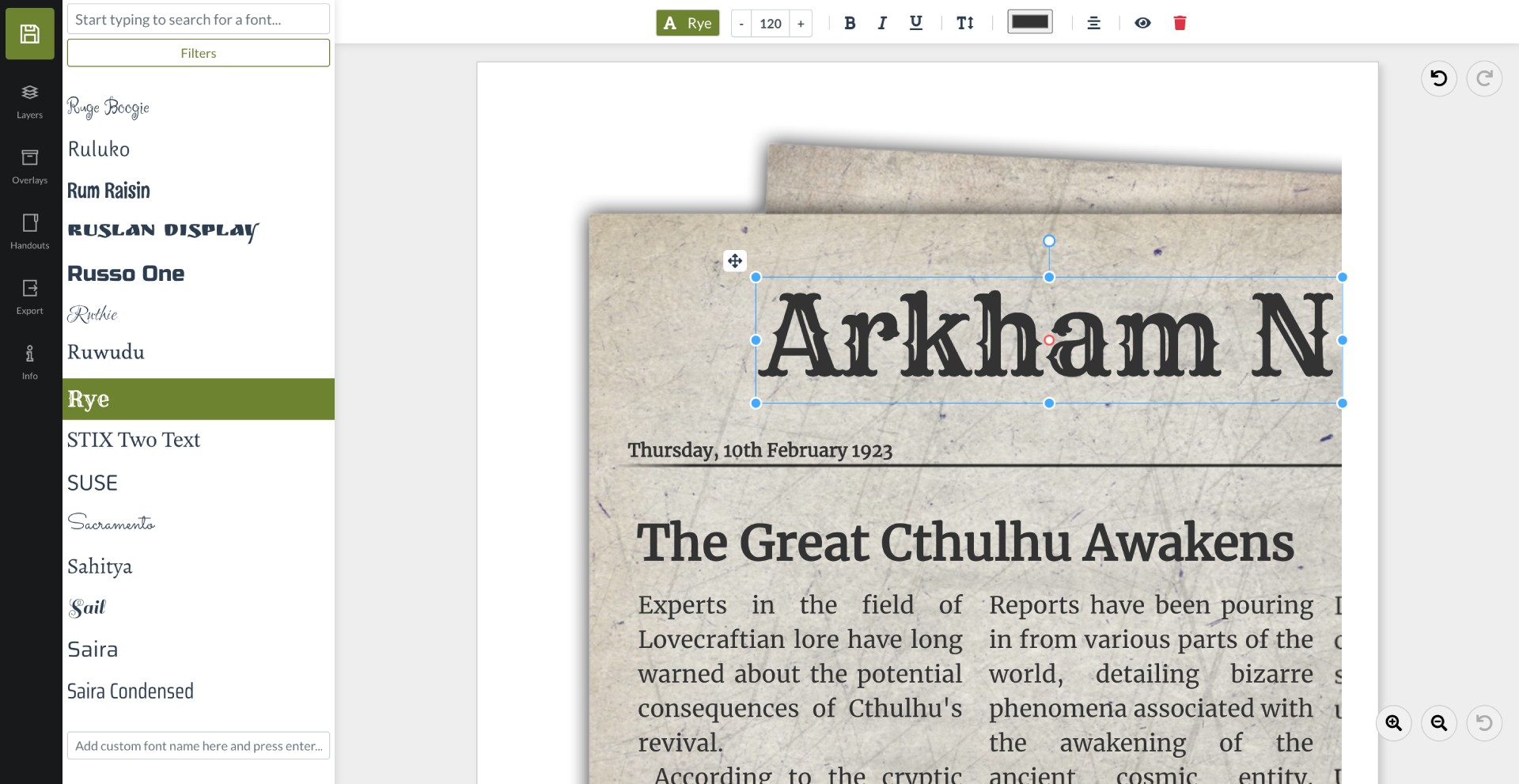
Manual handout tools like the one above give you fine control. You still have to make every decision yourself, though: which font, what size, how many columns, what paper texture. Sly Flourish recommends choosing a font that suits the writer, such as a fancier script for a drow high priestess than for a ratfolk ruffian. That is good advice, and it is also one more decision you have to make for every handout.
Prep Time Is a Finite Resource
Most GMs prep on top of jobs, families, and other commitments. The Great Game Master encourages GMs to distinguish what they need to run the game from what is merely nice to have, and to cut the tasks they don't enjoy. For many GMs, handouts land in the "nice to have" column. They get dropped because they take too long, even though players respond well to them.
Immersion Can Undermine Readability
The most atmospheric handouts are often the hardest to read. Sly Flourish advises keeping handouts to one page, making script fonts large enough to read, and bolding important words so players can find key details. Other GMs give similar advice, recommending never handing out more than a single page at a time. Accessibility is getting more attention as well, with designers arguing that TTRPG materials can be visually engaging while still being inclusive for players with disabilities.
In-Person and Online Tables Need Different Formats
A coffee-stained, torn-edge letter works well across a kitchen table. On a virtual tabletop it needs to be a clean PDF, image, or screenshot, ideally with a textured background that keeps the rustic feel online. Hybrid groups need both versions, which doubles the work.
This is the problem Jenova was built to solve.
The Jenova Solution: An AI RPG Handout Generator Built From Specialist Agents
Most generic tools handle one part of the job. Jenova gives you specialized agents for each stage of making a handout: writing the in-world text, laying it out, designing the visuals, and exporting it in the right format. You describe what you need in plain language, and each agent applies its own expertise.
| Traditional Approach | Jenova |
|---|---|
| Writing NPC documents from scratch in your own voice | In-character prose matched to the NPC's background, era, and literacy |
| Hunting through font sites and word-processor templates | Layouts designed for the document type and setting |
| Recreating handouts separately for in-person and online play | Export as print-ready PDF, image, HTML, or Markdown from the same session |
| Re-checking notes for NPC names and plot details | Persistent memory keeps campaign facts consistent across sessions |
| Learning design software for posters and props | Describe the prop in plain language and refine it through conversation |
In-World Writing That Sounds Like the Character
Creative Fiction Writer is a storytelling partner built for original fiction in any genre, with deep research for authentic worlds and polished prose. For handouts, that means letters, diaries, and decrees that read as if a person inside your world wrote them. You can ask for a desperate scrawl, a bureaucrat's officious memo, or a cryptic prophecy.
"Write a half-burned diary page from a lighthouse keeper in a 1920s New England town. He's slowly realizing the fog brings something with it. Keep it under 200 words and leave sentences cut off where the page is burned."
Print-Ready Documents, Posters, and Flyers
Once the text is ready, layout agents turn it into a physical prop:
- PDF Generator creates professionally formatted PDFs with adaptive design, so a letter, contract, or broadsheet prints cleanly on parchment-colored paper
- Poster Maker designs posters for wanted notices, festival announcements, and propaganda pinned to the city gates
- Flyer Maker produces single-sheet flyers, a good format for tavern notice boards, job postings, and circus bills
"Turn this proclamation into a one-page PDF styled as an official royal decree. Use a large readable script and bold the three place names the players need to remember."
Campaign Memory and Custom Handout Agents
Jenova offers unlimited chat history and persistent cross-session memory. The platform keeps track of the baron's name, the cult's symbol, and the fact that the players already found the first half of the cipher. Handout ten stays consistent with handout one without you re-reading your notes.
You can also build a custom agent in minutes. Give it your campaign setting document as a private knowledge base, choose your preferred model, and write instructions such as "all handouts follow the Ravenmoor house style." You then have a handout generator tuned to your world. Because the platform includes models from OpenAI, Anthropic, Google, DeepSeek, xAI, and others, you can also switch models if you prefer one's prose style.
Built for Every Table
Jenova has full feature parity across web, iOS, and Android, and its speech-to-text lets you dictate handout ideas when typing is inconvenient. Through Model Context Protocol (MCP) integrations, you can connect tools like Google Drive and Notion to keep campaign materials organized alongside your other prep.
Specialized AI Agents for RPG Handouts
Each agent below covers a different type of handout. Many GMs use two or three of them together on a single prop.
Creative Fiction Writer: The Voice Behind Every Document
Creative Fiction Writer writes the words on the page. It handles genre conventions across fantasy, horror, sci-fi, and noir, and it can research historical detail for period settings like Victorian London or 1920s Arkham.
- Writes letters, journals, confessions, and contracts in a distinct NPC voice
- Adjusts literacy, dialect, and tone to fit the character
- Seeds subtle clues and red herrings for players to find
PDF Generator: Clean, Printable Props
PDF Generator turns finished text into a properly formatted document. It works well for multi-column newspapers, legal-style contracts, and decrees that need a formal structure.
- Produces print-ready layouts in a single pass
- Applies document conventions automatically, such as columns for broadsheets and signature blocks for contracts
- Shares easily as a file for online groups
Poster Maker: Wanted Notices and Propaganda
Poster Maker handles anything that would hang on a wall in your world. Wanted posters are a staple of bounty-hunter arcs and work equally well in a western-themed one-shot or a cyberpunk megacity.
- Designs eye-catching posters for events, notices, and promotions
- Pairs bold headlines with supporting visuals
- Works for both printed props and digital handouts
Trading Card Game Creator: Item and Spell Cards
Trading Card Game Creator is a complete card-design studio covering mechanics, lore, card art, and balance. GMs can use it to make magic item cards, spell cards, or NPC reference cards that players keep on the table.
- Combines flavor text, artwork, and rules text on one card
- Keeps mechanics balanced across a set of cards
- Makes loot something players physically collect
Infographic Maker: Faction Webs and Investigation Boards
Infographic Maker turns complex information into clear visuals with built-in research and visual storytelling. It suits political intrigue campaigns, where players need to track who betrayed whom.
- Visualizes faction relationships, family trees, and timelines
- Creates in-world "investigation board" summaries
- Helps players re-orient at the start of a session
Try Jenova free, with no credit card required.
How to Create RPG Handouts With AI: Step by Step
Step 1: Define the Author and the Purpose
Before writing anything, decide who wrote the document in the fiction and what you want players to learn from it. Sly Flourish recommends balancing what the in-world author would write with what the GM wants players to know, and leaning toward revealing too much rather than too little.
"I need a handout from Captain Mirela, a disgraced naval officer, to her former first mate. Players must learn: the treasure is on Gull's Rest island, the Admiralty is hunting her, and she trusts no one wearing a blue sash."
Step 2: Generate the In-World Text
Ask the fiction-writing agent for a draft, specifying length, tone, and any physical damage to the document such as water stains, missing words, or a torn corner. Revise in conversation until it reads right.
"Make it shorter, around 150 words. She's writing in a hurry by candlelight, so her sentences get clipped toward the end."
Step 3: Add Visual Elements
Decide whether the handout needs an illustration, a sigil, or a sketch. Comic Creator, a sequential-art specialist, can produce illustrated scenes, such as a sketch of the cursed ship found tucked inside the letter.
"Draw a rough ink sketch of a three-masted ship with torn black sails, as if drawn by a sailor in the margin of a letter."
Step 4: Lay Out and Export
Send the final text to the layout agent that fits the prop: PDF for letters and newspapers, poster design for notices, flyer design for bulletins. For in-person play, print on parchment-style paper. For online play, export a PDF or image to drop into your virtual tabletop.
"Format this as a single-page letter PDF with a parchment background, a large handwritten-style font, and the island name in bold."
Step 5: Keep the Campaign Thread Going
Between sessions, return to the same chat. Jenova's persistent memory keeps established names and details, so follow-up handouts like Mirela's second letter or the Admiralty's arrest warrant stay consistent.
"The players intercepted Mirela's letter. Write the Admiralty's arrest warrant for her, referencing the same ship name and her old rank."
Results & Use Cases
📜 A Cosmic-Horror Newspaper Clue Chain
Scenario: A Keeper running a 1920s Lovecraftian investigation wants a series of three local newspaper clippings that escalate in strangeness over three sessions.
Traditional Approach: Researching period newspaper style, writing three articles, and laying out columns and mastheads by hand can take an entire evening per clipping.
With Jenova: The fiction agent writes era-appropriate articles with planted clues, and the PDF agent formats them as aged broadsheet pages.
- Consistent masthead and town names across all three clippings
- Period-appropriate vocabulary without hours of research
- Clues bolded or placed for easy reference without breaking immersion
🤠 A Bounty-Hunter Arc With Wanted Posters
Scenario: A GM running a frontier fantasy campaign needs five wanted posters for the outlaw gang the players are hunting, each with a portrait, a reward, and a "known associates" line that links the gang members together.
Traditional Approach: Using an online template gives five nearly identical posters and still requires writing every description.
With Jenova: The poster agent designs a distinct notice for each outlaw, while memory keeps the gang's names and connections consistent.
- Each poster has its own look while matching the same in-world sheriff's office
- Cross-references between posters create a puzzle players can solve
- Ready to pin to a cork board at the table
💻 An Online Campaign Played Entirely on a Virtual Tabletop
Scenario: A remote group plays on a virtual tabletop and wants handouts players can open, scroll, and revisit between sessions.
Traditional Approach: Photographing physical props or building image files manually for every handout, then re-uploading them whenever something changes.
With Jenova: HTML Generator turns handout content into polished, self-contained HTML that opens in any browser. Players get a responsive "found document" they can open on any device.
- Works on desktop and mobile without extra software
- Easy to share as a single file
- Pairs with PDFs for groups that also print props
📱 Last-Minute Handout on a Phone
Scenario: Thirty minutes before game night, a GM realizes the players will search the villain's study and there's no prep for what they'll find.
Traditional Approach: Improvise verbally and hope players remember the details.
With Jenova: On the iOS or Android app, the GM dictates a quick request by voice and gets a written journal page and a shareable file before arriving at the table.
- Full feature parity with the web version
- Speech-to-text for hands-free prep
- The handout is saved in campaign history for later reference
Frequently Asked Questions
Is there a free AI RPG handout generator?
Yes. Jenova's Free tier includes all core features with limited usage, so you can generate letters, posters, and PDFs for your next session without paying. GMs who prep heavily can upgrade to Plus at $20 per month for 30× the usage of the free tier, custom model selection, and no watermarks. Usage resets monthly on your billing date with no daily caps, so you can produce a large batch of handouts right before a big session.
Can AI-generated RPG handouts be printed?
Yes. Ask for a print-ready PDF and print it on parchment-colored resume paper for an aged look. Sly Flourish suggests a cheaper alternative: soaking normal paper in coffee, tearing the edges, and crumpling it for a rustic feel. Keep script fonts large and handouts to a single page so the props stay readable at the table.
How do I use AI handouts in online games like Roll20 or Foundry VTT?
Export handouts as PDFs or images and upload them to your virtual tabletop's handout or journal feature. For GMs who keep campaign wikis or notes apps, Markdown Generator converts content into clean, structured Markdown that pastes neatly into note-taking tools. Textured backgrounds help digital handouts keep the same atmosphere as printed ones.
Can an AI design faction sigils or wax seal emblems for my handouts?
Yes. Logo Generator is an expert logo and brand identity designer, and it works well for in-world heraldry: guild crests, noble house sigils, cult symbols, and wax-seal emblems. Once you have a sigil, reuse it across letters, posters, and banners so players start recognizing a faction by its mark.
Will the AI remember my campaign's NPCs and locations?
Yes. Jenova keeps unlimited chat history and persistent memory across sessions, so names, places, and plot details stay consistent from one handout to the next. For tighter control, create a custom agent with your setting document attached as a private knowledge base. That gives you a handout generator that already knows your world's history, factions, and house style.
Does the AI RPG handout generator work on mobile?
Yes. Jenova offers full feature parity across web, iOS, and Android, and settings sync across devices. You can start a handout on your laptop, refine it on your phone during a commute, and share the final file from either device. Built-in speech-to-text means you can dictate handout ideas without typing.
Conclusion: Bring More Handouts to the Table
Handouts make your world feel real, keep clues in front of your players, and, as experienced GMs point out, sharpen your own prep. GMs drop them because they demand writing, design, and time all at once. An AI RPG handout generator removes that bottleneck. You decide what players should learn, and specialized agents handle the voice, the layout, and the format.
Start with Creative Fiction Writer for in-character prose, format it with the PDF agent, and pin a custom wanted poster to your table's notice board. Whether you need tabletop props, D&D player handouts, or Call of Cthulhu clue documents, the workflow is the same.
Explore the full agent library at Jenova.
For Developers: Every agent in this article is available programmatically via the Jenova API, so you can build handout generation into your virtual tabletop, campaign manager, or RPG app with a single integration. Full documentation →