AI RPG Faction Reputation: Design Tiers, Ledgers & NPC Reactions
2026-10-22
Game Designer Assistant helps you build AI RPG faction reputation systems that stay consistent as your game grows. It works through tiered standings, cross-faction consequences, and NPC reactions with you by handling the systems analysis, balancing math, and design documentation.
As of October 2026, faction reputation is still where many RPG designs fall apart, whether you're building an RPG Maker project, an Unreal open-world game, or an LLM-narrated adventure. One rival relationship affects every quest, vendor, and dialogue line. This AI design partner turns that web of dependencies into a clear spec you can implement.
- ✅ Designs reputation tiers, thresholds, and decay rules for your genre and pacing
- ✅ Maps cross-faction relationships so siding with one group has visible costs
- ✅ Produces design docs and data tables your team can implement in any engine
- ✅ Generates concept art for faction emblems, colors, and visual identity
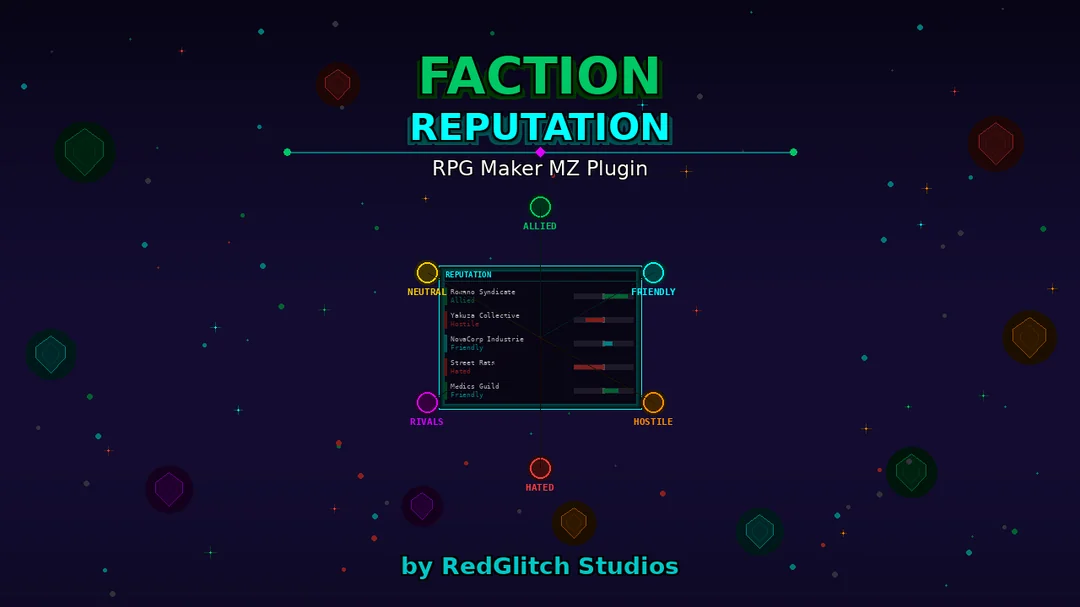
Faction systems look simple on a promotional screen: a few names, a few colored bars, and labels from "Allied" to "Hated." The difficulty lies in the logic underneath. Before looking at how an AI design partner helps, it's worth understanding why faction reputation is so hard to get right and why AI-driven RPGs make the problem sharper.
Quick Answer: What Is AI RPG Faction Reputation?
AI RPG faction reputation is a game system where each faction tracks the player's standing as persistent numeric state, and AI-driven NPCs, quests, and narration react to that standing in context.
What an AI design partner helps you build:
- Tier ladders (Hated → Hostile → Neutral → Friendly → Allied) with tuned thresholds
- Relationship matrices that spread gains and losses across rival and allied factions
- Rules for how quests, vendors, and dialogue change at each tier
- A compact reputation ledger that LLM-driven narrators read instead of improvising
The Problem: Why Faction Reputation Breaks So Many RPGs
Factions do more work in an RPG than most systems. Research published through the ACM notes that faction systems help define the world's context, advance the plot, and provide the player with rewards and achievements. Choice-driven structure also matters to players: one study found that branching narrative in an RPG leads to improved gameplay experiences compared to linear narrative.
AI-narrated RPGs add another failure point. LLMs are good at sounding reactive, but they don't reliably remember consistently:
"A ledger, not a mood" — One AI RPG developer argues faction reputation must be a ledger the narrator reads, not a mood it improvises
Building a faction system that holds together is difficult for four reasons:
- Combinatorial growth. Every faction pair needs a defined relationship. With factions, that's pairings. Six factions means 15 relationships to design and test.
- Flattened choices. A single global reputation score can't express "loved by the guild, hunted by the syndicate."
- Threshold tuning. If gains are too slow, players grind. If they're too fast, a single quest swings a faction from Hostile to Allied.
- Narrative drift. Without a structured state, AI narrators forget betrayals, invent alliances, or let tone override consequences.
This is the gap a dedicated AI design partner was built to close.
Why Game Designer Assistant for Faction Systems
Game Designer Assistant is a game design partner focused on brainstorming, systems analysis, documentation, and concept art across every genre and platform. For faction reputation, you can work through the whole system in one place: tier structure, ripple math, NPC behavior rules, and a spec document your programmer can build from.
| Traditional Approach | Game Designer Assistant |
|---|---|
| Spreadsheets of faction pairs maintained by hand | A generated relationship matrix with ripple multipliers explained |
| Thresholds tuned by trial and error in playtests | Proposed tier ranges with pacing analysis before you build |
| Design intent scattered across notes and chats | Structured design docs organized by system |
| Faction identity left to a later art pass | Concept art for emblems and palettes during design |
| AI narrators improvising reputation from history | A defined ledger schema and narrator rules |
Tier Architecture and Thresholds
A good tier ladder balances clarity with granularity. The assistant can propose ranges, explain the pacing implications, and adjust them to your quest density. A typical starting point looks like this:
| Tier | Standing Range | Typical Effect |
|---|---|---|
| Hated | −100 to −61 | Attack on sight, bounties issued |
| Hostile | −60 to −21 | Refused services, guarded dialogue |
| Neutral | −20 to +20 | Default prices and baseline quests |
| Friendly | +21 to +60 | Discounts, faction quest lines unlocked |
| Allied | +61 to +100 | Unique gear, companions, endgame support |
From there, you can stress-test it. Ask how many quests it takes to climb a tier, or what happens if a player betrays an Allied faction mid-game.
Cross-Faction Ripple Effects
Real faction systems are networks rather than lists. Helping the Street Rats might cost standing with NovaCorp and slightly raise it with the Medica Guild. The assistant helps you define a ripple multiplier for each faction pair, flag runaway loops where two allies amplify each other, and decide which actions should ripple and which should stay contained.
The Ledger, Not the Mood: Designing for AI Narrators
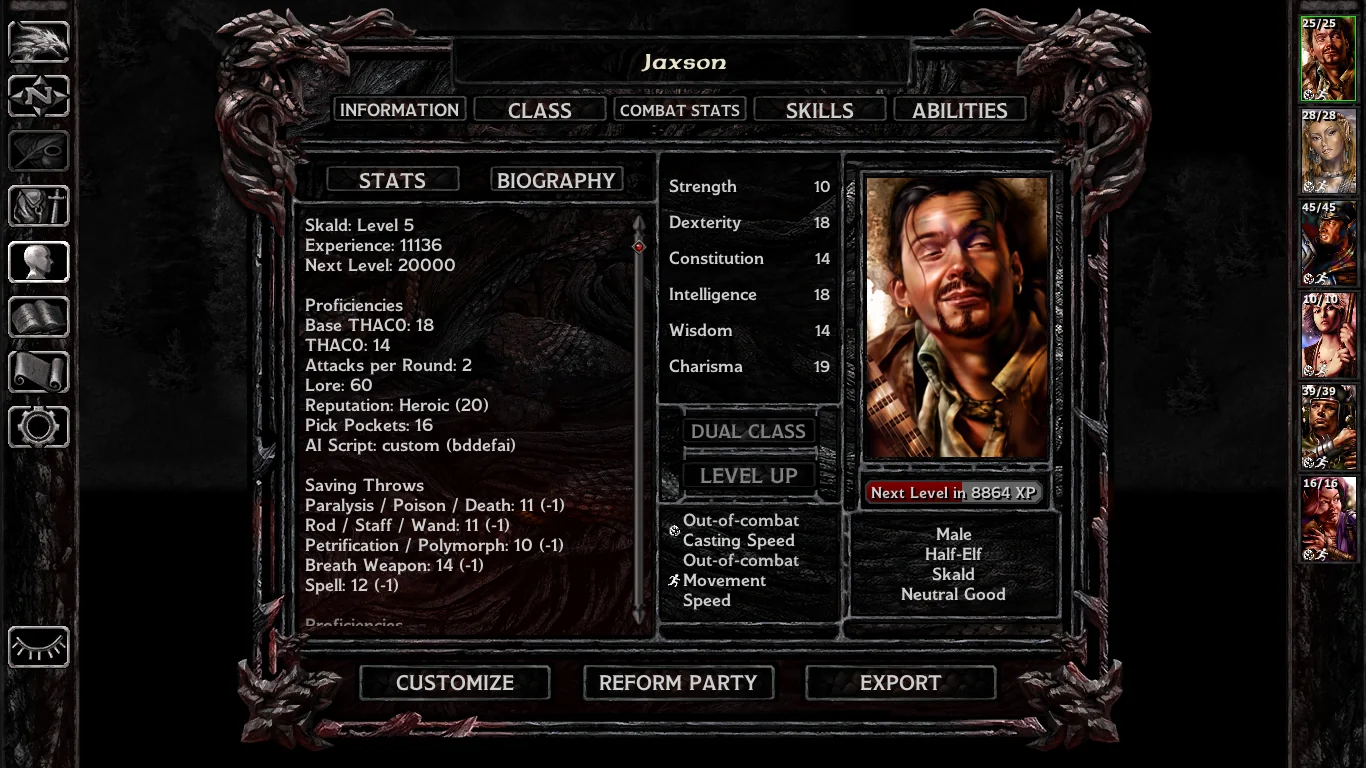
Classic CRPG character sheets often tracked reputation as one global number, as in the screen above. Modern AI RPGs face the opposite problem: they have too much freedom. Some communities recommend that you write RPG systems as guidelines rather than programmatic fixed rulesets. Others insist on a strict ledger.
A three-layer architecture resolves this tension, and the assistant can help you design each layer:
- State layer: Numeric standings per faction, owned by your game code and never by the model.
- Rules layer: Hard consequences at each threshold, such as locked vendors, bounties, and quest gates.
- Voice layer: How NPCs express their standing. This is where LLM improvisation adds value.
This split also helps with performance. Because LLM latency rose as conversational context grew in empirical testing, injecting a compact ledger into each prompt costs far fewer tokens than replaying a player's entire history.
Engine-Agnostic Documentation
According to the GDC 2026 State of the Game Industry report, 42% of developers use Unreal Engine as their primary engine, 30% use Unity, and Godot is gaining ground with newer indies. Marketplace plugins such as an Unreal Engine 5 reputation and faction system supply the plumbing, but they don't decide what your factions want. The assistant writes the design layer that sits on top of whichever engine or plugin you use.
Example prompts:
"Design a reputation system for five factions in a cyberpunk RPG. Include tier thresholds, a relationship matrix, and how each tier changes vendor prices."
"My players hit Allied with the Medica Guild in three quests. Rebalance gains so it takes most of Act 2."
"Write narrator rules for an LLM-driven RPG so NPCs reference faction standing without contradicting the numeric ledger."
Related Agents You'll Also Find Useful
Creative Fiction Writer
If you're also writing the lore behind your factions, Creative Fiction Writer can turn rival groups into living institutions with histories, grudges, and voices.
- Deep research for grounded, authentic worldbuilding
- Editorial feedback on faction dialogue and in-game texts
- Polished prose for codex entries and quest text
Machiavelli Mentor
Credible faction politics require believable incentives. Machiavelli Mentor brings power mapping and incentive analysis that translate well to designing why factions ally, betray, and negotiate.
- Power mapping across competing groups
- Incentive analysis for each faction's goals
- Multi-move strategy design for scheming NPC leaders
Deep Research
Before designing, it helps to study how other games handled factions. Deep Research searches hundreds of sources and synthesizes them into cited reports.
- Comparative analysis of reputation systems across titles
- Community sentiment on what players loved or hated
- Cited summaries you can share with your team
Try the assistant free. No credit card required.
How to Design an AI RPG Faction Reputation System
Step 1: Define Your Factions and What They Want
Start with motivations before mechanics. Open Game Designer Assistant, describe your setting, and list each faction's goals, resources, and enemies.
"Here are my five factions and setting summary. Identify where their goals conflict and where they could plausibly ally."
Step 2: Build the Tier Ladder and Thresholds
Choose your tier names and numeric ranges, then check the pacing against your quest count. The assistant can calculate how many standard actions it takes to move between tiers.
"I have about 40 quests. Propose reputation gains per quest type so reaching Allied with one faction takes roughly half the game."
Step 3: Map Cross-Faction Ripples
Generate a relationship matrix with ripple multipliers, then test edge cases such as double agents, faction wars, and redemption arcs.
"Build a ripple matrix for these factions and show what happens to all standings if the player completes the NovaCorp heist."
Step 4: Write Consequence and Narrator Rules
Document what changes at each tier: prices, quest access, hostility, and dialogue tone. If your game uses an LLM narrator, define the ledger format and the rules it must follow.
"Write a one-page spec for my programmer covering reputation data structure, threshold events, and narrator constraints."
Step 5: Give Each Faction a Visual Identity
Finish with concept art for emblems and color palettes so players can read a faction's status at a glance, much like the color-coded tiers in modern reputation UIs.
"Create emblem concepts for the Street Rats: scrappy, improvised, neon accents."
Results & Use Cases
🎮 Solo RPG Maker Developer Adding Factions
Scenario: A solo developer installs a faction plugin for an RPG Maker MZ project but has no plan for how the five factions should interact.
Traditional Approach: Weeks of improvising values in the plugin settings, then discovering broken pacing during playtests.
Game Designer Assistant: The AI game design partner produces tier ranges, a ripple matrix, and a values table mapped to the plugin's fields.
- Balanced pacing before the first playtest
- Clear documentation for future updates
- Faction emblems ready for the UI
🏰 Narrative Indie Studio Tying Quests to Standing
Scenario: A small team wants quests to matter beyond experience points. Players of AI-driven games have asked for this directly, with one community request noting that quests would be far more interesting if they awarded faction reputation rather than simply XP.
Traditional Approach: Retrofitting reputation rewards quest by quest, often inconsistently.
Game Designer Assistant: Builds a quest-type reward framework covering major, minor, betrayal, and diplomatic quests, with ripple rules applied consistently.
- Consistent reputation economy across all quests
- Lore support from Creative Fiction Writer for faction-specific quest text
- Fewer contradictions flagged late in QA
🤖 Builder of an LLM-Narrated RPG
Scenario: A developer's AI narrator keeps "forgetting" that the player burned down the syndicate's warehouse.
Traditional Approach: Stuffing ever-longer history into prompts, which raises latency and cost without guaranteeing consistency.
Game Designer Assistant: Designs a compact faction ledger, threshold events, and narrator constraints so the model reads state instead of guessing.
- Consistent NPC reactions across long sessions
- Smaller prompts with lower context overhead
- The model keeps creative freedom in voice but not in facts
📱 Designing on the Go from Mobile
Scenario: A designer has an idea for a faction schism during a commute.
Traditional Approach: Jotting a note and losing the thread before getting back to the desk.
Game Designer Assistant: On the iOS or Android app, the designer describes the schism, gets an updated relationship matrix and split-faction tier plan, and returns to the full spec later on the web.
- Ideas captured with full context
- Same capabilities across web and mobile
- No lost design momentum
FAQ
What is a faction reputation system in an RPG?
A faction reputation system tracks the player's standing with each group in the game world separately, rather than as one global score. Standing typically moves through tiers like Hostile, Neutral, and Allied, which change prices, quest access, and NPC behavior. Tabletop designers have long used reputation as an indicator of an NPC's default attitude toward a character, while individual NPCs can still deviate from it.
How do AI RPGs keep faction reputation consistent?
The most reliable approach separates state from storytelling. Game code owns numeric faction standings and threshold events. The LLM receives a compact ledger each turn and handles only how NPCs express their attitude. This prevents narrators from inventing or forgetting consequences, and it keeps prompts short. Research shows LLM NPC latency grows with conversational context, so a smaller prompt also means faster responses.
Is Game Designer Assistant free?
Yes. Game Designer Assistant is available on a free tier that includes all core features with limited usage. Paid plans start at $20 per month (Plus) with 30× the free usage, and higher tiers scale up for heavy use. Usage resets monthly with no daily caps, so you can run intensive design sessions whenever you need them.
Can it design faction systems for Unity, Unreal, Godot, or RPG Maker?
Yes. Faction design is engine-agnostic: tiers, thresholds, ripple matrices, and consequence rules translate into any engine's data structures. The assistant writes specs and value tables your programmer can map onto Unreal, Unity, Godot, or an RPG Maker plugin. It produces design documentation and analysis. Implementation inside your engine is still done by you or your team.
Does AI-assisted faction design replace a narrative designer?
No, and the industry is skeptical of tools that try. The GDC 2026 survey found that 63% of game design and narrative workers view generative AI unfavorably. Among professionals who do use AI, the most common use is research and brainstorming (81%). That is the role an AI design partner fits: a fast sounding board for systems math, while human designers own the vision.
Conclusion
Faction reputation is one of the most effective ways to make RPG choices feel consequential, and one of the easiest systems to break. Combinatorial relationships, pacing problems, and AI narrators that improvise instead of remember all push a well-intended design toward inconsistency. A structured approach, with numeric state, clear threshold rules, and a voice layer for AI-driven NPCs, turns AI RPG faction reputation from a liability into a strength.
Whether you're tuning a reputation tier system for a solo RPG Maker project or building ledger-driven narration for an LLM game, the work is the same: define what factions want, quantify how they react, and document it clearly. Try Game Designer Assistant now to design your faction system from first concept to implementable spec. Explore more at Jenova.
For Developers: Game Designer Assistant is available programmatically via the Jenova API. You can integrate faction and game systems design support into your studio tools or editor pipeline with a single API call. Full documentation →