AI RPG Experience Points: Track XP, Level Up & Run Fair Progression
2026-10-22
Roleplay Game Master helps you run campaigns where AI RPG experience points are actually tracked. You don't lose earned XP or level up at random, and you don't watch your character sheet quietly rewrite itself. Most AI storytellers treat progression as flavor text. This AI game master keeps a persistent record of your character, your choices, and the rules you set at the start of the campaign, so each XP award has a clear reason and each level-up follows the rules you chose.
As of October 2026, players expect more from AI-run tabletop sessions. They want real mechanics: XP thresholds, milestone triggers, rest and recovery, and stat growth.
- ✅ Unlimited memory that keeps your XP ledger, level, and inventory consistent across sessions
- ✅ Works with D&D-style XP tables, milestone leveling, or your own homebrew curve
- ✅ Any genre, including fantasy, cyberpunk, horror, sci-fi, or a setting you invent
- ✅ Full feature parity across web, iOS, and Android
Experience points are the backbone of character growth in most RPGs. They are also one of the first things a poorly structured AI game master gets wrong. To see why, start with how XP works at the table and why it breaks down when an AI runs the game without structure.
Quick Answer: What Are AI RPG Experience Points?
AI RPG experience points are numeric progression rewards that an AI game master awards for combat, quests, and roleplay, tracks across sessions, and uses to trigger level-ups based on a defined advancement table or milestone system.
Key capabilities to look for:
- A persistent XP ledger that survives long campaigns and session breaks
- Transparent awards that explain why you earned XP
- Support for standard tables, milestone leveling, or hybrid systems
- Level-up walkthroughs covering hit points, features, and proficiency changes
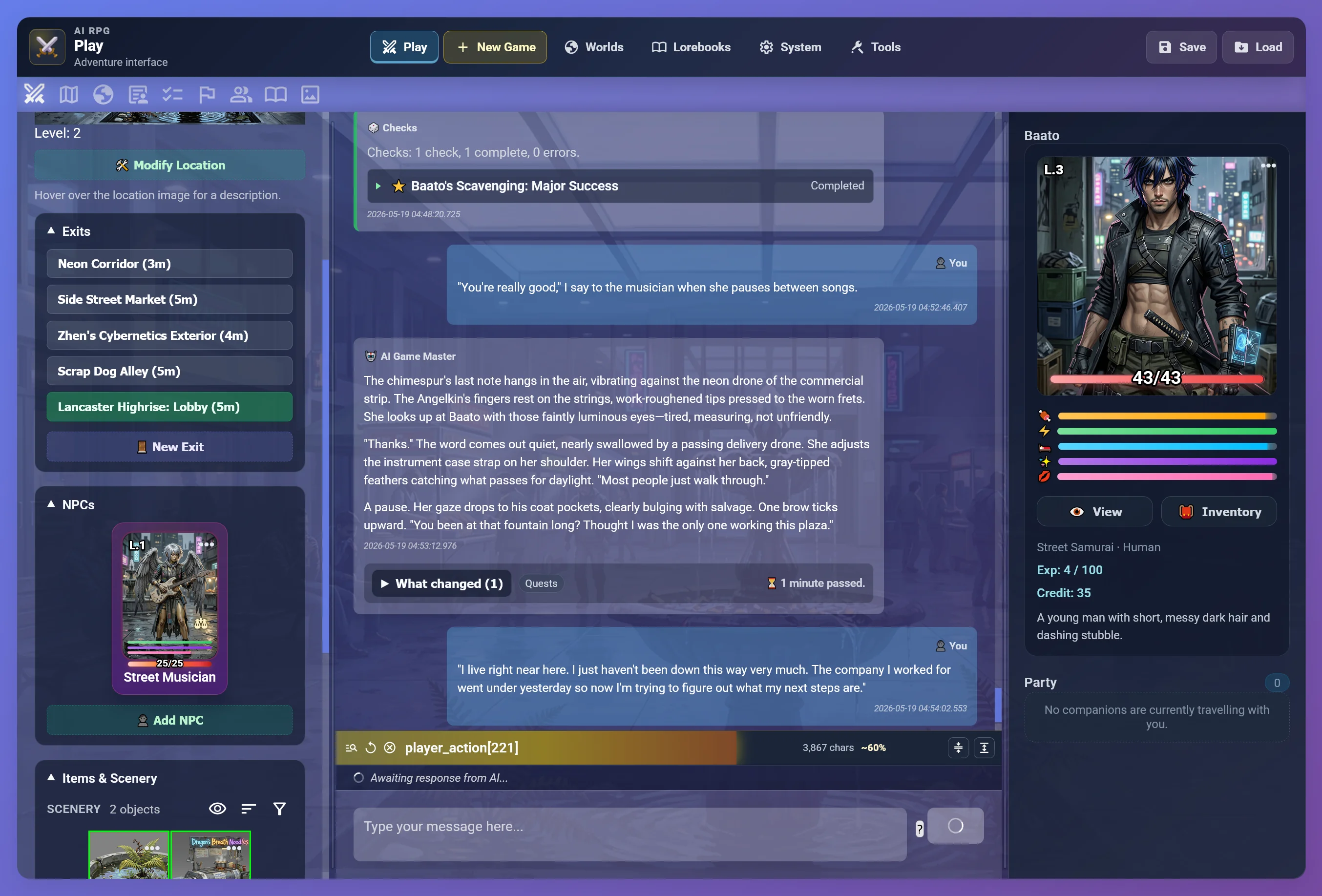
The example interface above shows what good XP design looks like in practice. The character is Level 3 with an XP bar at 4/100, which suggests a per-level reset rather than a cumulative total. A resolved "Major Success" check sits in the log. A "What changed" panel flags quest updates, and an in-game clock records that one minute passed. Each of these elements is something an AI game master has to track reliably, turn after turn.
The Problem: Why XP Breaks in AI-Run Games
AI in games is growing quickly. Research shows large language models now drive natural, context-sensitive NPC conversations, and AI is increasingly used to adjust difficulty and personalize gameplay.
**$4.4 billion** — [AI in gaming market size in 2025, projected to reach $51.3 billion by 2033 at a 36.1% CAGR](https://www.grandviewresearch.com/industry-analysis/ai-gaming-market-report)
355,000 XP — Total experience points required to reach level 20 under the D&D 2024 advancement table
That second number shows the scale of the bookkeeping. Classic D&D advancement requires 300 XP for level 2, 900 for level 3, and 2,700 for level 4. Each level-up then requires adjusting hit points, Hit Dice, class features, and proficiency bonus. Getting an AI to handle all of that consistently is often difficult:
- Ledger drift: Generic chatbots lose track of running XP totals after enough turns. Earned levels disappear, or unearned ones appear.
- Inconsistent awards: Without defined rules, the same goblin fight might be worth 50 XP one night and 500 the next.
- Rules hallucination: An AI GM juggling position, NPCs, and hidden information under a complex system starts making up rules when it lacks a clear answer.
- Narrative-only design: Some AI RPG platforms openly describe themselves as narrative-first rather than strict rules engines. That works for story, but it is frustrating if you care about numbers.
Players notice when progression feels arbitrary. Even in dedicated AI RPG titles, players dig into XP multiplier files to tune how fast they level. That is a clear sign XP pacing matters to them.
This is exactly what Roleplay Game Master was built for.
Why Roleplay Game Master Works for XP-Driven Campaigns
Roleplay Game Master is built around immersive roleplay with unlimited memory and character consistency. Those two traits are what a working XP system depends on. You define the progression rules once, such as a D&D-style table, milestones, or a custom curve. The AI game master then applies those rules throughout the campaign, keeping your total, your level, and the reasons behind each award in persistent memory.
| Traditional Approach | Roleplay Game Master |
|---|---|
| Human GM tracks XP on paper and must be scheduled | Available any time and remembers your XP between sessions |
| Generic chatbots forget totals after long chats | Unlimited memory keeps your ledger and character state intact |
| Rules vary from session to session | You set the XP rules once, and they are applied consistently |
| Level-ups require flipping through rulebooks | Guided level-up walkthroughs inside the story |
| Locked to one genre or rule system | Complete creative freedom, from fantasy to cyberpunk to homebrew |
Consistent XP Awards With Clear Reasons
You can ask the AI game master to state each award and its source in a short line after the scene, such as combat, objective completed, or clever roleplay. On the D&D Beyond forums, players note that XP is typically earned through combat and successfully resolving conflict. You can choose to follow that convention or reward exploration and social encounters too.
"Use the D&D 2024 XP table. After every encounter, show XP earned, the reason, and my running total in one line."
Milestone, Hybrid, or Pure XP
Not every table wants numbers. As one leveling guide puts it, milestone leveling strips away all numbers in favor of story beats. Some GMs combine the two with a hybrid milestone-plus-XP method. Roleplay Game Master can run any of these models. You simply describe the one you want.
"Run milestone leveling. I level up when I complete a major story arc, but secretly track XP so we can switch systems later."
Level-Ups That Update the Whole Character
Gaining a level involves more than a new number. You need to roll or take fixed hit points, add Hit Dice, record new class features, and adjust proficiency bonus. The AI game master can walk you through each step in order, then confirm your updated sheet before play resumes.
Recovery, Rest, and the Wider Mechanics Economy
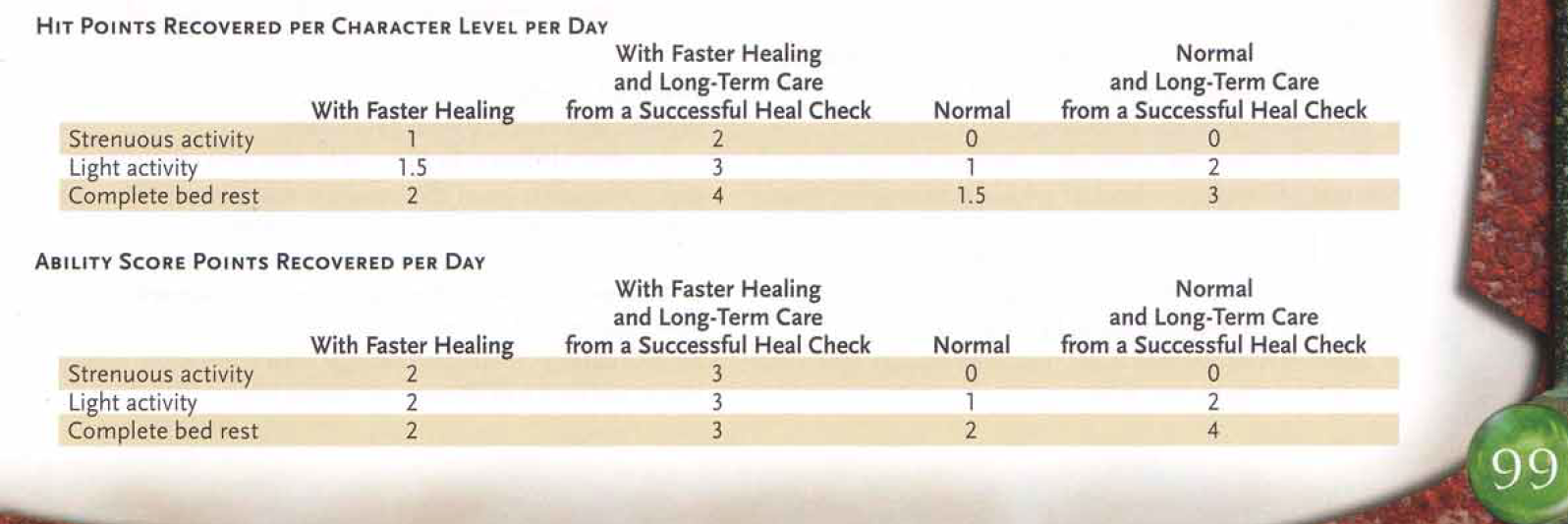
XP does not exist in isolation. Downtime and healing rules shape how quickly a character can return to earning it. In the recovery tables above, a character on complete bed rest normally recovers 1.5 hit points per character level per day. That rises to 4 with faster healing plus long-term care from a successful Heal check, while strenuous activity with normal healing recovers nothing.
Paste tables like these into your session setup, and the AI game master can factor rest days into your campaign clock. Advancement and recovery then follow the same rules.
Related Agents You'll Also Find Useful
Game Designer Assistant If you're designing your own XP curve or homebrew system, this agent can help you balance it before you play. It covers systems analysis and documentation across genres.
- Brainstorm and stress-test progression curves
- Document custom rules in a format you can paste into a session
- Generate concept art for your world
Creative Fiction Writer If you also want to turn your campaign into a written story, this agent helps you shape session logs into polished prose.
- Deep research for authentic worlds
- Editorial feedback on structure and pacing
- Full drafts from first chapter to final manuscript
One Among Us If you want a ready-made story instead of building your own, this detective mystery puts you at the center of a murder investigation where the killer is among the other characters.
- Self-contained narrative with high stakes
- Choices that drive the investigation
- Good for a one-session break from long campaigns
Try Roleplay Game Master free, with no credit card required.
How to Track Experience Points With an AI Game Master
Step 1: Choose Your Progression Model
Decide between pure XP, milestone leveling, or a hybrid. Pure XP suits combat-heavy dungeon crawls, while milestones suit story-driven campaigns.
"I want pure XP progression using the standard D&D 2024 advancement table."
Step 2: Set Up Your Ledger at the Start
Open the AI game master and give it your character, starting level, current XP, and award rules in one message. A precise setup prevents drift later.
"I'm Baato, a Level 3 Street Samurai with 900 XP. Award XP for combat, quest objectives, and creative solutions. Display totals after every scene."
Step 3: Play and Watch Awards Accumulate
Explore, fight, negotiate, and scavenge. After each encounter, the AI states what you earned and why, so your total stays easy to follow.
Step 4: Request Status Checks
Every few sessions, ask for a full character summary to confirm everything matches your expectations. This habit catches small errors early, which is good practice with any generative system.
"Status check: show my level, XP total, XP needed for next level, HP, inventory, and active quests."
Step 5: Level Up and Continue Later
When you cross a threshold, the AI walks you through the level-up. Close the session whenever you like. Your progress is still there when you return, on any device.
Results & Use Cases
📊 Long-Running Solo Cyberpunk Campaign
Scenario: A player runs a 40-session solo campaign in a neon megacity and wants to reach Level 10 through earned XP only.
Traditional Approach: Maintaining a spreadsheet alongside chat logs, and re-pasting the character sheet whenever a generic chatbot loses context.
Roleplay Game Master: XP, credits, gear, and NPC relationships persist across every session without re-pasting.
- No manual spreadsheets
- Consistent award values across months of play
- NPCs remember the character's past choices
📱 Mobile Sessions on the Commute
Scenario: A player squeezes in 15-minute adventure bursts on their phone during a daily train ride.
Traditional Approach: Short sessions rarely work with a human GM, and most chatbots lose state when you switch between devices.
The AI game master: Start a scene on iOS during the morning commute and finish the boss fight on desktop that night, with the XP ledger intact.
- Full feature parity across web, iOS, and Android
- Speech-to-text for hands-light play
- Quick status checks between stops
💼 Homebrew System Playtesting
Scenario: An indie designer wants to test whether their custom XP curve makes mid-levels feel too slow.
Traditional Approach: Recruiting playtesters and running weeks of sessions to collect pacing data.
Combined workflow: Draft and balance the curve with Game Designer Assistant, then run simulated sessions in the roleplay agent to see how quickly levels arrive in actual play.
- Faster iteration on progression pacing
- Clear XP logs to analyze afterward
- Quick rule changes between test runs
🎯 Switching From Milestones to XP Mid-Campaign
Scenario: A story-focused player using milestones decides they want granular XP after reaching Level 5.
Traditional Approach: Recalculating everything retroactively or starting over.
The AI-powered solution: If you asked the AI to track hidden XP from the start, switching systems only requires one message.
Frequently Asked Questions
How do experience points work in an AI RPG?
In an AI RPG, the AI game master awards experience points for actions like combat, quest completion, and creative problem-solving. It then adds them to a running total. When your total reaches a threshold defined by your chosen advancement table, you level up. The best results come from defining the rules explicitly at the start of a campaign, such as which table to use, what earns XP, and how often totals are displayed.
Is Roleplay Game Master free to use?
Yes. Roleplay Game Master is available on the free tier with all core features and limited usage. Paid plans start at $20/month for Plus, which provides 30× the usage and custom model selection. Higher tiers suit heavy campaign players. Usage resets monthly on your billing date with no daily caps, so long weekend sessions draw from your full monthly allowance.
Can an AI game master use D&D 5e experience point rules?
Yes, if you specify them. Paste or reference the advancement table, such as 300 XP for level 2, 900 for level 3, and so on, along with your award rules. Some experienced players recommend simplifying complex rule systems for AI play, because a simpler rule set keeps the game focused and reduces errors in edge cases.
Is milestone leveling or XP better for AI-run campaigns?
It depends on your play style. Pure XP rewards tactical, encounter-driven play and gives clear feedback after each scene. Milestone leveling suits narrative campaigns where story beats matter more than numbers. Many players use a hybrid, with milestones for major arcs and XP for side content. An AI game master can run any of these models consistently once you define the rules.
Can AI track experience points accurately over long campaigns?
AI with persistent, unlimited memory handles long campaigns far better than standard chatbots, which lose context over time. Even so, a periodic status check is good practice with any generative system. Asking for a full summary every few sessions confirms your level, XP, and inventory. If you're designing a custom system first, Game Designer Assistant can help you document rules clearly.
Conclusion
Experience points turn a story into a game. You can see progress, earned rewards, and a character who grows from apprentice adventurer to legend. AI RPG experience points only work when the system remembers your totals, applies rules consistently, and handles level-ups correctly. Generic chatbots tend to drift, and narrative-first platforms often ignore the numbers entirely.
A dedicated AI game master with persistent memory addresses both problems. You choose XP, milestones, or a hybrid, set the rules once, and spend your time playing instead of auditing your character sheet. That applies whether you're tracking AI-driven character progression in a solo fantasy crawl or a cyberpunk street saga.
Try Roleplay Game Master now. Explore more at Jenova.
For Developers: Roleplay Game Master is available programmatically through the Jenova API. You can add persistent AI game mastering with XP tracking to your application with a single API call. Full documentation →