AI RPG Encumbrance: Balance Slot & Weight-Based Inventory Rules
2026-10-22
Game Designer Assistant helps you design, balance, and rule on AI RPG encumbrance. It runs the carrying-capacity math, stress-tests real loadouts, and converts weight tables into slot or stone systems your table will actually use.
Most groups skip encumbrance because the bookkeeping slows play. This AI gives GMs, homebrewers, and indie developers a systems-design partner that checks every threshold before it reaches the table. As of October 2026, encumbrance is still one of the most debated subsystems in tabletop and video game RPGs, and one of the most fixable.
- ✅ Audits weight-, stone-, and slot-based encumbrance rules for D&D 5e, Pathfinder, OSR games, or homebrew
- ✅ Simulates starting kits by class so you know who is encumbered before session one
- ✅ Designs inventory limits for video game RPGs, including weight caps, grids, and slot progression
- ✅ Turns finished rules into one-page reference sheets and item slot tables
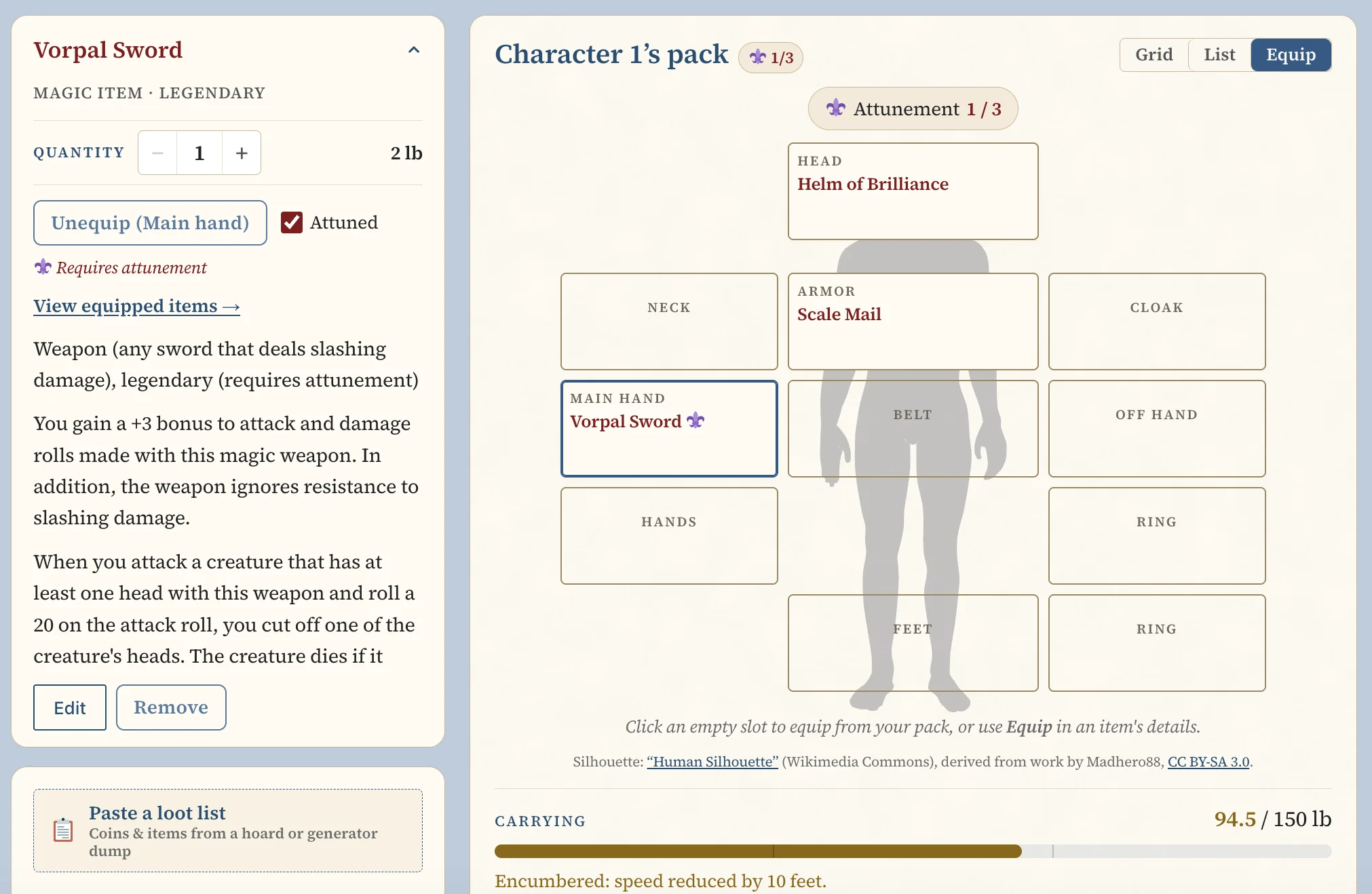
The screenshot above shows a well-built digital inventory manager. It tracks every pound, flags the penalty, and still leaves the GM with design questions. Is a 10-foot penalty the right consequence? Should armor count by weight or by bulk? What happens when the party loots a dragon hoard? To see why these questions matter, start with why encumbrance breaks down at so many tables.
Quick Answer: What Is AI RPG Encumbrance?
AI RPG encumbrance is the use of artificial intelligence to design, balance, and adjudicate carrying limits in role-playing games. It turns weight, slot, or stone rules into consistent movement penalties and meaningful inventory choices without hours of manual math.
Key capabilities:
- Threshold auditing: checks whether starting equipment pushes characters into penalties before any loot is found
- System conversion: translates pound-based rules into slots or stones, with a complete item cost table
- Edge-case rulings: handles bags of holding, mounts, hirelings, and backpack bonuses before they cause arguments
- Video game balancing: analyzes how weight caps and inventory grids affect pacing, looting, and player frustration
The Problem: Why Encumbrance Is the Rule Most Tables Ignore
Encumbrance is supposed to create choices. Do you carry more rope or more treasure? Do you take the heavy armor or the extra rations? As the designer behind the Homebrew Homunculus slot system argues, good mundane rules should be quick enough that players actually use them, which frees the GM to make rulings on more exciting things.
D&D 5e's numbers often work against that goal.
10 feet:
The same Homunculus analysis found that starting characters land at 140–190% of the light-encumbrance threshold under the Player's Handbook variant. Its slot-based alternative starts them at 40–70%. In other words, the printed rule can penalize a character before they find a single coin.
Fixing this is harder than it looks:
- The math is invisible until it hurts. Few GMs spreadsheet every class kit, so broken thresholds only surface mid-session.
- Tracking slows play. One GM asking for a simpler system put it plainly: "5e makes management take too long."
- Edge cases multiply. Players regularly debate when Handy Haversacks and Bags of Holding are appropriate, and each house ruling changes the balance.
- Alternatives conflict. Weight, stone, and slot systems all exist, but comparing their penalties by hand is tedious.
Video game RPGs face the same friction. When the team behind AI Game Master rebuilt its inventory, it wrote that "nobody wants to lose out on loot just because their bag is full". Its fix was to automatically send overflow items to the first party NPC with an empty slot. That is a design decision, not just a bookkeeping one.
For a sharp take on why the default 5e approach frustrates so many players, this breakdown is worth a watch:
https://www.youtube.com/watch?v=jFHP0aGcrYY
Encumbrance is a systems-design problem first and a tracking problem second. That is the kind of problem a dedicated AI design partner is built for.
Why Game Designer Assistant for AI RPG Encumbrance
Game Designer Assistant is a game design partner with deep expertise in systems analysis, documentation, and balance across genres and platforms. For encumbrance, that means you describe your rules, your party, and your goals, and it shows you where the system breaks and how to fix it.
You no longer have to guess whether a rule feels right. You can see the numbers for every character before anyone rolls a die.
| Traditional Approach | Game Designer Assistant |
|---|---|
| Spreadsheet every class kit by hand to find broken thresholds | Describe the rules and get a loadout-by-loadout analysis in one conversation |
| Ignore encumbrance because tracking pounds slows play | Convert weight into slots or stones with a ready-to-print item table |
| Improvise rulings on bags of holding, mounts, and loot hauls | Document edge-case rulings before the session starts |
| Playtest a video game inventory for weeks to find friction points | Get a rapid systems review of caps, penalties, and progression curves |
Audit Carrying Capacity Before It Breaks Your Game
Look back at the inventory manager screenshot. The character carries 94.5 of 150 lb and is already encumbered at −10 feet. That 150 lb cap matches the standard 5e capacity for Strength 10 (15 × Strength). Under the variant rule, Strength 10 also means encumbrance starts above 50 lb and heavy encumbrance starts above 100 lb.
So this character is only 5.5 lb away from the heavy tier, which brings a bigger speed loss and disadvantage on physical rolls. One looted shield or a few days of rations would push them over. That is exactly the kind of cliff the AI flags before it surprises a player.
Compare Weight, Stone, and Slot Systems Side by Side
Different encumbrance philosophies produce very different play experiences. Here is how four approaches treat the same Medium character with Strength 10:
| System | Unit | No penalty up to | First penalty | Heavy penalty | Hard cap |
|---|---|---|---|---|---|
| 5e PHB variant | Pounds | 50 lb | −10 ft speed | −20 ft speed, disadvantage on physical rolls (above 100 lb) | 150 lb |
| The Alexandrian "by stone" | Stones | 2 stones | −10 ft at 3+ stones | −20 ft, disadvantage on Str/Dex/Con at 6+ | 10 stones |
| Homebrew Homunculus slots | Slots | 20 slots | Speed becomes 20 ft | Speed 10 ft, disadvantage (31+) | Speed 0 at 41+ |
| Community slot sheet (below) | Slots | 16 slots | −5 ft, Dash gain halved | Half speed, disadvantage, no somatic spells (22+) | 26 slots |
Sources: The Alexandrian, Homebrew Homunculus, and the community sheet pictured below.
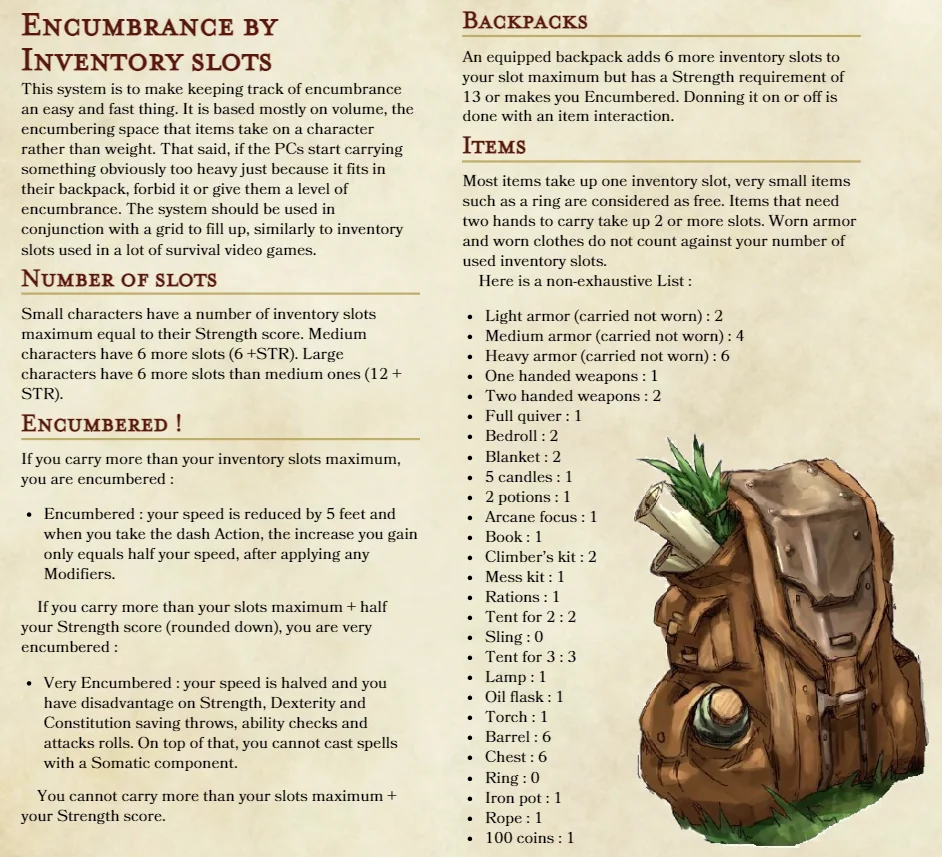
The community slot sheet above is a good example of a system that reads well but hides design trade-offs. A close look reveals three of them:
- The backpack trap. An equipped backpack adds 6 slots but requires Strength 13. Without it, the Strength 10 character gets 22 slots but becomes encumbered. Low-Strength characters face a built-in choice between capacity and speed. That may be intentional, but it should be a deliberate decision.
- A spellcaster penalty. "Very Encumbered" blocks spells with somatic components. Most other systems penalize movement and physical rolls, so this rule hits casters harder than martial characters.
- Free worn armor. Worn armor costs zero slots, while carried heavy armor costs 6. Encumbrance pressure shifts from armor to loot, rations, and camping gear.
The assistant surfaces trade-offs like these quickly, then helps you keep, adjust, or remove them on purpose.
Design Inventory Systems for Video Game RPGs
Studio developers already rely on AI for systems work. According to a Google Cloud survey of 615 developers conducted by The Harris Poll, 90% use generative AI in their workflows, and 95% use it to automate repetitive tasks. Inventory tuning is one of those repetitive tasks: choosing weight versus grid, overflow behavior, and when carrying-capacity upgrades unlock.
Player attitudes are a real constraint. Quantic Foundry reports that 85% of surveyed gamers feel below-neutral about generative AI in video games. Using AI for behind-the-scenes balance math, while the shipped game stays human-designed, avoids much of that concern.
Example Prompts
"Here are my 5e house rules for encumbrance. Simulate starting kits for a paladin, rogue, and wizard at Strength 8, 12, and 16, and tell me who starts encumbered."
"Convert the 5e equipment list into a slot system where a Medium character gets 6 + Strength slots. Give me a full item cost table and a one-page player reference."
"My survival RPG uses a 40 kg weight cap with a sprint penalty. Players report constant inventory frustration around hour three. Diagnose the likely causes and propose three fixes."
Related Agents You'll Also Find Useful
Encumbrance design rarely happens alone. These agents fit naturally alongside it.
Deep Research If you want to know how OSR games, Pathfinder, and indie RPGs handle carrying limits before choosing a direction, Deep Research searches hundreds of sources and delivers a cited report.
- Comprehensive surveys of rule variants across systems
- Rigorous inline citations you can check
- Actionable summaries for design decisions
Creative Fiction Writer If you're turning a campaign into prose or building a world where expedition logistics matter, this storytelling partner researches authentic details, such as what a caravan or pack mule can realistically haul.
- Deep research for authentic worldbuilding
- Expert editorial feedback on drafts
- Support from first draft to final manuscript
The Mansion If you'd rather experience exploration-driven play than design it, this ready-made mystery drops you into a mansion where every room hides secrets. It's a good reminder of how much item choices shape tension.
- Pre-built mystery scenario
- Exploration where every room holds secrets
- No campaign prep required
Try the design assistant free, no credit card required.
How to Build a Balanced Encumbrance System With AI
Step 1: Describe Your Current Rules and Pain Points
Open Game Designer Assistant and paste your encumbrance rules or attach a screenshot of your rules sheet. Name the specific problem, such as "nobody tracks it" or "fighters are always slowed."
"We use the 5e variant encumbrance rule, but my players stopped tracking weight after two sessions. Here's our party. What's going wrong?"
Step 2: Simulate Real Loadouts
Ask the AI to calculate where each character lands using their actual starting gear and Strength scores. You'll see who is penalized before any loot appears, which is the failure the Homunculus analysis identified.
"Calculate slot usage for each character's starting kit and show how far each one is from the first penalty."
Step 3: Choose or Convert a System
Compare weight, stone, and slot approaches against your group's priorities, whether that's speed of play, realism, or survival tension. Then have the AI build the full conversion, including item costs and thresholds.
"Convert our game to a slot system that feels like survival horror but never takes more than 30 seconds to check."
Step 4: Stress-Test the Edge Cases
Have the AI run a dragon-hoard haul, a party with a pack mule, and a low-Strength wizard carrying a backpack. Settle the rulings now so they don't become arguments mid-session.
"Run three stress tests: a 5,000-coin treasure haul, a Bag of Holding, and a Strength 8 wizard with a backpack. Propose a ruling for each."
Step 5: Export a One-Page Reference
Finish with a printable cheat sheet: thresholds, penalties, an item cost table, and your edge-case rulings. Players who can check the rules at a glance are much more likely to keep tracking.
"Format the final system as a one-page player reference with an item slot table."
Results & Use Cases
📊 Rescuing the Variant Rule at a 5e Table
Scenario: A GM wants encumbrance to matter, but the paladin starts slowed and the wizard never notices the rules.
Traditional Approach: Hours of spreadsheet work, or quietly dropping the rule.
With the AI design assistant: A loadout simulation shows the imbalance in minutes. The GM then adopts a slot conversion that keeps loot decisions meaningful without punishing heavy-armor classes before play begins.
- Thresholds checked against every class kit
- Rules the whole table understands
- Clear documentation for new players
💼 Balancing an Indie RPG's Weight-Limit Inventory
Scenario: A solo developer's playtesters complain that inventory management feels like a chore halfway through the game.
Traditional Approach: Repeated playtest builds, guessing at which number to change.
With the AI design assistant: A systems review compares raising the cap, adding overflow storage similar to AI Game Master's NPC overflow, and introducing mid-game capacity upgrades. Each option comes with expected pacing effects.
- Concrete tuning options instead of guesswork
- Design reasoning ready to drop into a design doc
- Faster iteration between builds
📱 Ruling on a Loot Haul From Your Phone
Scenario: Mid-session, the party finds a hoard and asks whether they can carry it all out.
Traditional Approach: Stopping the game to page through the rulebook, or a rushed ruling that sets a bad precedent.
With the AI design assistant on mobile: The GM types the party's Strength scores and the hoard contents into the app. In seconds they get slot counts, who becomes encumbered, and options like hiring porters or making a second trip.
- Fast rulings without breaking immersion
- Consistent with your documented house rules
- Full feature parity on iOS and Android
🎯 Building Tension in a Survival Campaign
Scenario: A GM running a frozen-wilderness campaign wants every torch and ration to feel precious.
Traditional Approach: Vague "you can't carry that much" calls that feel arbitrary.
With the AI design assistant: A tight slot system adds cold-weather gear costs, so players must trade firewood against treasure. The constraint drives the story instead of slowing it down.
- Scarcity enforced through clear rules
- Meaningful packing decisions every expedition
- Encumbrance that supports the genre's tone
Frequently Asked Questions About AI RPG Encumbrance
What is the easiest encumbrance system for D&D 5e?
Slot-based systems are usually the easiest, because each item counts as one slot instead of a precise weight. The Homebrew Homunculus variant gives 10 + Strength slots before any penalty, and The Alexandrian's stone system groups items into bundles. To compare more variants before choosing, Deep Research can compile a cited survey of the options.
Can an AI game master track encumbrance during a campaign?
Yes, with caveats. AI tools can track inventory, apply penalties, and rule on edge cases, and some AI RPG apps now automate overflow, such as moving extra loot to party NPCs. For long campaigns, pair the AI with a dedicated tracker or character sheet for running totals. AI is strongest at designing and adjudicating rules, so double-check its arithmetic when exact totals matter.
Can AI help balance inventory systems in video game RPGs?
Yes. AI is well suited to analyzing weight caps, grid inventories, overflow behavior, and capacity progression. A Google Cloud survey found that 90% of game developers already use generative AI in their workflows, and 44% use it for code generation and scripting. Encumbrance tuning is systems math that benefits directly from rapid iteration.
Is AI encumbrance design free to try?
Yes. Jenova offers a free tier with all core features and limited usage, with no credit card required. Paid plans start at $20/month (Plus) for 30× the free usage plus custom model selection. Higher tiers are available for heavy use, and usage resets monthly with no daily caps.
Does AI encumbrance work for systems other than D&D?
Yes. Encumbrance is a universal design problem, so the same analysis applies to Pathfinder, OSR games, survival RPGs, and fully homebrew systems. Describe your system's carrying rules, and the AI audits thresholds, converts units, and drafts edge-case rulings for that ruleset rather than forcing a D&D framework onto it.
Conclusion
Encumbrance fails at most tables for one reason: the rules are rarely tested against real characters. The result is paladins slowed before session one, wizards who never notice the rules, and loot hauls settled by improvised rulings. AI RPG encumbrance tools change that by making the math visible. You can audit thresholds, compare weight, stone, and slot systems, and document edge cases before they become arguments.
Whether you're rescuing 5e's variant rule, building a survival-horror slot system, or tuning a video game inventory, try Game Designer Assistant now and design carrying rules your players will actually track. Explore more at Jenova.
For Developers: Game Designer Assistant is available programmatically via the Jenova API, so you can integrate encumbrance analysis and systems balancing into your game tools with a single API call. Full documentation →