AI RPG Combat Rules: Initiative, Attacks & Damage Run by an AI GM
2026-10-22
Roleplay Game Master helps you run AI RPG combat rules, including initiative, attack rolls, saving throws, damage, and resource tracking, without stalling the story. As of October 2026, tabletop players have more systems and editions to choose from than ever. Someone still has to hold the turn order, remember the goblin's hit points, and decide what a failed save means for the scene.
This AI game master keeps optional live mechanics such as HP, spell slots, gold, and ammo in sync with the fiction. Fights carry real consequences instead of drifting into improvised hand-waving.
- ✅ Tracks HP, spell slots, gold, and ammo when you want mechanics to constrain the story
- ✅ Keeps every enemy's role, disposition, status, and location consistent across sessions
- ✅ Leaves your character's choices to you: you declare actions, and the world reacts
- ✅ Runs with full feature parity on web, iOS, and Android
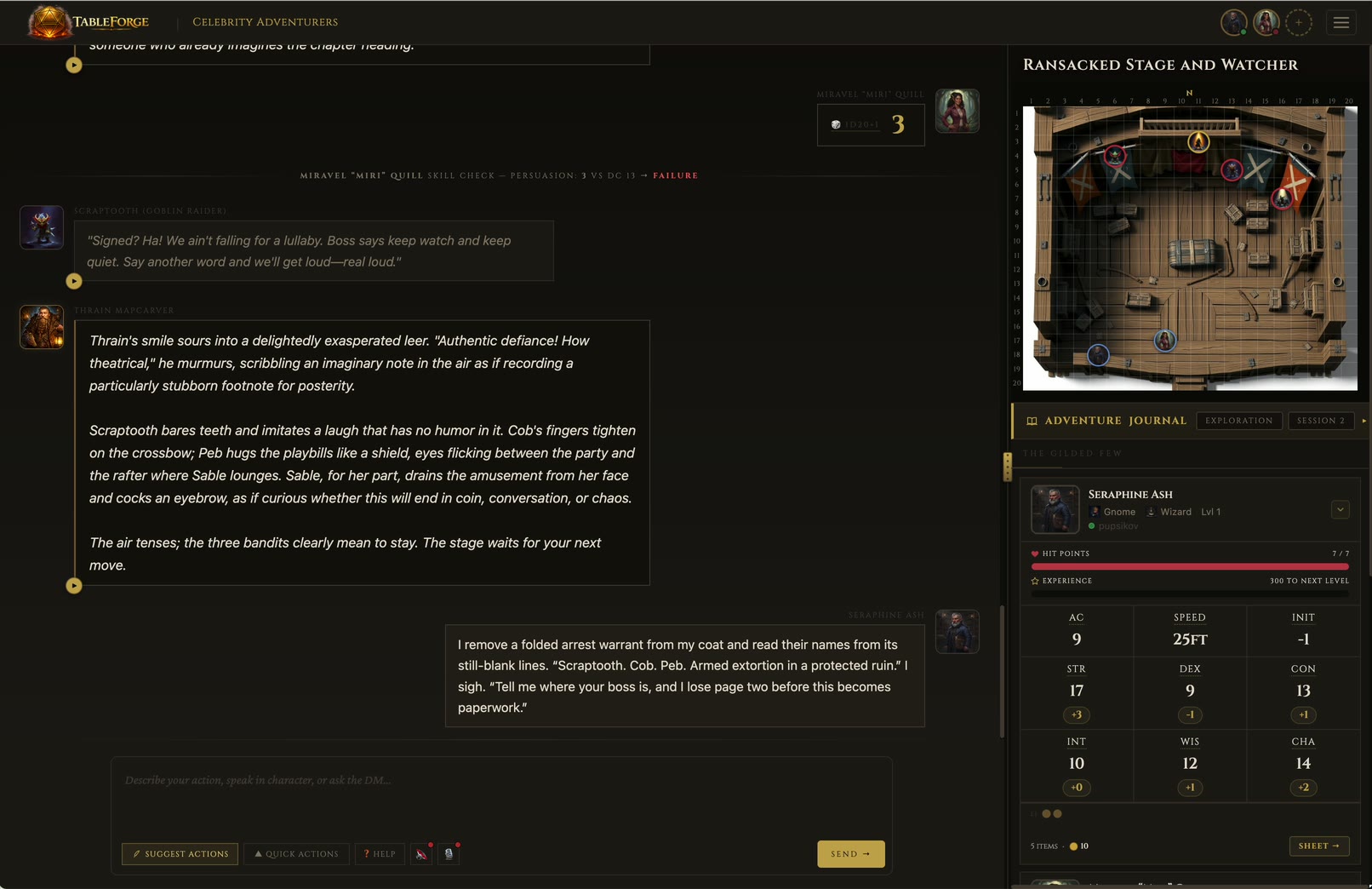
A failed Persuasion check (a total of 3 against DC 13) turns a negotiation into a standoff. Combat rules take over from moments like this.
Combat is where most AI-run campaigns fall apart. Narration is easy for a language model. Bookkeeping is the hard part. Before looking at how an AI GM handles it, it helps to see why combat rules strain both human game masters and generic chatbots.
Quick Answer: What Is Roleplay Game Master for AI RPG Combat?
Roleplay Game Master is an AI game master that narrates RPG combat and story scenes while tracking HP, spell slots, and ammo. It keeps enemies and consequences consistent from the first round through later sessions.
Key capabilities:
- Optional Live Mechanics for HP, gold, spell slots, ammo, and similar resources
- An NPC registry that keeps hostile enemies hostile and dead enemies dead
- Separate GM Mode for house rules and encounter design, and Roleplay Mode for in-character play
- Adjustable difficulty, with real failure, injury, and setbacks when you want stakes
Why RPG Combat Rules Break Down at the Table
Tabletop roleplaying keeps growing, and its audience is mostly adults with limited free time. Industry trackers put the market in the billions, and community surveys show play rose sharply after the pandemic.
USD 2.31 billion: Global tabletop role-playing game market value in 2025
36.5%: Share of survey respondents playing more board or tabletop games than before pandemic lockdowns
64.0%: Share of tabletop RPG spending attributed to adults in 2025
Combat is also the most rules-dense part of any session. In the current D&D ruleset, the game organizes combat into a cycle of rounds and turns. Each turn involves movement, actions, bonus actions, and reactions, and even small details are regulated. For example, object interactions are limited to one free interaction per turn during combat.
Running all of this consistently is hard:
- Prep burden. As Hidden Door's CEO told CNET, it takes a lot of work to run a good game, and whoever takes the GM role "has to do a lot of prep."
- No available GM. Projects like RPG Research's AI GM exist specifically for players who can't find a human game master.
- Chatbots that write scenes but can't run campaigns. Solo players report searching for .
- Edition drift. Community members have compiled covering skills, healing, and spells. Tables mixing old and new rules argue mid-fight.
For a visual breakdown of what you can do on a combat turn, this walkthrough of the current Player's Handbook is a solid reference:
https://www.youtube.com/watch?v=bKPFFJnYnto
Roleplay Game Master was built for exactly this problem.
Why Roleplay Game Master Works for AI RPG Combat Rules
Roleplay Game Master treats combat as part of the story, with mechanical state attached. When you want numbers to matter, it records them. When an enemy is wounded, frightened, or dead, that fact stays true in later scenes. You always decide what your character does.
| Traditional Approach | Roleplay Game Master |
|---|---|
| A human GM spends hours prepping encounters | Co-design encounters, tone, and house rules in GM Mode before play |
| Generic chatbots forget enemy HP and resources mid-fight | Live Mechanics keep HP, spell slots, gold, and ammo in view |
| Chatbots narrate your attack and decide your next move | You declare actions; the agent narrates consequences and stops at the next decision |
| Enemy attitudes shift randomly between sessions | NPC registry locks each enemy's disposition, status, and location |
| One model handles both rules planning and battle prose | Planning and combat narration can be routed across different models |
The d20 Math Behind Every Fight
Every combat rule in a d20 system traces back to one character sheet stat: the ability modifier. The official basic rules build skill checks, saving throws, attack rolls, and spellcasting on top of it. The diagram below maps how those pieces connect.
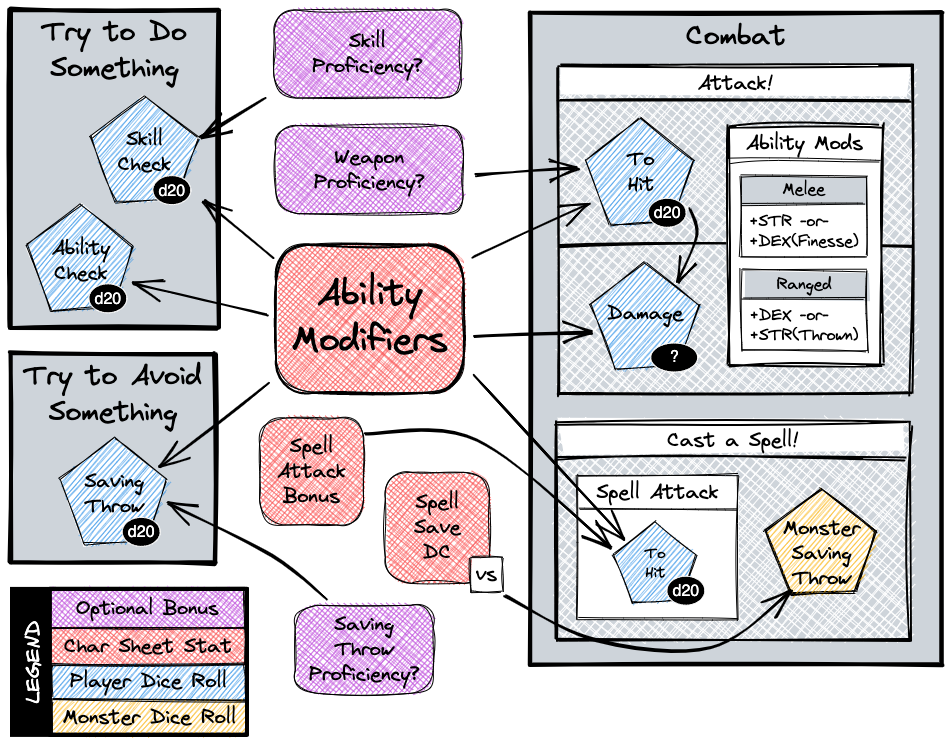
The modifier formula is simple:
The level 1 gnome wizard in the screenshot above shows why this matters. Her stats are STR 17, DEX 9, INT 10, and CHA 14, which give modifiers of +3, −1, +0, and +2. Her −1 initiative and AC 9 (an unarmored 10 plus her Dexterity modifier) both follow directly from that DEX 9.
With a +2 proficiency bonus at level 1, the math gives a counterintuitive result:
- Melee weapon attack:
- Spell attack:
- Spell save DC: $8 + 2 + 0 = 10$
This wizard hits harder and more often with a quarterstaff than with her spells. Her failed Persuasion check also makes sense: with a +2 Charisma modifier, a total of 3 means the die most likely showed a 1.
An AI GM that understands this math can explain outcomes instead of hand-waving them. That makes it a useful teaching partner for newer players. Try prompts like these:
"GM: Explain why my wizard's spell save DC is only 10, and what that means against these bandits."
"GM: Walk me through initiative order for this fight using my Dex modifier of −1."
Live Mechanics That Constrain the Fiction
Roleplay Game Master can track HP, gold, spell slots, ammo, and similar resources. If you burn your last spell slot in round two, round four reflects it. If you already track stats in another app or on paper, the agent won't duplicate them, and it never invents a hidden character sheet you didn't ask for.
Enemies That Stay Who They Are
Each named NPC keeps a role, faction, disposition (Friendly, Neutral, Wary, Hostile, or Complex), status, and last known location. A bandit leader who fled at 3 HP stays wounded and resentful when you meet him again. He doesn't return at full health with no memory of the fight.
Stakes You Can Tune
Failure, injury, betrayal, and setbacks are available when you want real danger. If a fight feels too punishing or too easy, you can recalibrate difficulty in GM Mode without breaking the campaign.
"GM: Make combat more lethal. Enemies should focus on wounded characters and retreat when bloodied."
Related Agents You'll Also Find Useful
If you're building your own combat system or fleshing out a campaign around your fights, these agents fit naturally into the same workflow.
Game Designer Assistant If you're homebrewing combat mechanics, this agent helps with systems analysis and design documentation before you test the rules in play.
- Brainstorming and stress-testing custom mechanics
- Systems analysis across genres and platforms
- Documentation and concept art for your game
Name Generator Every bandit crew needs a Scraptooth. This agent creates character, faction, and location names with real cultural and linguistic fluency.
- Names for characters, factions, and places
- Deep cultural and linguistic expertise
- Strategic naming that fits your setting's tone
Creative Fiction Writer If you want to turn a memorable campaign battle into polished prose, this storytelling partner takes you from first draft to final manuscript.
- Original fiction across any genre
- Research for authentic worlds
- Editorial feedback on your drafts
You can try Roleplay Game Master free and run your first encounter today.
How to Run AI RPG Combat With Roleplay Game Master
Step 1: Set Up Your Campaign in GM Mode
Start Roleplay Game Master and describe your setting, tone, and preferred ruleset. GM Mode is out-of-character planning, so this is where you settle rules questions before the first initiative roll.
"Let's run a low-level fantasy campaign using current D&D-style combat. I'm a level 1 gnome wizard. Keep combat gritty but fair."
Step 2: Lock In House Rules
Add standing combat rules to Custom Instructions so they apply every session instead of fading after one reminder. Examples include "critical hits maximize the first damage die" or "my character never kills."
"House rule: enemies always flee at one-quarter HP unless they're undead."
Step 3: Choose Which Mechanics to Track
Tell the agent which resources should constrain the story. Most players start with HP and spell slots, then add ammo or gold for longer campaigns.
"Track my HP, spell slots, and the bandits' HP during fights."
Step 4: Play the Fight in Roleplay Mode
Declare your actions in character and report your rolls. The agent narrates hits, misses, and enemy responses, then stops when it's your turn to decide. It won't make your choices for you.
"I raise my quarterstaff and strike at Scraptooth. I rolled a 14 plus 5, so 19 to hit."
Step 5: Recalibrate Between Encounters
After the fight, switch back to GM Mode by starting your message with "GM:" to adjust difficulty, review what happened, or get a recap.
"GM: That fight was too easy. Scale the next encounter up for a level 1 party."
Results & Use Cases
⚔️ Solo Dungeon Crawl Without a Table
Scenario: A player wants a weekly dungeon crawl, but their group's schedules never line up.
Traditional Approach: Wait weeks for a session, or juggle solo-play oracle tables and track every enemy manually.
Roleplay Game Master: Runs the dungeon, plays every monster, and keeps HP and resources consistent between sittings.
- Enemy status and locations persist across sessions
- Real setbacks and injuries when you want danger
- No human GM required
🧮 Teaching a New Player the d20 Math
Scenario: A newcomer can't figure out why their wizard keeps missing with spells.
Traditional Approach: Read rulebook chapters on proficiency, ability modifiers, and spellcasting, then cross-reference a character sheet.
Roleplay Game Master: In GM Mode, it explains each number using the player's own sheet, connecting ability scores to attack bonuses and save DCs as in the flowchart above.
- Explanations based on the player's own sheet, not abstract examples
- Rules questions handled out of character so they don't interrupt the scene
- Builds confidence before joining a human-run table
📱 Finishing a Boss Fight on Your Phone
Scenario: A player starts a climactic battle on their laptop and has to leave mid-fight.
Traditional Approach: Write down initiative order and HP totals and hope nothing gets lost.
Roleplay Game Master: Settings and campaign context sync across web, iOS, and Android, so the fight picks up on mobile exactly where it stopped.
- Tracked resources carry over between devices
- Full feature parity on mobile
- Short turns fit into a commute
🛠️ Stress-Testing a Homebrew Combat System
Scenario: An indie designer is building a custom stamina-based combat system.
Traditional Approach: Recruit playtesters, schedule sessions, and collect scattered feedback.
Outcome: The designer drafts the mechanics with Game Designer Assistant, then loads them as house rules and plays sample fights with Roleplay Game Master to find broken edge cases.
- Faster iteration on balance problems
- Rules tested in actual play, not just on paper
- Fewer playtest sessions needed before involving humans
Frequently Asked Questions
Can AI run tabletop RPG combat rules accurately?
AI handles narration and bookkeeping well, but critics note that no algorithm reads the room the way a human GM does. The most reliable approach is to make the AI's mechanical state explicit: track HP and resources, set house rules up front, and correct mistakes in an out-of-character planning mode. Your own view of the campaign should always be treated as ground truth.
Is Roleplay Game Master free to use?
Yes. Roleplay Game Master has a free tier with access to all core features and limited usage. Paid plans start at $20 per month for Plus, which offers 30× more usage and custom model selection, and scale up to Enterprise. All plans are billed monthly with no daily caps, so your full quota is available from the first day of each billing cycle.
Does an AI game master roll the dice for combat?
Many players prefer to roll physical or app-based dice and report their totals, which keeps randomness transparent and in the player's hands. The AI GM then resolves the result against the target's defenses, narrates the hit or miss, and updates tracked resources such as HP and spell slots. Agree on your dice approach during setup so every encounter uses the same method.
How is an AI GM different from using ChatGPT for RPG combat?
General chatbots often forget enemy HP, revive dead NPCs, or narrate your character's actions for you. Roleplay Game Master keeps campaign-specific state, including an NPC registry, story arcs, known locations, and optional live mechanics. It also never takes control of your character. It can switch between models from multiple providers, so rules planning and combat narration can each use a model suited to the job.
Can I use homebrew combat rules with an AI GM?
Yes. Put standing combat rules in Custom Instructions so they persist across sessions, and adjust them anytime in GM Mode. If you're designing a full custom system, draft and analyze it first with Game Designer Assistant, then playtest it in live encounters. For writing up your best battles afterward, Creative Fiction Writer can turn session notes into polished prose.
Conclusion
Combat is where tabletop RPGs ask the most of whoever runs the game: turn order, ability modifiers, attack bonuses, save DCs, and dozens of small rules that must stay consistent from round one to the final blow. Human GMs burn out on the prep, and generic chatbots lose track of the numbers.
An AI game master that tracks live mechanics, keeps enemies consistent, and leaves every decision to the player makes AI RPG combat rules workable, whether you're running a solo dungeon crawl, learning d20 math, or playtesting a homebrew system.
Try Roleplay Game Master for your next encounter. Explore more at Jenova.
For Developers: Roleplay Game Master is available programmatically via the Jenova API. Integrate AI-run campaign narration and combat state tracking into your game or app with a single API call. Full documentation →