AI RPG Character Build Planner: Class, Stats & Progression
2026-09-05
An RPG character build planner helps you lock class, ability scores, gear, and a level path before the first roll — so a dwarf fighter’s Strength 16 and a caster’s spell list actually fit the table. In September 2026, that work no longer has to live across a rulebook, a spreadsheet, and a half-written backstory. Jenova turns a character concept into a playable build by combining game systems, personality, story, and live-game meta in one workspace. You leave with numbers that match the campaign, a party role that does not collide with three other strikers, and a path you can still follow at level 12.
✅ Ability scores, class features, and gear that match the campaign theme ✅ Party-aware kits so five damage dealers do not walk into session zero ✅ Homebrew attributes and live-game RPG kits, not only the six D&D stats ✅ Persistent memory so the level 5 plan still holds when you hit 12
To understand why this matters, it helps to look at how character builds actually fail — at the table, in homebrew systems, and in live-game meta.
Quick Answer: What Is an RPG Character Build Planner?
An RPG character build planner is an AI workflow that maps class, stats, gear, and level path so a character is playable, party-fit, and campaign-ready before session zero. It is the mechanical contract between player, table, and story.
Key capabilities:
- Ability-score arrays, saving throws, and class features via Game Designer Assistant
- Party-role checks and progression charts that survive more than one level
- Live-game kits through Genshin Meta Analyst and Honkai Star Rail Meta Analyst
- Personality, motivation, and a short backstory that actually explains the numbers
Why RPG Character Builds Stall Before Session One
Character creation looks simple until it has to survive a campaign. Sly Flourish’s player-facing advice is blunt: build around the theme of the adventure and the group, not a class fantasy in isolation. Skip that, and the table spends session one retconning why the bookish noble is crawling a dungeon with three strangers.
Volume does not equal a good plan. D&D Beyond’s 2023 character-creation data showed Human as the most-created species at just over 700,000 entries, Elf next at about 500,000, and Fighter leading classes at roughly 350,000. The most common character on that platform was, in fact, Bob the Human Fighter. Popularity is not a build plan. It is a default.
~700,000 — Human characters at the top of D&D Beyond’s 2023 species chart
~350,000 — Fighter characters leading D&D Beyond’s 2023 class chart
Campaign organizers know the other half of the problem. Session zero exists to align vision, characters, and boundaries before anyone writes a number in ink. When that conversation is skipped, four people show up as stealth specialists and nobody can take a hit.
But turning a concept into a coherent build is still frustratingly difficult:
- Stats land in the wrong column for the fantasy you described
- The party has no support, no skills coverage, or four people sharing one niche
- Optimization blogs collide with a DM who wanted a story, not a spike
- Homebrew systems use Mighty / Deft / Smart — and your D&D spreadsheet does not
- Video-game kits (artifacts, light cones, teams) live in a different brain than the tabletop sheet
Ability Scores That Fight the Concept
Beginner guides still teach a sound rule: put the highest number in the class’s main stat — Strength for a Fighter, Charisma for a Sorcerer. Players break that rule constantly. They dump Intelligence on a character whose backstory is “the clever one,” or they spread points evenly until nothing is good. Designers who start character creation with core stats and skills know those numbers are not flavor. They are the verbs the character can actually use.
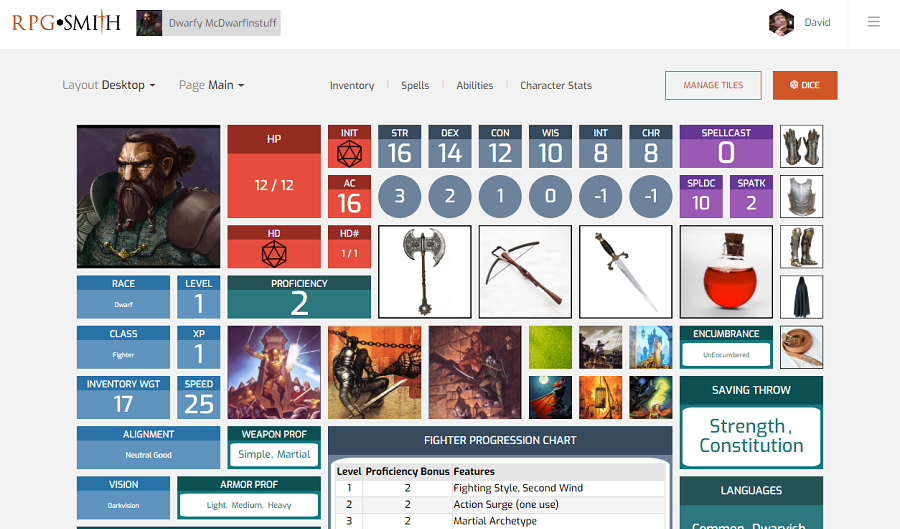
A level 1 dwarf fighter with Strength 16, Dexterity 14, Constitution 12, and Intelligence 8 is a readable kit: greataxe, AC 16, Second Wind, simple and martial weapons. That kit fails if the campaign is court intrigue and the player wanted a diplomat who happens to wear plate.
Party Composition Nobody Checked
Sly Flourish asks a mechanical question most builders skip: which abilities help the other characters? Building a huge damage spike is fun. So is making the rest of the table better. Tables that never compare sheets end up with five strikers, no one who can pick a lock, and a boss fight the DM cannot pace.
The same hole shows up in live-game RPGs. A Genshin account with three main DPS and no battery, or a Star Rail team with no sustain, is the same mistake with different icons.
Optimization That Steals the Table’s Fun
Practical optimization means using the written rules to make a character more effective — not breaking the scenario. Sly Flourish warns against kits designed to cage the boss or auto-win every check. Players who plan 20 levels of multiclass combos before session zero often discover the campaign is a ten-session mystery. The plan was never the problem. The plan was written for a different game.
Homebrew Math With No Translator
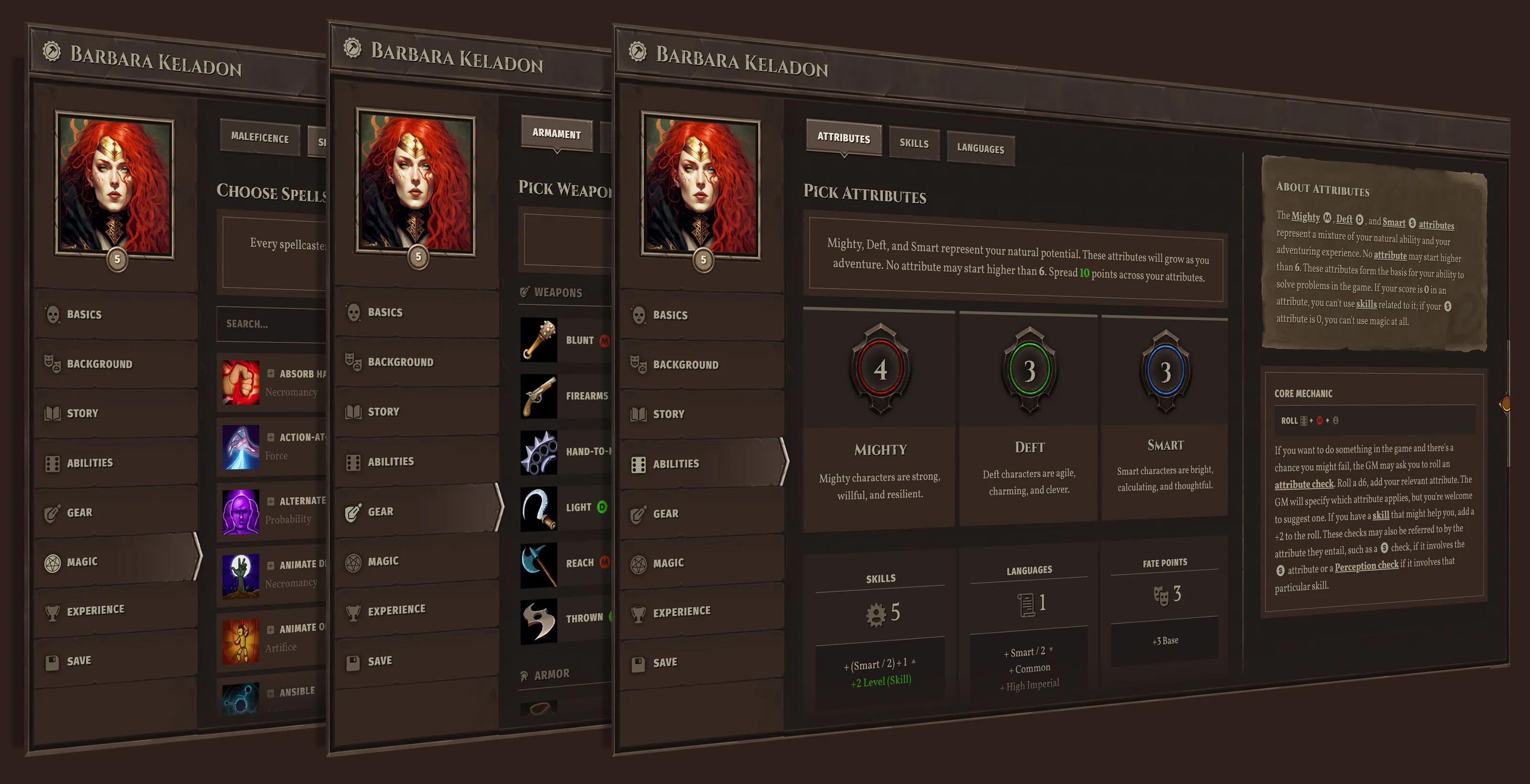
Not every table uses six abilities, proficiency bonuses, and a fighter progression chart. Plenty of systems split the body into Mighty, Deft, and Smart, then ask you to spend a small pool across attributes, skills, languages, and fate points. Spell lists, weapon families (blunt, firearms, reach), and armor are separate screens. A D&D-only companion cannot tell you whether Mighty 4 / Deft 3 / Smart 3 is a bruiser, a duelist, or a misfit until someone who knows that system reads the sheet.
Two Hobbies, Two Build Languages
The same player often runs a tabletop fighter on Friday and a Genshin or Star Rail main on Sunday. Tabletop cares about fighting style, armor proficiency, encumbrance, and saving throws. Live-game RPGs care about weapon type, artifact sets, light cones, team buffs, and the current patch. Guides live on different sites. None of them remember that both characters are your characters, or that the dwarf’s grim personality is the same fantasy you wanted on the gacha account.
This is exactly what Jenova was built for.
The Jenova Solution
Jenova is not a fifth-edition sheet with extra fields. It is a workspace of specialist agents that cover the full build: rules, party fit, personality, story, and live-game meta. You describe the table, the fantasy, and the constraints once. Persistent memory keeps the array, the feat path, and the “why they travel with these people” note attached to the next question. Multi-model access lets you pick the reasoning style you want without juggling accounts.
While D&D Beyond remains a strong official companion for fifth-edition sheets, Jenova is built for the planning layer across systems — homebrew attribute arrays, video-game kits, and the story that has to justify the numbers.
| Traditional Approach | Jenova |
|---|---|
| PHB + spreadsheet + Discord arguments | Systems, story, and meta in one thread |
| Official tools locked to one edition | Tabletop, homebrew, and live-game RPG builds |
| A five-page backstory and empty feat slots | Short biography plus a real level path |
| Rebuild from scratch at every level | Memory of the plan you already locked |
| One optimizer blog per game | Specialist agents per domain |
Tabletop Rules, Homebrew Kits, and the Math
Game Designer Assistant treats the sheet as a system, not a vibe. Ask it to assign a standard array, flag dumped stats that contradict the concept, and list what Fighting Style, Second Wind, and armor proficiency actually do at level 1. Hand it a homebrew screen — Mighty, Deft, Smart, a ten-point spread, skills and fate points — and it will translate the same fantasy into that math.
Pair it with Deep Research when you need a feat, spell, or errata trail with sources instead of table folklore.
"Build a level 1 dwarf fighter, Neutral Good, standard array emphasizing Strength and Constitution. Fighting Style and Second Wind. Simple and martial weapons, light through heavy armor. Darkvision, Common and Dwarvish. Tell me what this kit cannot do in a social campaign."
Personality That Earns the Numbers
A build without a person is a damage formula. Personality Analyzer and MBTI Personality Guide turn “ Neutral Good dwarf who hits things” into traits the table can play: what they protect, what they will not say, how they fail under pressure. Machiavelli Mentor is the right specialist when the character is a court operator, a faction lieutenant, or anyone whose “build” is leverage rather than a greataxe.
Character-creation advice that lasts still starts with motivation, a secret, and a voice — not a feat chain.
Story Short Enough for Session Zero
Sly Flourish’s rule of thumb is one to five sentences, not one to five pages, and it is allowed to stay unfinished until you have actually played. Film Screenwriter writes that digestible hook: why this person leaves home, why they stay with the party, what will hurt if the campaign theme is loss or duty. Microdrama Screenwriter is useful when you need the same character to carry a long, episodic arc without dumping a novel on the DM.
Campaign planners treat the first session as a pilot — tone, party chemistry, whether the joke-heavy table actually wanted grimdark. A short, playable bio is what makes that pilot possible.
Live-Game RPG Builds on the Same Desk
Genshin Meta Analyst plans pulls, team cores, and artifact priorities against your roster and the current Abyss. Honkai Star Rail Meta Analyst does the same for light cones, relics, and endgame comps. Both are build planners in the sense players actually search for: not a blank sheet, a kit that works in this patch, on this account.
The point is not that a dwarf fighter and a limited five-star share rules. The point is that the same person should not have to re-explain their goals every time they switch games.
A Face That Matches the Kit
When the table wants a portrait or a reference for VTT tokens, Manga Creator and Comic Creator hold silhouette, armor, and weapon scale so the greataxe on the sheet is the greataxe in the art. That is optional. The build still stands without it. When you do want it, you do not start a second tool chain.
Specialized AI Agents for Character Builds
If you are locking a character this week, these are the agents most players and GMs reach for first.
Game Designer Assistant
Game Designer Assistant is the rules brain of the plan. It reads class fantasy against the actual verbs on the sheet: attack bonus, armor, encumbrance, spell slots, or a custom three-stat spread.
- Standard-array and point-buy recommendations tied to role
- Feature timing (what you get at 1 vs what you only get at 5)
- Homebrew translation when the system is not D&D
Genshin Meta Analyst
Genshin Meta Analyst is the planner for Teyvat mains: who to pull, which weapon ranks matter, which teammate actually batteries the carry.
- Account-aware team cores
- Artifact and talent priority
- Abyss and patch context instead of generic tier lists
Honkai Star Rail Meta Analyst
Honkai Star Rail Meta Analyst maps traces, relics, light cones, and sustain vs. hypercarry choices to the content you actually run.
- Pull verdicts against your current roster
- Endgame comps with a real sustain plan
- Build paths that do not assume unlimited resources
Personality Analyzer and MBTI Personality Guide
Personality Analyzer and MBTI Personality Guide stop “chaotic funny” from being the entire character. You get a playable temperament, stress behavior, and how this person sits next to a paladin or a trickster.
- Alignment that matches deeds, not a label
- Conflict hooks the GM can use without a ten-page lore dump
- Voice notes you can keep on a phone at the table
Machiavelli Mentor
Machiavelli Mentor plans the political build: who you owe, what you can threaten, which faction gift is actually a leash. Use it when the campaign is intrigue and Charisma is not a dump stat in disguise.
Film Screenwriter and Deep Research
Film Screenwriter writes the one-paragraph origin. Deep Research pulls feat wording, spell lists, and setting facts with citations when the table is arguing from memory.
Try Jenova free — no credit card required.
How to Plan an RPG Character Build
Step 1: Name the table, not just the class State system, tone, expected level band, and what the rest of the party is bringing. Ask the GM what themes and skills will matter if they have not said so yet. A fighter for a dungeon crawl is not a fighter for a city-politics game.
"We are starting a dungeon-heavy 5e game, levels 1–8. Party so far: a wizard and two rogues. I want a front-line dwarf who can take hits and still have a Neutral Good reason to travel with thieves."
Step 2: Lock the mechanical skeleton Open Game Designer Assistant. Give the array method (standard, point buy, rolled) and the non-negotiables: race or ancestry, class, armor, signature weapon. Ask for what the kit cannot do. For homebrew, paste the attribute rules — including caps, such as no score above 6 and a 10-point spread — and request a first-pass allocation plus skill and language spend.
Step 3: Fit the person to the numbers Send the skeleton to Personality Analyzer or MBTI Personality Guide. Keep the biography short. Motivation, a secret, and a memorable detail beat a family tree. Compelling characters need room to grow; if the sheet is already the best at everything, the campaign has nowhere to go.
"Keep the dwarf fighter’s Intelligence 8. Give me a Neutral Good motivation that is not ‘I love justice,’ one secret the party does not know, and a reason they tolerate two rogues."
Step 4: Map three levels ahead, not twenty Ask for the next two feature breakpoints only — Action Surge, a fighting-style change, a feat versus an ability-score increase. Practical optimization stays inside the rules and inside the story. If you also main a live-game RPG, open Genshin Meta Analyst or Honkai Star Rail Meta Analyst in the same workspace and reuse the fantasy (“sturdy front-liner,” “support who enables others”) instead of starting from a blank tier list.
Step 5: Reuse the plan when you level Stay in the thread. When you hit the next level, say what happened at the table — who died, which skill never came up, which magic item dropped — and revise the path. Persistent memory is the difference between a planner and another chat that forgets your Constitution was 12.
Results and Use Cases
🎲 Session-Zero Dwarf Fighter
- Scenario: Four players and a GM meet Sunday. You want a front-liner that does not steal the wizard’s job.
- Traditional Approach: Fill a sheet from memory, argue about Fighting Style in the group chat, discover at the table that nobody brought a healer.
- Jenova: Game Designer Assistant produces the level 1 kit (Strength 16, AC 16, greataxe, Second Wind, armor and weapon proficiencies) and flags the missing support role so the table can adjust before dice hit the mat.
- Campaign-theme fit instead of a generic “Bob the Fighter”
- Encumbrance, languages, and saves filled in, not left blank
- A one-paragraph bio the GM can hook without reading a novella
🪄 Homebrew Caster With Custom Attributes
- Scenario: The table is not using D&D. Attributes are Mighty, Deft, and Smart. You pick spells, then weapons (blunt, firearms, reach), then spend a small pool on skills, languages, and fate points.
- Traditional Approach: Guess at the spread, dump Smart, and find out in combat that every check you care about keys off the stat you ignored.
- Game Designer Assistant: Translates “cunning malefice caster who still wants a sidearm” into a legal spread, a spell shortlist, and a weapon family that does not fight the caster’s action economy.
- Caps and point budgets respected
- Core-mechanic notes (when to add a skill, when a check is just the attribute) attached to the sheet
- A build you can screenshot into the VTT
🎮 Live-Game Main on a Real Account
- Scenario: You have limited pulls and a favorite playstyle — a sturdy on-fielder or a support who makes the carry look good.
- Traditional Approach: Six conflicting YouTube “must-pull” videos and a spreadsheet you stop updating after one patch.
- Genshin Meta Analyst or Honkai Star Rail Meta Analyst: Account-aware team, weapon, and relic plan for the content you actually run this cycle.
- No advice that assumes a whale roster
- The same “front-liner / enabler” fantasy you use at the tabletop
- A next-pull decision you can live with
📱 Train-Ride Plan Before Game Night
- Scenario: Session starts at 7. You remember at 6:10 that you never finished the sheet.
- Traditional Approach: Voice memo to yourself, then a panicked PHB search at the table.
- Jenova: Full feature parity on iOS and Android. Dictate the brief, generate the array and features, send the plan to the party channel before you sit down.
- Speech-to-text for messy, specific constraints
- Synced history so desktop can continue the phone draft
- No “I’ll finish it when I get home” delay
FAQ
What is an RPG character build planner?
An RPG character build planner is a workflow that outputs class, ability scores, gear, and a short level path from a campaign brief. On Jenova, that workflow is a set of specialist agents — game design, personality, story, and live-game meta — rather than a single blank sheet. The goal is a character the table can play tonight, not a 20-level theorycraft for a campaign that may end at 6.
Is Jenova’s RPG character build planner free?
Yes. Jenova has a free tier with core features and limited usage, so you can plan a first character without a credit card. Plus starts at $20/month for more usage and custom model selection; higher tiers raise the monthly allowance. Start on the homepage, lock a level 1 kit, then upgrade only if you outgrow the free allowance.
How is this different from D&D Beyond?
D&D Beyond is a strong official companion for fifth-edition characters and content you own. An RPG character build planner on Jenova is system-agnostic: homebrew three-stat arrays, party-fit advice, personality, and video-game kits sit in the same workspace. Use Beyond for the legal 5e sheet if that is your table. Use Jenova when the question is “should this dwarf exist in this campaign, with this party, at these levels?”
Can it plan Genshin and Star Rail builds too?
Yes. Genshin Meta Analyst and Honkai Star Rail Meta Analyst are built for account-aware teams, weapons, and endgame comps, not generic tier lists. That is the same job as a tabletop planner — constrained resources, a role in a group, a patch or chapter that will change — with different verbs. You can keep a Friday-night fighter and a Sunday main in one memory.
Does an RPG character build planner work on mobile?
Jenova runs with full feature parity on web, iOS, and Android. You can dictate ancestry, class, and party gaps on a phone, review the array, and paste the result into the group chat. Speech-to-text helps when your notes are “tanky dwarf, don’t step on the wizard, Neutral Good, no more backstory than a paragraph.”
How do I keep a whole party consistent?
Stay in one project thread and list every locked sheet (role, main stat, what they refuse to do). Game Designer Assistant can police niche overlap. Personality Analyzer can keep four Neutral-adjacent heroes from sounding like one person. For a house system, build a private agent with your table’s attribute rules and allowed sources so nobody quietly imports a feat the GM banned.
Conclusion
A character build is the contract that stops a concept from mutating between the pitch and session three. Traditional pipelines spread that contract across a rulebook, a spreadsheet, a lore doc, and three Discord pins, then pay for it when the campaign theme was never in the plan. An RPG character build planner on Jenova collapses the loop: Game Designer Assistant locks the numbers, Personality Analyzer and Machiavelli Mentor make them playable, Film Screenwriter keeps the bio short, and Genshin or Star Rail specialists handle the other hobby with the same brain.
Describe the table. Assign the array. Flag the party hole. Map two levels, not twenty. That is the job — and it no longer requires a Sunday night of mismatched stats to get there.
Explore the full agent library at Jenova.
For Developers: Every agent in this article is available programmatically via the Jenova API — integrate RPG character-build planning into your application with a single API call. Full documentation →