AI RP Bot That Doesn't Forget Context After 20 Messages: Full Recall
2026-09-17
Roleplay Game Master helps you run immersive, long-form roleplay by remembering characters, relationships, and plot threads across the full story — not just the last handful of turns. While most AI RP chats start dropping names, locations, and promises after roughly twenty messages, this AI keeps canon available so scenes stay coherent. In September 2026, players who care about continuity no longer have to recap their own world every time they sit down.
✅ Persistent memory that outlasts a 20-message sliding window ✅ Character-consistent NPCs, relationships, and voice ✅ Creative freedom to play any scenario you imagine ✅ Synced play on web, iOS, and Android
To understand why this matters, it helps to look at why so many AI RP bots lose the plot after a couple dozen exchanges — and what actually has to change in memory architecture for a story to survive.
Quick Answer: What Is an AI RP Bot That Doesn't Forget Context After 20 Messages?
Roleplay Game Master is an AI roleplay bot that keeps characters, plot, and world details available far beyond a 20-message chat window. It is built for long campaigns, not one-off scenes.
Key capabilities:
- Persistent conversation memory so earlier turns remain usable later
- Character consistency for names, motives, secrets, and relationships
- Retrieval of relevant story events instead of dumping the entire transcript
- Cross-session continuity so you can pause a scene and resume without a recap
Why Most AI RP Bots Forget After 20 Messages
Roleplay is unusually hard on language models. A campaign is not a Q&A thread. It is a growing web of names, factions, injuries, vows, inventory, and tone. Once the model can no longer see the early turns, it starts improvising — and improvisation looks like amnesia.
That failure mode is not a mystery to players. In community discussions,
for long-lasting roleplay. Industry research points in the same direction: 74% of users expect AI to remember past interactions, and analysts have argued that memory is becoming a competitive moat for chat products.But accessing that kind of continuity is frustratingly difficult:
- Finite context windows drop earlier turns as the chat grows
- Naive "remember everything" prompts still get truncated or summarized poorly
- Characters contradict their own history, breaking immersion
- Session boundaries force players to write recaps instead of playing
Context Windows Fill Faster Than a Campaign Does
A context window is a hard budget. Some production setups still run into windows around 4k tokens, which fill quickly once you include system instructions, character sheets, and back-and-forth prose. Even larger windows do not solve the real RP problem: the model needs the right memories, not a longer pile of recent messages.
~4k tokens — a common context cap that fills fast when full chat history is appended
After twenty or so dense RP turns, names from scene one are already competing with the latest banter. The bot did not "decide" to forget your paladin's oath. The early tokens simply fell off the edge.
Sliding Windows Destroy Character Continuity
When older dialogue is discarded, NPCs lose their promises. A merchant who was blackmailed in message 8 becomes cheerful in message 32. A scar vanishes. A secret is treated as news. Players then spend turns correcting the bot instead of inhabiting the scene.
That is why context memory is not a nice-to-have for roleplay. As HackerNoon notes, yesterday's messages are what turn a static responder into a partner that feels calibrated to the user.
Recaps Are a Tax on Play
The usual workaround is to paste a synopsis at the start of every session. That works until the synopsis itself becomes a second novel — and until the model still misses a detail you forgot to include. Players should not have to be their own campaign wiki.
Retrieval Without Curation Still Breaks Stories
Dumping similar past lines into the prompt is not enough. Conversational research on retrieval-augmented generation shows that retrieval is not automatically useful in every turn; the system has to decide what to bring back. For RP, that means distinguishing a character's standing personality from a one-off joke, and a plot-critical vow from scenery.
This is exactly what Roleplay Game Master was built for.
Why Roleplay Game Master Keeps the Story Intact
Roleplay Game Master is a dedicated AI RP bot for long-form play: unlimited-feeling memory, stable character voices, and room to explore any scenario without stopping every twenty messages to repair canon.
It does not rely on keeping the entire transcript inside a single context window. It treats story events as memories that can be stored, retrieved, ranked, and placed back into the prompt when they matter — the same family of techniques used in RAG-driven conversational memory architectures and memory-grounded conversational systems.
| Traditional Approach | Roleplay Game Master |
|---|---|
| Sliding window that drops early turns | Persistent memory across the full campaign |
| Recap the plot at the start of every session | Resume mid-scene without restating canon |
| NPCs contradict earlier dialogue | Character-consistent voices, secrets, and relationships |
| World details evaporate after ~20 messages | Lore, inventory, and plot threads stay retrievable |
| One generic chatbot personality | A game master that holds the world while you play |
Persistent Memory Beyond the Last 20 Messages
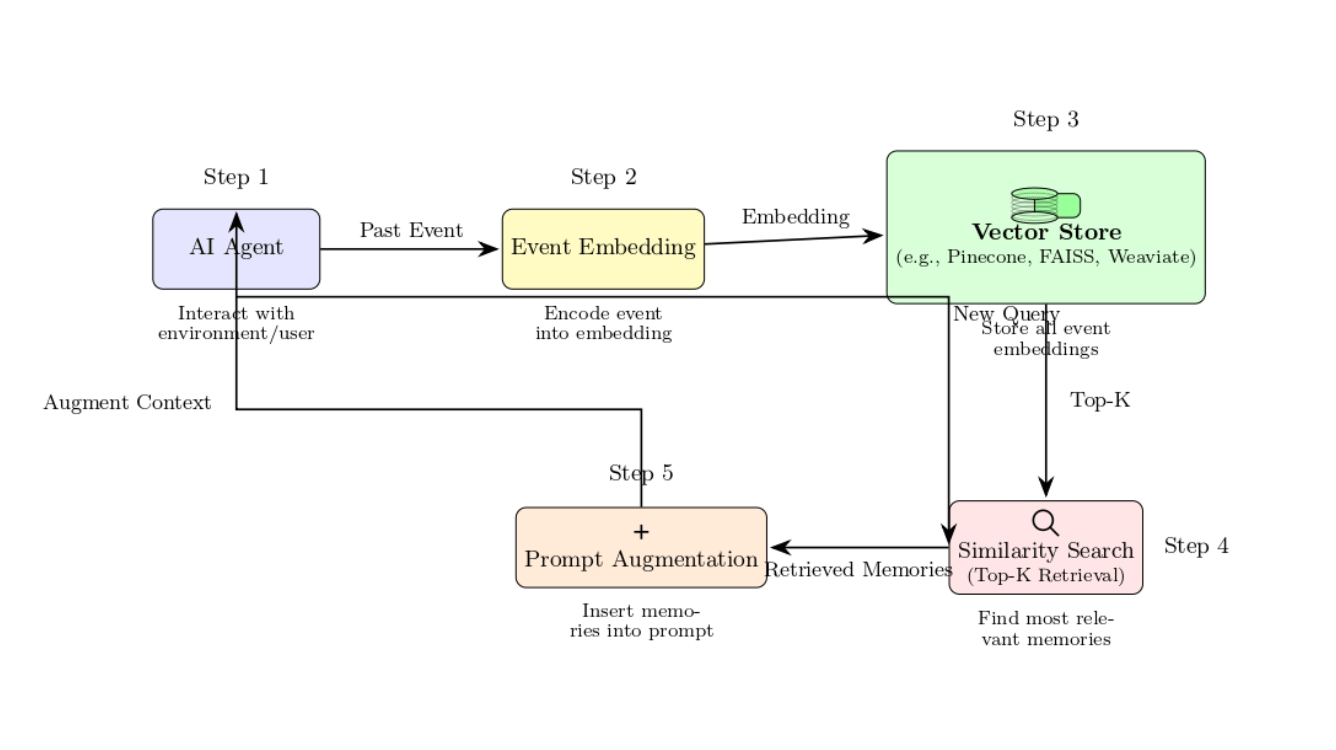
The practical difference is architectural. Events from play are encoded, stored, and fetched when a new turn needs them. A survey of memory mechanisms for LLMs frames this as more than "a longer chat log": memory systems decide what to keep, how to index it, and when to inject it.
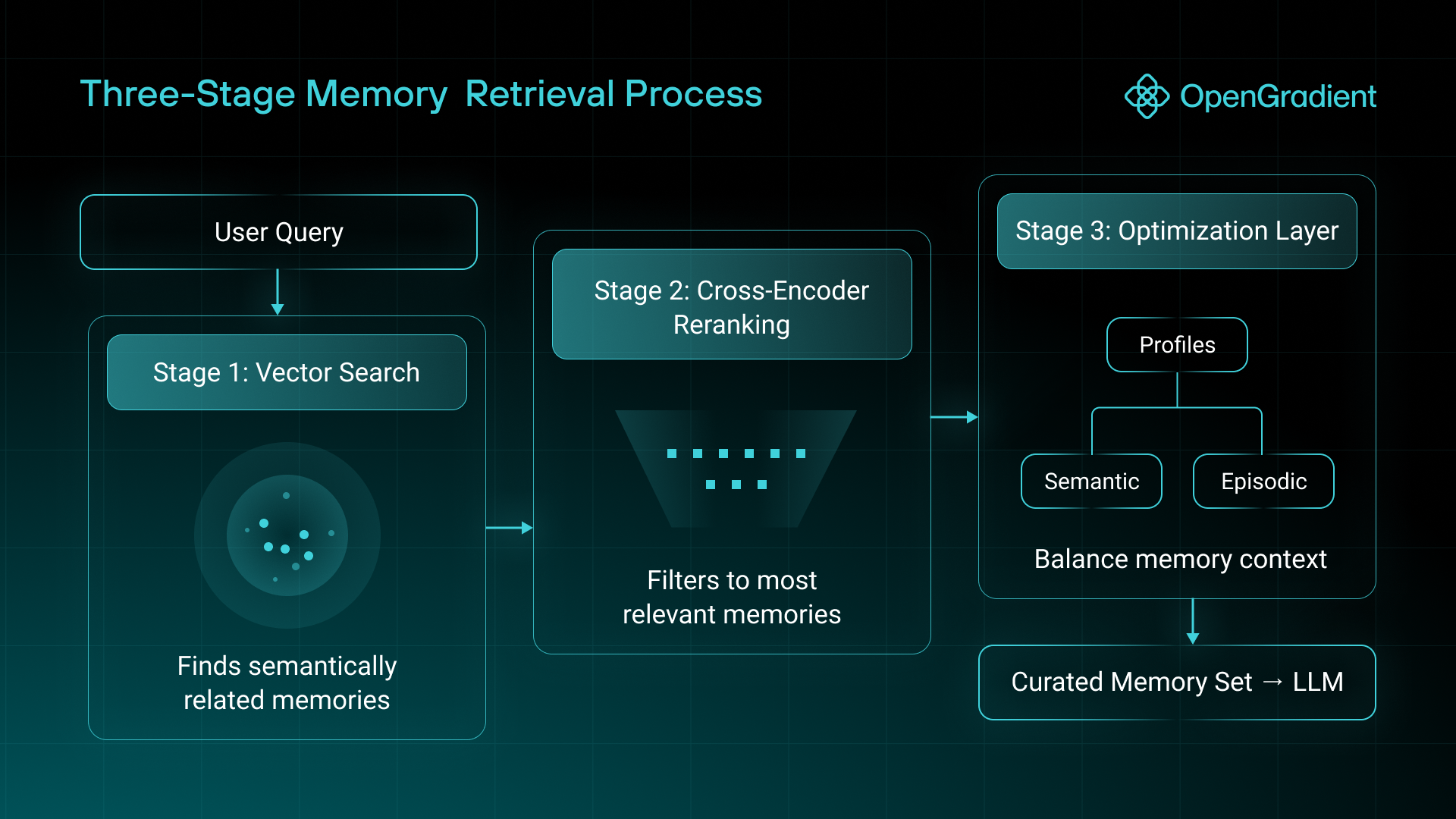
A useful mental model is the pipeline in the diagrams above:
- Vector search finds semantically related memories (the oath, the rival, the locked door).
- Reranking keeps the few memories that actually matter for this turn.
- Prompt augmentation inserts that curated set so the model can write the next beat in-character.
That is closer to how memory and retrieval-augmented generation differ in practice than to a chatbot that only sees the latest page of the thread.
Character Consistency That Survives Time Jumps
Long RP fails in small ways first: a changed eye color, a forgotten spouse, a reset of speech patterns. This AI is designed to hold those anchors so an NPC still sounds like themselves after a week away. You can leave a cliffhanger, close the app, and continue as if the scene never stopped.
"You are the GM. I am Captain Ilya Voss, a disgraced privateer with a broken left hand and a debt to the harbor witch. We last left off in the salt cellar under Pier 9. Continue in-character. Do not reset lore."
Creative Freedom Without Constant Canon Repair
The agent description is blunt: immersive roleplay, unlimited memory, perfect character consistency, and complete creative freedom. In practice that means you are not negotiating with a forgetful chatbot. You are playing. If the story needs a heist, a slow-burn romance, a political court, or a quiet conversation on a train, you can stay in that register for hundreds of turns.
"Remember that Elspeth already knows I lied about the fire. She would not ask me to explain it again. Play her as wary, not naive."
"Keep the tone darkly comic. The city still uses the ration tokens from session one. Do not invent a new currency."
Research on conversational agents with long-term, time-sensitive memory is explicit: retrieval is how you give a model a past. Roleplay is simply the use case where players notice immediately when that past is missing.
Related Agents You'll Also Find Useful
If you want the same continuity in a language-learning scene rather than a campaign, Learn English Through Roleplay puts you in immersive scenarios where idioms and grammar stick because the moment matters.
- Any scenario and intensity, not a scripted textbook dialog
- Vocabulary and natural speech practiced in-character
- Memory that lets a scene evolve instead of restarting every lesson
If your RP leans toward Japanese media, honorifics, and long-running character dynamics, Learn Japanese Through Roleplay keeps the same immersive, story-first approach.
- Boundless scenarios with full creative freedom
- Vocabulary and grammar anchored to memorable scenes
- Continuity so speech levels and relationships do not reset
If the story in your head wants panels, not just prose, Manga Creator helps you turn a long RP into a visual narrative without losing character design or plot logic.
- Visual storytelling and panel flow for one-shots or long serials
- Consistent art direction across many pages
- A natural next step when a campaign wants a comic adaptation
Try Roleplay Game Master free — no credit card required.
How It Works
Step 1: Open a Scene, Not a Questionnaire Start by stating who you are, who the GM or partner character is, and where the story begins. You do not need a perfect wiki. You need enough canon for the first scene to stand.
"GM a slow-burn mystery in a rain-soaked port city. I am a cartographer who just inherited a map that should not exist. Begin in the archive at midnight."
Step 2: Lock the Details You Refuse to Lose Call out the facts that would ruin immersion if forgotten: names, injuries, relationships, house rules, tone. This roleplay AI can carry those forward so you are not restating them every twenty messages.
"House rules: no plot armor, NPCs remember debts, and magic always has a visible cost. My character will never kill a surrendering foe."
Step 3: Play Past the Point Where Other Bots Drift Keep going. Introduce subplots. Let NPCs leave and return. The test of an AI RP bot that doesn't forget context after 20 messages is not the first page — it is message 80, when someone mentions a throwaway detail from the opening scene and the world still knows it.
"Weeks have passed in-world. The rival crew still has the locket from the tavern fight. Do not reintroduce it as if it is new."
Step 4: Leave and Come Back Without a Recap Novel Close the session mid-conversation if you need to. When you return, ask to continue from the last beat. Persistent memory is what makes that feel like one story instead of a series of disconnected chats.
"Continue exactly where we stopped. Do not summarize. Elspeth is still waiting for my answer."
Step 5: Steer Continuity in Plain Language If a detail starts to slip, correct it once, clearly. A memory-aware RP bot should treat that correction as canon, not as optional flavor.
"Correction: the harbor witch is named Maer, not Mira. She already knows my true name. Keep that consistent from now on."
Results & Use Cases
🎭 A Fantasy Campaign That Runs for Weeks
Scenario: You and a GM-style bot are running a sandbox campaign. Session one established a stolen relic, a one-eyed smuggler, and a city watch captain who took a bribe.
Traditional Approach: By message 25 the smuggler has two eyes again, the captain is inexplicably honest, and you paste a 600-word recap every night.
The AI RP bot: You continue from the last cliffhanger. The bribe is still leverage. The relic is still missing. Play time goes into choices, not repairs.
- Long-running NPC agendas stay intact
- Inventory and injuries persist
- Subplots can sleep and return without being rewritten
💞 Character RP That Depends on Emotional History
Scenario: A slow character study where two people have already lied, forgiven, and failed each other. The next scene only works if both remember the last fight.
Traditional Approach: After twenty messages the partner character resets to day-one chemistry. You spend the session reminding them what they did.
Roleplay with persistent memory: The argument is still in the air. Subtext survives. You can write silence, not exposition.
- Relationship state does not wipe at session boundaries
- Secrets stay secret until you reveal them
- Voice and tone remain stable enough to feel like the same person
If you want that same continuity while practicing a language, Learn English Through Roleplay puts the memory problem in service of fluency: the scene keeps going, so the vocabulary has somewhere to live.
📱 Mobile Roleplay on a Commute
Scenario: You play in short bursts on a phone — ten minutes on the train, then nothing until evening.
Traditional Approach: Each gap costs you the thread. By the time you reopen the chat, the bot has lost the room, the stakes, or the last line of dialogue.
On iOS or Android: You pick up mid-sentence. Settings and history sync, so a mobile session is the same campaign as the desktop one, not a disposable side chat.
- Short sessions still accumulate into one story
- No need to write "quick recap" messages on a crowded train
- Speech-to-text lets you play when typing is inconvenient
FAQ
Is there an AI RP bot that doesn't forget context after 20 messages?
Yes. This roleplay tool is built for campaigns that outgrow a short sliding window. Instead of keeping only the latest turns, it stores and retrieves story-relevant memories so names, plot commitments, and character details can still inform later scenes. That is the difference between a chat that drifts and a bot you can play with for the long haul.
Why do AI roleplay bots forget after 20 messages?
Most consumer chat UIs are bounded by a context window. As PromptHub explains, appending the full transcript fills that budget quickly. Older turns fall out, so the model improvises. Roleplay makes the failure obvious because players notice forgotten canon immediately. Retrieval-based memory is the standard technical response, including RAG with memory.
Is Roleplay Game Master free?
Yes. There is a free tier with core features and limited usage, and paid tiers if you need more headroom. You can start a campaign without a credit card. If you later want higher limits, plans scale from Plus at $20/month upward. Usage resets monthly on the billing date, with no daily caps.
Does this AI RP bot work on mobile?
Yes. Play is available on web, iOS, and Android with feature parity and synced settings. That matters for roleplay because a commute session and a late-night desktop session should be the same story, not two amnesiac chats. If you only have a phone, you can still run a long campaign.
Can it remember across sessions, not just inside one long chat?
That is the point of persistent memory. A bot that only "remembers" inside one sitting still fails the moment you close the thread. Cross-session memory is what lets you continue a scene days later. Researchers studying how people use agent memory keep finding the same expectation: if the product claims memory, users want it to feel like a continuing relationship, not a reset.
How is this different from a general chatbot for roleplay?
A general chatbot is optimized for answers. An RP bot is optimized for continuity: who knows what, who promised what, and what the world already established. Independent reporting has also shown that generic chatbot memory can be opaque and uneven for users. Here the product promise is narrower and clearer — hold the campaign together so you can play.
Conclusion
An AI RP bot that doesn't forget context after 20 messages is not a luxury setting. It is the difference between a story and a sequence of disconnected scenes. Finite windows, dropped turns, and recap labor are why so many roleplay chats collapse just as they get good.
Roleplay Game Master solves that by treating your campaign as memory, not as a transcript that falls off the bottom of the screen. Characters stay themselves. Plot threads remain available. You can play past the twenty-message cliff without becoming the bot's editor.
Try Roleplay Game Master now. Explore more at Jenova.
For Developers: Roleplay Game Master is available programmatically via the Jenova API — integrate persistent-memory roleplay into your application with a single API call. Full documentation →