AI Romance Story Generator: Write Love Stories That Actually Feel Real
2026-08-08
Creative Fiction Writer is an AI romance story generator that helps you write emotionally believable love stories — from first-meet tension to the final confession — with characters who stay consistent across every chapter. Most generic AI tools flatten romance into predictable beats and forgettable dialogue. This one is built for the craft: pacing a slow burn, escalating tension without rushing it, and holding voice steady across 80,000 words.
✅ Genre-fluent across romance subgenres — contemporary, historical, romantasy, sports romance, and more ✅ Persistent memory so your characters, timeline, and emotional arcs stay consistent chapter to chapter ✅ Editorial-grade feedback, not just generation — structure, dialogue, and prose critique ✅ Free to start on web, iOS, and Android with no credit card required
To understand why a dedicated romance writing partner matters, it helps to look at what's actually happening in the genre right now — and why so many writers who try AI for love stories end up frustrated with what comes back.

Quick Answer: What Is an AI Romance Story Generator?
An AI romance story generator is a writing tool that drafts, develops, and refines love stories — building characters, pacing romantic tension, and producing chapters from a premise or prompt. The strongest ones function as collaborative writing partners rather than one-click text machines.
Key capabilities:
- Generate full romance plots with structured emotional arcs and satisfying payoffs
- Maintain character voice, backstory, and relationship history across long manuscripts
- Draft dialogue and scenes tuned to a specific subgenre and heat level
- Provide editorial critique on pacing, tension, and prose quality
- Support parallel formats — webtoon, manga, or screenplay adaptations of the same story
The Problem: Why Most AI Romance Output Falls Flat
Romance is the strongest-performing category in commercial fiction, and demand keeps climbing.
24% increase in print romance sales — Romance novels are keeping the publishing industry's lights on
Romance is the leading growth category, with romantasy and sports romance posting triple-digit growth — Shelf Awareness
15% ahead of the prior year — fiction sales pace, per Writers & Artists' publishing year review
Writers are responding. Roughly 45% of surveyed authors already use some form of generative AI somewhere in their process. But most of them use it for research and admin — not the actual writing. There's a reason for that.
But getting usable romance prose out of a general-purpose AI is genuinely difficult:
- Emotional beats arrive too fast. Generic models resolve tension the moment it appears.
- Characters drift. Voice, backstory, and motivation shift between chapters.
- Dialogue reads generic. Everyone sounds like the same polite narrator.
- Subgenre conventions get ignored. Regency and hockey romance are not interchangeable.
- No editorial pushback. The tool agrees with everything, including your weak scenes.
Slow Burn Requires Restraint That Generic AI Doesn't Have
The defining pleasure of romance is delayed gratification. A slow burn works because the writer withholds — a glance that lands too long, a conversation that stops one sentence short. Most AI systems are optimized to be helpful and resolve tension, which is the exact opposite instinct. Ask for a "tense first meeting" and you'll often get a confession by paragraph four.
Character Consistency Breaks Down at Novel Length
A romance novel runs 70,000 to 100,000 words. Your love interest's childhood, her verbal tics, the specific reason she doesn't trust easily — all of it has to hold across dozens of chapters. Tools without persistent memory reintroduce characters as strangers, contradict established history, and quietly flatten distinct voices into one uniform register.
Genre Homogenization Is a Real Risk
The University of Cambridge's research on generative AI and novelists surfaced a sector-wide concern that AI could produce blander, more formulaic fiction that exacerbates stereotypes, because models regurgitate patterns from centuries of prior text. The same study found two-thirds of respondents named romance authors as the genre most threatened by AI — which makes tool choice and authorial control the deciding factors, not optional preferences.
The Craft Gap Between Draft and Publishable
Generating 2,000 words is easy. Generating 2,000 words where subtext carries the scene, where the dialogue reveals character through what's not said, and where the chapter ends on a hook — that requires genuine editorial understanding. Volume without craft just produces more revision work.
This is exactly what the Creative Fiction Writer was built for.
Why Creative Fiction Writer Works for Romance
The Creative Fiction Writer approaches your love story the way a developmental editor would — asking what the emotional stakes are, where the tension lives, and what your protagonist actually wants versus what she says she wants. It drafts, but it also interrogates the draft.
Critically, it holds context. Your character bible, your established timeline, your heroine's specific way of deflecting a compliment — all of it persists across sessions, so chapter forty sounds like it was written by the same author as chapter one.
| Generic AI Writing Tool | Creative Fiction Writer |
|---|---|
| Resolves romantic tension immediately | Paces slow burn across chapters with deliberate restraint |
| Forgets characters between sessions | Persistent memory holds character bibles and story history |
| One flat narrative voice | Distinct voice per character, maintained at novel length |
| Generic "romance" defaults | Subgenre-fluent — romantasy, historical, contemporary, sports |
| Agrees with every draft | Editorial critique on structure, pacing, and prose |
| Text only | Research-backed worldbuilding for authentic settings |
Emotional Architecture, Not Just Plot Points
Romance structure is about escalation. The agent maps your story's tension curve — the meet, the forced proximity, the almost-kiss, the rupture, the grovel, the resolution — and paces each beat so the payoff earns its weight. You can ask it to hold a beat longer, and it will.
"Write the scene where they're stuck sharing a hotel room after the storm. Maximum tension, zero kissing. End the chapter mid-sentence of hers."
Character Voice That Survives 80,000 Words
Build your leads once — background, wounds, speech patterns, what makes them defensive — and the agent writes them consistently from there. Ask for a scene twenty chapters later and their voices still hold.
"My heroine deflects vulnerability with sarcasm; my hero over-explains when nervous. Write their fight in the parking lot using only those two habits."
Subgenre Fluency With Authentic Detail
Historical romance needs period-accurate social constraints. Romantasy needs magic systems that constrain the relationship. Sports romance needs the actual rhythm of a season. The agent researches domain specifics so your setting doesn't read like a costume.
"Draft the masquerade ball opening — 1820s London, correct etiquette around unmasking, and she recognizes him before he recognizes her."
Honest Editorial Feedback
Paste your own chapter and ask for a critique. You'll get specifics: where the tension slackens, which dialogue lines are doing no work, where you're telling an emotion you already showed two paragraphs earlier.
Related Agents You'll Also Find Useful
Romance writing rarely stays in one format. These agents extend the same story into adjacent workflows.
Webtoon Creator
If your love story is better told visually, the Webtoon Creator adapts it for mobile-first vertical scroll — the format where digital romance has its largest young readership.
- Vertical scroll pacing and panel rhythm built for phone reading
- Episode-ending hooks engineered to drive next-episode taps
- Full-color character consistency across 100+ episode runs
Manga Creator
For romance in a manga idiom, the Manga Creator handles panel flow, visual beats, and the specific grammar of the form.
- Complete story development from one-shot to serialized epic
- Consistent art direction and character design across volumes
- Visual storytelling for confession scenes and emotional turns
Microdrama Screenwriter
Vertical microdrama is where a huge volume of romance narrative now lives. The Microdrama Screenwriter writes for that structure specifically.
- 60–100 episode season architecture
- Cliffhanger construction at every episode break
- Paywall-aware pacing that places hooks where they convert
Film Screenwriter
Adapting your novel into a script? The Film Screenwriter handles format, structure, and the translation from interior monologue to visible action.
- Feature-length structure and beat sheets
- Dialogue that carries subtext without narration
- Concept through final revision support
Try any of these free — no credit card required.
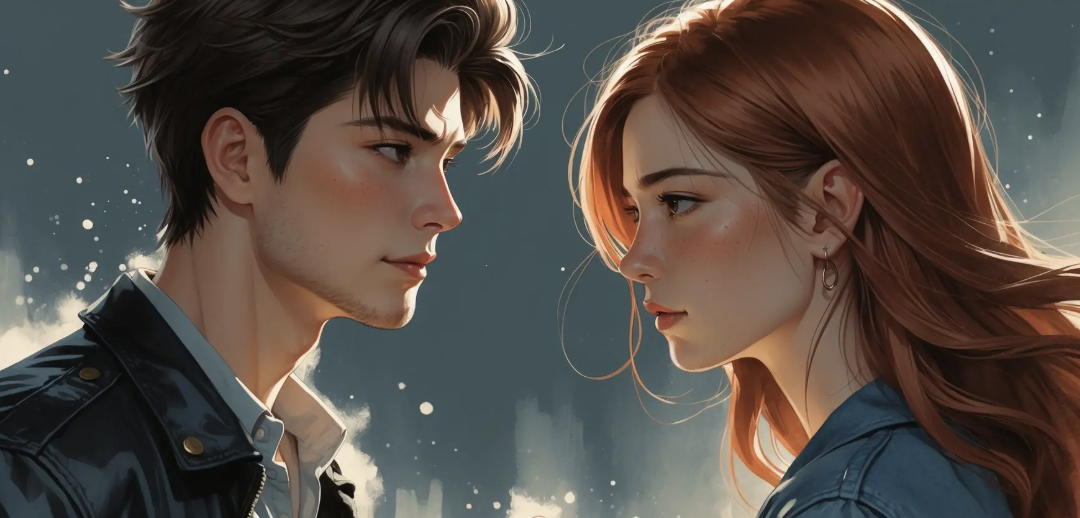
How the AI Romance Story Generator Works
Step 1: Define Your Premise and Subgenre
Start with whatever you have — a single image, a trope, a full outline. Name the subgenre and heat level so the agent calibrates tone from the first message.
"Enemies-to-lovers romantasy. She's a court assassin, he's the prince she was hired to kill. Closed door, slow burn, dual POV."
Step 2: Build Your Characters
Establish your leads before drafting. Wounds, wants, verbal habits, and the specific lie each one believes about themselves. This becomes the reference the agent holds for the rest of the project.
"Build character bibles for both leads. Give each one a core wound, a defense mechanism, and one physical tell they don't know they have."
Step 3: Map the Tension Curve
Outline the romantic escalation before prose. Where's the first spark, the point of no return, the black moment, the grovel? The agent will flag beats that arrive too early.
"Outline a 30-chapter arc. Mark exactly where the first kiss lands and justify the placement."
Step 4: Draft Scene by Scene
Generate chapters against the outline. Push back freely — ask for more restraint, sharper dialogue, a different POV, or a colder ending.
"Rewrite chapter 12 from his POV. He's realizing he's in love and refusing to name it. No internal monologue that states it directly."
Step 5: Revise With Editorial Feedback
Submit finished chapters for critique. Ask specifically: is the tension holding, is the dialogue earning its space, does the chapter end on a hook?
"Critique this chapter for pacing. Flag every line of dialogue that could be cut without losing meaning."
Results & Use Cases
📚 Drafting a Full Romance Novel
Scenario: A writer with a strong premise and no completed manuscript wants a 90,000-word contemporary romance.
Traditional Approach: Six to eighteen months of solo drafting, with the character-consistency burden carried entirely in the writer's head and notes.
Creative Fiction Writer: Outline, character bibles, and chapter-by-chapter drafting with persistent context — the agent holds continuity so revision focuses on craft rather than error-hunting.
- Consistent voice across the full manuscript
- Structural feedback before you've written 40,000 words in the wrong direction
- Author retains full creative control over every choice
💕 Breaking Through a Middle-Act Stall
Scenario: A writer is 45,000 words in and the romance has gone inert. The leads are together but nothing is at stake.
Traditional Approach: Weeks of stalling, or paying a developmental editor several hundred dollars for a manuscript assessment.
Creative Fiction Writer: Diagnose the structural problem, propose three viable complications, and draft the pivot scene the same day.
- Immediate diagnosis of where tension collapsed
- Multiple structural options rather than one prescriptive fix
- Draft-ready scenes to test each direction
📱 Writing Romance on Mobile Between Commutes
Scenario: A writer with a day job has forty minutes of train time twice daily and no laptop.
Traditional Approach: Notes app fragments that never assemble into chapters.
Creative Fiction Writer: Full feature parity on iOS and Android with speech-to-text — dictate a scene idea on the morning ride and refine the draft on the way home. Everything syncs across devices.
- Voice input for hands-free drafting
- Story context persists across sessions and devices
- No re-briefing the agent every time you open the app
🎭 Adapting a Novel Into Serialized Episodes
Scenario: A completed romance novel needs restructuring into a vertical webtoon series for a mobile platform.
Traditional Approach: Hiring an adaptation writer familiar with vertical-scroll conventions and episode economics.
Creative Fiction Writer + Webtoon Creator: The fiction agent preserves emotional throughline while the Webtoon Creator restructures for scroll pacing and per-episode hooks.
- Source novel's character consistency carries into adaptation
- Episode breaks placed at maximum-tension moments
- Format-native pacing rather than a straight text port
Frequently Asked Questions
Is the AI romance story generator free?
Yes. You can use the Creative Fiction Writer on the free tier with all core features and limited monthly usage — no credit card required. Paid tiers start at $20/month for 30× the usage plus custom model selection. Usage resets monthly on your billing date with no daily caps, so the full allowance is available from day one.
Can it write full-length romance novels or just short scenes?
It handles full-length manuscripts. Unlimited chat history and persistent cross-session memory mean your character bibles, outline, and established story history stay intact across an entire 80,000–100,000 word project. You can return weeks later and continue without re-explaining your premise.
How is this different from using ChatGPT for romance writing?
The difference is specialization and continuity. A general assistant treats each conversation as fresh and defaults to resolving tension quickly. This agent is built around fiction craft — slow-burn pacing, subgenre conventions, character voice discipline — and retains your story context permanently. You also get editorial critique, not just generation.
Will AI-written romance sound generic?
That depends heavily on how you use it. Cambridge's research documented genuine industry concern about AI producing formulaic fiction, and the risk is real when writers accept first drafts uncritically. Used as a collaborator — where you supply the specific emotional truth and push back on weak output — the result carries your voice, not the model's defaults.
Should I disclose AI use to readers?
Reader sentiment on this is strong. An International Thriller Writers survey found 97.1% of readers believe publishers should state on the cover when a book was written using AI. Disclosure norms are still forming and vary by publisher and platform, so check the specific requirements of wherever you're submitting. Transparency is the safer position.
Does it work on my phone?
Yes — full feature parity across web, iOS, and Android, including state-of-the-art speech-to-text for dictating scenes. Settings and story context sync across every device automatically.
Start Writing Your Love Story
Romance is the strongest-growing category in commercial fiction, and the writers who thrive in it are the ones who pair genuine craft with tools that respect it. A good AI romance story generator doesn't replace your instinct for what makes two people impossible to keep apart — it removes the friction between having that instinct and getting it onto the page.
The gap between a premise and a finished manuscript is usually consistency, pacing discipline, and honest feedback. That's precisely what a dedicated romance writing partner provides: characters who stay themselves across a hundred thousand words, tension that builds instead of collapsing, and an editor who tells you when chapter twelve isn't working.
Try Creative Fiction Writer now — free, no credit card required. Explore the full agent library at Jenova.
For Developers: Creative Fiction Writer is available programmatically via the Jenova API — integrate long-form narrative generation with persistent character memory into your writing or publishing application with a single API call. Full documentation →