AI Romance Route Generator: Plan Dates, Trips & Story Paths
2026-09-01
Date Planner helps you generate a complete romance route by sequencing venues, pacing, and conversation beats around a specific intent. While last-minute dinner plans still collapse into the same three restaurants, this AI builds a first-date walk, an anniversary drive, or a multi-city couples itinerary with local research and backups. In 2026, a romance route generator is less about a single restaurant pick and more about a full arc — arrival, tension, a peak moment, and a graceful exit.
✅ Intent-driven itineraries for first dates, anniversaries, and getaways ✅ Local venue research across cities, languages, and budgets ✅ Weather, timing, and reservation backups built into every plan ✅ Works with full feature parity on web, iOS, and Android
To understand why a dedicated romance route generator matters, it helps to see how real dates, couple trips, and branching love stories all fail in the same place: the path between “we should do something” and a night that actually feels designed.

Quick Answer: What Is a Romance Route Generator?
Date Planner is an AI romance route generator that builds sequenced date itineraries, couple travel paths, and backup plans matched to your intent, city, and budget. It treats romance as a route with stops, pacing, and an ending — not a single reservation.
Key capabilities:
- Intent-first planning for first dates, slow-burn evenings, and high-stakes nights
- Multi-stop routes that mix food, walking, views, and a closing beat
- Local research for hours, neighborhoods, and language-specific venues
- Contingency paths when weather, crowds, or closures break the original plan
The Problem With Planning Romance by Hand
A memorable night is a sequence. The café that is quiet enough to talk, the walk that creates a shared view, the dessert stop that gives you a reason to linger — those beats only work if someone designs the order, the timing, and the exit. Most people do not design that path. They pick one place, hope the conversation carries, and call it a date.
The same gap shows up in couple travel and in interactive romance. Choice-based interactive fiction advances when a reader picks among options — a menu or a hyperlink — rather than wandering a world of typed commands. A good romance route works the same way: constrained choices, rising stakes, and an ending that feels earned. Demand for that structure is not theoretical. The global dating simulators market was valued at USD 1.2 billion in 2024 and is projected to grow at a 15.2% CAGR through 2032. A separate 2025 snapshot put the dating sim and romance game market at $1–1.2 billion, with Asia Pacific holding more than 60% share and smartphones more than 50%.
USD 1.2 billion — Dating simulators market size in 2024
$1–1.2 billion — 2025 global dating sim / romance game market
But accessing a route that feels personal — in a real city or in a story — is still frustratingly difficult:
- Generic “romantic restaurant” lists that ignore neighborhood, budget, and energy level
- Multi-stop trips assembled from disconnected blogs, maps, and booking tabs
- Branching love stories that look open but reconverge into one ending
- Last-minute planning on a phone with no backup if the first venue is full
People searching for a romance route generator are usually solving one of those four failures. They want a path, not a pin on a map.
Why Date Planner
This is exactly what Date Planner was built for. It is a standalone dating strategist and concierge: you state the intent, the city, the constraints, and the tone, and it returns a route — stops, timing, conversation texture, and a Plan B. It does not dump a list of “cute cafés.” It designs the night as a sequence with psychology behind each beat.
| Traditional Approach | Date Planner |
|---|---|
| One restaurant reservation and hope | A multi-stop route with pacing and a closing scene |
| Tab-hopping maps, reviews, and hours | Local research folded into one itinerary |
| No backup when it rains or the venue is full | Contingency stops designed in advance |
| Same date repeated in every city | Intent, language, and neighborhood as inputs |
| Story “routes” that are really one plot | Distinct beats, choices, and endings you can replay |
Intent before venues
The first input is not a cuisine. It is the job of the night: impress, repair, slow down, celebrate, or test chemistry. A first date in a noisy tasting-menu room fights conversation. An anniversary that starts in a mall food court undercuts the occasion. The generator starts from intent, then selects venues that serve that intent — which is why the same city produces completely different routes for a second date versus a proposal-adjacent weekend.
Multi-stop pacing, not a single pin
A strong romance route has an opening (low pressure), a middle (shared activity or view), and a close (a reason to stay or a clean goodbye). That structure is the real-world cousin of branching narrative, where paths diverge with choice and often reconverge at a later scene. The difference is practical: your “scenes” are actual doors, streets, and reservation windows.
"Build a three-stop romance route in Naga for a second date: one café with real tables, one short walk with a view, one dessert. Budget under $40. If it rains, keep everything indoors within a 10-minute walk."
Local research and language fluency
A route that ignores opening hours, neighborhood safety after dark, or the difference between a tourist strip and a local street will feel fake by stop two. Date Planner researches locally and can work in multiple languages, so a couples evening in Osaka, Mexico City, or Naga is not a translated copy of a New York template.
"I have six hours in Kyoto with my partner. We want quiet, not Fushimi-Inari-at-noon. Generate a romance route that starts after 3 p.m., includes one garden or temple that is not packed, and ends with a sit-down meal. No shopping malls."
Contingency as part of the design
Romance fails in the gap between the plan and the night. Kitchens close. Shows sell out. Weather turns. A usable romance route generator includes the fork: if the rooftop is rained out, here is the covered alternative that preserves the same emotional beat. That is closer to how playable romance visual novels treat route progression — affection and choices change what happens next — than to a static blog list.
"Anniversary in our city, 7 p.m. to midnight. She hates surprise crowds. Design the route with a quiet peak moment and a full rain backup that still feels like an anniversary, not a mall."
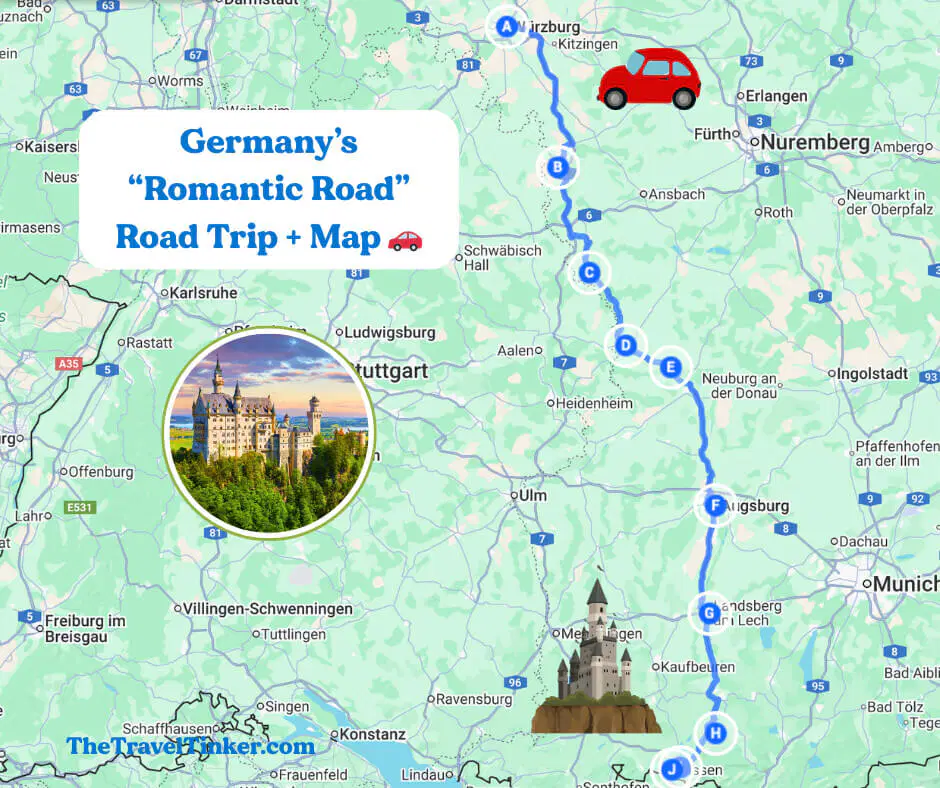
The same logic scales from a rooftop tea date to a multi-day drive. Germany’s Romantic Road — Würzburg south toward Füssen, with castle country in between — is a classic example of romance as geography: a named path, ordered stops, and a destination that pays off the drive. A generator should be able to produce that kind of arc for your calendar, not only recite someone else’s.
Related Agents You'll Also Find Useful
If you are generating romance routes for real life, you will often need the step before the date, the trip around the date, or a fictional route you can actually play. These agents sit next to Date Planner in that workflow.
Travel Planning Advisor
If the “route” is a weekend or a week — flights, hotels, and the days between the peak moments — Travel Planning Advisor handles logistics the date concierge should not be forced to invent. Use it when a romance route becomes an itinerary with airports attached.
- Destination research and hidden-gem stops, not only headline sights
- Flights, stays, and day-by-day pacing for couples
- Local constraints (transit, neighborhoods, seasonality) baked into the plan
Dating App Advisor
A perfect route still needs someone to meet. Dating App Advisor works on the profile, the opener, and the first-date decision so you are not generating itineraries for matches that never leave the chat.
- Profile critique and photo sequencing
- Conversation strategy that gets to a real meetup
- First-date guidance that hands off cleanly to a planned route
College Life
If you meant “romance route” in the visual-novel sense — branching affection, rival friends, and endings that depend on what you chose — College Life is the playable version. Relationships emerge from your decisions rather than from a fixed script.
- Open-world college romance with friendships and heartbreak
- Choices that change who you get close to
- Replayable social paths instead of a single linear crush
Tour Guide
Once you are standing in front of the castle, the mural, or the menu you cannot read, Tour Guide turns a stop on the route into a story. Send a photo of the landmark or the street and get cultural narration plus practical tips in the moment.
- Photo-based landmark and menu explanations
- Local fluency without a human guide on payroll
- Useful on walking dates and couple travel days alike
Try Date Planner free — no credit card required. Use the agents above when the night needs a match, a flight, a playable story, or a guide at the next corner.
How It Works
Step 1: State the intent, not the restaurant
Open Date Planner and describe the job of the night in one or two sentences. Include city, time window, budget, mobility, and hard nos (no loud bars, no walking in heels, no surprise crowds). Specific constraints produce a better route than “somewhere romantic.”
"First date, Saturday 5–9 p.m. in Naga. I want talking, not a movie. Mid-range budget. She is vegetarian. End somewhere we can leave without an awkward bill split at a white-tablecloth place."
Step 2: Review the sequenced route
The AI returns ordered stops with timing, why each stop exists, and how to move between them. Read it as a storyboard: opening beat, shared activity, peak, close. If a stop feels wrong for the person you are meeting, say so in the next message — “swap the bar for a bookstore café” is a better edit than starting over.
"Keep the three-stop structure but replace the cocktail bar with a quiet dessert counter. We both have early mornings."
Step 3: Lock logistics and the backup
Ask for reservation notes, walking minutes, weather forks, and a kill-switch if the first venue is full. A romance route generator is only useful if it survives contact with Friday night.
"Give me a rain route that stays within 800 meters of the original first stop, plus a 15-minute delay version if we are running late."
Step 4: Run the night, then save what worked
After the date, tell the AI what landed and what felt forced. On the next run it can reuse neighborhood knowledge and drop the stop that killed conversation. That memory is what turns a one-off list into a personal romance route generator you can reuse in the same city or a new one.
"The walk was the best part; the café was too bright. Next time start with golden-hour outside and keep indoor stops dim and small."
Results & Use Cases
📊 First Date in a City You Barely Know
Scenario: You matched with someone in a city that is not yours. You have one Saturday evening, no local friends to text, and a strong preference against “let’s just grab drinks.”
Traditional Approach: Thirty minutes of map scrolling, three overbooked restaurants, and a default to the hotel bar.
Date Planner: A three-stop route with a low-stakes opener, a walk that creates a shared view, and a dessert close that makes leaving easy. Vegetarian constraint and noise limit are already in the plan.
- Neighborhood chosen for walking, not for Instagram density
- Timing that avoids the 7:30 rush without feeling like a late-night bar crawl
- A backup if the first café has a 40-minute wait
💼 Anniversary Drive Modeled on a Classic Romance Road
Scenario: You want a two-day couples trip with a named arc — departure town, castle or viewpoint, overnight, payoff at the end — in the spirit of a scenic heritage drive rather than a resort stay.
Traditional Approach: A folder of blog posts, a highlighted highway, and hotels booked without thinking about sunset timing.
Date Planner plus Travel Planning Advisor: The date concierge designs the emotional beats (where you stop, how long you linger, where the night peaks). The travel advisor attaches the driving time, stay, and day-two logistics so the romance route is actually drivable.
- Ordered stops instead of a pile of “must-sees”
- Overnight placed after the peak view, not before a four-hour transfer
- Room in the schedule for one unplanned café, so the route does not feel militarized
📱 Last-Minute Route From Your Phone
Scenario: The original plan dies at 4 p.m. — kitchen closed, friend flaked on the double date, weather turned. You are already dressed and on a train.
Traditional Approach: Panic-search “romantic near me,” pick the first result with a 4.5, arrive to a waitlist.
Date Planner: A compressed two-stop route using what is still open in your radius, with walking minutes and a covered alternative. Built for the phone you are already holding — web, iOS, or Android, same capability.
- Works in a short time window, not only for weekends planned on Tuesday
- Respects “we can walk 12 minutes, not 40”
- Preserves the intent (talk, celebrate, reset) even when the original venue is gone
🎯 Play the Branching Route Instead of Planning It
Scenario: You are not booking a table. You want to play a romance route — choices, affection, fallout — the way dating sims have done for decades, especially in Japan’s large share of that software market.
Traditional Approach: Buy a title and live inside one studio’s heroine list, or stare at a blank Twine file. Twine has been downloaded more than 150,000 times from its official site, with the browser builder used hundreds of thousands of times, because branching stories are easy to want and hard to structure well.
College Life: An open-world college romance where friendships, heartbreak, and who you end up close to follow from your choices. Use Date Planner when the route is streets and reservations; use College Life when the route is people and consequences.
- Multiple social paths rather than a single scripted crush
- Replay value when you want a different ending
- No need to design systems, art, or dialogue trees yourself
FAQ
What is a romance route generator?
A romance route generator is a tool that builds a sequenced path for a romantic experience — a date, a couples trip, or a branching story — instead of recommending one venue. Date Planner is an AI version of that idea for real nights out: you give intent, city, time, and constraints, and it returns ordered stops, pacing, and backups. Fictional romance routes (visual novels, otome paths, college sims) are a parallel use of the same structure: choices, rising affection, distinct endings.
Is Date Planner free?
Yes. Date Planner is available on Jenova’s free tier with core features and limited monthly usage. Paid tiers raise usage and add options such as custom model selection. You can generate a full romance route without a credit card; heavier weekly planning is when people typically move up a tier. Check current plan details in the product’s subscribe menu if you need exact limits for your account.
How is an AI romance route generator different from a restaurant list or a story generator?
A restaurant list is one pin. A prose romance generator is one plot. A romance route generator is a path with order, timing, and forks. Generic AI romance-arc tools outline tropes; couple trip planners sketch getaways. Date Planner specializes in the in-between: the night as a designed sequence in a real city, with venue psychology and a Plan B. For playable branching romance, College Life is the better fit than a date itinerary.
Can Date Planner plan a multi-day couples trip, not just a single date?
Yes, as a route of days rather than a route of hours — but long-haul logistics (flights, hotels, border timing) are cleaner when you pair it with Travel Planning Advisor. Use Date Planner to define the emotional arc: which evening is the peak, which morning should stay slow, which stop is skippable. Hand the transport and lodging layer to the travel agent so the romance does not get buried in airline rules.
Does Date Planner work on mobile?
Yes. Jenova runs the same Date Planner experience on web, iOS, and Android, including voice-to-text if you would rather talk the constraints than type them on a sidewalk. That matters for the last-minute use case: the generator is useful only if it still works when the original reservation dies and you are already out the door.
Can I use this for fictional romance routes or only real dates?
Date Planner is built for real-world nights and trips. If you want a playable romance route with characters, affection, and endings, use College Life. If you are designing a game’s romance systems rather than living or playing them, a dedicated game-design workflow is a better next step than forcing a date concierge to write a visual-novel script.
Conclusion
A romance route is a designed path — stops, pacing, a peak, and a way out — whether that path is three city blocks, a heritage highway, or a set of choices that change who you end up with. Most tools give you a pin, a trope, or a highway highlight reel. An AI romance route generator gives you the sequence.
Date Planner is the product to use when the route has to survive a real calendar: intent, local research, and backups included. Pair it with travel planning when the route grows into a trip, with dating-app help when you still need the meetup, and with College Life when you want to play the branch instead of walk it.
Try Date Planner now. Explore more at Jenova.
For Developers: Date Planner is available programmatically via the Jenova API — integrate intent-driven romance route generation into your application with a single API call. Full documentation →