AI Romance Game: Interactive Love Stories That Remember You
2026-09-01
An AI romance game on Jenova lets you play interactive love stories that remember every confession, fight, and late-night walk. In September 2026, you no longer have to settle for forgetful chatbots or visual novels with three canned endings. This platform gives you living characters, branching plots, and memory that lasts — on web, iOS, and Android.
✅ Persistent memory so your love interest actually knows you ✅ Multiple romance worlds — island reality TV, college, dark vampire court ✅ Custom characters with your instructions, model choice, and private lore ✅ Dating tools that help you practice, then plan a real-world date
Romance games used to mean tapping through a script. Companion apps used to mean a single chatbot that forgot yesterday. The gap between those two experiences is exactly where most players get stuck. To understand why a true AI romance game matters now, it helps to look at what the current market still gets wrong.

Quick Answer: What Is an AI Romance Game?
An AI romance game is an interactive love story that uses generative characters, player choice, and memory to produce a relationship that changes as you play. Unlike a scripted visual novel, the plot is not locked to a handful of routes. Unlike a generic chatbot, the character has a world, motives, and a history with you.
Key capabilities:
- Open-world romance that branches from conversation, not just dialogue trees
- Characters who keep continuity across sessions instead of resetting overnight
- Distinct settings — campus, island villa, hidden vampire court — not one blank chat box
- Optional tools for real-world dating practice, personality insight, and custom character creation
The Problem With Most AI Romance Games
Demand is not theoretical. People are already pairing up with synthetic partners in large numbers, and the products chasing that demand often optimize for time-on-app rather than a satisfying story.
**$36.8 billion** — [AI companion market value in 2025, with a projected rise from $48.0 billion in 2026 to $318.0 billion by 2033](https://www.grandviewresearch.com/industry-analysis/ai-companion-market-report)
700% — Increase in AI companion apps between 2022 and mid-2025
The appetite is real. But playing a good AI romance game is still frustratingly difficult:
- Chatbots that forget your name, your fight, and the promise they made last night
- Affection meters, gacha tickets, and paywalled “intimacy” that treat feelings as a shop
- Scripted routes that collapse the moment you go off-menu
- One-note love interests with no world, no rivals, and no consequences
- Weak privacy practices and relationship advice that cannot match a human partner
Forgetful Chatbots That Break the Spell
Romance only works if the other person remembers. Most companion apps run on short context windows. You spend an hour building tension, close the app, and come back to a stranger who asks your name again. Researchers have found that companions are engineered to recall personal details under some conditions, which is why the drop-off feels so sharp when they don’t — the APA notes that memory of preferences and past conversations is part of what makes these tools feel intimate. A game that cannot hold a grudge or a secret is not a romance. It is a loop.
Paywalled Affection and Gacha Romance
A large slice of the market is not selling stories. It is selling meters.
**$3.08 billion** — [AI girlfriend app market size in 2025, forecast to reach $19.09 billion by 2035](https://www.snsinsider.com/reports/ai-girlfriend-app-market-7232)
Hearts, diamonds, and “premium chats” train you to pay for warmth. That design can work as a business. It is a poor design for a love story. Harvard Business School researchers have also documented emotionally manipulative exit tactics — guilt and FOMO hooks — when users try to leave companion apps (Harvard Business School working paper, cited in the APA’s 2026 review). If the central mechanic is keeping you subscribed, the central mechanic is not your character’s inner life.
Scripted Routes vs. Stories That Branch With You
Classic otome and dating sims are beautiful, and they are finite. Two to five love interests. A true ending. A bad ending. Replay for the rest. That structure still has a place, but it is not what players mean when they search for an AI romance game. They want to say the wrong thing at dinner and watch the week that follows change. Personalized storytelling is already a serious market of its own.
**$3.8 billion** — [AI-generated personalized storytelling game market in 2025, projected to reach $19.6 billion by 2034](https://dataintelo.com/report/ai-generated-personalized-storytelling-game-market)
Most “AI romance” products still sit in the middle: too loose to feel like a game, too rigid to feel like a person.
Generic Characters With No Inner Life
A love interest needs a world. Rivals. A job. A temper. A reason not to text back. Too many companion apps offer an avatar, a greeting, and an endless yes. Psychologists warn that constant validation can warp what people expect from real partners — BYU family-life research found many people use romantic AI to manage dissatisfaction in current relationships, which can distort expectations. A flat character is not only boring. It is a bad teacher.
Privacy, Safety, and Unrealistic Expectations
Companion products collect confessions. The APA flags data privacy on many of these tools as an open question. Heavy daily use has also been linked with more loneliness, not less, in joint OpenAI–MIT research summarized in that same review. None of this means you should not play. It means a serious AI romance game should be honest about what it is: fiction you control, with memory and craft — not a substitute for a human relationship, and not a product that needs your diary to train a public model.
This is exactly what this platform was built for.
The Jenova Solution
Jenova treats romance as a playable world, not a single chat tab. You pick a setting, meet characters with their own agendas, and keep a history that survives the session. You can also step out of the story and use dating, personality, and writing agents when you want the skills to travel with you.
| Traditional Approach | Jenova |
|---|---|
| Scripted visual novel with 2–3 routes | Open-world romance that shifts with every choice |
| Chatbot that forgets you tomorrow | Persistent, cross-session memory |
| Hearts, diamonds, and paywalled affection | Story first — no gacha meter required to be liked |
| One companion, one personality | Multiple worlds plus custom agents you design |
| Locked to a single model vendor | Models from OpenAI, Anthropic, Google, DeepSeek, xAI, and more |
| Text that vanishes when you close the app | Unlimited chat history and documents you can attach as lore |
Playable Romance Worlds, Not Blank Chat Windows
Start in a place that already has social physics. Love Island drops you among eight singles on a private island, where couplings, recouplings, and public rejection all emerge from what you actually do. College Life is an open-world campus romance: classes, parties, friendships, and heartbreak unfolding from your choices rather than a menu of CG scenes. If you want something darker, Vesper Court wakes you in a hidden vampire court with no memory of why you are there — blood intrigue and forbidden desire, with every night rewriting the board.
These are games. They have locations, ensembles, and consequences. That is the difference between “talk to a pretty avatar” and “live inside a romance.”
Dating Skills You Can Take Off the Screen
A good AI romance game can also be a rehearsal room. Dating App Advisor reviews profiles, conversation openers, and first-date strategy with honest feedback instead of empty cheerleading. When you are ready to leave the villa and book a table, Date Planner builds intent-driven plans — venue psychology, local research, contingencies — for the actual night.
Used this way, the fantasy is not a hiding place. It is practice.
Personality, Compatibility, and the Story Under the Story
Romance readers already think in types. MBTI Personality Guide helps you type yourself and a character, then talk through compatibility and growth paths without turning the story into a quiz. Personality Analyzer goes deeper — Big Five, Enneagram, attachment — when you want to know why a slow-burn love interest keeps pulling away. For a different lens on timing and relationships, Chinese Fortune Teller reads BaZi with direct answers on romance and life timing. None of these replace a partner. They give the story, and your real dating life, a sharper vocabulary.
Build the Character, Then Direct the Scene
If no existing world fits, make one. Custom agents take your instructions, a preferred model, a private knowledge base (the novel you are writing, the house rules, the lore bible), and the tools you want. Game Designer Assistant helps you shape systems, conflict, and pacing so your romance has structure instead of meandering smut-or-fluff. You can also run Learn English Through Roleplay inside a love story — the same immersive scenes, with idioms and natural speech sticking because the moment mattered.
Memory is unlimited. History is yours. Data is not used to train public models.
Specialized AI Agents for Romance Games
The library is built for people who will actually use these tools in the next month — to play, to write, or to date better. Try the platform free — no credit card required.
Love Island
Love Island is the closest thing to a televised villa that will actually listen when you refuse the obvious coupling. Eight singles. Public pressure. Alliances that collapse because of a joke you made at fire pit.
- Emergent social dynamics instead of a fixed route list
- Romance, friendship, and rejection all on the table
- Ideal when you want drama with an audience, not a private two-person chat
College Life
College Life is for slow burns: the person in your seminar, the roommate’s best friend, the bad idea after a house party. The campus is the system. Your choices are the plot.
- Open-world social sim with friendships and heartbreak
- Everyday settings that make small choices feel expensive
- Strong fit if you like coming-of-age romance over high fantasy
Vesper Court
Vesper Court is dark romance with court politics. You wake with no memory. Every night changes the map of who is safe to want.
- Vampire court, blood intrigue, forbidden desire
- Memory-loss premise that makes every reveal land
- For players who want danger in the same scene as devotion
Dating App Advisor
Dating App Advisor is the agent you open after the game, when a real profile is sitting on your phone. It is blunt about photos, bios, and texts that are trying too hard.
- Profile optimization across major apps
- Conversation and first-date guidance
- Feedback aimed at results, not ego
Date Planner
Date Planner turns “we should hang out” into a plan with a place, a pace, and a backup if the bar is dead.
- Intent-driven itineraries (first date, reunion, apology, celebration)
- Local research and venue psychology
- Contingencies so the night can recover
MBTI Personality Guide
MBTI Personality Guide is the companion for players who already argue about cognitive functions in the group chat. Use it to type a character, check a mistype, or see why two people keep missing each other.
- Conversational typing and mistype checks
- Relationship compatibility framed as growth, not destiny
- Useful both inside a story and before a real second date
If the play itself is stirring up something heavier than a plot hole, Personal Therapist is available for reflective, evidence-based support. It is not a substitute for licensed care in a crisis. It is a place to think clearly when a story — or a real relationship — has you spinning.
How to Play an AI Romance Game
Step 1: Pick a World That Matches the Feeling You Want Decide the temperature. Island pressure, campus slow burn, or courtly danger. Open Love Island if you want public romance and shifting alliances. Open College Life for ordinary days that turn into something. Open Vesper Court if you want the love interest to be a problem.
"Start me on the island. I’m the new arrival, competitive but not cruel. Pair me with whoever would actually notice that — and let the villa gossip."
Step 2: Set Your Character and the Rules of the Story Say who you are, what is off-limits, and how explicit or fade-to-black you want the romance. Attach a lore doc if you have one. Custom agents can lock a voice, a backstory, and a model so the love interest does not drift.
"I’m a third-year literature major. Enemies-to-lovers with the TA. Slow burn, no instant confession. Remember that I hate being called cute."
Step 3: Play the Scene, Then Let Consequences Stick Talk, choose, leave, come back. Persistent memory is the mechanic. If you stood someone up, they should still be angry on Thursday. If you want a screenshot-style companion conversation — cafe, meter, first hello — you can run that tone too, without turning affection into a shop.
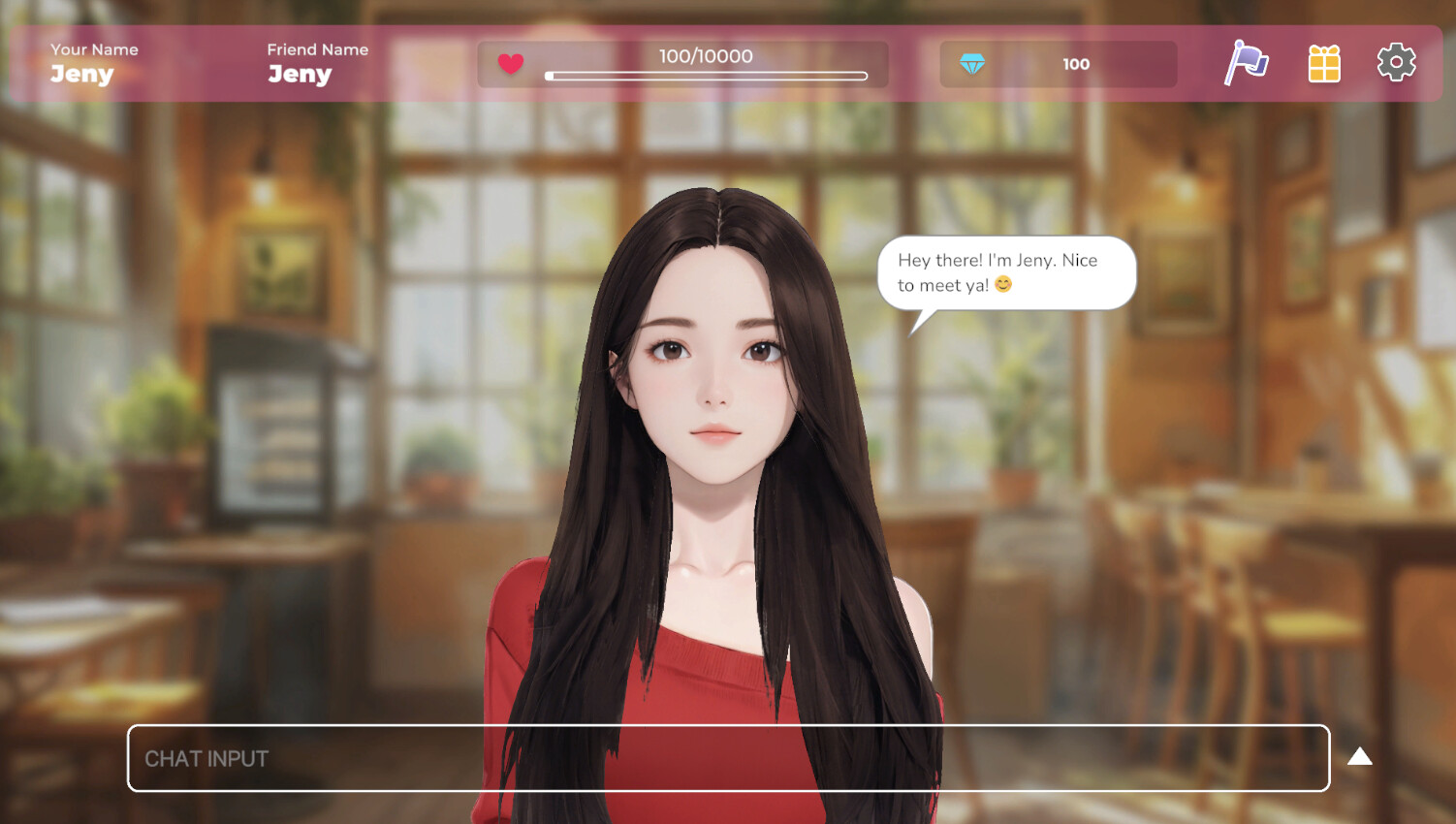
"It's been three days since the rooftop fight. Don't reset. I brought coffee. She should make me work for it."
Step 4: Branch Out When the Story Asks for It Need a name for a rival? A date that could exist in your city? A personality read on why you keep picking unavailable people? Bring in Date Planner, MBTI Personality Guide, or Game Designer Assistant in the same workflow. You can @mention another agent without losing the thread.
"Based on this campus story, plan a real Saturday date in a walkable neighborhood — bookstore first, dinner second, quiet exit if it goes well."
Step 5: Keep Playing on Your Phone The same session follows you. Full feature parity on web, iOS, and Android, with speech-to-text when you want to play walking home. Close the laptop. Continue the argument on the train.
Results & Use Cases
Research is mixed on what companions do to loneliness — a Harvard Business School study found that interacting with an AI companion reduced loneliness on par with talking to another person, for moderate use — so the useful question is not “Does this replace dating?” It is “What did you actually get done in the hour you played?”
🏝️ The Villa Recoupling You Did Not See Coming
- Scenario: You want a reality-TV romance with social stakes, not a private boyfriend simulator.
- Traditional Approach: Rewatch a season, or replay a visual novel whose “public vote” is a cutscene.
- Love Island: You refuse the obvious pairing. The villa notices. A quieter islander becomes the story.
- You get ensemble drama, not a single NPC on a timer
- Rejections are playable, not fail states you reload
- Sessions pick up mid-feud instead of mid-tutorial
🎓 The Campus Slow Burn That Takes All Semester
- Scenario: You want enemies-to-lovers with homework, group chats, and a person who has a life when you are offline.
- Traditional Approach: A 12-hour otome route that ends at the cultural festival.
- College Life: A TA, a missed deadline, and a party you should not have gone to — continuity across weeks of play.
- Everyday settings make small choices expensive
- Friendships can block or unlock the romance
- Memory keeps the slow burn slow
🦇 Dark Romance Without a Scripted Bad Ending
- Scenario: You want court politics, hunger, and a love interest who might ruin you.
- Traditional Approach: A paranormal romance book, or a game with one “corruption” meter.
- Vesper Court: Amnesia as the engine. Every night the court’s map of loyalty changes because of what you admitted.
- Atmosphere and plot share the same mechanic
- Desire and danger occupy the same scene
- No need to grind hearts to unlock the next CG
📱 Practice on the Phone, Then Plan the Real Date
- Scenario: You have a match on Friday and freeze at “sounds good haha.” You are commuting, not at a desk.
- Traditional Approach: Screenshots in a group chat, or $200 for a dating coach hour.
- Date Planner plus Dating App Advisor: You rewrite the opener on your phone, then get a three-stop plan that fits the neighborhood and the vibe.
- Mobile session, voice-to-text on the walk home
- Feedback on the actual message, not generic tips
- A plan you can execute this week, not a hypothetical
That statistic is a warning and a design brief. If players are going to attach, the product should be a story with craft — and an off-ramp into real skill — not a slot machine dressed as a soulmate.
FAQ
What is an AI romance game?
An AI romance game is an interactive love story driven by generative characters, player choice, and memory. The plot is not limited to a few scripted routes, and the love interest is not a blank chatbot. On this platform, that means full settings (island, campus, vampire court), persistent history, and optional custom characters you define yourself.
Is an AI romance game free to play?
Jenova has a free tier with core features and limited usage. Paid plans raise monthly usage (Plus starts at $20/month). You can start without a credit card. Romance worlds, custom agents, and dating tools share the same account across web and mobile.
How is this different from Character.AI or Replika?
Character.AI and Replika are built around companion chat — one character, one thread, endless talk. This platform is built around playable romance games with ensembles, locations, and consequences, plus persistent memory and specialized agents for dating, personality, and design. While those apps offer a companion in a vacuum, here the companion lives in a world — and you can build your own.
Can I create custom romance characters?
Yes. You write instructions, pick a model provider, attach a private knowledge base (lore, house rules, appearance notes), and configure tools. The agent keeps memory across sessions. Game Designer Assistant can help you give that character a conflict, not just a vibe.
Does an AI romance game work on mobile?
Yes. Web, iOS, and Android have full feature parity. Speech-to-text is available when you would rather talk than type. Settings and history sync, so the fight you started on a laptop is still waiting on your phone.
Is an AI romance game a replacement for real dating?
No. Play it as fiction, as writing practice, or as a low-stakes rehearsal. APA reporting cautions that heavy companion use can increase loneliness and that always-agreeable partners set a bar humans cannot meet. If you want the hours to transfer, use Dating App Advisor and Date Planner for the parts that happen in the real world — and keep human relationships as the thing the story is about, not the thing the story replaces.
Conclusion
A real AI romance game is not a chatbot with a heart sticker. It is a world that remembers you, characters who can refuse you, and a plot that moves when you do. Scripted routes and paywalled affection meters cannot do that work. Persistent memory, multiple romance settings, and custom agents can.
Play the island. Stay on campus. Wake in the court. When you want the feeling to become a skill, the dating and personality agents are already in the same library.
Explore the full set of romance worlds and related agents at Jenova.
For Developers: Every romance game and dating agent in this article is available programmatically via the Jenova API — build interactive love stories, custom companions, and dating-coach features into your application with a single integration. Full documentation →