AI Roleplay Without Dementia: Characters Who Never Forget
2026-09-17
Roleplay Game Master helps you run immersive stories that stay consistent by remembering characters, lore, and choices across every session. While most chatbots lose the plot after a few thousand tokens, this AI provides unlimited memory and character continuity. In September 2026, players hunting for AI roleplay without dementia are done restarting worlds that forget their own names.
✅ Unlimited conversation history that carries across sessions ✅ Character voices, relationships, and canon that stay intact ✅ Creative freedom to explore any scenario without a reset ✅ Full feature parity on web, iOS, and Android
To understand why this matters, it helps to look at how most roleplay tools actually “remember” — and why so many campaigns collapse into amnesia.
Quick Answer: What Is AI Roleplay Without Dementia?
Roleplay Game Master is an AI game master that remembers characters, plot, and lore across sessions so long-running stories stay consistent. In player slang, “dementia” means the model forgets names, alliances, injuries, and earlier scenes. Persistent memory is the fix.
Key capabilities:
- Roleplay Game Master tracks NPCs, inventory, and canon without a session reset
- Short-term scene memory plus long-term lore that survives inactivity
- Character consistency so villains, companions, and your own backstory do not drift
- Open-ended scenarios — mystery, romance, horror, or sandbox — without losing the thread
Why Most AI Roleplay Feels Like Dementia
Demand for companion-style and story-driven AI is not a niche hobby. The global AI companion market was valued at USD 37.73 billion in 2025 and is projected to expand sharply through the next decade. A separate estimate puts the 2025 market at USD 37.12 billion. Therapy and companionship now rank among the top reasons people use generative AI, and roleplay sits in the same cluster of long, emotionally detailed conversations.
But keeping a story coherent is frustratingly difficult:
- Context windows fill up, so early scenes get truncated
- Generic chatbots treat each thread as a blank slate
- NPCs change personality, names, and motives without warning
- Players spend more time recapping than playing
700% — Increase in AI companion apps between 2022 and mid-2025
20 million — Character.AI monthly users, more than half under age 24
1.1–2.2 billion — Estimated global monthly visits across AI companion platforms in a 110-product market scan
Those numbers explain the appetite. They do not explain continuity. Large language models are excellent at the next sentence and weak at the last chapter. Memory is the backbone of long-term conversational intelligence, and without a dedicated store, “the innkeeper,” “your sword,” and your own backstory fall out of the prompt.
Human memory research is a useful map. Working memory and short-term memory hold the current scene; long-term memory stores experiences that can shape later behavior. Formation is not a dump of raw chat logs. It is encoding, consolidation, and retrieval — the same pipeline production agent systems now try to copy.
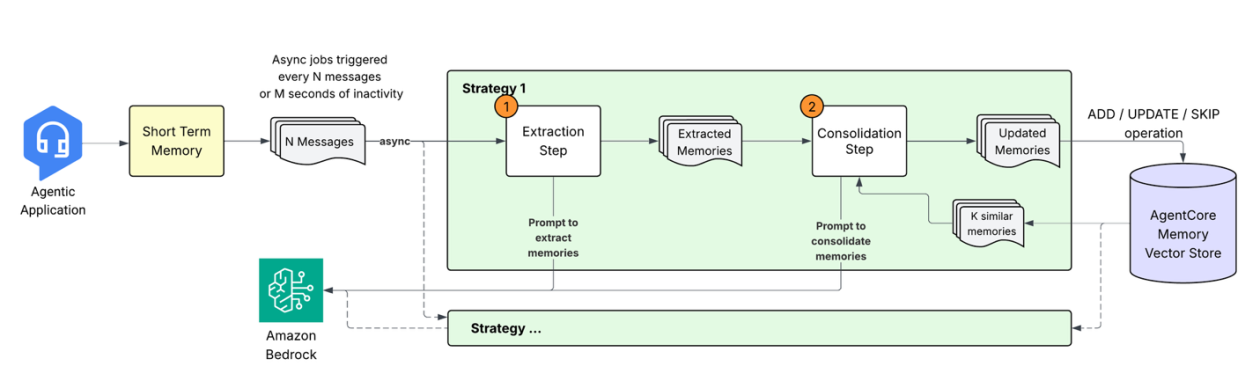
In practical terms, a roleplay session needs two layers. Recent messages stay in a short-term buffer. After N messages or a stretch of inactivity, an async job extracts durable facts (“Kael lost his left hand in the docks fight”; “the mayor is secretly funding the smugglers”). A consolidation step compares those facts with similar memories already in a vector store, then adds, updates, or skips. That is how a campaign stops contradicting itself.
Benchmarks such as LongMemEval and LoCoMo exist specifically because recovering facts from very long conversations is still hard. Players feel that failure as dementia: a companion who proposes marriage on Tuesday and asks your name on Wednesday.
This is exactly what a dedicated AI game master with unlimited memory was built for.
Why Roleplay Game Master Stays in Character
This AI game master is built as a standalone roleplay product: unlimited memory, character consistency, and complete creative freedom. It does not treat your campaign as a disposable chat. It treats names, factions, injuries, and promises as canon that should survive the next login.
| Traditional Approach | Roleplay Game Master |
|---|---|
| Recap the last session every time you return | Persistent memory carries plot, NPCs, and player choices |
| Context window truncates early chapters | Unlimited history; older scenes remain retrievable |
| NPCs drift in voice, goals, and relationships | Character consistency across long-running threads |
| Generic chatbot tone | Game-master framing with scene control and consequences |
| Restart when the model contradicts itself | Continuity that lets a campaign actually finish |
The architecture that makes this possible matches how serious agent memory is designed, not how a one-shot prompt is written.
Scene memory versus campaign memory
Short-term memory holds the current exchange — dialogue, dice-adjacent decisions, the room you are standing in. Long-term memory holds what should still be true next week: your oath to the guild, the scar from the wyvern, the fact that the bartender is your sister. Long-term memory is the information an AI can retain and use over extended periods so responses adapt to a broader context. Without that split, every session is improv with amnesia.
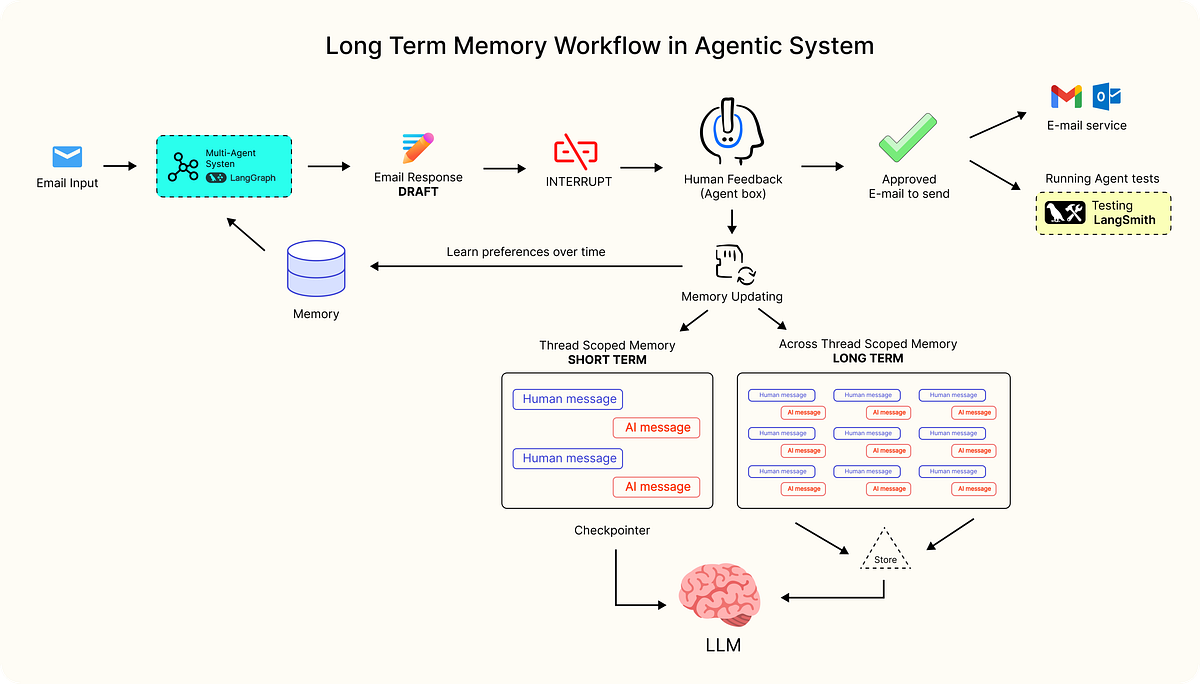
The second distinction is thread scope versus across-thread scope. Thread-scoped memory is this scene, this night, this dungeon. Across-thread memory is the campaign bible: preferences you stated once, lore you established in a different chat, a character you asked the model never to kill. Systems that only checkpoint the current thread will still “forget” when you start a new scene. Across-thread memory is what players mean by AI roleplay without dementia.
Extraction, then consolidation
Raw transcripts are noisy. A usable memory store extracts facts, then consolidates them against similar existing memories so you do not get three conflicting versions of the same event. Survey work on agent memory treats this store as the foundation for long-horizon interaction. For a game master, that means the dragon stays dead, the romance stays earned, and the villain’s secret stays secret until you reveal it.
Prompts that lock canon early
You do not need a special syntax. You do need to state what must never be forgotten.
"You are the game master. I am Captain Irena Voss, a one-eyed privateer who betrayed the Crown for the island of Vesper. Never reset her injury, her ship (the Night Heron), or her debt to the witch Marrow. Continue from the mutiny in the hold."
"Track inventory, NPC loyalty, and unresolved quests. If I contradict established canon, stop me and cite the earlier event."
"Keep three distinct NPC voices: Marrow (archaic, calm), First Mate Pell (blunt, loyal), and the Crown inquisitor (formal, cruel). Do not blend them."
Those instructions work because the memory layer can keep them. On a stateless chatbot, they expire as soon as the window slides.
Related Agents You'll Also Find Useful
If you want AI roleplay without dementia in adjacent stories — campus drama, survival horror, language immersion, or naming a cast — these agents extend the same continuity-first habit.
College Life
If you also want an open-world campus story where friendships, rivalries, and heartbreak emerge from your choices, College Life is the social sandbox version of long-form roleplay.
- Emergent relationships instead of a scripted route
- Social dynamics that should remember who you embarrassed at the party
- A setting that rewards continuity the same way a tabletop campaign does
The Mansion
If your next session is a locked-room mystery, The Mansion drops you into a house with no memory of how you arrived — while the system still needs to remember every room you searched.
- Exploration-driven horror and puzzle pacing
- Secrets that only stay fair if earlier clues are not rewritten
- A single location that becomes richer the more you return
Learn English Through Roleplay
If you are also using stories to practice a language, Learn English Through Roleplay turns every scene into vocabulary and grammar practice without breaking immersion.
- Scenario-based speech instead of flashcards
- Idioms and register that stick because the moment mattered
- The same demand for character consistency as a campaign
Name Generator
Before session one, Name Generator helps you lock culturally fluent names for people, ships, guilds, and places so the game master is not inventing a new spelling every chapter.
- Names for characters, brands, pets, and worlds
- Linguistic and cultural constraints when you need them
- A stable cast list you can paste into opening canon
Try Roleplay Game Master free — no credit card required.
How It Works
Step 1: Open a campaign, not a throwaway chat Start your AI game master with the facts that must survive every future session: your character, the setting, tone, and hard limits. Treat this as the campaign bible.
"Dark political fantasy, no comedy NPCs. I am a disgraced cartographer mapping a cursed coast. Magic is rare and always costs a memory. Begin in the archive the night before exile."
Step 2: Establish living canon Name the people who matter, what they want, and what already happened. Ask the game master to recap in a structured block you can correct once.
"List established facts: PC, allies, enemies, locations, open quests, and items. Flag anything you inferred versus anything I stated."
Step 3: Play the scene, then let memory consolidate Stay in character. Make choices. When you pause, the durable facts — who died, who was lied to, what you stole — belong in long-term memory, not only in the last twenty messages. That is the extraction-and-consolidation loop illustrated above, applied to fiction instead of a helpdesk ticket.
Step 4: Resume without a recap ritual Come back hours or weeks later and continue. A continuity-first game master should greet you with the world as you left it, not a polite amnesia.
"Continue from the cliffside bargain. I still owe Marrow a year of service. Pell does not know."
Step 5: Correct drift immediately If a name or fact slips, correct it in one line and demand the store be updated. Do not write a three-page recap as punishment. Persistent memory is supposed to make that labor unnecessary.
"Correction: the inquisitor's name is Halvern, not Halberd. Keep Halvern from now on."
Results & Use Cases
🎭 Multi-session pirate campaign
Scenario: You want a 20-session privateer chronicle with a stable ship, crew, and political map.
Traditional Approach: Paste a growing “memory” document into every new chat. When it exceeds the window, the first mate changes names and your mutiny never happened.
The AI game master: Crew roster, injuries, and unpaid debts remain true. You spend sessions on choices, not recaps.
- Canon that compounds instead of resetting
- NPCs who remember how you treated them
- A campaign you can actually finish
🏫 Campus story that remembers the party
Scenario: You are writing a slow-burn college drama and need last month’s embarrassment to still matter.
Traditional Approach: Each new thread reintroduces the roommate. The love interest forgets the fight.
College Life: Social fallout stays in the world. Combined with a continuity-first GM mindset, the semester has a plot rather than a loop.
- Relationships that evolve from specific incidents
- No “who are you again?” after a weekend off
- Open-world pacing instead of a visual-novel route lock
📱 Horror on the commute
Scenario: You play in ten-minute bursts on your phone between stops.
Traditional Approach: Mobile sessions are short, so the model never sees enough context. The mansion rearranges itself every train ride.
The same persistent roleplay agent on iOS or Android: You search the east wing on Monday and the bloodstain is still there on Wednesday. The Mansion is built for that kind of room-by-room dread; unlimited memory is what keeps the clues fair.
- Full feature parity on a phone
- Thread-scoped scenes plus across-thread lore
- No laptop-only “real” campaign
🗣️ Language immersion that does not break character
Scenario: You want to practice English (or another language) inside a noir mystery, not a textbook dialogue.
Traditional Approach: The tutor snaps into grammar mode and forgets the case you were solving.
Learn English Through Roleplay: The scene stays the scene. Corrections can happen in character. Vocabulary attaches to a moment you will remember.
- Immersion first, drill second
- Character voices that do not collapse into a generic tutor
- Practice you will actually return to
FAQ
What does “AI roleplay without dementia” actually mean?
It is player slang, not a medical claim. It means the model does not forget established facts: names, injuries, relationships, inventory, and prior scenes. Long-term conversational memory is still an active research problem, which is why so many generic chatbots feel like they have amnesia. A dedicated game master with persistent memory is the practical answer.
Is Roleplay Game Master free?
Yes. You can start on the free tier with no credit card. Higher tiers increase usage if you run long, daily campaigns. Pricing is usage-based rather than a per-character lock, so you are not paying a separate “memory add-on” to keep your own plot.
How is this different from Character.AI or a generic chatbot?
Character.AI draws tens of millions of monthly users, and many people use it for roleplay. The difference is the job. A general companion or chatbot optimizes for the next engaging reply. This roleplay agent is built to keep a world consistent: unlimited history, character continuity, and game-master control so canon does not dissolve when the context window fills.
Can the AI game master handle any scenario I imagine?
That is the design: complete creative freedom across mystery, romance, horror, political intrigue, slice-of-life, and sandbox play. State tone and boundaries up front. Continuity still depends on you correcting rare drift immediately so long-term memory stores the version you want.
Does AI roleplay without dementia work on mobile?
Yes. Sessions sync across web, iOS, and Android, including speech-to-text if you play hands-free. Short mobile bursts are exactly when persistent memory matters, because you cannot paste a 4,000-word recap on a train.
Is persistent memory the same as the model being “conscious”?
No. Long-term memory in AI is retained, structured information used to adapt later responses — extraction, consolidation, retrieval — not inner experience. That is also why you should treat continuity as an engineering feature you can inspect and correct, not as a person who “remembers you.”
Conclusion
AI roleplay without dementia is not a vibe. It is memory architecture: short-term scene state, long-term canon, extraction, consolidation, and across-thread recall so characters do not reboot. Generic chat windows were never built for a 30-session campaign. A game master that keeps names, scars, and promises is.
If you are tired of recapping your own story, try the AI game master now. Explore more at Jenova.
For Developers: Roleplay Game Master is available programmatically via the Jenova API — integrate persistent-memory roleplay into your application with a single API call. Full documentation →