AI Roleplay with Persistent Memory: Campaigns That Never Reset
2026-09-15
Roleplay Game Master helps you live inside AI roleplay with persistent memory by keeping every character, vow, and plot thread available when you return. While most chatbots drop the scar, the locket, and last week’s deal the moment you close the tab, this AI provides a campaign you can inhabit rather than a disposable scene. In September 2026, that gap is the difference between a clever reply and a world that still knows you on Tuesday.
✅ Persistent memory across sessions, not a longer prompt ✅ Characters, relationships, items, and lore that stay consistent ✅ Any genre or tone without restarting the chat ✅ Full roleplay on web, iOS, and Android
To understand why persistent memory matters more than a bigger context window, it helps to look at how most roleplay chats actually store — and lose — your story.
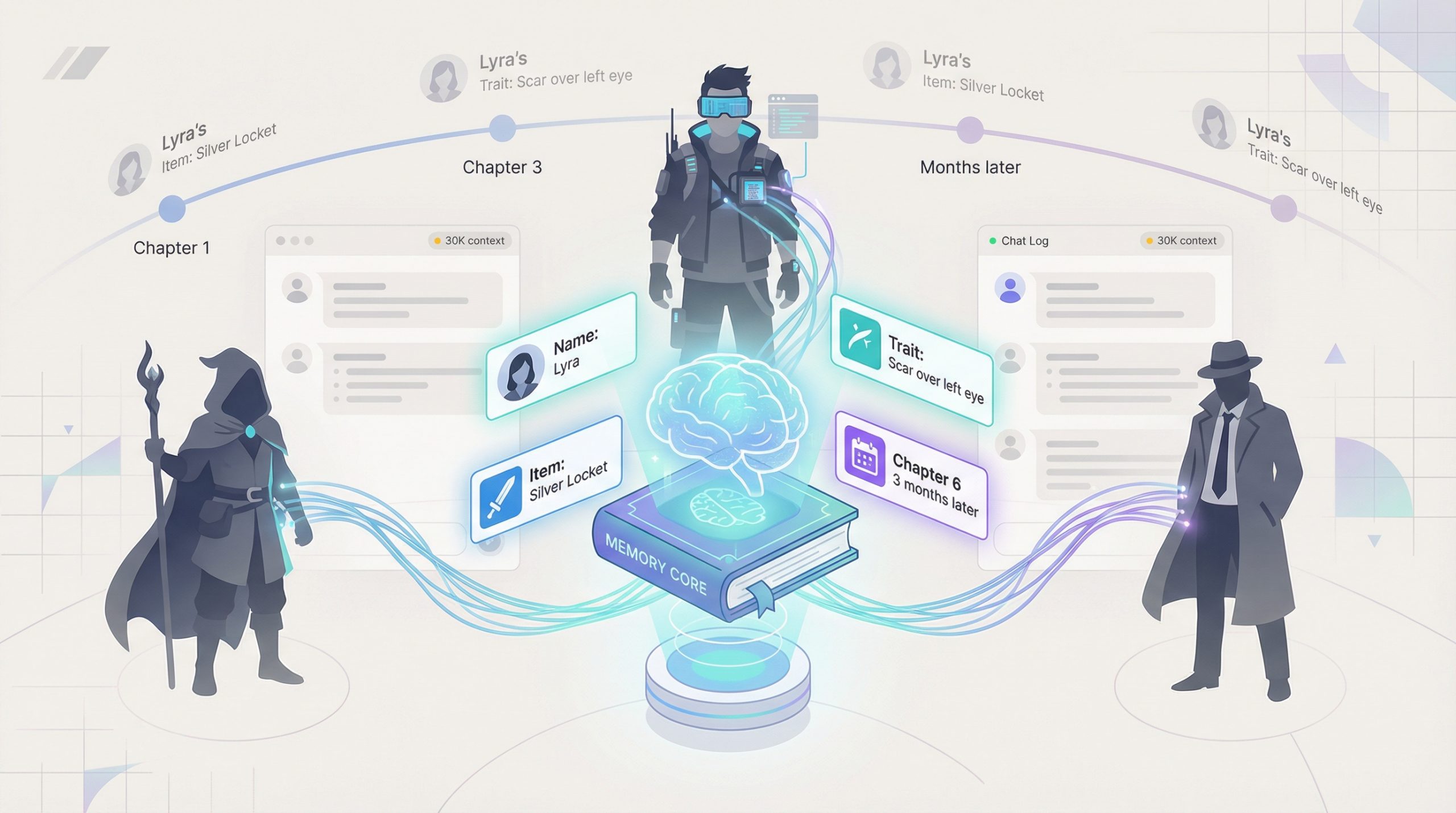
Quick Answer: What Is AI Roleplay with Persistent Memory?
AI roleplay with persistent memory is immersive character chat that stores story facts across sessions so plot, lore, and personality stay consistent instead of resetting. A dedicated game master goes further by treating that memory as campaign state, not leftover transcript.
Key capabilities:
- Keep NPCs, secrets, items, and unfinished promises available across weeks of play
- Hold voices, relationships, and world rules stable from scene to scene
- Continue a campaign without pasting a lore bible into every prompt
- Play fantasy, romance, mystery, or slice-of-life without starting a new chat to “fix” the bot
Why AI Roleplay with Persistent Memory Is So Hard to Find
Demand for companions and character chat is no longer a niche hobby. Industry estimates put the [**global AI companion market at $49.52 billion in 2026**](https://www.fortunebusinessinsights.com/ai-companion-market-113258), after a 2025 valuation of $37.73 billion. A parallel read from Grand View Research places 2025 at $36.8 billion and 2026 at $48.0 billion. People are showing up for long-running characters. Most products still cannot remember them.
But getting AI roleplay with persistent memory is frustratingly difficult:
- Session chat forgets the moment the window fills or the tab closes
- “Memory” is often a premium lock, not a story system
- Characters drift: names swap, tone flips, and promises vanish
- Players become unpaid archivists, maintaining recaps and lore docs
- Intimate story details may be treated as training data on other platforms
Forgetting is the default, not a glitch
A memory-enabled character should retain previous conversations, major decisions, introductions, and conflicts — the load-bearing facts of a campaign, as roleplay memory guides describe. Most chatbots do not work that way. They reread as much recent transcript as the window allows, then improvise the rest.
Without stored history, an agent cannot learn preferences, habits, or prior events, which makes tailored, long-horizon play nearly impossible. You feel it as Alzheimer’s AI: the innkeeper who forgets the bribe, the rival who no longer hates you, the romance that resets to stranger-level formality.
Memory is frequently sold back to you
Research on companion products finds a blunt commercial pattern. In the UK alone, the AI companion sector generated about £1.3 billion in 2024, with mixed-use roleplay platforms showing far stickier use than one-shot romance apps — on the order of 16 return visits per month.
The same analysis notes that premium tiers often sell extra storage so the companion can remember previous conversations. Continuity becomes a subscription hostage. You are not paying for better prose. You are paying so the character does not forget you.
£1.3 billion — UK AI companion sector revenue in 2024, with memory storage commonly gated behind premium plans
Privacy is part of the memory problem
Persistent roleplay only works if you can tell the story the plot requires. That means secrets, fears, and invented intimacies sitting in a log. A Stanford report on chatbot privacy is direct: users should worry. The Ada Lovelace Institute’s platform review found 14 of 16 companion services claiming broad rights to use user-generated content, including private chats, for model training.
The U.S. Federal Trade Commission has also opened an inquiry into consumer AI chatbots that act as companions — including how firms handle conversation data. For roleplay, the practical test is simple: can the world remember your campaign without turning that campaign into someone else’s training set?
This is exactly what a persistent-memory game master was built to solve.
Why Roleplay Game Master Remembers the Whole Campaign
Roleplay Game Master is built for immersive play with unlimited memory and stable characterization. It does not ask you to treat a raw transcript as a campaign bible. It keeps the world, the cast, and the unfinished business available so the next scene continues from what actually happened.
That is a different product from “a chatbot with a bigger window.” A context window is working memory. Persistent memory is the hard drive: facts, relationships, and developments you can retrieve when chapter six needs something from chapter one.
| Traditional Roleplay Chat | Roleplay Game Master |
|---|---|
| Memory dies when the window fills or the chat ends | Persistent memory across sessions |
| You maintain lore notes, recaps, and memory templates | Characters, items, deals, and plot threads stay available |
| Personality and relationship drift over time | Consistent characterization over long campaigns |
| Continuity sold as extra storage | Continuity treated as the core product |
| Start a new chat to “reset” the bot | One ongoing world you can leave and re-enter |
Persistent memory, not a stuffed prompt
Confusing a context window with memory is how campaigns die. Dumping every prior turn into the next prompt is expensive, noisy, and still lossy. A dedicated roleplay agent stores the facts that matter — a scar over the left eye, a silver locket, a promise made three sessions ago — and brings them back when the scene needs them.
You can leave a political intrigue for three days, return, and pick up the same alliances. You do not paste a 2,000-word recap unless you want to. The campaign state is the product, not a workaround.
A world graph, not a scrolling chat log
Long-form roleplay is an entity problem. Characters connect to places, objects, factions, and later developments. When those links are explicit, the story can pay off. When they live only in a rolling transcript, chapter six invents a new version of chapter one.

That graph is what players actually want from AI roleplay with persistent memory: not every word ever typed, but the durable network of who knows what, who owes whom, and what changed.
Character consistency that survives the next chapter
Long-form play collapses when an NPC’s voice slips. The stoic captain becomes chatty. The villain forgets their own threat. The love interest resets to small talk.
Here, personality, relationship dynamics, and established facts are load-bearing. Ask the agent to stay consistent with a promise made several sessions ago and it has the continuity to do it — the same way a human GM checks notes before sitting down.
Try prompts like these:
"You are the game master for a slow-burn political fantasy. I play a disgraced spymaster returning to a city that thinks I am dead. Track every NPC’s secret, alliance, unpaid favor, and physical detail."
"Three sessions ago, Lady Voss promised safe passage if I delivered the cipher. She just smiled at me in the marketplace. Stay consistent with that deal, her personality, and the silver locket I am still carrying."
"Continue from the rain-soaked archives. Do not resolve the missing prince. Keep my rival’s grudge from the duel, and let the city react to the rumor I planted last night."
Related Agents You'll Also Find Useful
If you want AI roleplay with persistent memory, you probably also want a tighter premise, a social sandbox, or language practice that feels like a story. These sit next to a campaign GM in a normal week of play.
Vesper Court
A lone woman wakes in a hidden vampire court with no memory of why. Dark romance, blood intrigue, and forbidden desire only work if last night still happened. If your GM campaigns lean gothic, this is the scenario-shaped version of the same hunger for continuity.
- Court politics that depend on who already knows your secret
- Romance that should remember a glance, a refusal, a bite
- A contained world for players who want structure around the improvisation
The Mansion
You wake in a mansion with no memory of how you arrived. Every room hides secrets; every shadow could be your last. Mystery roleplay is a memory test: clues, failed escapes, and NPC tells have to remain true or the house stops being a puzzle.
- Room-by-room investigation that depends on what you already found
- Tension that only works if earlier choices still count
- A strong fit when you want a closed map instead of an open campaign
Learn English Through Roleplay
If you already think in scenes, language practice does not have to be a textbook. This tutor runs immersive scenarios — any intensity — so idioms, grammar, and natural speech stick because the moment mattered, and because the café argument from Tuesday is still the café argument on Wednesday.
- Roleplay as the lesson, not a gimmick on top of drills
- Scenarios you actually want to stay in character for
- A practical way to keep a story habit while training a language
Try this AI game master free — no credit card required.
How AI Roleplay with Persistent Memory Works
You do not manage token budgets or write a memory template in a special syntax. You set the world, play, and return. Each step below is what you actually do.
Step 1: Open the agent and name the world Start a session with your AI game master and state genre, tone, and what “winning” or “living in” this story means. Specific constraints beat vague ones: slow-burn, no instant romance, lethal combat, grounded mystery — say it once, clearly.
"Run a grounded neo-noir in 1947 Los Angeles. I am a private investigator with a ruined reputation. Keep the city hostile, NPCs morally gray, and never hand me the killer in the first scene."
Step 2: Establish the facts that must never drift Introduce your persona, key NPCs, and non-negotiables: a secret identity, a limp, a debt, an item that cannot vanish. Treat this like session zero. Concrete facts are what persistent memory is for.
"I am Mara Chen, 29, former codebreaker. I limp from a bullet in the left thigh. Captain Alvarez distrusts me but owes me his brother’s life. Do not soften Alvarez, and do not forget the limp or the cipher half-burned in my coat."
Step 3: Play the scene — then leave and come back Roleplay normally. Make choices, fail, bargain, disappear for a day. Continuity is the test: when you return, ask the story to proceed from the last established state, not from a generic “we meet again.”
"Pick up in the archive stacks after the blackout. I still have the cipher. Lady Voss’s deal stands. What does the night watch actually do when they find the open window?"
Step 4: Steer continuity instead of restarting the chat When something matters, name it. Call out a promise, a clue, or a tone slip in one sentence. You are directing a GM who can remember, not rebuilding a bot that forgot.
"OOC: stay with the political plot. Do not skip to a fight. Remind me what I already know about the cipher, then continue in-character."
Results & Use Cases
These are the situations where AI roleplay with persistent memory either holds or collapses. The difference is whether last week’s scene still exists.
📊 Multi-week fantasy campaign
Scenario: You are running a 20-session political fantasy. Six NPCs have secrets. Two factions think you are an ally. One does not.
Traditional Approach: You keep a notes doc, paste recaps every few days, and still watch the GM forget the bribe that started the plot. Memory templates and fresh chats become part of the hobby.
Roleplay Game Master: The unpaid favors, the false name, and the duke’s smile in the marketplace remain available, so session 14 can pay off session 3.
- Campaign-length continuity without a second job as archivist
- NPCs who can hold a grudge
- Space to add factions instead of pruning them to save tokens
💼 Slow-burn character drama
Scenario: A rivals-to-allies arc. The turning point is a conversation from five nights ago that neither character has admitted mattered.
Traditional Approach: The model resets to witty banter. The almost-confession never happened. You re-explain the relationship until you stop caring.
This AI roleplay partner: Relationship facts stay in play. You can write the quiet scene because the loud one is still true.
- Emotional continuity, not just plot continuity
- Payoff scenes that depend on old dialogue
- Fewer “who are you again?” resets
Players who want that same continuity inside a darker, already-framed romance often move from custom campaigns into Vesper Court for a night of court intrigue that still has to remember yesterday’s bargain.
📱 Mobile roleplay between real-life scenes
Scenario: You play 10 minutes on the train, another 10 in line, then a longer scene at night. The thread has to survive interruptions.
Traditional Approach: A new phone session feels like a new bot. You reread the last page to remind it who you are.
The persistent-memory GM: Open the iOS or Android app, continue the same world, and spend the commute in the scene instead of reconstructing it.
- Full play on phone, not a cut-down companion mode
- Short sessions that still accumulate into a campaign
- No laptop required to keep lore straight
🎯 Mystery where clues must still count
Scenario: You found a locked drawer, a false name, and a bloodstain that does not match the official story. Tomorrow’s scene is worthless if those facts reset.
Traditional Approach: The house rearranges itself. Witnesses contradict last night. You stop trusting the puzzle.
The Mansion: Investigation roleplay that depends on what you already found — rooms, tells, failed escapes — so the mystery can actually resolve. Use it when you want a closed map; keep the open campaign for everything else.
- Evidence that survives the next login
- Atmosphere that builds across locations instead of resetting
- A contained test of the same memory hunger as a long GM game
FAQ
What is AI roleplay with persistent memory?
It is character-driven chat in which story facts — people, places, items, promises, and relationship shifts — are stored and reused across sessions, not merely reread from the latest transcript. A memory-enabled character should retain previous conversations, major decisions, introductions, and conflicts. The useful version is a campaign that remains consistent when you come back tomorrow, not a bot that only remembers the last few messages.
Is Roleplay Game Master free?
Yes. You can use it on a free plan with limited monthly usage and no credit card. Paid plans start at $20/month if you need more volume, custom model selection, and no watermarks. Higher tiers increase usage further. Start on free, then scale only if your campaigns actually need it.
How is persistent memory different from a long context window?
A context window is working memory: as much text as the model can see in one pass. Persistent memory is stored campaign state that can be recalled later. Without that layer, an agent cannot learn history or preferences in a durable way. You are not pasting a lore bible into every prompt to fake a GM.
Does AI roleplay with persistent memory work on mobile?
Yes. Play on the web or in the iOS and Android apps with the same story state. That matters more for roleplay than for one-shot Q&A: a campaign you can only continue at a desk is a campaign you will abandon. Voice-to-text is there when you would rather speak a reply than type it on a train.
Can it remember lore across multiple sessions?
That is the design goal — unlimited memory and character consistency across the stories you actually play. Very long dialogues are still a hard problem, so you will get better results if you state load-bearing facts clearly once, then correct drift in a single OOC line instead of restarting the chat. Name the scar, the locket, the debt. Memory needs something solid to hold.
Is my roleplay private?
On this platform, conversation data is not used to train public AI models, is encrypted in transit and at rest, and is not sold to advertisers. That stands in contrast to companion apps whose policies claim broad rights to use private chats for training. If you are putting a campaign’s secrets into a product, read that difference before you write the scene.
Keep the Story — Not Just the Last Message
Most AI roleplay fails in a boring way. The tab closes, the middle of the story goes dark, and the character you built becomes a stranger with the same name. A longer prompt helps until it does not. Persistent memory, used on purpose, is what lets a campaign exist.
Roleplay Game Master is the version of AI roleplay with persistent memory that treats continuity as the product: characters who stay themselves, plots that pay off, worlds you can leave and re-enter. Try it on the next scene you actually care about.
Explore more at Jenova.
For Developers: Roleplay Game Master is available programmatically via the Jenova API — integrate memory-persistent, character-consistent roleplay into your application with a single API call. Full documentation →