AI Roleplay Starter Generator: Instant Scene Hooks for Any Table
2026-09-13
Roleplay Game Master helps you generate a playable roleplay starter by assembling character, pressure, setting, and opening lines that already belong at your table. While most GMs and fiction writers still stall on the first beat—or spin disconnected prompt cards—this AI returns a scene you can start in one sitting. In September 2026, campaigns, drafts, and language sessions still die in the same place: nobody knows how the night begins. A dedicated roleplay starter generator closes that gap. You name the world and the stakes; it returns a hook, a speaker, and a reason to play now.
- ✅ Starters that match your genre, tone, and existing continuity
- ✅ Character, situation, and setting generated together—not as random cards
- ✅ Immediate play: opening lines, secrets, and what happens if nobody acts
- ✅ Same experience on web, iOS, and Android
Hand-built random tables still dominate session zero and the blank first page. To see why that workflow fails, look at how a scene actually has to start.

Quick Answer: What Is a Roleplay Starter Generator?
Roleplay Game Master is a roleplay starter generator that builds playable scene hooks, characters, and openings so you can begin a session without a blank page. You describe the table; it returns a first beat you can speak, write, or run.
Key capabilities:
- Combined character, situation, and setting instead of five unrelated spins
- Opening lines and secrets you can read aloud immediately
- Continuity that respects the campaign, draft, or language goal you already have
- Rewrites until the first line sounds like a person under pressure
The Problem With Random Prompts and Blank First Scenes
A good start is not flavor text. It is a person, a place, a problem, and a line someone can say before the dice hit the table. Educators have treated that cluster as a skill, not a mood: improv exercises that practice the parts of a story get ideas flowing and help students add structure, and Stanford teaching research has long argued that improvisation raises the quality of classroom exchange. Writers face the same freeze. Studies of how creative writers actually integrate AI show people already ask models for starting points and warm-up prompts—not because they want a machine to own the story, but because the first move is the expensive one.
Improv story games move writers through core literacy skills quickly — Research on collaborative improv and writing fluency
Imagination gains were largest for writers who struggled most with ideation — Analysis of AI use in fiction writing
But getting a starter that you can actually play is frustratingly difficult:
- Random wheels give a character, a situation, and a setting that do not share a world
- Genre tables ignore the campaign you already run
- Synopses are not opening lines
- Last session’s grudges never make it onto the prompt card
Prompt Wheels Isolate the Pieces That Have to Click Together
Classic generators treat a scene like five locked slots: character, situation, setting, style, space. That is useful for a warm-up. It is a weak campaign tool. An unapologetic travel agent who realizes they started the rumor, on a seaside pier, in physical theatre, for a raked audience, is a fun drill. It is not Friday’s dockside informant unless those facts share a motive, a secret, and a cost for staying silent.
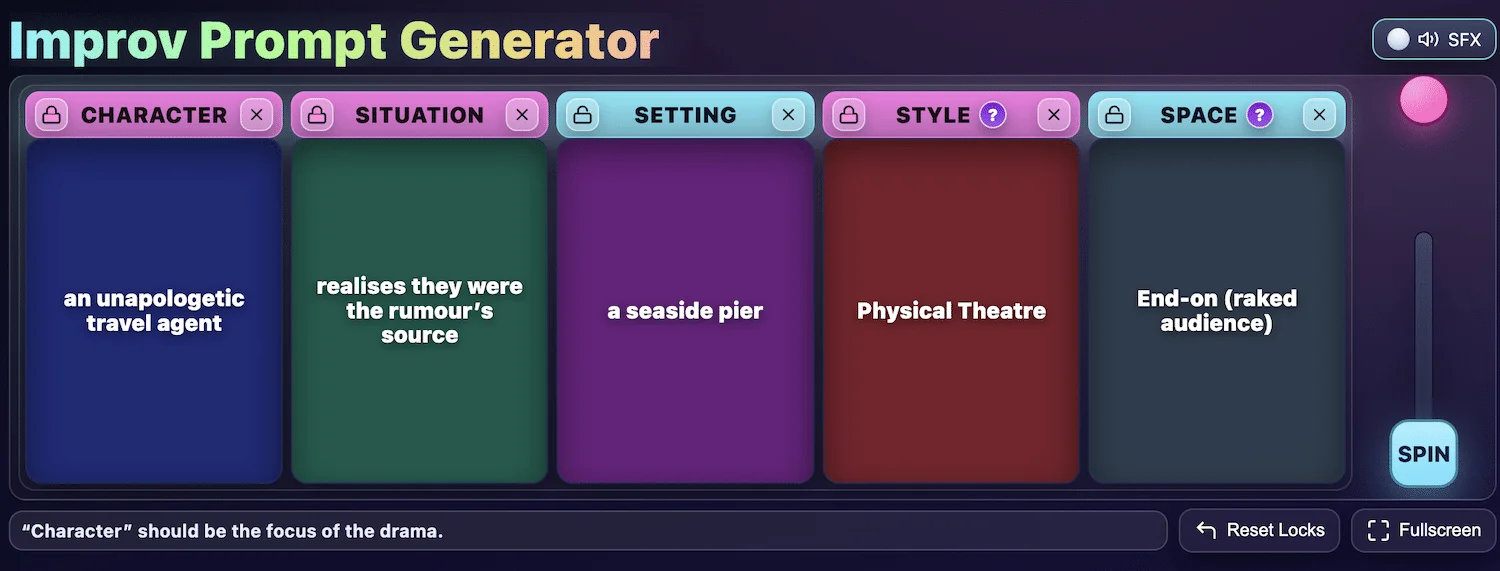
Short-form improvisation has been studied as a path into writing fluency because the pieces have to answer each other in real time. A spinner never does that work. You still have to invent why the travel agent is on that pier, and what happens if the rumor is true.
The Blank First Beat Kills Prep and Drafts
Interactive stories live or die on the opening choice. Designers of branching interactive fiction keep running into the same bottleneck: authored starts do not scale with player freedom. Interactive narrative research has treated that first fork as an AI problem for years, because a plot engine with no speakable opening still feels hollow. At the table, the cost is simpler. You spend the first twenty minutes describing a tavern that does not want anything.
Continuity Never Fits on a Random Card
A starter that ignores last week’s unpaid bribe is just another one-shot. Writers in long-running AI practice studies already use models to check “is this in character” and to build character templates before prose. Duke faculty writing on classroom practice make the same cut: AI is most defensible at the ideation and editing layer if the writer’s voice stays in charge. Random cards cannot hold a grudge. Your opener has to.
This is exactly what a dedicated roleplay starter generator was built for.
Why Roleplay Game Master Works as a Starter Engine
This AI game master is a standalone roleplay partner: unlimited memory, stable characters, and complete scenario freedom. You are not filling a template of “warrior / mage / rogue.” You are asking for a first scene that can threaten, bargain, flirt, confess, or shut down—then remembering what that opening cost you next session.
| Traditional Approach | Roleplay Game Master |
|---|---|
| Five disconnected prompt cards | One scene where character, place, and pressure share a cause |
| A paragraph of lore with no spoken line | An opening you can read in the character’s voice |
| Hours of prep for a cold open | A playable hook in a single sitting |
| Genre clichés that ignore last session | Continuity you pin: who lied, who left, what hums in the crate |
| A synopsis you still have to dramatize | Secrets, tells, and what happens if nobody acts |
A 2025 Oregon State study found AI can improve creativity in student writing when a human still sets the standard. That is the right split for a starter: the generator proposes the first beat; you keep the line only if it sounds like your table.
Generate the Whole Starter, Not Five Isolated Cards
Ask for the person, the place, the problem, and the first line in one pass. Specify social class, subtext, and what the character will never admit. Writers already use AI this way as an interactive muse—a source of sparks they still edit. You stay the GM. The generator stays the tireless cold-open machine.
"Give me a roleplay starter for a rain-soaked noir dock. Include the NPC, what they want, what they will not say, and the first three lines they speak if I arrive unannounced."
Fit the Hook to the Campaign You Already Have
Paste the facts that must survive: the crate that hums, the sergeant who took no bribe, the guest who already decided you are rude. Then demand an opening that uses those facts instead of a fresh tavern. Interactive fiction only collaborates with its audience when the next beat can change. A starter that cannot remember is not interactive. It is a random encounter with better adjectives.
"Remember: Hale logged my name and thinks the crate hums. Start the next scene 48 hours later at the same dock. Open in his voice. Do not reset."
Open on Pressure, Not Lore
The best first line carries threat, humor, or cultural mismatch in the same breath. Prompt for that mix. Ask what happens if the players do nothing. Play belongs in serious creative work; a dump of setting history does not. If the opener could be skipped without changing anyone’s week, it is not a starter. It is a brochure.
"Do not summarize the city. Open on the moment the travel agent realizes the rumor started with them. One block of spoken text, then what they do with their hands."
Rewrite Until the First Line Is Speakable
Research on AI-assisted fiction found the ideation lift is real, especially when a writer is stuck. Use that. Generate three cold opens, reject the clever one that nobody would say out loud, and keep the ugly true one. AI-powered co-creation studies keep returning to engagement: the value is the back-and-forth, not the first dump of text.
"Here are three opening monologues. Flag anything out of character, then rewrite the coldest one so a GM can read it in under twenty seconds."
Related Agents You'll Also Find Useful
If the starter has to become a shootable scene, Film Screenwriter takes the improvisation and shapes it into dramatic structure, subtext, and dialogue that can survive a page. Use it when table talk has to become a script.
- Concept through revision without losing the original pressure
- Character work that keeps the opener’s voice
- Visual storytelling so the first image matches the first line
If the conversation lives in panels instead of paragraphs, Comic Creator turns that hook into sequential art: balloon placement, page turns, and a first-page beat that matches the voice you already generated.
- Layouts that land the cold open on page one
- Consistent visual style across the scene
- Sequential rhythm so the starter is not just a caption
If the goal is fluency rather than fiction, Learn English Through Roleplay uses the same immersive-scene muscle for idioms, grammar, and natural speech. A starter is a rehearsal cue. You walk into the hotel complaint, the checkpoint, or the job interview already in character.
- Any scenario, including the odd ones random wheels invent
- Idioms attached to a moment you will remember
- Character consistency so the language lesson does not break
Try Roleplay Game Master free — no credit card required.
How to Generate a Roleplay Starter in Minutes
Step 1: Name the Table and the Missing Beat State who is playing, what genre you are in, and which moment you do not have. “Fantasy tavern” is weak. “Night-shift gate sergeant who already wrote the party up once this week, and they are smuggling a sealed crate” will talk. Open your scene partner with that level of grit.
"Scene: a frozen customs dock. You are Sergeant Hale, 20 years on the job. I am smuggling a sealed crate. You suspect me but have no proof. Give me a roleplay starter I can run in the first two minutes."
Step 2: Lock the Constraint a Random Wheel Cannot See Give the rules the spinner would ignore: no lore dump, no new city, never say the villain’s name, last session’s insult still stands. Writers who integrate AI well treat this as a decision point—they prompt when the vision is fuzzy and write through when it is not. Do the same with the opener.
"Stay in Hale’s voice: clipped, tired, no monologues. The starter must use the humming crate. If I insult you, you go colder, not louder."
Step 3: Demand a Playable Opening, Not a Synopsis Ask for the first spoken lines, one physical tell, one secret the NPC will not volunteer, and what happens if the players stall. That is the difference between a prompt card and a scene. Interactive narrative systems only feel alive when the next line can change.
"Do not pitch the adventure. Give Hale’s first three lines, what his hand does on the crate, and the consequence if we walk away."
Step 4: Capture Continuity for the Next Cold Open Paste the facts that must persist: who lied, who saw the crate, who is now an enemy. Unlimited memory only helps if you tell it what mattered. Next session, start from those facts instead of another random pier.
"Remember: Hale took no bribe, logged my name, and thinks the crate hums. Next starter is 48 hours later, same dock, in character."
Roleplay Starter Generator Use Cases
🎲 Tabletop Cold Opens in One Sitting
Scenario: You have a Friday game and no first beat for the dockside informant who knows about the missing cargo.
Traditional Approach: A page of bullet motives, a random tavern table, and a panic rewrite when a player asks something off-script.
The generator: You run three cold opens in advance, steal the speakable one, and keep the rest as improvisation fuel.
- In-character first lines you can read aloud
- A secret and a tell baked into the opener
- Continuity notes so next week’s starter is not a reset
✍️ First Pages When the Draft Will Not Start
Scenario: Two characters stall because every opening paragraph sounds like you, not them.
Traditional Approach: Stare at the blank, then write six versions of the same polite arrival.
A roleplay starter, then a craft pass: Improvise the entrance until someone finally says the cruel true thing. Lift that line into prose, or hand the scene to Film Screenwriter if you need act structure around the hook. Classroom evidence suggests AI helps most when a human still judges the result.
- Options when imagination stalls
- Openings that sound like people under pressure
- You still cut, order, and own the first page
📱 Language Rehearsal on the Train
Scenario: You have 15 minutes on your phone and want spoken English that is not a textbook shop dialogue.
Traditional Approach: Flashcards and listening drills, with almost no production.
Learn-by-playing: Generate a starter—a hotel complaint, a checkpoint, a seaside-pier rumor—then run it in Learn English Through Roleplay on iOS or Android. The character does not break. Neither does the commute.
- Idioms attached to a moment you will remember
- Immediate replies instead of waiting on a tutor slot
- Full feature parity with desktop, including voice input
🎬 Visual First Beats for Comics and One-Shots
Scenario: You need page one of a comic, not a paragraph of campaign notes.
Traditional Approach: A caption, a talking head, and a setting that does no work.
Starter first, panels second: Generate the spoken open and the physical tell, then move the same beat into Comic Creator so the first panel already contains the rumor, the pier, and the hands.
- A first page that starts mid-problem
- Dialogue that matches the roleplay voice
- Faster tests of whether the character is actually distinct
FAQ
What is a roleplay starter generator?
A roleplay starter generator is an AI that builds the first playable beat of a scene: who is there, what they want, where you are, and the opening lines someone can speak. Unlike a one-shot “give me a random prompt” wheel, a strong generator keeps those pieces in one world and can remember last session’s facts. Roleplay Game Master is built for that loop: you describe the table, it returns a hook you can run, and the next starter can continue the same pressure.
Is Roleplay Game Master free?
Yes. You can use it on the free tier with all core features and limited monthly usage. Paid plans raise that usage ceiling if you generate large batches of cold opens or run long campaigns. There is no requirement to enter a credit card to try a scene. Start with one stubborn first beat and see whether the voice holds.
How is this different from a random prompt wheel?
A prompt wheel isolates character, situation, and setting. You still have to invent why they belong together. A roleplay starter generator writes them as one scene, with spoken lines, a secret, and a cost for doing nothing. That is closer to improv that practices the parts of a story together than to five locked cards. You can still ask for wild combinations. You should not have to assemble causality by hand.
Can it create starters for any genre or system?
Yes. Fantasy study, neon city, alien first contact, seaside farce—there is no pre-built content pack you have to stay inside. Specify tone, intensity, and what must not appear. The output should feel like your table, not a generic quest board. If a line is off-genre, demand a rewrite the way you would correct a co-GM.
Does a roleplay starter generator work on mobile?
Yes. Roleplay Game Master runs with full feature parity on web, iOS, and Android, including speech-to-text if you would rather play the opener out loud. That is the practical setup for GMs who prep on a phone and for learners who want a scene that is not stuck to a desk.
Will the starters stay consistent with my campaign?
They stay consistent when you pin the facts that matter and correct out-of-character lines. Memory is unlimited, but it is not telepathy—tell it who lied, who left, and which subject is forbidden. Then keep the opening only if it sounds like your NPC. That human edit step is how working writers already keep AI from flattening their voice.
Generate a Roleplay Starter You Can Actually Play
Random cards, blank first pages, and taverns that want nothing cannot keep up with a table that expects the night to start on pressure. A roleplay starter generator that remembers, speaks in character, and opens on a real problem turns that freeze into a playable draft.
Roleplay Game Master gives you that draft on demand: sergeants who go cold, informants who hedge, travel agents who started the rumor themselves. Write the constraint. Demand a spoken line. Keep what you would actually run.
Try Roleplay Game Master now. Explore more at Jenova.
For Developers: Roleplay Game Master is available programmatically via the Jenova API — integrate roleplay starter generation into your application with a single API call. Full documentation →