AI Roleplay Retcon: Rewrite Story Canon Without Breaking Continuity
2026-10-19
Roleplay Game Master lets you perform an AI roleplay retcon, which means rewriting something that already happened in your story. It keeps the full session history and carries the change through every character, location, and plot thread that depended on the original version. Many chatbots ignore the correction or slip back to the old version a few scenes later. This AI treats your revised canon as the new baseline.
For roleplayers running long campaigns in October 2026, that matters most when a story needs its first major revision.
- ✅ Built for unlimited memory and consistent characterization across long sessions
- ✅ Accepts plain-language retcons, so you don't have to restart or hand-edit your history
- ✅ Supports any genre and any scenario
- ✅ Available on web, iOS, and Android, with sessions synced across devices
A retcon (short for "retroactive continuity") is a common tool in comics, TV, and tabletop campaigns. In AI roleplay it is harder, because the model has to change one fact and then rework everything that followed from it. Before looking at how to retcon well, it helps to see why most attempts fail.
Quick Answer: What Is an AI Roleplay Retcon?
An AI roleplay retcon is a deliberate revision of established story facts during a session. The AI rewrites canon and updates every dependent detail so the story continues as if the new version had always been true.
Key capabilities of a retcon-capable AI:
- Removes, adds, or revises past events from a single out-of-character instruction
- Updates character knowledge, relationships, injuries, and inventory to match the new canon
- Avoids "retcon bleed," where the discarded version creeps back in later
- Tells the difference between a deliberate rewrite and a continuity error it should simply fix
Why AI Roleplay Retcons Usually Fail
Roleplay is now a subject of serious research. Researchers have analyzed real-world Character.AI chat sessions, studied user experiences on role-playing chatbot platforms such as Xuanhe AI, and proposed AI role-play as a formal research methodology for complex, multi-stakeholder scenarios. The commercial side is growing just as fast:
$8.5 billion: Projected global revenue from agentic conversational AI services by 2030, roughly triple today's level
**$27.29 billion**: [Forecast global chatbot market by 2030, up from $7.76 billion in 2024](https://wytlabs.com/blog/chatbot-statistics/)
That Springer survey focuses on illustrated storybooks, but its central point applies directly to roleplay: a lack of consistency "can disrupt the reader's engagement, resulting in confusion or disengagement." The same authors also found that most advances remain fragmented and miss the cross-dimensional interactions that drive real inconsistencies. A retcon is exactly that kind of interaction. When you change one event, time, character, and plot all shift with it.
But keeping a revised canon intact is frustratingly difficult:
- Retcon bleed. The AI accepts the change, then reverts to the old version 20 turns later.
- Knowledge leakage. Characters "remember" an event that no longer happened.
- Orphaned consequences. You erase the ambush, but the wound from it is still mentioned.
- Collateral rewrites. The AI over-corrects and changes facts you never asked it to touch.
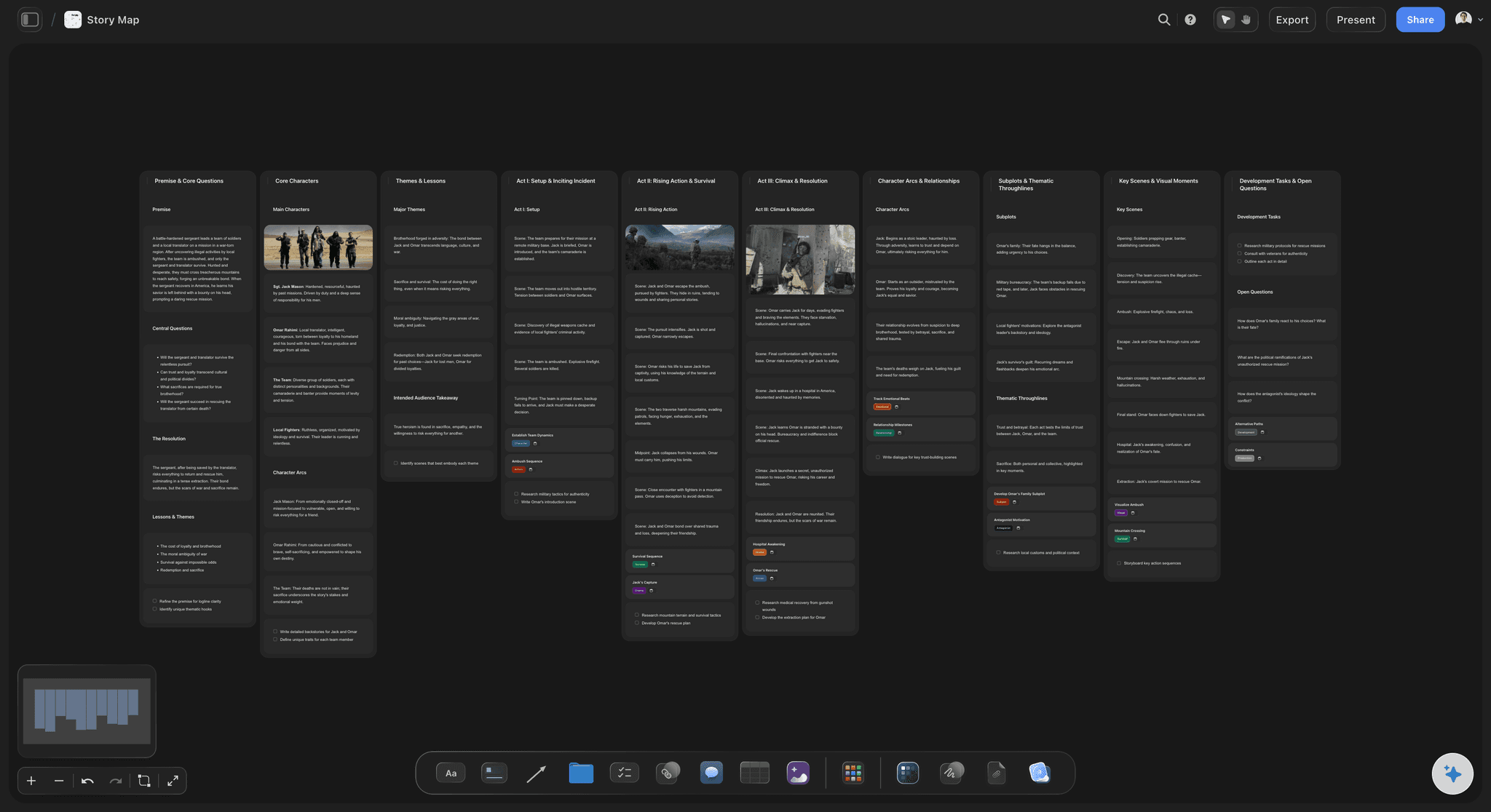
The Three Types of Roleplay Retcon
A story map like the one above shows why retcons spread. Each card under premise, characters, acts, and arcs connects to cards in other columns. Changing one card can affect several others, and the type of retcon determines how far the change reaches:
| Retcon Type | Example | What the AI Must Update |
|---|---|---|
| Additive | "The innkeeper was a spy all along." | Reinterpret past scenes and plant retroactive clues, without deleting events |
| Subtractive | "The dragon attack never happened." | Remove the event and all downstream consequences: injuries, deaths, grudges |
| Revisionary | "Mira didn't betray the guild. She was captured." | Swap the cause, then rewrite every character's understanding of it |
Additive retcons are the easiest for an AI because nothing has to be deleted. Revisionary retcons are the hardest, since the event still happened but every character's interpretation of it must change. This is what Roleplay Game Master was built for.
Why Roleplay Game Master Handles Retcons Cleanly
Roleplay Game Master is an immersive roleplay partner with unlimited memory and a focus on character consistency. Because it keeps your full history, it can apply a retcon to the whole story instead of only the latest message. That is why the revision holds up over later scenes.
| Traditional Approach | Roleplay Game Master |
|---|---|
| Restart the chat and replay hours of scenes to remove one event | State the retcon in one message and keep playing |
| Manually paste a "corrections" summary every few turns | Corrections persist because the full history is retained |
| Characters lose their voice after a context reset | Personalities, speech patterns, and motives stay intact |
| Short context windows silently drop early lore | Early setup remains available when the AI reworks later events |
Full-History Memory Makes Ripple Edits Possible
Research on role-playing language models has found that AI personas give more realistic and accurate responses when recent user history is included in the prompt. Retcons need even more than that. The AI has to see the original event, everything that followed, and your correction together. With unlimited memory, all three are always in view.
Characters Stay in Character After the Rewrite
A clean retcon changes what characters know without changing who they are. If your revisionary retcon turns a betrayal into a capture, the paranoid quartermaster should still be paranoid. Now he is paranoid about who sold Mira out. Roleplay Game Master keeps each character's established voice and motives while updating their knowledge.
Treat Narrative Consistency as Structure
Academic work on AI storytelling describes architectures that put semantic alignment, temporal coherence, and narrative consistency at the center of generation. In practice, you get better retcons when you give the AI structure: a canon summary, explicit retcon markers, and a request to confirm what changed.
Stress-Test Continuity Before a Long Campaign
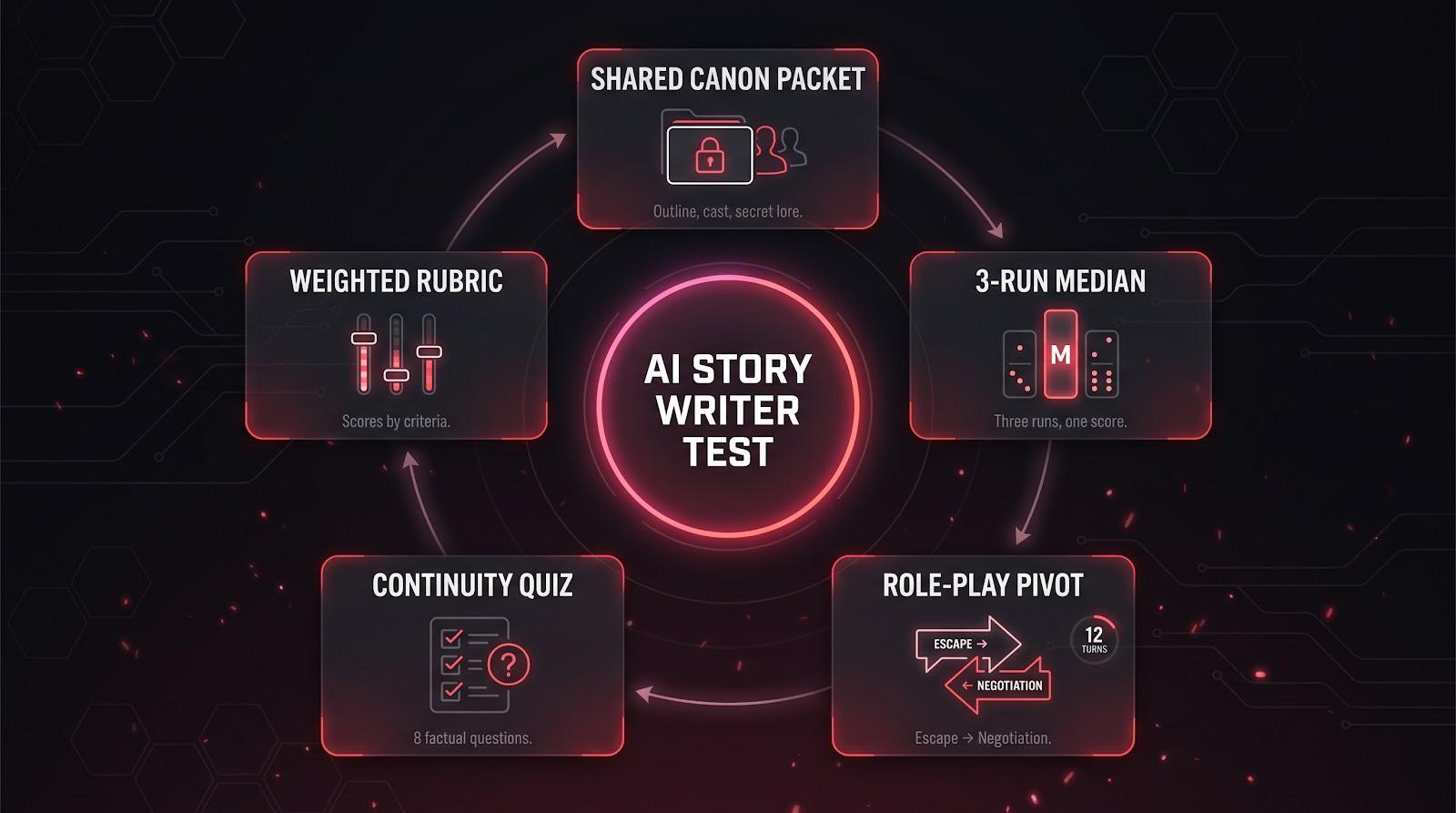
The framework above gives you a practical way to check whether an AI roleplay setup can hold a retcon:
- Shared canon packet: an outline, cast list, and secret lore that the AI must respect
- 3-run median: run the same scene three times and score the middle result, which filters out lucky or unlucky generations
- Role-play pivot: shift a scene from escape to negotiation over 12 turns, which is a natural place to introduce a retcon
- Continuity quiz: eight factual questions about the story, asked after the retcon
- Weighted rubric: score continuity, character voice, and prose quality by importance
Example retcon prompts:
"OOC: Retcon. Mira never betrayed the guild. She was captured at the docks. Update what every character believes happened, then continue the scene."
"OOC: The dragon attack in the village never happened. Remove Toren's burn scar and the townsfolk's fear of the north road."
"OOC: Additive retcon. The innkeeper has been a crown spy since chapter one. Don't change past events. Show me two earlier moments that now read as clues."
One honest limitation: explicit, scoped retcons work much better than vague ones. If you want to rewrite most of a story, starting a fresh session with an updated canon packet is often cleaner than stacking many retcons.
Related Agents You'll Also Find Useful
If a roleplay grows into something you want to publish, illustrate, or play differently, these agents fit naturally into the same workflow.
Creative Fiction Writer Once a campaign's canon is settled, this agent can help you turn it into polished prose. It is useful when you want the retconned version of events to become the official manuscript.
- Editorial feedback on structure, pacing, and voice
- Research support for authentic settings
- Help from first draft through final manuscript
Manga Creator If you want to see your story, this agent adapts narratives into manga, with attention to panel flow and a consistent art style. Character consistency carries over from text to visuals.
- Visual storytelling and panel layout
- Consistent character art across chapters
- Formats from one-shots to long serialized epics
Love Island For roleplayers who enjoy emergent social drama, this open-world romance scenario places you on an island with eight strangers. Connections and rejections develop from your choices.
- Open-world romance with emergent dynamics
- Branching relationships driven by player decisions
- A ready-made setting when you want to play rather than build lore
Try Roleplay Game Master free, with no credit card required.
How to Retcon an AI Roleplay Step by Step
Step 1: Establish Canon Up Front Start by giving the AI a short canon summary covering your main cast, key locations, and any secrets. This becomes the baseline it measures every later change against.
"Before we begin: the setting is a flooded port city. Mira is a guild thief, Toren is a disgraced knight, and the harbormaster secretly works for the crown."
Step 2: Play Until Something Needs Changing Open Roleplay Game Master and play normally. Retcons usually come from a scene that went somewhere you regret, such as a character death or a twist that closes off better options.
Step 3: Declare the Retcon Explicitly and Scope It Mark the instruction as out-of-character and name the type of retcon. Say clearly what changes and what must stay the same.
"OOC: Revisionary retcon. The fight on the bridge still happened, but Toren lost on purpose to protect Mira. Keep everything else from that scene."
Step 4: Request a Ripple Check Ask the AI to list every downstream detail it updated. This catches orphaned consequences before they cause problems later.
"Before continuing, list which characters' knowledge and relationships changed because of this retcon."
Step 5: Verify With a Continuity Quiz A few scenes later, ask a handful of factual questions about the revised events. If the answers match the new canon, the retcon has held.
Results & Use Cases
🎲 Rescuing a Long Fantasy Campaign
Scenario: Two hundred turns in, a key mentor dies in a scene you rushed. Traditional Approach: Restart the session and replay dozens of scenes, or accept the death and work around it. Roleplay Game Master: A subtractive retcon brings the mentor back. Grief-driven dialogue is removed, and the campaign continues from the current scene.
- No replaying earlier sessions
- Other characters' arcs remain intact
- The ripple check confirms what changed
🕵️ Planting a Twist After the Fact
Scenario: Midway through a mystery, you decide the friendly harbormaster should be the villain. Traditional Approach: The reveal feels unearned because no clues were planted. Roleplay Game Master: An additive retcon reinterprets earlier scenes and points out moments that now work as foreshadowing.
- Past events stay the same; only their meaning changes
- The twist lands as if it had been planned from the start
📱 Fixing a Scene on Your Phone
Scenario: On a commute, you notice the AI has quietly dropped a companion from the party. Traditional Approach: Wait until you're at a desk to scroll back and rewrite. Roleplay Game Master: Type a one-line out-of-character retcon in the mobile app. The fix syncs to every device.
- The same experience on iOS, Android, and web
- Speech-to-text works for quick corrections
✍️ Cleaning Canon Before Drafting a Novel
Scenario: You want to turn a roleplay into a novella, but the transcript contradicts itself. Traditional Approach: Audit the transcript by hand and track contradictions in a spreadsheet. Roleplay Game Master: Retcon the contradictions in-session, then bring the clean canon to a fiction-writing partner for drafting.
- One consistent source of truth
- A straightforward handoff from play to prose
Frequently Asked Questions
What does retcon mean in AI roleplay?
A retcon, or retroactive continuity, is a deliberate change to facts already established in a story. In AI roleplay, you tell the AI that an earlier event happened differently or never happened at all. The AI then updates characters, relationships, and consequences so the story continues consistently. A good AI roleplay retcon reaches every detail that depended on the old version, not just the next reply.
Why does my AI roleplay keep forgetting or contradicting earlier events?
Most contradictions come from limited context. When early scenes drop out of the model's working memory, it fills the gaps with plausible but wrong details. That produces accidental retcons, the kind you didn't ask for. AI roleplay tools with unlimited memory keep the full history available, which reduces drift and makes intentional retcons more reliable.
Can an AI game master undo something that already happened?
Yes, if the retcon is explicit. Mark the instruction as out-of-character, state what changed, and say what should stay the same. Then ask the AI to list the downstream details it updated. This works for subtractive retcons that erase events, revisionary retcons that change causes, and additive retcons that reveal hidden truths.
What's the difference between a retcon and regenerating a response?
Regenerating replaces only the most recent reply, and it works best right after a bad response. A retcon changes something further back, often dozens or hundreds of turns earlier. It requires the AI to rework everything that happened since. Use regeneration for small, immediate fixes and retcons for structural story changes.
Can I turn a retconned roleplay into a finished story?
Yes. Once your canon is consistent, you can adapt the roleplay into prose with Creative Fiction Writer, which helps with structure, pacing, and polished drafting. Clean up contradictions with retcons first so the manuscript starts from a single, reliable version of events.
Does AI roleplay with retcons work on mobile?
Yes. Jenova offers the same features on web, iOS, and Android, and sessions sync across devices. You can start a campaign on desktop, apply a retcon from your phone, and pick up later on any device with the revised canon intact. Speech-to-text also makes quick out-of-character corrections easy while you're away from a keyboard.
Conclusion
Retcons are a normal part of storytelling. Stories change as they develop, and the AI should be able to follow those changes. Most AI roleplay setups have trouble because they treat a correction as a single message instead of a change to the whole canon. The result is retcon bleed, characters remembering events that no longer happened, and consequences that outlive their causes.
A clean AI roleplay retcon needs three things: full-history memory, explicit and scoped instructions, and a habit of verifying continuity. With those in place, you can revise a story mid-session and still keep it consistent.
Try Roleplay Game Master now to rewrite your story's past without losing continuity. Explore more at Jenova.
For Developers: Roleplay Game Master is available programmatically through the Jenova API, so you can add long-memory, continuity-aware interactive storytelling to your application with a single API call. Full documentation →