AI Roleplay Repetitive Responses: Causes, Fixes & Better Prompts
2026-10-18
Roleplay Game Master helps you run long, immersive stories without the loops. It combines unlimited memory with consistent character tracking, so the narrative keeps moving instead of circling back. As of October 2026, AI roleplay repetitive responses remain one of the most common complaints from people who use AI for collaborative fiction. The same smirk, the same catchphrase, and the same "What should we do next?" can show up three replies in a row. This AI is built as a dedicated game master: it remembers what happened, keeps characters in voice, and pushes the story forward.
- ✅ Unlimited memory, so earlier plot points and character details stay available
- ✅ Character consistency across long campaigns and multiple sessions
- ✅ Complete creative freedom across fantasy, mystery, horror, sci-fi, romance, and more
- ✅ No sampler settings to tune. You write the story and the agent handles continuity.
Repetition is not random bad luck. It comes from how language models generate text and how most chat interfaces handle memory. Once you understand the mechanics, the fixes make sense, whether you are rescuing a stalled campaign or starting a new one. Let's look at why AI roleplay falls into loops and what actually breaks them.

Quick Answer: What Causes AI Roleplay Repetitive Responses?
AI roleplay repetitive responses happen when a language model reinforces its own earlier phrasing and loses track of story context. A dedicated AI game master with persistent memory and active narrative direction breaks this cycle.
The most reliable fix combines better scenario setup with a tool designed for long-form continuity, such as Roleplay Game Master.
Key capabilities that counter repetition:
- Unlimited memory that keeps past events, promises, and relationships available
- Consistent character voices that don't flatten into one recycled catchphrase
- Game-master pacing that introduces complications instead of waiting for you to drive every beat
- Open-ended scenarios with no genre restrictions, so stories have room to evolve
The Problem: Why AI Roleplay Falls Into Loops
Repetition is a documented, structural tendency of language models, not just a quirk of one app. Researchers have a name for it: the "Repeat Curse". A 2025 arXiv study describes how large language models "often suffer from repetitive text generation" that reduces both the quality and diversity of their output. Users notice it too. Review summaries for one popular character chat platform show people frequently complain that its chatbots have become completely repetitive and suffer from poor memory. In roleplay communities, the verdict is blunter:
.39% higher task success, 84% fewer tokens: Reported gains from proper context management in multi-turn AI conversations
But keeping a long roleplay fresh is frustratingly difficult:
- Loops reinforce themselves. Apple's machine learning research found that models prefer to repeat the previous sentence. The more often a sentence appears in context, the more likely the model is to generate it again.
- Most chatbots are stateless. LLMs don't remember previous exchanges unless that history is explicitly provided. When older story beats drop out, the model falls back on safe, generic moves. Chatbots are stateless and siloed by design, which is why many tools seem to forget you.
- Names and catchphrases become anchors. In the Repeat Curse study, names were the features most likely to trigger repetition. That is a real problem in roleplay, where character names appear in nearly every reply.
- Errors snowball. Without careful context handling, "context poisoning" sets in: a single mistake gets repeated and compounds into bigger inconsistencies.
Why Tweaking Settings Rarely Solves It
Many roleplayers first reach for temperature or repetition-penalty sliders. Research suggests these are blunt instruments. Decoding fixes like repetition penalties and nucleus sampling can reduce repetition but may compromise the model's overall performance. In one engineer's production case study, a 46% reduction in prompt length eliminated degeneration entirely, while parameter changes had zero effect. What the model sees matters more than how it samples.
Diagnosing Your Loop
| Symptom | What's Happening | What Helps |
|---|---|---|
| Every reply opens the same way ("She smirks…") | Self-reinforcing sentence patterns | Break the pattern immediately with an out-of-character (OOC) note |
| Character repeats their name or catchphrase | Name and phrase anchoring | Define a voice range, not a single tic |
| Bot re-asks things you already settled | Older context dropped or truncated | Persistent, long-term memory |
| Story circles the same scene | No narrative pressure or stakes | A game master who introduces complications |
| A wrong detail keeps resurfacing | Context poisoning | Correct it out of character right away |
The causes are structural: the model reinforces its own patterns, loses track of the story, and waits for you to supply momentum. Fixing them takes both better technique and a tool built for long-form continuity. This is exactly what a dedicated AI game master is built for.
Why Roleplay Game Master
Roleplay Game Master is an immersive roleplay partner built for long campaigns. It targets the three root causes above. Unlimited memory keeps the story's history available, so the model isn't forced to improvise from a thin slice of recent replies. Character consistency keeps voices distinct, and the game-master framing gives the narrative forward motion instead of leaving every decision to you.
The result is a roleplay that builds on itself: callbacks to chapter one, NPCs who remember slights, and plot threads that pay off.
| Traditional Approach | Roleplay Game Master |
|---|---|
| Bot forgets early plot points once the chat gets long | Unlimited memory keeps the full story available |
| Characters flatten into one catchphrase or mannerism | Built for consistent, distinct character voices |
| You drive every beat while the bot reacts passively | Game-master pacing introduces complications and new threads |
| Hours spent tweaking temperature and penalty settings | No settings to tune; you focus on the story |
| Each new session feels like starting over | Return to a campaign and pick up where you left off |
Memory That Moves the Story Forward
Repetition often fills a vacuum: when a model can't see what came before, it reaches for its most probable, safest phrasing. With unlimited memory, this AI can reference the dagger you pocketed forty scenes ago or the promise a character made in session one. That gives every reply concrete material to build on.
Characters Who Stay Themselves Without Looping
Consistency and repetition are different things. A consistent character reacts in recognizable ways across very different situations. A repetitive one says the same line in every situation. The agent is designed to hold personality, history, and relationships steady while varying expression.
"Run a dark fantasy campaign. My character is a disgraced knight. Keep the innkeeper NPC suspicious of me until I earn her trust, and let that change slowly."
Complete Creative Freedom
Stories loop faster when the AI keeps steering away from where you want to go. Roleplay Game Master supports any genre and scenario you can imagine, from sprawling naval adventures to tight psychological thrillers. You get room to escalate, twist, and explore.
"Start a 1920s noir mystery. I'm a private investigator. Introduce three suspects with conflicting alibis and don't reveal the culprit until I solve it."
Related Agents You'll Also Find Useful
If you enjoy interactive storytelling, these agents extend the same experience in different directions.
Creative Fiction Writer If you're also turning your roleplay campaigns into written stories, this agent works as a storytelling partner from first draft to final manuscript.
- Original fiction across any genre
- Deep research for authentic worlds
- Editorial insight and polished prose
The Mansion For a structured, self-contained adventure, this interactive horror-mystery starts you in a mansion with no memory of how you arrived.
- Rooms full of secrets to uncover
- Escalating tension and danger
- A clear goal: find the truth and escape
Learn Spanish Through Roleplay If you're also learning a language, this agent turns immersive scenarios into practice where vocabulary sticks because the moments matter.
- Fully immersive scenarios on any theme
- Grammar and vocabulary learned in context
- Complete creative freedom over the story
Ready to break the loop? Start a free session with the AI game master. No credit card required.
How to Fix Repetitive AI Roleplay: Step by Step
These steps work best with a memory-capable agent, and the techniques improve any roleplay. Open a session with Roleplay Game Master and follow along.
Step 1: Establish the Scenario, Roles, and Rules Up Front
A vague opening forces the model to guess, and guessing produces generic, repeatable replies. State the setting, era, your role, the AI's role, and how you'll communicate out of character. The example below shows a strong setup: it covers the world, the stakes, and the relationship, and it invites clarifying questions.
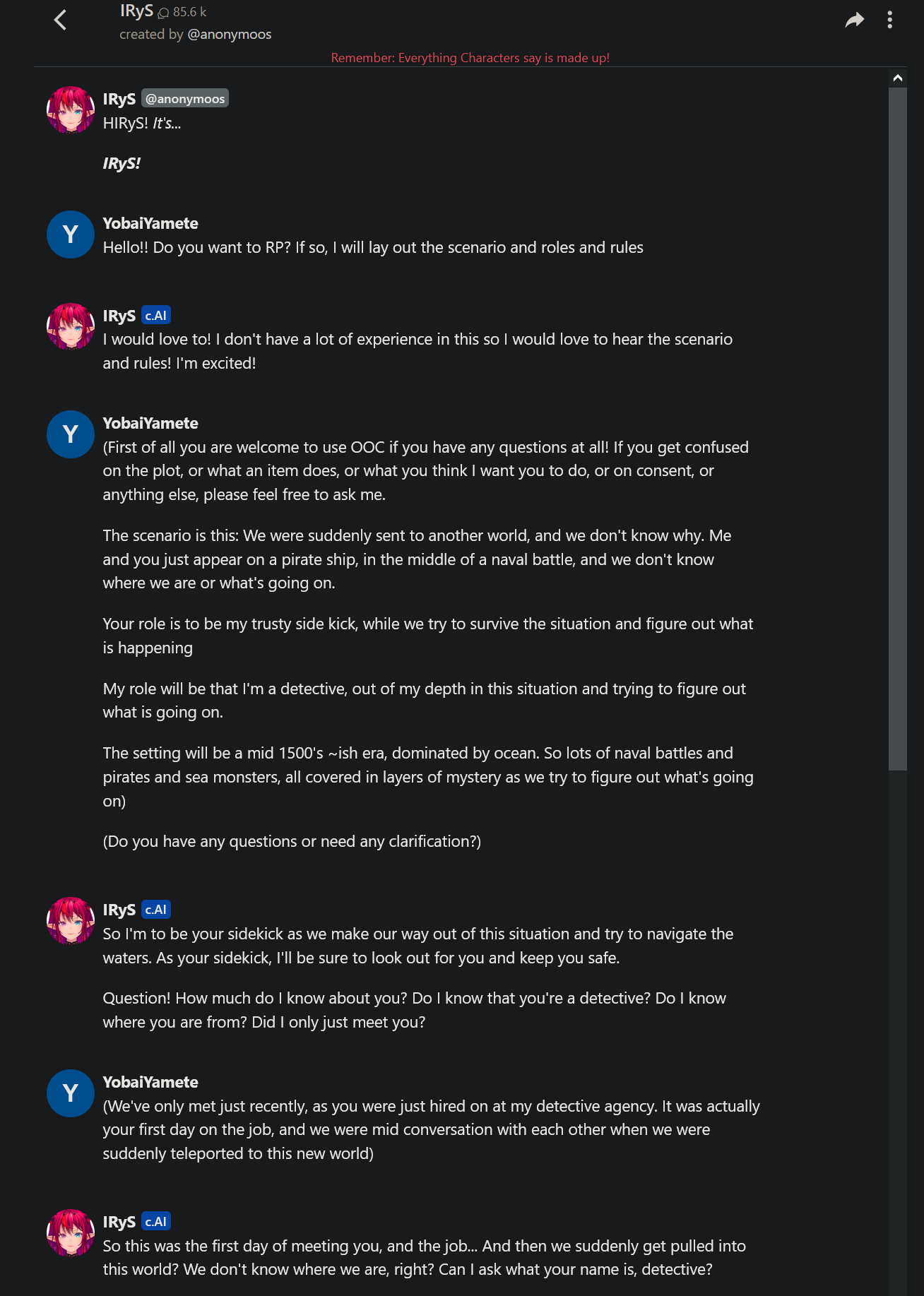
Notice how the character asks what it already knows about the user. Settling relationship history early removes a whole category of later re-asks.
"Setting: mid-1500s ocean world full of pirates and sea monsters. I'm a detective transported here mid-conversation with my new assistant, which is you. We've known each other one day. Use (OOC) for questions."
Step 2: Give Characters a Voice Range, Not a Catchphrase
Since names and stock phrases are strong repetition triggers, describe how a character reacts under different pressures instead of handing them one signature line. Range gives the model varied material to draw from.
"My sidekick is cheerful when things are calm, terse and focused in danger, and sarcastic when she's scared. Never give her a recurring catchphrase."
Step 3: Build In Forward Motion
Loops thrive when nothing is at stake. Give the story an open question, a ticking clock, or a rival with an agenda, and let the game master introduce complications.
"Introduce a complication every few scenes: a betrayal, a storm, a rival crew. Keep at least one unresolved mystery running at all times."
Step 4: Break Loops the Moment They Appear
Repetition is self-reinforcing: the more a pattern appears in context, the more likely it is to repeat. Every generated token becomes part of the context for the next prediction. Don't let a repeated opener survive three turns. Flag it immediately.
"(OOC: You've opened the last few replies with a description of the wind. Vary sentence openings and move straight into action or dialogue.)"
Step 5: Return to the Campaign Instead of Restarting
Restarting throws away the history that makes replies specific. With unlimited memory, you can come back days later and continue the same thread, so callbacks and character arcs pay off.
"Let's continue our pirate campaign. Remind me where we left off with the mutiny subplot, then pick up the scene."
Results & Use Cases
⚔️ Long-Running Fantasy Campaign
Scenario: A player runs a weekly fantasy campaign that has grown to hundreds of messages, with recurring NPCs and political intrigue.
Traditional Approach: The bot forgets early allegiances, NPCs reset to default personalities, and the player spends each session re-explaining backstory.
With Roleplay Game Master: Earlier alliances, betrayals, and debts stay in play, so NPC reactions build on history.
- Callbacks to early scenes arrive naturally
- NPCs stay distinct instead of merging into one voice
- Sessions start with momentum instead of recap
🔍 Mystery and Detective Stories
Scenario: A user runs a detective mystery where clues must stay consistent for the solution to make sense.
Traditional Approach: Clues contradict each other, suspects repeat the same alibi lines, and the reveal falls flat because the model lost track of what it set up.
With the AI game master: Clues, alibis, and red herrings stay consistent from introduction to reveal.
- Suspects respond differently under different questioning
- Planted details pay off at the climax
- Contradictions are far less likely to undermine the solution
📱 Roleplay on the Go
Scenario: A commuter continues a sci-fi story in short bursts on their phone during the daily train ride.
Traditional Approach: Short, fragmented sessions make memory gaps worse. Each burst feels like starting over, and the bot reaches for the same filler lines.
With the AI game master: The story continues seamlessly across web, iOS, and Android, so a five-minute session picks up exactly where the last one ended.
- Full feature parity across devices
- Settings and story continuity sync automatically
- Speech-to-text for hands-free story input
✍️ From Roleplay to Manuscript
Scenario: A writer wants to turn a favorite roleplay arc into a short story.
Traditional Approach: Copying chat logs into a document and manually untangling repeated phrasing and inconsistent details.
With the AI game master plus Creative Fiction Writer: The consistent campaign becomes clean raw material, and the fiction partner shapes it into polished prose.
- Less cleanup thanks to fewer loops in the source material
- Editorial guidance on structure and pacing
- A clear path from play to publishable draft
Frequently Asked Questions
Why does my AI roleplay keep repeating the same phrases?
AI roleplay repeats because language models favor patterns already in context. Research shows repeated sentences become more likely to repeat again, creating a self-reinforcing loop. Lost context makes it worse: when earlier story details fall out of view, the model falls back on safe, generic phrasing. Stronger scenario setup, early OOC corrections, and a memory-capable tool all help break the cycle.
How do I stop an AI character from repeating catchphrases?
Give the character a range of reactions instead of a signature line. Describe how they behave when calm, scared, angry, or relieved, and explicitly ask the AI to avoid recurring catchphrases. If a phrase still repeats, flag it out of character immediately before it reinforces itself. Agents built for consistency, like Roleplay Game Master, help keep personality steady while varying expression.
Does raising temperature or repetition penalty fix repetitive AI responses?
Sometimes, but rarely completely. Studies note that decoding fixes like repetition penalties can reduce repetition while hurting overall output quality. High temperature can also make characters erratic. Repetition usually stems from what the model sees, meaning context, memory, and narrative direction, so improving those tends to work better than sampler tweaks.
Is Roleplay Game Master free?
Yes. You can start on the free tier, which includes all core features with limited usage. Paid plans start at $20 per month for 30× the free usage plus custom model selection, with higher tiers for heavy roleplayers. Usage resets monthly with no daily caps. Try Roleplay Game Master to see how it handles your scenario.
Can an AI remember my roleplay across multiple sessions?
Many chatbots can't, because LLMs are stateless and only see what's included in each request. Roleplay Game Master offers unlimited memory, so you can return to a campaign days later and continue with characters, relationships, and plot threads intact. For a structured alternative with a defined goal, The Mansion offers a self-contained mystery adventure.
Does it work on mobile?
Yes. The agent offers full feature parity across web, iOS, and Android, with settings and conversations syncing across devices. You can start a scene on your laptop and continue it on your phone without losing continuity. Built-in speech-to-text also lets you dictate story turns hands-free.
Conclusion
AI roleplay repetitive responses come from real, documented mechanics. Models reinforce their own patterns, lose track of stories when context drops away, and stall when nothing pushes the narrative forward. Sampler tweaks offer limited relief. Lasting fixes combine clear scenario setup, characters with voice range, built-in stakes, prompt OOC corrections, and a tool designed for long-form memory and consistency.
That combination turns a looping chatbot into a storytelling partner that builds on everything that came before. If you're tired of the same smirk and the same filler line, it's time for a game master that remembers.
Try Roleplay Game Master now and start a campaign that keeps moving. Explore more at Jenova.
For Developers: Roleplay Game Master is available programmatically through the Jenova API, so you can integrate memory-backed, character-consistent interactive storytelling into your application with a single API call. Full documentation →