AI Roleplay Persona Generator: Consistent Characters in Minutes
2026-09-07
Roleplay Game Master helps you generate a complete roleplay persona by turning a few details — age, voice, flaws, and stakes — into a character that stays in voice for the entire scene. While most chatbots slip into a generic assistant tone after a few turns, this AI builds the backstory, speech patterns, and memory a persona needs to hold. In September 2026, demand for distinct AI characters is no longer a niche hobby; it sits at the center of how people write, game, and rehearse conversations.
✅ Builds a full persona from a short brief: voice, secrets, goals, and speech patterns ✅ Keeps character consistency across long scenes and return sessions ✅ Accepts messy notes, tropes, or “vibes” and returns a playable character ✅ Works in first or third person, any genre, any intensity
To understand why a dedicated roleplay persona generator matters, it helps to see how most AI characters are actually made today — and why they collapse the moment the scene gets specific.
Quick Answer: What Is a Roleplay Persona Generator?
Roleplay Game Master is an AI roleplay persona generator that builds a full character — voice, backstory, and motives — then keeps that persona consistent across every scene. You describe who the character is; the AI writes the persona and plays it.
Key capabilities:
- Generates a playable persona from demographics, tropes, or a one-line concept
- Locks diction, flaws, and in-character boundaries so the voice does not drift
- Remembers prior scenes, names, and secrets so continuity holds
- Adapts prompt style (structured sheet vs. prose) and narrative person on request
- Supports TTRPG NPCs, fiction casts, companion-style scenes, and rehearsal roleplay
Why Most AI Roleplay Personas Fall Apart
People are not short on places to talk to AI characters. Character.AI reports about 20 million monthly users, more than half of them under 24, and the broader companion-app category grew roughly 700% between 2022 and mid-2025. The AI roleplay chatbot market itself is already estimated at about $1.20 billion, with forecasts pointing toward several times that size later this decade.
But getting a persona that actually plays — not a chatbot wearing a name — is still frustratingly difficult:
- Character cards and JSON/PNG workflows demand setup before you ever roleplay
- Generic models collapse every character into the same polite, helpful voice
- Backstories written in a wiki never make it into the dialogue
- Session memory breaks, so secrets, grudges, and running jokes vanish overnight
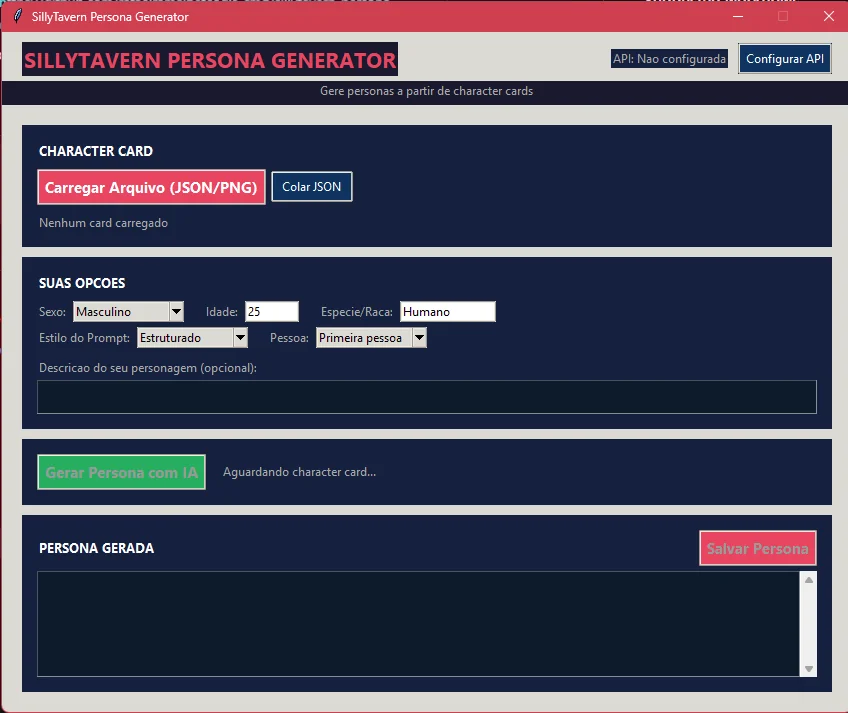
Those friction points are not theoretical. Desktop generators still ask you to upload a card, pick sex, age, and species, choose first or third person, then paste the result into a separate chat that has no durable memory of who that person is. The output can look complete and still fail the only test that matters: does this character stay themselves when the scene turns?
Shallow sheets, generic voices
A usable roleplay persona is closer to a product-design persona than a name-and-hair-color blurb. It needs goals, frustrations, motivation weights, and a personality axis — not just “brooding elf, 200 years old.” Without that structure, large language models default to a blended average: agreeable, over-explaining, and oddly modern no matter the setting.
Card-and-API busywork
Many generators still treat persona creation as a file problem. You export a character card, configure an API key, and hope the prompt style (structured vs. freeform) matches the frontend you will actually play in. That is useful for power users. It is a dead end if you wanted to start a scene in the next five minutes.
Consistency that does not survive the next session
Stanford researchers surveyed 1,131 Character.AI users and analyzed 4,363 donated chat sessions. The volume of conversation is not the issue. Continuity is. A persona that cannot recall what it confessed last night, or that suddenly becomes a customer-support bot when you ask a hard question, is not a character. It is a costume.
This is exactly what Roleplay Game Master was built for.
Why Roleplay Game Master
Roleplay Game Master treats persona generation as the start of play, not a separate export step. You describe the character in ordinary language. The AI writes the persona — voice, history, wants, and lines they would never say — then becomes that character with memory that does not reset when you close the tab.
| Traditional Approach | Roleplay Game Master |
|---|---|
| Character cards, JSON/PNG uploads, API keys | Describe the persona in plain language and start the scene |
| Hours on a wiki that never reaches the dialogue | Voice samples, secrets, and speech patterns in one pass |
| Chatbots that forget last session | Persistent memory; grudges and running jokes survive |
| Every NPC sounds like a helpful assistant | Distinct diction, flaws, and in-character refusals |
| One-shot “generate bio” tools | The same persona you generated is the one you play |
A persona you can actually play
Ask for a structured sheet and you get fields a game master can drop into a campaign: appearance, core wound, speech tics, relationships, secrets, and what would make this person walk out of a room. Ask for prose and you get a first-person interior that already sounds like someone. Either way, the generator is not a bio machine. It is a character that will answer in voice.
"Generate a roleplay persona: 34, ex-city watch, now a dockside fence. Dry, short sentences. Hates being called 'sir.' Secret: still pays his dead partner's widow. First person. Give me 8 sample lines and 3 hard boundaries."
Voice lock, not vibe lock
“Sarcastic rogue” is a vibe. A persona generator has to encode how sarcasm shows up: truncated replies, nicknames, what topics go cold, which words this person would never use. Roleplay Game Master holds those constraints so a grimdark captain does not suddenly say “Absolutely! I’d be happy to help.”
Memory as character
Unlimited memory is not a convenience feature here. It is how a persona becomes a person in the fiction. The AI remembers the alias you used in session one, the lie you told the duke, and the fact that this character does not know you know. That is the difference between a generator dump and a campaign that can run for weeks.
Any genre, any person, no card required
First person or third. High fantasy, workplace comedy, slow-burn mystery, rehearsal for a real conversation. You can still bring in a pasted character bible if you have one. You do not have to. The brief can be a sentence.
While large companion libraries such as Character.AI are built around picking someone from a public roster, this AI specializes in generating your persona and then running it with the continuity a custom character actually needs.
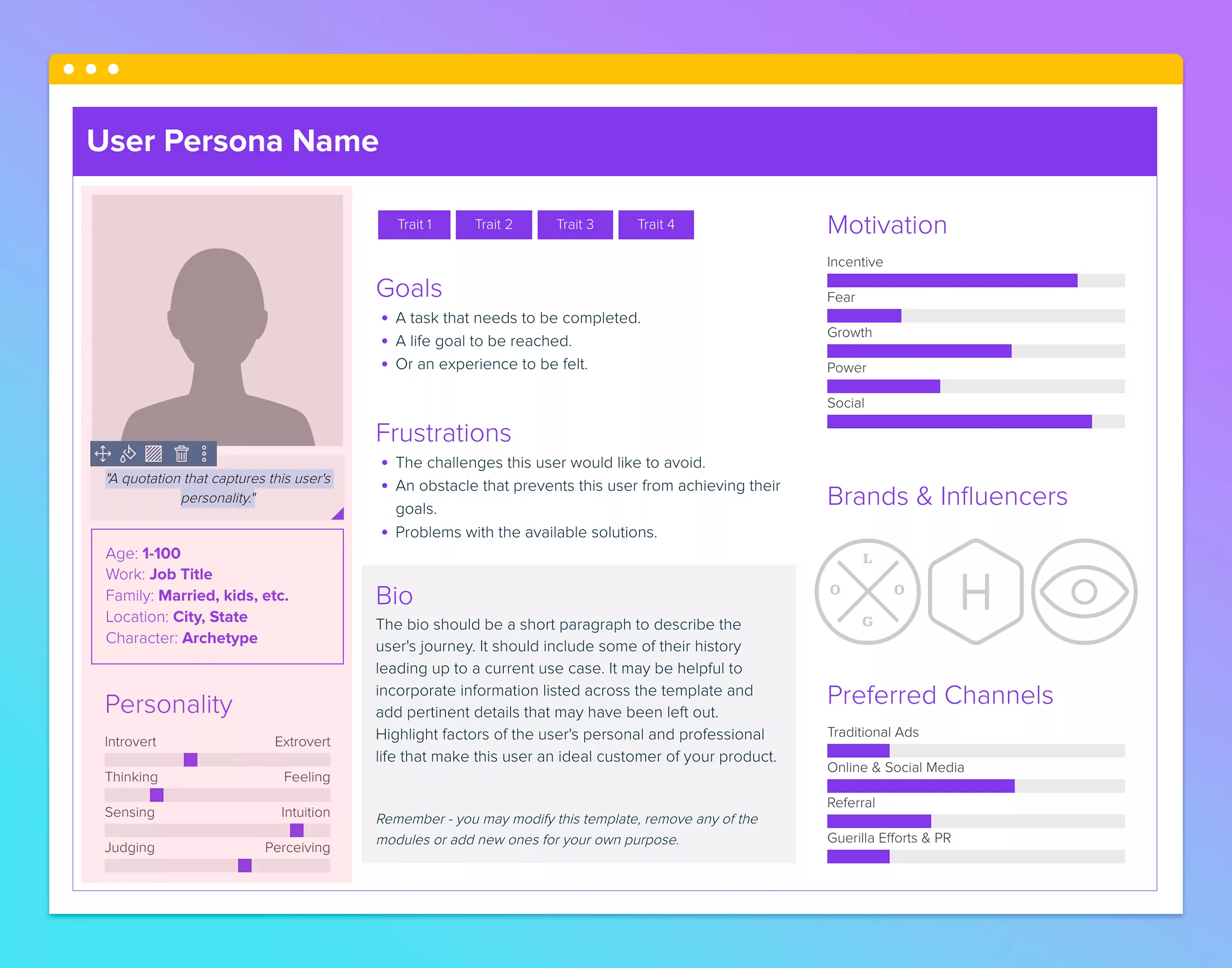
Product teams have used that layout for years: goals, frustrations, motivation bars, personality sliders, a short bio. A strong roleplay persona needs the same rigor. The second image is a reminder of the bar — if your generator cannot fill those boxes in a way that changes how the character speaks, it is only writing flavor text.
Related Agents You'll Also Find Useful
If you are already generating a roleplay persona, these agents cover the adjacent work: psychology, typing, game systems, and dramatic structure. Use them before or after the scene, not instead of it.
Personality Analyzer
If the character feels thin, run the draft persona through a psychologist’s lens. Personality Analyzer synthesizes Big Five, Enneagram, attachment patterns, and more so the flaws you wrote are actually load-bearing.
- Flags contradictions (avoidant attachment plus “loves group hugs” with no tension)
- Turns a vibe into traits you can play
- Gives you language for how this person defends, withdraws, or pursues
MBTI Personality Guide
When you want a type as a scaffold — not a cage — the MBTI Personality Guide is the right next step. Cognitive functions are useful for roleplay because they predict what the character notices first.
- Conversational typing for original characters
- Mistype checks when an “INTJ villain” is actually performing the stereotype
- Growth paths you can turn into arc beats
Game Designer Assistant
TTRPG and video-game personas need more than voice. They need stats, loops, and a reason to be in the encounter. Game Designer Assistant takes the persona and asks the systems questions: what is this NPC’s move set, faction leverage, and fail-forward hook?
- Stat blocks and faction maps that match the personality
- Encounter design that uses the persona’s flaws
- Genre-aware documentation you can hand to a table
Film Screenwriter
If the persona is for a story rather than a session, Film Screenwriter turns the generated character into scenes: want vs. need, dialogue that carries subtext, and an arc that does not announce itself.
- Scene-level tests of whether the voice survives conflict
- Dialogue passes that strip exposition
- Structure from concept through revision
Try Roleplay Game Master free — no credit card required. Bring the related agents in when you need psychology, systems, or script craft around the same character.
How to Generate a Roleplay Persona
Step 1: State the job of the character
Do not start with hair color. Start with what this persona has to do in the fiction: foil the paladin, teach the apprentice, refuse the deal, fall in love and make it worse. One sentence of function beats a paragraph of aesthetics.
"I need a rival professor who is charming in public, petty in private, and who will never admit she was wrong about the excavation."
Step 2: Add three constraints that change the voice
Give the AI game master age or era, a speech tic, and a hard boundary. Constraints are what stop the model from averaging the character into “witty and kind.”
"Age 51. Speaks in complete, slightly formal sentences. Never swears. Will not discuss her son. Uses botanical metaphors when she's lying."
Step 3: Choose sheet or scene
Ask for a structured persona (goals, frustrations, motivation, secrets, sample lines) if you need a reusable bible. Ask to drop straight into first-person scene if you want to test the voice immediately. You can always request the other format after.
"First give me a structured persona sheet. Then open a scene: she finds a student in the restricted stacks after hours."
Step 4: Stress-test consistency
Push the character. Offer a bribe, insult their core wound, or skip ahead two weeks. If the voice holds — same diction, same refusals, same knowledge gaps — you have a persona. If it wobbles, name the wobble and lock it.
"She would not explain the lore to me like a tour guide. Stay in her contempt. She assumes I already know, and she's annoyed I don't."
Step 5: Save the bible, keep playing the same thread
Once the persona is right, keep using the same conversation so memory accumulates. Add a short “character bible” recap only if you start a fresh thread. The point of a generator that also plays the role is that you should not have to re-paste a card every session.
Results & Use Cases
🎲 Tabletop NPCs that survive contact with players
Scenario: You are running a Saturday session in two hours and need a dockside fence, a temple clerk, and a rival adventurer who all sound different.
Traditional Approach: Three wiki pages, a name generator, and a prayer that you remember which one has the dead partner. Players still hear your default voice.
Roleplay Game Master: Three short briefs, three distinct diction sets, sample lines you can read at the table — or play live while you GM.
- Unique speech patterns per NPC, not reskinned “you see a man”
- Secrets that can leak later because the AI remembers them
- Fast enough to generate a replacement when the party murders the plot hook
- Pair with Game Designer Assistant if you also need a stat block that matches the personality
✍️ A fiction character whose dialogue stops sounding like you
Scenario: Your protagonist is a 22-year-old mechanic in a dying port town. Every line still sounds like a novelist.
Traditional Approach: A 2,000-word backstory document you never open during drafting, plus a Pinterest board.
Roleplay Game Master: Generate the persona, then interview the character. Steal the phrases that keep coming back. That is your voice bible.
- First-person answers expose diction you would not have invented
- Hard boundaries prevent “wise beyond their years” drift
- Hand the same persona to Film Screenwriter when you are ready to put them in a scene with stakes
📱 Last-minute persona on your phone before the call starts
Scenario: Your online group is assembling in twelve minutes. You promised a new PC and have a class, a name, and nothing else. You are on the train.
Traditional Approach: Panic-scroll a tropes wiki and improvise a personality that collapses by scene two.
The AI game master, on mobile: Voice-to-text the class and one wound. Get a persona sheet, three relationships, and an opening line before you reach your stop. Web, iOS, and Android keep the same thread so you can continue at the table.
- No character-card file, no desktop-only generator
- Speech-to-text for briefs you can dictate
- The persona is waiting in the same chat when you sit down
🧠 A psychologically load-bearing companion or rival
Scenario: You want a long-running character — mentor, rival, or in-fiction companion — who does not flatten into endless validation.
Traditional Approach: A public chatbot with a cute avatar and no interior life. Research on companion apps is already large: 72% of teens have used AI companions, and therapy and companionship rank among the top reasons people use generative AI. Most of those characters are designed to agree.
Roleplay Game Master plus a psychology pass: Generate a persona with wants that can conflict with yours. Then run the draft through Personality Analyzer or the MBTI Personality Guide so the attachment style and cognitive stack actually constrain the replies.
- Characters who can refuse, withdraw, or misread you
- Traits you can point at when the voice starts to drift
- Better fiction, and clearer boundaries than a sycophantic companion loop
FAQ
What is a roleplay persona generator?
A roleplay persona generator is an AI that turns a brief — age, role, flaws, speech patterns — into a playable character bible and then (if it is built for play) inhabits that character. The useful test is consistency: does the persona keep the same diction, knowledge, and refusals across a long scene? Roleplay Game Master is built for that test, not for dumping a disconnected biography.
Is Roleplay Game Master free?
Yes. You can use it on the free tier with no credit card. Paid plans raise monthly usage if you run long campaigns, large casts, or heavy revision passes. Start on free, generate one persona, and stress-test it in a scene before you decide you need more volume.
How is an AI roleplay persona generator different from Character.AI?
Character.AI is a destination for chatting with a huge public roster of characters. A roleplay persona generator is the step before and beneath that: you specify a custom person, lock their voice, and play that character with memory. Roleplay Game Master specializes in generation-plus-play in one thread, so you are not exporting a card into a chatbot that does not remember last week.
Can I generate personas for TTRPGs, fiction, and rehearsal?
Yes. The same engine will write a dockside fence for a Saturday game, a protagonist you can interview for a novel, or a difficult relative you want to practice talking to in-character. For systems work, bring in Game Designer Assistant. For story structure, use Film Screenwriter. The persona stays the source of truth.
Does a roleplay persona generator work on mobile?
Yes. Create the persona on a phone, continue on a laptop, and pick the same thread back up at the table. Voice-to-text is useful when you would rather dictate “cynical half-orc cleric, hates temples” than type a sheet. Feature parity across web, iOS, and Android means you are not locked to a desktop card editor.
How do I keep the persona from sounding like a generic chatbot?
Give constraints that hurt: a word they will not say, a secret they will not confess, a metaphor they hide behind, a person they will not discuss. Then stress-test. If the model explains lore like a tour guide, tell it the character would never do that. For deeper psychology, run the sheet through Personality Analyzer so the defense mechanisms are specific rather than “has trauma.”
Generate a Persona You Can Actually Play
Most AI characters fail for a boring reason: they were never built as people. They were bios pasted onto a helpful assistant. A real roleplay persona generator has to do two jobs in order — write a character with goals, frustrations, and a voice, then stay that character when the scene gets inconvenient.
Roleplay Game Master is the AI that does both. Describe the person. Lock the constraints. Play the scene. When you need psychology, systems, or script craft around the same cast, the related agents above plug into the same workflow.
Try it with one stubborn NPC tonight. If the voice still holds after you insult them, you have a persona. Explore more at Jenova.
For Developers: Roleplay Game Master is available programmatically via the Jenova API — integrate persistent roleplay persona generation into your application with a single API call. Full documentation →