AI Roleplay Pacing: Control Scene Speed, Tension & Slow-Burn Arcs
2026-10-18
Roleplay Game Master helps you control AI roleplay pacing by keeping your story's tempo, tension, and character threads steady across sessions of any length. Many AI chat partners either rush to the climax in three messages or circle the same scene for twenty. This AI keeps unlimited memory of your story and stays in character, so slow burns stay slow and action scenes move when you want them to.
This guide, updated for October 2026, covers the practical side of pacing: how to set tempo, structure turns, skip time, and sustain tension without losing control of your story.
- ✅ Unlimited memory: Planted secrets, promises, and unresolved tension stay intact across long arcs
- ✅ Consistent characters: Motives and personalities don't reset mid-scene
- ✅ Complete creative freedom: Any genre and any tempo, from slow-burn drama to fast combat
- ✅ Cross-device access: Available on web, iOS, and Android for short sessions or marathon campaigns

Look at any AI story library and you'll see that pacing expectations start before the first message. A tagline like "Engines, secrets, and a slow-burn oath" promises a very different rhythm than "Two strangers, one crash, and a frozen wilderness." When the AI ignores those signals, the experience falls apart. To see why, let's look at where AI roleplay pacing usually breaks down.
Quick Answer: What Is AI Roleplay Pacing?
AI roleplay pacing is how quickly an AI-driven story moves through scenes, tension, and plot events, controlled by response length, turn structure, and decisions about when to linger, summarize, or skip time. Good pacing matches the genre and the player's intent.
Key pacing levers:
- Response length: Short replies speed up action. Longer replies deepen atmosphere and emotion.
- Turn structure: Who acts, who reacts, and where each reply hands control back to you
- Scene vs. summary: Playing a moment out beat by beat, or compressing it into a sentence or a time skip
- Tension tracking: Remembering planted conflicts so they escalate on schedule instead of resolving early
The Problem: Why AI Roleplay Pacing Breaks Down
Interactive fiction has no fixed script. As StoryLab explains, AI interactive storytelling means the story adapts in real time to player choices, behavior, and context. That flexibility is the appeal. It also means the AI has to make pacing decisions on every turn, and general-purpose models often make them poorly.
Academic researchers have documented the underlying weakness:
"Struggle to maintain thematic consistency and structure" — Breda University of Applied Sciences researchers on large language models in narrative generation, especially for longer, more complex stories
Turn timing matters even in ordinary conversation. Research published by MDPI notes that conversational turn-taking involves complex timing mechanisms influenced by linguistic, prosodic, and multimodal cues. Text roleplay removes the prosodic and visual cues entirely. Tempo has to come from reply length, sentence rhythm, and where each turn ends.
Getting AI roleplay pacing right is harder than it should be:
- Runaway plots: The AI resolves the central conflict, delivers the confession, or wins the battle within a handful of messages.
- Stalled loops: Scenes circle, with the same descriptions and the same hesitation, and nothing advances.
- Bloated turns: Replies run so long that the AI narrates your character's actions and leaves you nothing to respond to.
- Long-session drift: Hundreds of messages in, earlier tension is forgotten and a carefully built slow burn resets to strangers.
The last problem is the hardest to fix with prompting alone. You can't sustain a slow burn if the AI forgets it's burning. This is the problem a dedicated AI game master was built to solve.
Why Roleplay Game Master Gets AI Roleplay Pacing Right
Tabletop game masters have managed pacing for decades. They know when to cut a travel montage, when to let a tense negotiation play out, and when to end a session on a cliffhanger. That craft has long informed AI storytelling research. A paper from the AAAI Conference on Artificial Intelligence and Interactive Digital Entertainment explicitly used tabletop role-playing games as a model for interactive digital storytelling.
Roleplay Game Master brings that game-master approach to AI roleplay. Because it has unlimited memory and consistent characters, the agent can treat pacing as a story-long arc rather than a turn-by-turn guess.
| Generic AI Chat | Roleplay Game Master |
|---|---|
| Forgets planted tension after long sessions | Unlimited memory keeps every unresolved thread available |
| Characters shift personality to move the plot along | Consistent characters whose motives drive believable escalation |
| One default tempo for every genre | Adapts to slow-burn drama, horror build-up, or fast combat |
| You re-paste summaries to restore context | Picks up where you left off, with the story's momentum intact |
| Content and scenario limits flatten stakes | Complete creative freedom to explore any scenario you imagine |
Memory That Protects Long Arcs
Slow-burn pacing depends on accumulation: small moments that add up. When an AI remembers that a character flinched at a name forty scenes ago, it can bring that back at the right moment instead of inventing new drama to fill space. Unlimited memory turns pacing from improvisation into structure.
Character Consistency That Creates Real Tension
Tension comes from characters who want things and won't easily get them. If a guarded mercenary suddenly opens up because the plot needs it, the tension is gone. Consistent characterization keeps resistance believable, so every step forward feels earned.
Scene, Summary, and the Time Skip
Narrative theorists, notably Gérard Genette, describe story tempo as a mix of scene (moment by moment), summary (compressed time), ellipsis (skipped time), and pause (description that stops the clock). Skilled roleplay moves between all four. You can direct the shift in plain language:
"Summarize the three-day ride to the capital in one paragraph, then slow down to full scene when we reach the gates."
"Hold this moment. Describe the silence after she reads the letter, but don't let either character speak yet."
"Time skip two weeks. Show me what's changed between the crew members, then hand control back to me."
Related Agents You'll Also Find Useful
Pacing skills carry over to other kinds of interactive and written storytelling. If your roleplay goals extend beyond a single campaign, these agents fit naturally into the same workflow.
Creative Fiction Writer
If you want to turn a strong roleplay arc into polished prose, Creative Fiction Writer acts as a storytelling partner for original fiction in any genre. It's useful when a roleplay produces a story worth keeping.
- Expert editorial insight on structure and rhythm
- Deep research for authentic worlds
- Support from first draft to final manuscript
Love Island
For pacing driven by social dynamics rather than plot, Love Island places you among eight strangers on a private island. Its open-world romance shows how emergent relationships build and break at their own speed.
- Emergent social dynamics shaped by your choices
- Connections and rejections that unfold over time
- A sandbox for practicing slow-build romantic tension
Learn Spanish Through Roleplay
If you're also learning a language, Learn Spanish Through Roleplay combines immersion with the pacing control learners need. Shorter turns and slower scenes give vocabulary room to stick.
- Fully immersive scenarios with any theme
- Grammar and vocabulary reinforced through meaningful moments
- Complete creative freedom over story direction
Try the AI game master free. No credit card required.
How to Control AI Roleplay Pacing Step by Step
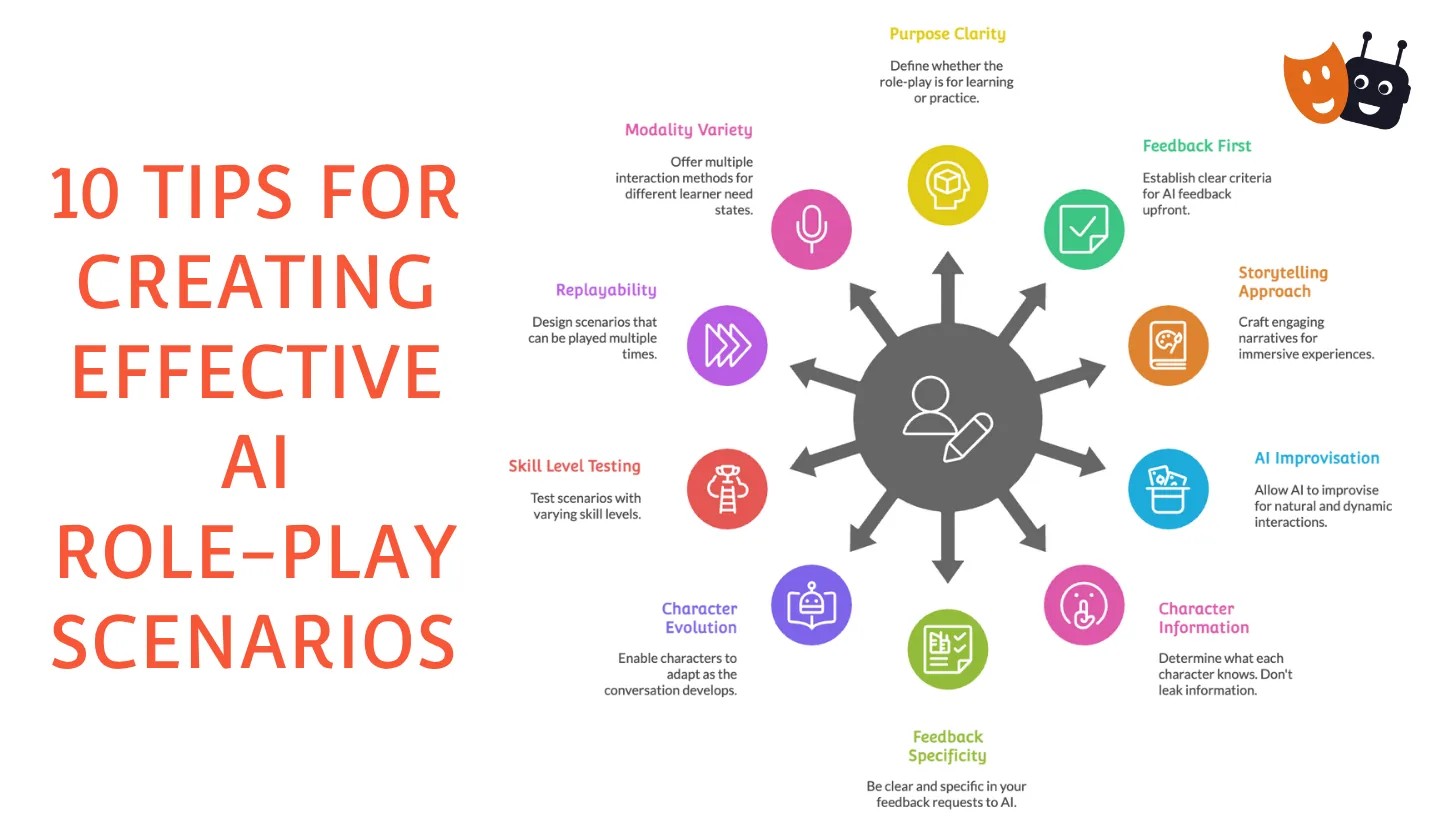
Several principles in this framework apply directly to pacing. Character Information (deciding what each character knows) prevents reveals from arriving too early. Character Evolution lets relationships change gradually. AI Improvisation keeps scenes from feeling scripted. The steps below put those principles into practice.
Step 1: Declare the Tempo in Your Opening Prompt
State the genre, the intended pace, and the reply length you want before the story starts. A clear opening setup prevents most rushed or stalled scenes, because the AI knows what rhythm it's aiming for.
"Gothic mystery, slow pacing. Keep replies to 2–3 paragraphs. The truth about the manor should take many sessions to uncover. No major reveals without clues first."
Step 2: Set Turn-Taking Rules
Turn-taking mechanisms are the rules and patterns that govern how speaking roles are exchanged, and roleplay needs them too. Early-childhood researchers call good exchanges "serve and return". Each turn should give the other side something to respond to.
"Never write my character's actions, thoughts, or dialogue. End each reply on a moment that invites my response."
Step 3: Switch Between Scene and Summary on Purpose
Decide which moments deserve full detail. Combat, confessions, and confrontations usually work best in full scene. Travel, routine, and recovery usually work better as summary or a time skip.
"Fast-forward through the training montage, but play the final sparring match beat by beat."
Step 4: Plant Tension Milestones
For slow-burn arcs, outline the beats you want and roughly when they should happen. With unlimited memory, the game master can track those beats across sessions instead of jumping straight to the payoff.
"Arc plan: rivalry, then reluctant respect, then one moment of trust, then betrayal. Don't move to the next stage until the current one feels earned."
Step 5: Check In Out of Character
Every few sessions, step outside the story and adjust. A short out-of-character note works like a session-zero conversation at a tabletop game.
"(OOC: The last few scenes felt slow. Raise the stakes in the next scene. Maybe the patrol finds our camp.)"
Results & Use Cases
🐢 Sustaining a Months-Long Slow-Burn Romance
Scenario: A writer runs an enemies-to-lovers story between a disgraced knight and the noble who exiled her, played across dozens of sessions.
Traditional Approach: Generic chatbots tend to deliver the emotional payoff early. Keeping the arc on track means repeatedly re-pasting summaries and correcting characters who soften too quickly.
With the AI game master: Unlimited memory keeps every barbed exchange and almost-moment on record, so the eventual turning point draws on real history.
- Escalation built on remembered moments, not invented drama
- Characters who stay guarded until the story earns the change
- No summary pasting between sessions
⚔️ Balancing Combat and Travel in a Fantasy Campaign
Scenario: A player runs a quest across a war-torn kingdom where the travel matters but shouldn't take over the story.
Traditional Approach: Every road becomes a twenty-message trek, or every battle ends in one paragraph.
With Roleplay Game Master: The player summarizes the journey and expands key fights into full scene, with tactical detail and consequences that carry into later sessions.
- Deliberate shifts between summary and scene
- Wounds, losses, and alliances that persist
- Momentum that holds across the campaign
🗣️ Slower Pacing for Language Learners
Scenario: An intermediate learner wants to practice Spanish in a café-heist story without getting buried in long paragraphs.
Traditional Approach: Textbook dialogues are predictable. General AI chats often produce dense replies that are too much for a learner.
With Learn Spanish Through Roleplay: Short, paced turns let the learner respond meaningfully each time, and the story keeps them engaged.
- Reply length matched to the learner's level
- Vocabulary tied to memorable story moments
- Steady pacing that supports output instead of overwhelming it
📱 Quick Mobile Sessions on a Commute
Scenario: A player has 15-minute windows on the train and wants each session to feel complete.
Traditional Approach: Picking up a story on a phone usually means scrolling back to remember what happened, which uses up most of the session.
With Roleplay Game Master: The player asks for a short scene that ends on a hook, then continues it later from the iOS or Android app, with the story's memory intact.
- Bite-sized scenes designed around a cliffhanger
- Seamless continuation across devices
- Speech-to-text for hands-light play
Frequently Asked Questions
What does pacing mean in AI roleplay?
Pacing in AI roleplay is the speed at which the story moves through events, emotions, and tension. It depends on reply length, how turns are structured, and whether moments are played out in full scene, summarized, or skipped. Good pacing matches the genre. Horror and slow-burn romance need patience, while action and thrillers benefit from short, punchy turns. Poor pacing shows up as rushed climaxes, looping scenes, or replies that leave the player nothing to do.
How do I stop an AI from rushing the story?
State the pace explicitly in your opening prompt, outline the tension milestones you want, and tell the AI not to move to the next beat until the current one is earned. Ask it to end each reply on an open moment instead of a resolution. An agent with persistent memory, such as Roleplay Game Master, helps because it can track planted tension across sessions rather than inventing quick payoffs.
How long should AI roleplay responses be?
It depends on the scene. Fast action and dialogue-heavy exchanges work well at one to two short paragraphs. Atmospheric moments, reveals, and emotional turning points can run longer. The most reliable approach is to set a default length at the start, then adjust scene by scene with a quick out-of-character note. Whatever the length, each reply should leave a clear opening for your next move.
Is Roleplay Game Master free to use?
Yes. Roleplay Game Master is available on Jenova's free plan, which includes all core features with limited usage. Paid plans start at $20 per month for Plus, which adds 30× the free usage and custom model selection. Higher tiers scale usage further for long, frequent campaigns. Usage resets monthly on your billing date, with no daily caps.
Can I turn an AI roleplay into a written story?
Yes. Many roleplayers use strong campaigns as raw material for fiction. Export or summarize your key scenes, then work with Creative Fiction Writer to restructure them into chapters, tighten pacing for readers, and polish the prose. Pacing that works in interactive play often needs adjusting on the page, since readers don't take turns.
Does AI roleplay pacing work the same on mobile?
The pacing techniques are the same, but mobile sessions benefit from shorter scenes that end on a hook. Roleplay Game Master offers full feature parity across web, iOS, and Android, with settings and story memory synced between devices. You can start a scene on your laptop, continue it on your phone, and use speech-to-text when typing isn't practical.
Conclusion: Make Pacing a Deliberate Choice
Most failed AI roleplays aren't failures of imagination. They're failures of tempo: plots that sprint to the end, scenes that stall, and slow burns that reset when the AI forgets. Controlling AI roleplay pacing comes down to a few habits: set the tempo upfront, structure turns so control returns to you, switch between scene and summary on purpose, and plan tension milestones that the AI can actually remember.
A storytelling partner with unlimited memory and consistent characters makes those habits much easier to sustain, whether you're running a months-long slow-burn romance, a fantasy campaign, or a quick commute session. Your story should move at the speed you choose.
Try Roleplay Game Master now. Explore more at Jenova.
For Developers: Roleplay Game Master is available programmatically via the Jenova API. You can integrate memory-driven, character-consistent interactive storytelling into your app or game with a single API call. Full documentation →