AI Roleplay NPC Secrets: Build Characters Who Hide, Lie & Reveal
2026-10-19
Roleplay Game Master helps you run AI roleplay NPC secrets that hold up under pressure. It keeps every hidden motive, cover story, and planted clue in unlimited memory, so characters stay consistent from the first scene to the final reveal. Most AI characters confess their hidden agenda the moment you ask directly. This AI gives you NPCs who guard what they know, show subtle tells, and reveal the truth only when the story has earned it.
As of October 2026, persistent memory has become the dividing line between AI roleplay that feels like a living world and roleplay that resets every few scenes.
- ✅ Unlimited memory that keeps secrets, alibis, and lies on file across sessions
- ✅ Character consistency so a cover story doesn't quietly change between scenes
- ✅ Complete creative freedom for any genre: fantasy intrigue, sci-fi betrayal, noir mystery, slow-burn romance
- ✅ Player-driven reveals that come from trust, evidence, or leverage instead of random info dumps
A secret only works if the story remembers it exists. It also has to remember who knows it and what it would take to pry it loose. To see why that's harder than it sounds, it helps to look at where AI-driven NPCs usually break down and why secrets are the first thing to fail.
Quick Answer: What Are AI Roleplay NPC Secrets?
AI roleplay NPC secrets are hidden facts, motives, or relationships that an AI-controlled non-player character knows but deliberately withholds, guarding them until the story meets specific trust, evidence, or pressure conditions for revealing them.
Key capabilities a strong setup needs:
- Persistent memory that stores the secret outside the current scene, so it survives long sessions and breaks between them
- Reveal conditions that tie disclosure to player actions rather than direct questioning
- Behavioral tells such as nervous habits, deflections, and contradictions that let players detect a secret before they uncover it
- Consequence tracking so a revealed secret changes relationships, factions, and future scenes
Why AI NPCs Struggle to Keep Secrets
Demand for AI-driven characters is growing quickly. AI can now shape the personalities and actions of non-player characters, and players increasingly expect immersive experiences that adapt to their choices. Research labs have studied this space for years, including Disney Research's work on proactive conversational agents for interactive narratives.
**$4.8 billion** — [Global interactive storytelling platform market value in 2025, projected to reach $14.6 billion by 2034](https://dataintelo.com/report/interactive-storytelling-platform-market)
Up to 38% — Engagement increases reported in 2025 by storytelling platforms with embedded AI
81% — Share of surveyed gamers who said they would pay more for a game with AI-improved NPCs
20 million — Estimated number of people now building fiction with AI
Interest in AI roleplay is high. Keeping an NPC's secret intact across a real campaign is still difficult:
- The leak problem. General-purpose chat assistants are designed to be helpful and forthcoming. Ask the suspicious innkeeper "Did you poison the baron?" and many AI characters effectively confess, because answering the question feels like the right response.
- Memory drift. Runebook's analysis of AI story games describes the context window as a desk. As the story grows, old papers slide underneath new ones. When the page holding the secret falls off the desk, the NPC simply stops knowing it.
- Shifting lies. A cover story that says "I was at the shrine all night" in session one becomes "I was at the docks" in session three. A good mystery depends on inconsistency that the NPC causes on purpose. Inconsistency caused by the model forgetting ruins it.
- Flat, fluent reveals. Research cited in a 2025 MDPI study on AI-assisted storytelling notes that AI may prioritize plot fluency over deep causal logic. The same review highlights findings that AI-generated stories tend to be more homogeneous than human-written ones. In practice, that means secrets often get revealed because it's dramatically convenient, not because the player earned it.
Runebook puts the core issue well: memory is relevance under pressure. A secret is that principle in its purest form.
This is exactly the problem a dedicated AI game master was built for.
Why Roleplay Game Master for NPC Secrets
Roleplay Game Master is an immersive roleplay partner built around unlimited memory and consistent characters. It doesn't treat each message as a fresh prompt. It carries the full state of your story forward: who each NPC is, what each one is hiding, and what the player has already discovered.
The result is closer to a skilled human game master who keeps private notes. NPCs can lie, deflect, and drop tells. The truth surfaces only when the story's conditions are met.
| Traditional Approach | Roleplay Game Master |
|---|---|
| Human GM keeps secret notes and cross-references them every session | Secrets, alibis, and reveal conditions persist in unlimited memory |
| Generic chatbots confess when asked directly | NPCs stay in character and deflect, lie, or bargain based on their motives |
| Cover stories drift as conversations grow long | Character consistency keeps lies and their contradictions deliberate |
| Reveals happen at random or all at once | Disclosure is tied to trust, evidence, and leverage you define |
| Content limits flatten darker intrigue | Complete creative freedom for betrayal, crime, and morally grey characters |
Unlimited Memory Keeps Secrets on File
The most common way AI NPC secrets fail is forgetting, not leaking. Persistent memory means the blacksmith's smuggling debt from your first session is still there in your tenth, along with the fact that you've already seen her ledger. Hidden facts don't slide off the desk. They stay archived until something in the present makes them relevant.
Character Consistency Keeps Lies Straight
A convincing liar needs to keep the lie consistent. The Game Master holds an NPC's public story and private truth separately, so the captain's alibi stays the same until you produce evidence that breaks it. When contradictions appear, they work as clues because the NPC is slipping under pressure, not because the model lost track.
A Three-Layer Model for NPC Secrets
Strong secrets usually work in layers. You can set these up explicitly in your opening prompt:
- Surface layer: What the NPC tells anyone, such as their cover story, public role, and polite deflections.
- Guarded layer: What they reveal to people they trust or when they're cornered, like a partial truth, a debt, or a fear.
- Core layer: The secret itself. It is revealed only through specific conditions: hard evidence, a confession under pressure, or a betrayal that makes silence pointless.
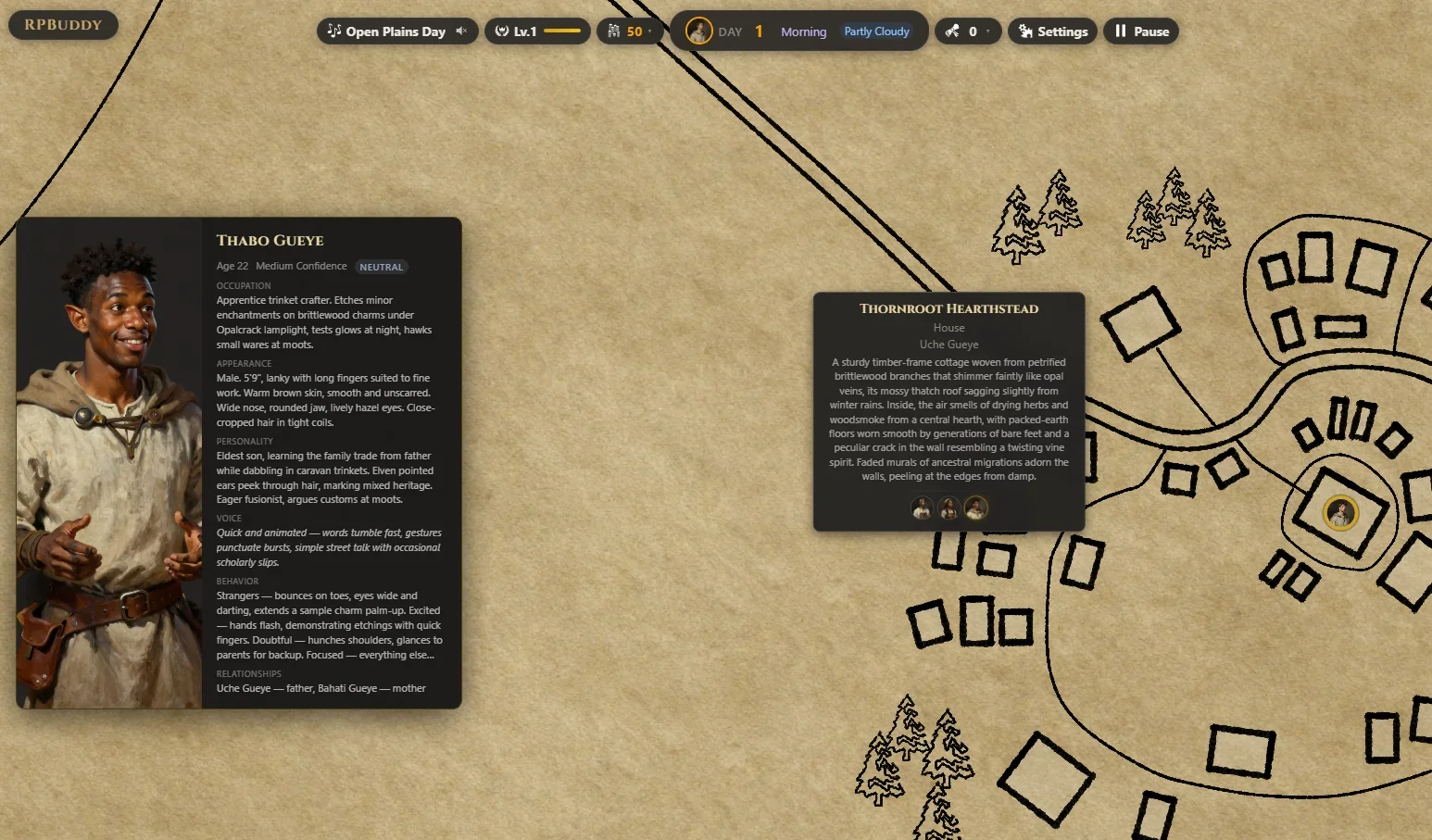
Each layer should come with tells, which are observable behaviors that hint at what lies beneath. Look at the NPC profile at the top of this article. It separates voice, behavior with strangers, and behavior when doubtful ("hunches shoulders, glances to parents for backup"). Those mood-based behaviors are exactly where tells come from.
Complete Creative Freedom
Some of the best secrets are uncomfortable: a mentor who sold out your family, a lover with a hidden identity, a priest covering for a murderer. The Game Master supports any scenario you imagine, so intrigue doesn't get softened into something safe and predictable.
Example prompts:
"Run a fantasy murder mystery. The innkeeper Maren poisoned the tax collector to protect her son. Her surface story is that she was serving the night crowd. She only admits she saw the victim alive if I mention her son's gambling debt. She confesses only if I find the empty vial."
"Create a sci-fi first officer who is secretly reporting to a rival admiral. Give her two subtle tells and never break character, even if I ask her directly."
"My character's sister has been dead for three years. Introduce a merchant who knows she's alive. He should drop hints over several sessions without saying it outright."
Related Agents You'll Also Find Useful
If you're building secret-driven stories, these agents fit naturally into the same workflow.
Character Creator
If you want fully developed NPCs before the first scene starts, Character Creator builds roleplay characters and OCs with backstories you can mine for secrets. It's useful for designing a whole cast in which every member is hiding something different.
- Quick-gen or guided character builds
- Media research for characters inspired by existing genres and franchises
- Portraits across genres to put a face to your suspects
Name Generator
Secret identities need convincing aliases. Name Generator brings cultural and linguistic depth to character naming, which helps when a false name has to sound plausible in your setting.
- Culturally fluent names for characters in any world
- Linguistic expertise for consistent naming conventions
- Strategic naming for aliases, noble houses, and hidden lineages
Creative Fiction Writer
If your roleplay campaign starts turning into a story you want to write down, Creative Fiction Writer can help shape it into polished prose. It's a good fit for turning a great reveal into a short story or the opening of a novel.
- Deep research for authentic worlds
- Expert editorial insight on structure and pacing
- Support from first draft to final manuscript
Try the AI game master free, no credit card required.
How to Run AI Roleplay NPC Secrets, Step by Step
Step 1: Define the NPC and Their Secret Layers
Describe your character, then spell out the surface story, the guarded truth, and the core secret. Be concrete. "She has a dark past" gives the AI little to work with, while "she forged the duke's will" gives it something to protect.
"Create Brother Ansel, a temple archivist. Surface: a humble scholar. Guarded: he's been selling restricted texts. Core: he forged the prophecy that crowned the current king."
Step 2: Set the Reveal Conditions
Tell the Game Master what unlocks each layer. Useful triggers include trust earned over time, physical evidence, leverage such as threats or bribes, and situations where silence costs the NPC more than speaking.
"Ansel only admits to selling texts if I show him the merchant's receipt. He never reveals the forgery unless the king's guards arrest him."
Step 3: Seed Tells and Clues
Ask for two or three behavioral tells and a few discoverable clues placed around the world. This gives players a way to notice the secret before they can prove it, which is what makes deduction feel rewarding.
"Give Ansel a tell: he straightens his sleeves when lying. Hide one clue in the archive and one with a fence in the lower city."
Step 4: Play, Probe, and Apply Pressure
Now roleplay normally. Question NPCs, follow leads, and try direct accusations. A well-configured NPC will deflect, bargain, or lie instead of confessing on demand. Because memory persists, you can leave and come back days later to the same suspicions.
Step 5: Pay Off the Reveal and Track Consequences
When the core secret surfaces, let it change the world. Runebook describes the difference as the story changing because of your action rather than merely acknowledging it. Ask the Game Master to carry the fallout forward, such as who now distrusts you or which faction gains power.
"Ansel is exposed. Show me how the temple, the king, and the lower-city fence react over the next few sessions."
Results & Use Cases
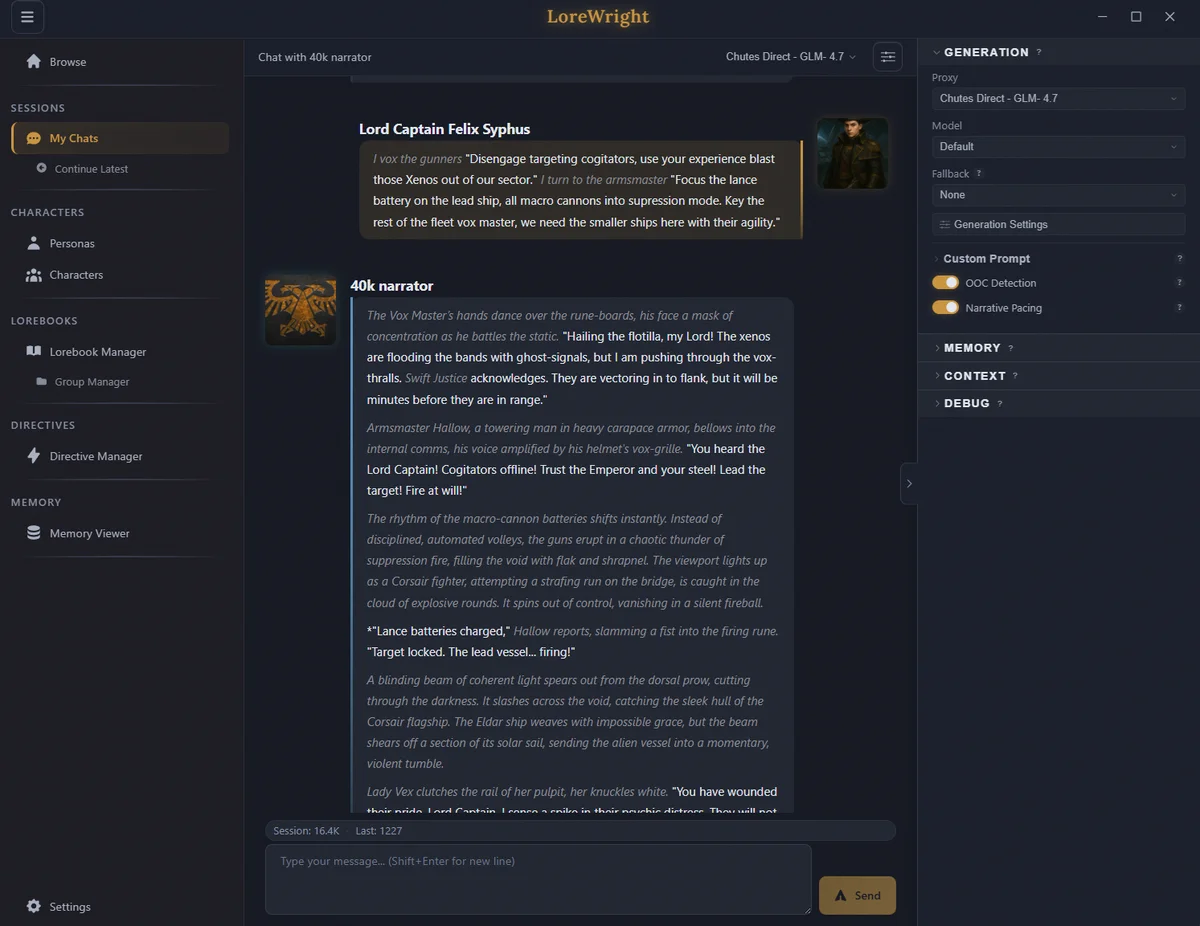
Interfaces that split lore, memory, and directives into separate tools, like the one shown above, reflect a simple principle: secrets need a home outside the current scene. A dedicated AI game master handles that bookkeeping for you, so you can stay in the story.
🕵️ Village Murder Mystery
Scenario: A tax collector dies at a roadside inn. Four NPCs each hide something, but only one is the killer.
Traditional Approach: A human GM writes a suspect matrix, tracks which clues each player has found, and rereads notes before every session to keep alibis straight.
Roleplay Game Master: Each suspect keeps a stable alibi with deliberate cracks. The innkeeper's tell shows up only when her son is mentioned, and the real confession comes only with the vial in hand.
- Red herrings stay consistent across sessions
- Clues found in session two still matter in session five
- Multiple suspects can each guard a different, smaller secret
🚀 Traitor on the Flagship
Scenario: In a space-opera campaign, one bridge officer is leaking fleet positions to the enemy.
Traditional Approach: Keeping a traitor believable over a long campaign usually means heavy prep, plus the risk of accidentally revealing the twist too early.
AI Game Master approach: The traitor behaves loyally in combat scenes and keeps their cover under casual questioning. Small inconsistencies surface only when you start cross-checking duty logs.
- Long-running betrayal arcs without the AI forgetting the twist
- Tells that reward attentive players
- Fallout that reshapes crew loyalty after the reveal
💔 Slow-Burn Romance With a Hidden Past
Scenario: A charming stranger joins your party. Their real identity is the exiled heir your character was sworn to hunt.
Traditional Approach: General chatbots often reveal the twist early or forget it entirely after a long stretch of romance scenes.
AI Game Master approach: The character's affection and evasions are both consistent. When the truth lands, it carries weight because of everything you've built together. If you later want to write the arc as prose, Creative Fiction Writer can help shape it.
- Emotional reveals grounded in shared history
- Gradual disclosure of the guarded layer as trust grows
- Moral dilemmas that persist after the secret is out
📱 Commute-Length Sessions on Mobile
Scenario: You play 15-minute intrigue sessions on your phone during your commute and continue on desktop at home.
Traditional Approach: Short, fragmented sessions are where AI roleplay usually loses the thread, and secrets are the first casualty.
AI Game Master approach: Settings and history sync across web, iOS, and Android, and built-in speech-to-text lets you interrogate suspects hands-free.
- Pick up an interrogation exactly where you left off
- Persistent memory bridges sessions that are days apart
- Full feature parity across devices
Frequently Asked Questions
How do I stop an AI NPC from revealing its secret too early?
Define explicit reveal conditions in your opening prompt. Separate the NPC's surface story, guarded truth, and core secret, then state what unlocks each layer, such as specific evidence, earned trust, or leverage. Also instruct the NPC to deflect or lie when questioned directly. A roleplay setup with persistent memory will keep honoring those conditions over long campaigns instead of losing them as the conversation grows.
Can AI roleplay NPCs lie convincingly?
Yes, when the AI keeps a stable record of both the lie and the truth. Convincing lies depend on consistency: the same alibi every time, with cracks that appear only under pressure. Adding behavioral tells, like a nervous habit or a change in speech pattern, gives players something to detect. Without persistent memory, lies tend to drift randomly, which undermines mysteries.
Is Roleplay Game Master free to use?
Roleplay Game Master is available on Jenova's free tier, which includes all core features with limited usage. Players who run long campaigns can upgrade to paid plans starting at $20 per month for 30× the free usage, with higher tiers for heavier use. Usage resets monthly on your billing date, with no daily caps.
Can I design NPCs with secrets before starting a roleplay?
Yes. Many players build their cast first, then bring it into a roleplay session. Character Creator offers quick-gen or guided builds for roleplay characters and OCs, including backstories you can use to define hidden motives. Once your cast is ready, paste their profiles and secret layers into your opening prompt.
How is an AI game master different from a general chatbot for roleplay?
General chatbots are built to answer questions helpfully, which often means NPCs give up their secrets when asked. A dedicated AI game master focuses on staying in character, keeping characters consistent, and holding story state over time. That makes it much better at sustaining mysteries, betrayals, and slow reveals.
Does AI roleplay with NPC secrets work on mobile?
Yes. Jenova offers full feature parity across web, iOS, and Android, and settings and chat history sync across devices. You can start an investigation on your laptop and continue questioning suspects on your phone. Speech-to-text also supports voice-driven roleplay sessions.
Conclusion
AI roleplay NPC secrets fail for predictable reasons: characters leak under direct questioning, forget what they're hiding, or let their lies drift. Fixing that takes more than a bigger context window. It takes memory that preserves hidden truths, consistent characters who lie on purpose, and reveal conditions the player actually has to meet.
With layered secrets, deliberate tells, and consequences that carry forward, AI NPCs start to feel like people with something to lose. Whether you're running a murder mystery, a shipboard betrayal, or a romance with a buried past, the secrets will hold until you've earned them.
Try Roleplay Game Master now and build your first NPC with something to hide. Explore more at Jenova.
For Developers: Roleplay Game Master is available programmatically via the Jenova API. You can integrate persistent, character-consistent roleplay into your game or storytelling app with a single API call. Full documentation →