AI Roleplay Metagaming: Keep Characters From Knowing Too Much
2026-10-18
AI roleplay metagaming happens when an AI character reacts to something it could never have known: your character's private thoughts, a secret from the lore notes, or an out-of-character aside. As of October 2026, it is one of the most common immersion problems in AI storytelling. Jenova addresses it with purpose-built story agents, persistent memory, and custom characters whose knowledge you can define. The result is roleplay where secrets stay secret until the story earns their reveal.

- ✅ Story-driven game agents built around hidden information and gradual reveals
- ✅ Persistent cross-session memory and unlimited chat history, so revealed facts stay tracked
- ✅ Custom agents with your own instructions and private knowledge bases, including "who knows what" rules
- ✅ Access to models from OpenAI, Anthropic, Google, DeepSeek, xAI, and more, with full parity across web, iOS, and Android
Metagaming isn't new. Tabletop players have argued about it for decades. AI changes the shape of the problem because the "player" is a language model, which treats everything in the conversation as fair game. To fix it, you first need to understand why AI characters leak knowledge in the first place.
Quick Answer: What Is AI Roleplay Metagaming?
AI roleplay metagaming is when an AI character acts on information it shouldn't have, such as your narration, private thoughts, lore notes, or out-of-character comments, instead of only what the character could plausibly see, hear, or know inside the story. It is the AI version of the classic tabletop conflict between player knowledge and character knowledge.
How Jenova helps prevent it:
- Interactive story games like The Mansion structure secrets so they surface through exploration, not exposition
- Custom agents let you write explicit knowledge boundaries into a character's instructions
- Persistent memory keeps track of what has actually been revealed, so information doesn't drift between sessions
- Multi-model access lets you switch to whichever model holds character perspective best for your story
The Problem: Why AI Characters Metagame
In tabletop gaming, the definition is settled. Metagaming is the act of using knowledge a PLAYER has that a CHARACTER would not have. Many groups take it seriously. One GM writing for Roleplaying Tips described removing a long-time group member who wouldn't stop metagaming, and noted that no one at the table complained.
"Metagaming is when a player allows his character to have out of game knowledge." — Roleplaying Tips reader discussion on preventing metagaming
AI roleplay is now a large and fast-growing category, so the problem reaches far more people than it used to:
**$1.20 billion** — [Estimated 2026 value of the AI roleplay chatbot market, projected to reach $8.92 billion by 2033](https://skywork.ai/skypage/en/ai-chatbot-platforms-trends/2032013830073556992)
Roleplay use also extends beyond entertainment. AI role-play is gaining ground in workplace training and skills practice, and in those settings character consistency directly affects learning outcomes.
But keeping AI characters honest about what they know is frustratingly difficult:
- The narrator leak: The AI treats your narration and inner monologue as if the character heard it
- The omniscient NPC: Every character "knows" everything in the lore or character card
- Memory drift: Revealed facts get forgotten, or hidden facts get remembered as if they were already revealed
- Player-side exploitation: Users steer the story with knowledge their character couldn't have
- No session zero: Nobody establishes the rules about secrets, tone, and boundaries up front
The Narrator Leak
This is the most common form of AI metagaming. You write "Kael smiles warmly, secretly planning to steal the map tonight," and the innkeeper NPC immediately narrows her eyes and hides the map. The model can't reliably separate the narrator's voice from what's observable in the scene, so your private intent becomes the NPC's knowledge. In practice, this is the fastest way to kill a heist, a betrayal arc, or a slow-burn mystery.
The Omniscient NPC
Character cards and lorebooks often contain secrets meant only for the narrator: the duke's hidden lineage, the cult's location, the twist ending. A model with all of that in context may let a random guard reference it casually. Experienced GMs know this balance well. One wrote that they try to keep NPCs from having too much metagaming knowledge, but some NPC metagaming is necessary to maintain tension. AI narrators need the same discipline, and most generic chatbots aren't told to apply it.
Memory Drift and Contradiction
Long campaigns run into context limits. When older messages fall out of the window, the AI may forget that your character revealed her true name in chapter three. It may also "remember" a secret that was only ever hinted at. Both failures break the fog of war that makes discovery satisfying. Tabletop players already notice the gap between player and character memory:
.Player-Side Metagaming
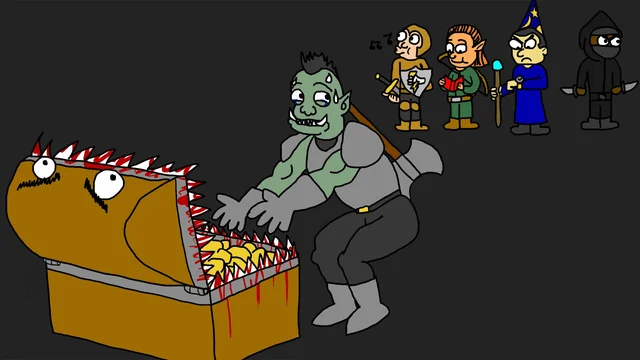
Metagaming goes both ways. Users regenerate replies until the NPC confesses, use out-of-character notes to steer outcomes, or apply genre knowledge their character wouldn't have. That last one is the mimic problem above: every player knows treasure chests can bite, but a first-level adventurer doesn't. The question of how to handle knowing more than your character does is one of the oldest threads in RPG communities.
Not all metagaming is harmful, though. Some communities argue for constructive metagaming in RPGs, and some games tolerate or even encourage a degree of it.
https://www.youtube.com/watch?v=JjeBXQdnZjs
No Session Zero
Human tables increasingly start with explicit agreements. The TTRPG Safety Toolkit, curated by Kienna Shaw and Lauren Bryant-Monk, organizes tools by when they're used: before, during, and after play. Widely used tools include the X-Card, Lines and Veils, and Debrief. Most AI roleplay sessions skip this step entirely. As a result, the model never learns which information is off-limits, which tone you want, or how to handle out-of-character signals.
This is exactly what Jenova was built for.
The Jenova Solution
The most reliable fix for AI roleplay metagaming combines two things: agents designed around hidden information, and tools that let you define and preserve knowledge boundaries. Jenova provides both. You can use story agents built for structured discovery, or build a custom character whose instructions spell out exactly what they know.
| Traditional Approach | Jenova |
|---|---|
| Generic chatbot treats everything you type as heard by the character | Story agents and custom instructions that define what each character can know |
| Older reveals fall out of context and get forgotten or invented | Persistent cross-session memory and unlimited chat history |
| Lore secrets sit in context with no access rules | Private knowledge bases you attach and govern through instructions |
| One model for every story, whatever its strengths | Switch freely between OpenAI, Anthropic, Google, DeepSeek, xAI, and more |
| Waiting for a human GM's schedule | Play anytime on web, iOS, or Android with synced settings |
Story Games Built Around Secrets
Interactive fiction agents work best when the design itself withholds information. Vesper Court opens with a protagonist who wakes in a hidden vampire court with no memory of why. The premise forces the narrative to reveal its intrigue through play rather than up front. Horror exploration in the style of The Mansion follows the same principle: every room hides something, and discovery is the reward.
Social simulations add a different layer. In College Life, friendships and heartbreak unfold from your choices through emergent social dynamics. That only works if characters react to what they've actually witnessed, not to what the narrator knows.
The principle is spreading beyond entertainment. Training-focused roleplay platforms now promote characters that reveal information gradually and maintain context across sessions as a core design feature.
Character and World Building With Knowledge Boundaries
Writers and worldbuilders can treat knowledge boundaries as part of the craft. Creative Fiction Writer helps you research authentic worlds and draft scenes where each character's perspective stays distinct. You can also build a custom agent with your own instructions, preferred model, and a private knowledge base that holds your world bible.
A simple "knowledge ledger" gives the AI clear rules for each type of information:
| Information Type | Who Knows It | How the AI Should Treat It |
|---|---|---|
| Narration and inner thoughts | Narrator only | Never quoted, referenced, or reacted to by NPCs |
| Spoken dialogue | Characters present in the scene | Usable only by characters within earshot |
| Lore secrets | Specific named NPCs | Revealed only when story conditions are met |
| Out-of-character notes | You and the AI | Never treated as in-world events |
Example instruction to set this up:
"Kael's thoughts in italics are narrator-only. No NPC may react to them. The innkeeper knows nothing about the map's value unless Kael says it aloud in her presence."
Multi-Model Flexibility and Persistent Memory
Roleplayers are particular about which models hold character voice and perspective best. Community threads show users
, trying to decide which performs better. Jenova removes the need to juggle accounts: you can switch providers within one platform.Memory persists across sessions, so a reveal from last week stays revealed. Your data is encrypted and never used to train public AI models.
No AI system eliminates metagaming completely. Models can still slip, especially in very long scenes. Clear structure, memory, and the ability to correct the story in-scene reduce those slips substantially.
Specialized AI Agents for Immersive Roleplay
Character Creator
Character Creator is an expert character designer for roleplay, fiction, and original characters. It is the natural starting point for anyone who wants a character with a defined inner life and defined blind spots. You can quick-generate a character or work through a guided build.
- Quick-gen or guided character builds across genres
- Media research for characters inspired by existing works
- Character portraits to anchor your vision
The Mansion
The Mansion drops you into a house with no memory of how you arrived. Escaping depends on what you uncover. Because the premise is built on secrets, it's a strong example of fog-of-war storytelling that rewards curiosity without handing you the answers.
- Exploration-driven horror mystery
- Secrets distributed across rooms and encounters
- Stakes that escalate with every discovery
Game Designer Assistant
GMs and indie designers can use Game Designer Assistant to architect information flow before play begins. It helps you decide who knows what, when clues surface, and how to reward deduction over metagame shortcuts.
- Brainstorming and systems analysis
- Design documentation and concept art
- Expertise across genres, platforms, and markets
Learn Japanese Through Roleplay
Character consistency matters for learning too. Learn Japanese Through Roleplay anchors vocabulary and grammar to immersive scenarios, where a believable scene partner makes the language stick.
- Fully immersive scenarios with any theme
- Vocabulary and grammar anchored to memorable moments
- Natural conversation practice inside a story
Try any of these agents free, with no credit card required.
How to Prevent Metagaming in AI Roleplay
Step 1: Build a Character With Defined Blind Spots
Start by defining what your character, and each key NPC, does not know. A character with clear gaps produces better drama than an all-knowing one. Use Character Creator to formalize this.
"Create a smuggler NPC named Mara who knows the harbor's patrol routes but has no idea the governor is her estranged father. List her known facts and her blind spots separately."
Step 2: Separate Narration, Dialogue, and Out-of-Character Text
Pick a consistent formatting convention and tell the AI what each format means. A common setup is quotes for speech, italics for thoughts, and brackets for out-of-character notes. This directly addresses the narrator leak.
"Format rules: dialogue in quotes is heard by anyone present. Italics are my character's private thoughts. No NPC can perceive them. Text in [OOC: ] brackets is out-of-character and never part of the story."
Step 3: Run a Session Zero With the AI
Before the first scene, agree on tone, hard limits, and how secrets get revealed, just as a tabletop group would. Ask the AI to confirm the rules back to you.
"Before we start: the tone is slow-burn political intrigue. Lines: no graphic torture. Secrets are revealed only through in-scene discovery, never through narration. Summarize these rules back to me."
Step 4: Track Reveals in a Knowledge Ledger
As the story progresses, periodically ask for a summary of what each character currently knows. Because memory persists across sessions, the ledger carries forward.
"[OOC: Give me a who-knows-what summary. Which characters have learned Mara's identity so far, and how did each one find out?]"
Step 5: Correct Slips In-Scene
When a character knows something it shouldn't, flag it and request a rewrite rather than restarting. A short correction teaches the session its boundaries.
"[OOC: The guard couldn't have heard that conversation. He was outside the gate. Rewrite his last reply so he only reacts to what he could see.]"
Results & Use Cases
🕯️ Solo Horror Mystery Nights
Scenario: A player wants a tense investigation where clues matter and the narrator doesn't spoil the twist.
Traditional Approach: A generic chatbot summarizes the asylum's history in the first reply, and the mystery collapses.
Jenova: The Asylum casts you as an investigator in a shuttered psychiatric institution where every ward hides secrets.
- Discovery paced through exploration
- Clues that reward attention instead of arriving through exposition
- Persistent memory for multi-night investigations
📱 Language Practice on a Commute
Scenario: A learner practices Spanish on their phone during a 30-minute train ride and wants a scene partner who stays in character.
Traditional Approach: Flashcard apps without context, or a chatbot that drops character as soon as you make a grammar mistake.
Jenova: Learn Spanish Through Roleplay runs fully immersive scenarios on iOS or Android, with full parity to web.
- Speech-to-text for hands-free practice
- Settings and progress synced across devices
- Vocabulary anchored to story moments that stick
💼 GMs Prepping Secret-Heavy Campaigns
Scenario: A game master is planning a betrayal arc and needs to map which NPCs know the traitor's identity, and when the players can find out.
Traditional Approach: Hours of spreadsheet work. Some groups try a shared approach instead; one GM suggests altering the world to surprise players who already know the source material.
Jenova: Game Designer Assistant helps map information flow, clue placement, and reveal timing before session one.
- Structured clue trees and NPC knowledge maps
- Documentation ready to share with co-GMs
- Twists designed to resist genre-savvy players
✍️ Novelists Testing Character Perspective
Scenario: A fiction writer wants to roleplay a dinner scene to check that each character speaks only from their own perspective.
Traditional Approach: Drafting and redrafting by hand, with point-of-view errors caught only in late edits.
Jenova: Creative Fiction Writer workshops scenes with editorial insight, flagging moments where characters know too much.
- Point-of-view discipline built into drafting
- Research for authentic settings
- Polished prose from first draft to manuscript
FAQ
What is metagaming in AI roleplay?
Metagaming in AI roleplay occurs when an AI character uses knowledge it shouldn't have, such as your character's private thoughts, narrator-only lore, or out-of-character comments. It mirrors the tabletop concept of player knowledge versus character knowledge. It also applies in reverse, when users steer the story with information their character couldn't know. Both versions undermine immersion, mystery, and narrative stakes.
Why does my AI character know things it shouldn't?
Language models process the whole conversation as one block of text, so narration, thoughts, and lore notes can blur together with dialogue. Without explicit instructions, the model may treat everything in context as known by every character. Story-focused agents like Vesper Court are built around hidden information, and custom instructions can define clear knowledge boundaries for any character.
How do I stop an AI from reading my character's thoughts?
Set a formatting rule at the start of the session. For example, italics are private thoughts, and no character may perceive or react to them. Mark out-of-character notes with brackets. If a slip happens, flag it with an OOC note and ask for a rewrite. Repeating the rule early in a session usually improves consistency for the rest of it.
Is Jenova free for AI roleplay?
Yes. Jenova's free tier includes all core features with limited usage. Paid plans start with Plus at $20/month, which adds 30× usage and custom model selection. Higher tiers scale up from there. Usage resets monthly on your billing date with no daily caps, so long roleplay sessions draw from your full monthly allowance from day one.
Is metagaming always bad in roleplay?
Not always. Many tables accept some metagaming, such as players coordinating out of character to keep scenes moving, or groups that share rules knowledge cooperatively. The problem arises when out-of-story knowledge removes tension or overrides another player's choices. In social simulations like College Life, outcomes depend on characters reacting only to what they've witnessed.
Does AI roleplay on Jenova work on mobile?
Yes. Jenova offers full feature parity across web, iOS, and Android, including speech-to-text for voice input. Your settings and chat history sync across devices, so you can start a story on your laptop and continue it on your phone with memory of prior reveals intact.
Conclusion
AI roleplay metagaming turns mysteries into spoilers and betrayals into non-events. It usually traces back to the same causes: blurred narration, omniscient NPCs, memory drift, and a missing session zero. The fix is structural. Use agents built around hidden information, set clear rules separating narration from dialogue, and keep persistent memory of what each character has actually learned.
Whether you want a horror mystery in The Mansion, a character with real blind spots from Character Creator, or help designing a campaign's secrets with Game Designer Assistant, consistent character knowledge is what makes AI storytelling feel earned.
Explore the full agent library at Jenova.
For Developers: Every agent in this article is available programmatically via the Jenova API. You can build character-consistent roleplay features into your application with a single integration. Full documentation →