AI Roleplay Memory: Keep Characters, Lore & Story Arcs Consistent
2026-10-19
Roleplay Game Master helps you run long-form stories where every character, scar, and secret stays consistent from the first scene to the hundredth. Most AI chatbots start forgetting once a conversation grows past their working window, so names drift and plot threads disappear. This AI roleplay partner offers unlimited memory, consistent characters, and full creative freedom. As of October 2026, long-term memory is the main difference between a roleplay that holds together and one that falls apart by chapter three.
- ✅ Unlimited memory that carries your story across sessions, weeks, and months
- ✅ Consistent characters whose traits, relationships, and voices stay stable
- ✅ Any genre, any scenario, including dark fantasy, noir mysteries, sci-fi epics, and slow-burn romance
- ✅ Available on web, iOS, and Android, with your story synced across devices
Memory is often described as a technical detail. In practice, it decides whether your fictional world feels real. To see why, it helps to look at how most AI systems handle long conversations and where they break down for people building stories over time.
Quick Answer: What Is AI Roleplay Memory?
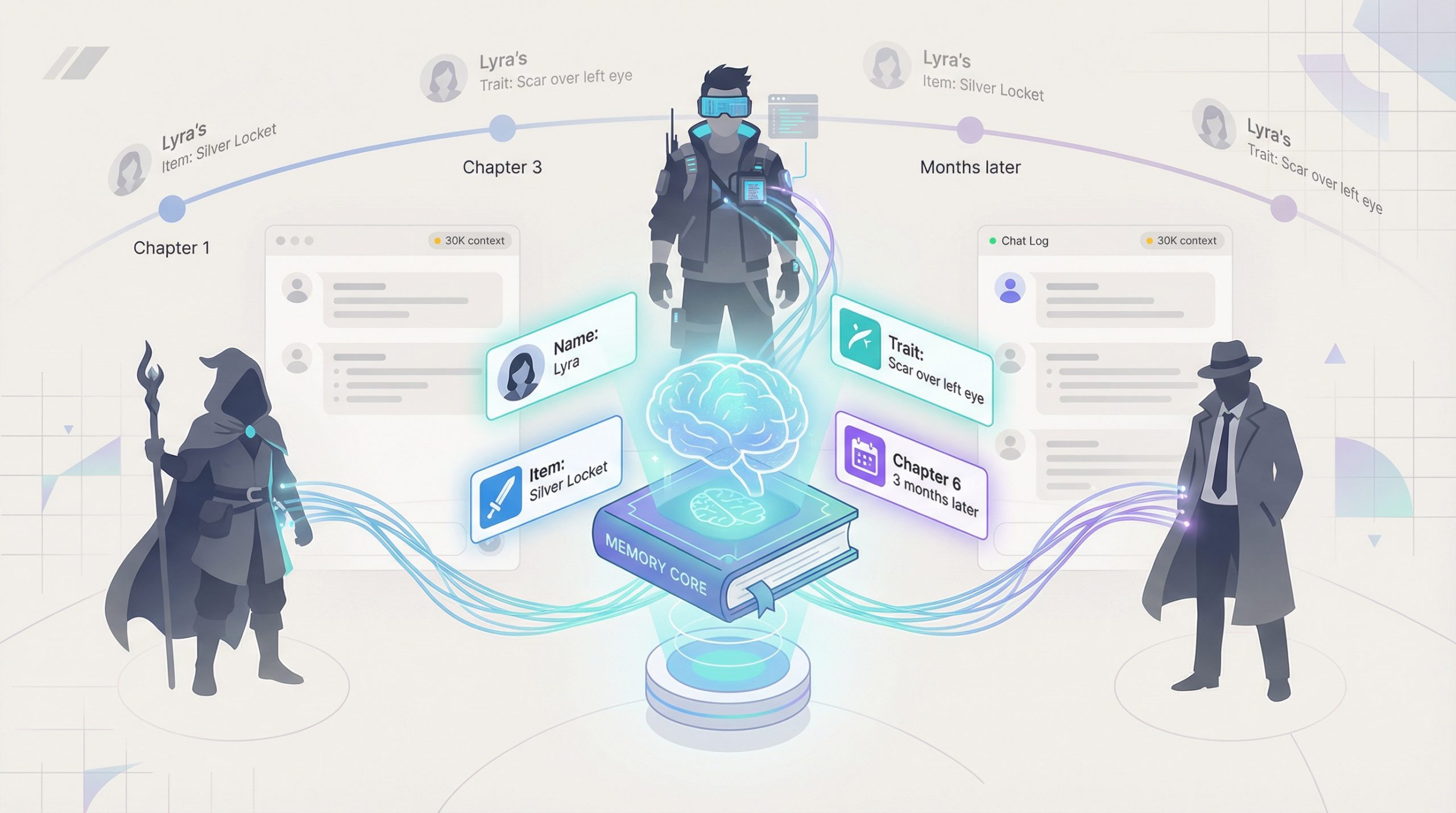
AI roleplay memory is the ability of an AI storytelling partner to retain characters, world details, and plot events across long conversations and separate sessions, so the narrative stays consistent over weeks or months.
Key capabilities:
- Persistent recall of character names, traits, inventory, and relationships, which Roleplay Game Master handles automatically
- Continuity of plot events, promises, and unresolved conflicts across sessions
- Stable character voice and personality, with no slow drift into a generic tone
- World-state tracking for factions, locations, timelines, and consequences of past choices
The Problem: Why Most AI Roleplay Forgets
AI is now part of daily life for a large share of people, and many of them spend long stretches in conversation:
25% — Share of Americans who now use AI every day, up from 19% a year earlier
24% — Share of AI users who spend more than an hour a day with AI
Long sessions are exactly where memory fails. Researchers note that the reasoning and planning capabilities of LLM agents are fundamentally limited by the fixed size of their context window. When a story grows past that limit, early details fall out of view. Bigger windows don't fully fix the problem. In one benchmark, a model built for 1M-token contexts declined sharply as input grew:
75.8 → 0.0 — Accuracy of a long-context model as input scaled from 50 to 6,400 documents in a long-context QA benchmark
NVIDIA's researchers describe scaling with context length, in terms of both loss and latency, as the most fundamental problem in long-context LLM research. Among machine learning practitioners, a common view is that
.But keeping a story coherent is frustratingly difficult for roleplayers:
- Character drift: A stoic mercenary becomes cheerful and chatty 200 messages later, with no in-story reason.
- Lost lore: The magic system you defined in session one gets contradicted in session five.
- Forgotten consequences: Betrayals, injuries, and promises vanish, so your choices stop mattering.
- Manual workarounds: You end up pasting character sheets and "previously on" summaries into every session just to keep the AI on track.
Memory also shapes how people perceive the AI itself. A pilot study from the ACM Digital Library examined how semantic long-term memory affects user assessments of chatbot likeability and perceived intelligence. Coverage of roleplay platforms similarly argues that context memory makes AI chat more natural, immersive, and personalized.
Persistent, consistent memory is the core feature of this AI game master.
Why Roleplay Game Master Solves AI Roleplay Memory
Roleplay Game Master is built around one promise: your story stays intact. It doesn't treat each session as a fresh start or quietly drop older messages. It keeps the full arc of your narrative available, so a detail planted in chapter one can pay off months later.
| Traditional AI Chatbots | Roleplay Game Master |
|---|---|
| Forget early details once the context window fills | Unlimited memory across the entire story |
| Characters drift in tone and personality | Consistent character voices and traits |
| You re-paste character sheets every session | Story state carries over between sessions |
| Choices lose weight as history disappears | Past decisions shape future scenes |
| Restrictive scenario and genre limits | Full creative freedom across any scenario |
🧠 Unlimited Memory Across Sessions
Your roleplay doesn't have an expiration date. Close the app on Tuesday, return three weeks later, and the dragon you spared still remembers your mercy. The tavern keeper still owes you money. The rival who swore revenge is still out there. Persistent cross-session memory means you can start where you left off without writing a recap.
🎭 Consistent Characters
The AI game master tracks who each character is: their speech patterns, motives, physical traits, and relationships. If Lyra has a scar over her left eye and carries a silver locket, she still has both in chapter six. Personalities change only when the story gives them a reason to.
🌍 World-State and Consequence Tracking
Factions, alliances, inventory, injuries, and timelines all accumulate. This is what makes long campaigns feel alive. The world reacts to what you've already done instead of resetting to a neutral default.
✍️ Complete Creative Freedom
Dark fantasy, cyberpunk heists, gothic horror, political intrigue, and slice-of-life romance are all available. You set the tone, pacing, and rules, and the game master adapts while keeping everything consistent.
Example prompts to start a memory-rich campaign:
"Start a noir detective story in 1940s Los Angeles. I'm a disgraced cop named Vince Marlowe with a gambling debt to the mob. Track every informant I meet."
"Continue our fantasy campaign. Remind me where we left Lyra and what she promised the river spirit."
"Run a slow-burn sci-fi story aboard a generation ship. Keep a running log of crew relationships and who suspects the captain."
Related Agents You'll Also Find Useful
If you enjoy long-form storytelling, these agents extend the experience in different directions.
Creative Fiction Writer
If you want to turn a roleplay campaign into a polished manuscript, this agent works as an editorial partner for original fiction in any genre.
- Deep research for authentic, believable worlds
- Expert editorial insight on structure and pacing
- Polished prose from first draft to final manuscript
Vesper Court
For readers who prefer a ready-made premise, Vesper Court drops you into a hidden vampire court with no memory of how you arrived.
- Dark romance and blood-soaked political intrigue
- Choices that change the story every night
- A curated setting with an open-ended narrative
The Mansion
If you prefer horror and mystery, you wake in a mansion full of secrets and have to find your way out.
- Room-by-room exploration with hidden clues
- Tension and danger that build over time
- A single goal: uncover the truth and escape
Learn Russian Through Roleplay
If you're also studying a language, this agent combines immersive scenarios with a dedicated language mentor. It is designed around unlimited memory and consistent characters.
- Vocabulary and grammar practiced inside living stories
- Characters who remember your progress
- Natural, memorable conversation practice
Try Roleplay Game Master free, no credit card required.
How It Works: Running a Roleplay That Remembers
Step 1: Set Your Premise Describe the genre, setting, and your character. The more specific you are, the richer the foundation the AI has to remember.
"High fantasy. I'm Kael, a half-elf cartographer hired to map the Shattered Coast. I'm afraid of deep water and secretly working for a rival guild."
Step 2: Establish Key Details Early Introduce companions, items, and rules for your world. Roleplay Game Master keeps track of them so you don't have to maintain a separate notes file.
"My companion is Lyra, a mercenary with a scar over her left eye. She carries a silver locket she never opens."
Step 3: Play Across Multiple Sessions Return whenever you like, from any device. The story state persists, so you can continue directly from the last scene.
"Pick up where we left off at the lighthouse."
Step 4: Test the Memory With Callbacks Reference earlier events to bring back old threads. A consistent game master will connect past choices to present consequences.
"Lyra finally opens the locket. What's inside, and how does it connect to what the lighthouse keeper told us in chapter two?"
Step 5: Steer the Arc Ask for recaps, adjust the tone, or introduce time skips. The narrative carries forward with continuity intact.
"Jump ahead three months. Summarize what changed in the guild war while we were at sea."
Results & Use Cases
🐉 Long-Running Fantasy Campaigns
Scenario: A player runs a 40-session fantasy campaign with a party of five companions, three rival factions, and a prophecy seeded in the first session.
Traditional Approach: Maintaining a wiki, pasting character sheets into every chat, and still correcting the AI when it confuses companions.
Roleplay Game Master: The prophecy pays off in session 38 because the AI still remembers the exact wording from session one.
- No external notes required
- Faction relationships evolve based on real player choices
- Companions keep distinct voices throughout
🕵️ Mystery and Noir Investigations
Scenario: A detective story where clues are scattered across dozens of scenes and suspects lie in subtle, trackable ways.
Traditional Approach: The AI forgets which suspect had which alibi, so the mystery becomes unsolvable or contradicts itself.
The AI game master: Alibis, red herrings, and timelines stay internally consistent, so the reveal feels earned.
- Clues remain fixed once introduced
- Contradictions in suspect stories are intentional, not accidental
- Fair-play mysteries you can actually solve
📱 Commute-Sized Story Sessions on Mobile
Scenario: A reader plays 15-minute chapters on their phone during the train ride to work, then continues on a laptop at night.
Traditional Approach: Short sessions on separate devices mean constantly rebuilding context.
This AI-powered storyteller: The story syncs across web, iOS, and Android, so each short session continues seamlessly. Speech-to-text also makes it easy to narrate actions hands-free.
- No recap needed between devices
- Short sessions build into a long, coherent arc
- Voice input for quick play on the go
💌 Slow-Burn Character Relationships
Scenario: A romance-focused story where trust builds gradually over weeks of interactions.
Traditional Approach: Characters forget shared moments, so emotional progress resets.
Roleplay Game Master: Inside jokes, past arguments, and turning points stay part of the relationship. For a curated version of this genre, Vesper Court offers a ready-made dark romance setting.
- Emotional continuity that rewards patience
- Characters reference shared history naturally
- Relationships change in response to your choices
Frequently Asked Questions
What is the difference between a context window and AI roleplay memory?
A context window is the amount of text a model can process at once. Long-context research shows that even large windows degrade as input grows. AI roleplay memory goes further: it keeps characters, events, and world details available across long stories and separate sessions, so older details aren't lost when a conversation gets long. This is why dedicated memory systems often perform better than simply expanding the window.
Is Roleplay Game Master free to use?
Yes. Roleplay Game Master is available on a free tier that includes all core features with limited usage. Players who run longer or more frequent sessions can upgrade to Plus at $20 per month for 30× the free usage, with higher tiers available for heavy use. Usage resets monthly on your billing date, with no daily caps.
Can AI roleplay remember my story across different sessions?
With the right tool, yes. Roleplay Game Master is built around unlimited memory and persistent cross-session recall. You can close a story, return weeks later, and continue from the last scene. Characters, items, relationships, and plot threads carry over automatically, so you don't need to paste summaries or character sheets at the start of each session.
Will AI characters stay consistent over a long roleplay?
Character consistency is one of the main goals of dedicated roleplay agents. General chatbots often drift in tone after many messages. Roleplay Game Master is designed to keep personalities, speech patterns, and physical traits stable unless the story gives a reason for change. That consistency lets long arcs, redemption stories, and slow-burn relationships feel believable.
Does AI roleplay memory work on mobile?
Yes. Roleplay Game Master offers full feature parity across web, iOS, and Android, and all settings and story history sync across devices. You can start a campaign on your laptop and continue it on your phone without losing context. Built-in speech-to-text also lets you narrate your character's actions by voice.
Is my roleplay data private?
Your conversations are encrypted in transit and at rest, are never used to train public AI models, and are not sold or shared with advertisers. This matters for roleplayers who invest personal creativity into long stories.
Conclusion
Long-form roleplay depends on memory. Without it, characters drift, lore contradicts itself, and the choices you made early in a story stop mattering. Research on long-context models confirms that bigger context windows alone don't solve the problem. Consistent storytelling needs memory that persists.
Roleplay Game Master was built for that need. It offers unlimited memory, consistent characters, and the freedom to run any story you can imagine, whether it lasts one evening or many months. For anyone looking for AI roleplay with long-term memory and reliable story continuity, it is a practical place to start.
Try Roleplay Game Master now and start a story that holds together. Explore more at Jenova.
For Developers: Roleplay Game Master is available programmatically via the Jenova API, so you can add persistent-memory interactive storytelling to your game or app with a single API call. Full documentation →