AI Roleplay Group Turn Order: Run Fair Multi-Character Scenes
2026-10-19
Roleplay Game Master helps you run multi-character scenes where every participant gets a fair, coherent turn. It tracks who has acted, who is waiting, and what each character knows across the entire session. As of October 2026, most AI chat tools still treat a group scene like a one-on-one conversation. The AI answers every message, speaks for everyone at once, or forgets the rogue who hasn't acted in ten exchanges. This AI game master gives you explicit control over AI roleplay group turn order, whether you prefer strict initiative, round-robin, or a spotlight that follows the story.
- ✅ Unlimited memory, so the turn queue and character states persist across long campaigns
- ✅ Consistent character voices, even with a crowded cast in a single scene
- ✅ Any turn system you describe in plain language: initiative, round-robin, spotlight, or freeform
- ✅ Complete creative freedom across genres, from dungeon crawls to courtroom drama
Turn order sounds like a small mechanical detail. In practice, it decides whether a group scene feels like a living table of distinct characters or a single narrator talking to itself. To see why this matters, it helps to look at why group roleplay breaks so easily, and why this problem is harder for AI than for human game masters.
Quick Answer: What Is AI Roleplay Group Turn Order?
AI roleplay group turn order is the set of rules an AI narrator follows to decide which character speaks or acts next in a multi-character scene, so that each participant gets fair spotlight time and the story stays coherent.
Key capabilities of a well-run turn system:
- A defined sequence, such as initiative rolls, round-robin, or narrative spotlight
- Memory of who has acted this round and who is still waiting
- Distinct voices and motivations for each AI-controlled character
- Player override, so you can call on a character, skip a turn, or allow an interruption
Why AI Roleplay Breaks Down in Group Scenes
Turn-taking is one of the oldest problems in conversation research. As Gabriel Skantze notes in his review of conversational systems, participants need to coordinate who speaks next because it is difficult to speak and listen at the same time. Researchers at Tufts similarly describe smooth turn-taking as essential to maintaining mutual comprehensibility.
Meanwhile, conversational AI has moved well beyond novelty:
1 in 25 adults — use AI chatbots for companionship, according to a 2026 report summarized by the Congressional Research Service
**$11.8 billion** — [projected global chatbot market size, on track to reach $41.2 billion by 2033](https://www.grandviewresearch.com/industry-analysis/chatbot-market)
The core design assumption has not caught up with that growth. Research published in the ACM Digital Library observes that AI agents typically engage in one-on-one conversations, where each message from the user receives a response from the agent. That reply-to-everything default works for Q&A. It falls apart when you are one adventurer in a party of five.
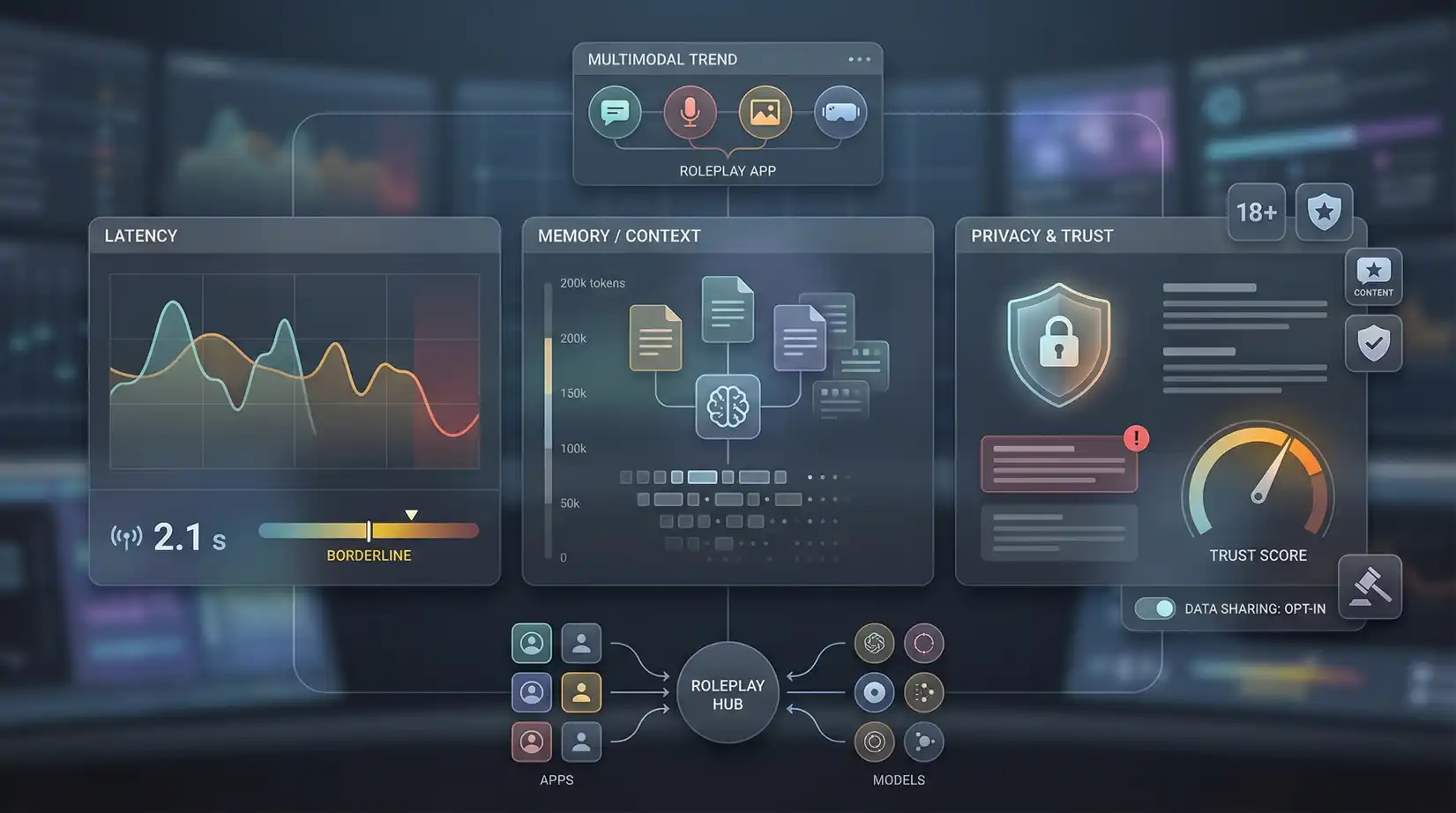
Running a group scene well is frustratingly difficult in most AI tools:
- The AI answers everything. Every message triggers a response from every character, burying your action under a wall of NPC reactions.
- Characters collapse into one voice. The gruff mercenary and the nervous scholar start sounding identical by the third round.
- Spotlight drift. Quieter characters vanish from the scene because nothing tracks whose turn was skipped.
- Context loss. As the dashboard above illustrates, latency and memory are linked. Long scenes push older turns out of short context windows, and the AI forgets who already acted.
Google researchers summarize the trade-off well: designers of multi-party conversation have historically had to settle for the rigidity of scripted interaction or accept the unpredictability of purely generative models.
This is exactly the problem a dedicated AI game master was built to solve.
Why Roleplay Game Master Handles Group Turn Order Better
Roleplay Game Master is an immersive roleplay narrator with unlimited memory and consistent characterization. You don't fight a generic chatbot's habits; you tell the game master how your table runs, and it holds that structure for the whole session. Because it remembers the full history of the scene, it knows who acted last round, who is waiting, and which NPC is still nursing a grudge from an hour ago.
| Traditional AI Chatbot | Roleplay Game Master |
|---|---|
| Replies to every message with every character | Advances only the character whose turn it is |
| Voices blur together over long scenes | Each character keeps a distinct voice and motive |
| Forgets turn order as context fills up | Unlimited memory preserves the queue and scene state |
| You manually prompt each NPC to act | You set the rules once; the narrator enforces them |
| Rigid script or chaotic improvisation | Structured turns with room for interruptions |
Turn Systems You Define in Plain Language
Different stories need different pacing. Here are the most common systems and when each works best:
| Turn System | How It Works | Best For |
|---|---|---|
| Initiative order | Characters act in a ranked sequence, often set by a roll | Combat, tactical encounters |
| Round-robin | Every character acts once per round in a fixed loop | Parties of equal importance |
| Narrative spotlight | The narrator shifts focus to whoever the story needs | Drama, mystery, intrigue |
| Reactive | NPCs speak only when addressed directly | Interrogations, quiet scenes |
| Mixed-initiative | NPCs can interject, but you can always call the next turn | Social scenes, debates, councils |
Describe the system in a single sentence and the game master applies it consistently.
"Run this as initiative order: my ranger, then the orc chieftain, then Brother Aldric, then the two goblin scouts. Announce each turn before it happens."
Persistent Memory That Tracks the Queue
Group scenes fail most often in long sessions. A short context window means the AI eventually loses track of round three while you're on round nine. With unlimited memory, the game master retains the initiative queue, wounds, alliances, and secrets each character holds, so you can pause mid-battle and resume days later without restating anything.
Distinct Voices for Every Character at the Table
A five-character scene only works if the five characters feel different. The game master maintains each character's speech pattern, goals, and knowledge boundaries, so the paranoid spy never accidentally reveals information only the cleric overheard.
"Keep Mira terse and sarcastic, Brother Aldric formal and slow, and make sure neither of them knows about the forged letter yet."
Mixed-Initiative Control: You Can Always Call the Next Turn
The research is clear that fully autonomous turn-taking isn't the goal. In Google's DialogLab study, participants compared three modes: autonomous agents acting in a random or one-by-one order, reactive agents that spoke only when mentioned, and a human control mode. Participants found the human control mode significantly more engaging, and generally more effective and realistic.
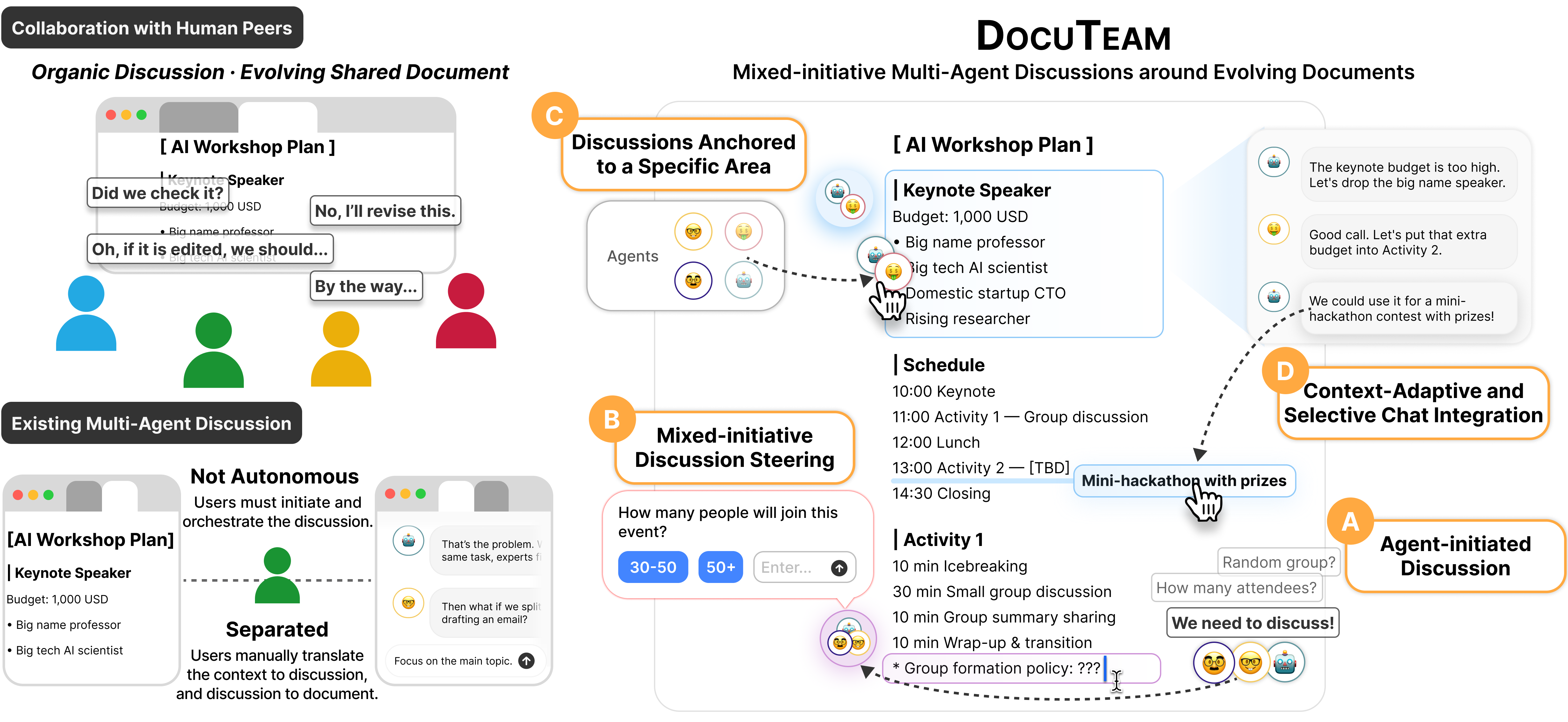
The DocuTeam diagram above shows the same tension from a collaboration angle. Existing multi-agent discussions are "not autonomous," because users must initiate and orchestrate every exchange. The alternative pairs agent-initiated contributions with human steering. Good group roleplay works the same way: NPCs should feel alive enough to interject, while you keep the authority to redirect the scene.
"Let the innkeeper interrupt if someone mentions the missing caravan. Otherwise, wait for me to call on characters."
Related Agents You'll Also Find Useful
Group scenes are only as strong as the characters and worlds behind them. These agents fit naturally alongside your campaign.
Character Creator If you're building a party before the first session, this agent designs characters for roleplay, fiction, and original creations, so every member of your table has a clear voice before turn order even matters.
- Quick-gen or guided character builds
- Research on existing media for fan-inspired characters
- Character portraits across genres
Love Island If you want to see group dynamics at work in a ready-made scenario, this open-world romance drops you onto a private island with eight single strangers. Connections and rejections unfold from your choices.
- Emergent social dynamics among a large cast
- Relationships that shift in response to your actions
- A turnkey multi-character setting
Game Designer Assistant If you're designing your own tabletop or narrative system, this partner helps you brainstorm and document mechanics, including initiative rules and pacing structures.
- Brainstorming and systems analysis
- Design documentation
- Concept art and genre expertise
Try the AI game master free — no credit card required.
How to Set Up AI Roleplay Group Turn Order
Step 1: Establish the Scene and Cast
Open Roleplay Game Master and describe your setting and everyone present. List which characters are yours and which the narrator controls, so it never speaks for you.
"Dark fantasy tavern. I play Kael, a disgraced knight. You control Mira the thief, Brother Aldric, and the innkeeper. Never write Kael's actions or dialogue."
Step 2: Choose a Turn System
Pick one of the systems from the table above and state it explicitly. Being precise up front prevents the reply-to-everything behavior entirely.
"Use round-robin: Kael, then Mira, then Aldric. The innkeeper only speaks when addressed."
Step 3: Take Your Turn and Let the Queue Advance
Write your character's action. The game master resolves it, then moves to the next character in the queue, briefly signaling whose turn is coming so you always know where you stand.
"Kael slams the bounty notice on the table and asks who posted it."
Step 4: Adjust Pacing Mid-Scene
Stories change shape. You can call on a specific character, skip someone, or switch systems when a conversation turns into combat.
"Skip Aldric this round. Combat starts now — switch to initiative and roll for everyone."
Step 5: Resume Without Recapping
Close the session whenever you want. When you return, the game master still knows the queue, the round number, and every character's state.
"Let's continue. Whose turn was it?"
Results & Use Cases
🎲 Running a Full Adventuring Party Solo
Scenario: A solo player wants the feel of a five-person tabletop party without recruiting four friends.
Traditional Approach: Scheduling a human group often takes weeks, and generic chatbots blur four companions into one voice within an hour.
Roleplay Game Master: The narrator runs four companions in strict initiative, each with a distinct personality and tactical style.
- Fair spotlight for every party member
- Combat rounds that stay ordered across long fights
- Companions who remember past arguments and favors
💼 Political Intrigue at a Crowded Council Table
Scenario: A writer drafts a novel scene where six faction leaders debate a treaty, and wants to test how it plays out.
Traditional Approach: Hours of manual drafting, rewriting each speaker to keep motives consistent.
Roleplay Game Master: Narrative spotlight mode lets the scene shift naturally toward whoever has the most at stake, while reactive rules keep minor delegates quiet until addressed.
- Six distinct voices with hidden agendas
- Interruptions that feel organic rather than random
- A playable draft the writer can mine for dialogue
For a social take on the same principle, Love Island shows how a large cast can generate drama from your choices alone.
📱 Continuing a Campaign on Your Commute
Scenario: A player starts a heist scene on their laptop at home and wants to keep playing on their phone during the train ride.
Traditional Approach: Copy-pasting summaries between apps and re-explaining who has acted.
Roleplay Game Master: The session picks up exactly where it left off on iOS or Android, with the turn queue intact.
- Full feature parity across web and mobile
- Settings and history sync automatically
- No recap prompts needed
Frequently Asked Questions
What is the best turn order system for AI group roleplay?
It depends on the scene. Initiative order works best for combat because it creates a clear, tactical sequence. Round-robin suits parties where everyone matters equally. Narrative spotlight fits drama and mystery, where the story should follow whoever is most relevant. Many players combine systems, using spotlight for conversation and switching to initiative once a fight breaks out. The key is stating the system explicitly so the AI applies it consistently.
Can Roleplay Game Master control multiple characters in one scene?
Yes. Roleplay Game Master can voice an entire cast while keeping each character's personality, goals, and knowledge separate. Its unlimited memory means it tracks who has acted and what each character knows, even across very long sessions. You decide which characters belong to you, and it will not write your character's actions or dialogue when you instruct it not to.
How do I stop the AI from speaking for my character?
Declare it at the start of the scene: name your character and tell the narrator never to write their actions, thoughts, or dialogue. Then define a turn system so the AI knows to pause after reaching your character in the queue. Clear boundaries plus an explicit turn order eliminate most cases of the AI taking over your role in group roleplay.
Is AI group roleplay free to try?
Jenova offers a free tier with all core features and limited usage. Paid plans start at $20 per month for Plus, which adds 30× the free usage and custom model selection, with higher tiers available for heavy campaign play. Usage resets monthly on your billing date, with no daily caps, so long weekend sessions draw from your full monthly allowance.
Does AI roleplay with group turn order work on mobile?
Yes. Jenova has full feature parity across web, iOS, and Android, and all settings and chat history sync between devices. You can start a multi-character scene on a desktop and continue it on your phone with the turn queue, round number, and character states preserved.
Conclusion
Group roleplay breaks when AI treats a crowded scene like a private chat: every character answers at once, voices merge, and quieter companions disappear. Getting AI roleplay group turn order right means defining a clear system, remembering the queue across long sessions, and keeping you in control of the spotlight. That combination turns a chaotic multi-character chat into a table that feels genuinely shared.
Whether you're running a solo dungeon crawl, testing a tense council scene, or managing a sprawling party of companions, the right narrator keeps every turn fair and every voice distinct. Try Roleplay Game Master now and run your next multi-character scene the way it was meant to play.
Explore more at Jenova.
For Developers: Roleplay Game Master is available programmatically via the Jenova API — integrate structured, multi-character roleplay narration into your application with a single API call. Full documentation →