AI Roleplay Godmodding: Stop Bots From Controlling Your Character
2026-10-18
Roleplay Game Master lets you play immersive AI roleplay without losing control of your character. The AI narrates the world, voices every NPC, and then stops so you can decide what happens next.
AI roleplay godmodding happens when a bot writes your dialogue, tells you what you feel, or makes its villain impossible to beat. As of October 2026, it is still one of the most frustrating parts of AI storytelling. This AI combines unlimited memory with consistent characters, so the rules you set at the start of a story stay active as the story grows.
- ✅ Unlimited memory keeps your boundaries, plot threads, and character details in play across long campaigns
- ✅ Consistent characterization means NPCs stay true to themselves and don't rewrite who your character is
- ✅ Full creative freedom covers fantasy, romance, horror, mystery, sci-fi, or any setting you invent
- ✅ Works on web, iOS, and Android, so you can continue the same story on any device
Godmodding rarely comes from one bad reply. It usually starts with small overreaches that add up until the story no longer feels like yours. To fix it, you need to know what it looks like, why language models do it, and what a well-designed roleplay partner does differently.
Quick Answer: What Is AI Roleplay Godmodding?
AI roleplay godmodding is when an AI character takes control it was never given: writing your character's actions, dialogue, or feelings, making itself unbeatable, or deciding story outcomes without your input. The term comes from forum and tabletop roleplay, where it has long been considered bad etiquette.
Common forms of godmodding:
- Puppeting: the AI writes your character's speech, actions, or decisions
- Emotion-dictating: the AI tells you what your character feels ("You can't help but feel flattered…")
- Invincibility: NPCs dodge every attack, win every argument, or survive anything
- Outcome-forcing: the AI resolves fights, choices, or plot turns before you get to act
The fix is a roleplay partner that treats your character as off-limits. It describes the world, plays its own characters, and hands the next move back to you.
Why AI Roleplay Godmodding Keeps Happening
AI roleplay is no longer a niche hobby. The global AI companion market is projected to reach $174.39 billion by 2031, and a large share of that usage is interactive storytelling.
950 million: Monthly active users of AI companion apps by Q2 2026
33% of teens: Use AI companions for social interaction and relationships, including role-playing
These users are invested in their stories. That is why it stings when the AI hijacks a scene. But keeping control of your own character is frustratingly difficult:
- Second-person narration slides into puppeting. Bots that narrate in "you" naturally continue the "you" thread, and that means writing your character's reactions.
- Instructions fade in long chats. A "don't speak for me" rule that worked at message 10 often stops working by message 200.
- Characters get written as dominant. "Confident," "possessive," or "unstoppable" personas can turn into a character that overrides everyone else in the scene.
- AI fills gaps with invention. Australia's eSafety Commissioner notes that AI chatbots may say things that are inaccurate. In roleplay, that shows up as made-up backstory, relationships, or memories assigned to your character.
Anatomy of a Godmodded Reply
The screenshot below shows a typical case. It comes from a classroom-romance bot where the user plays a character named Lilith.
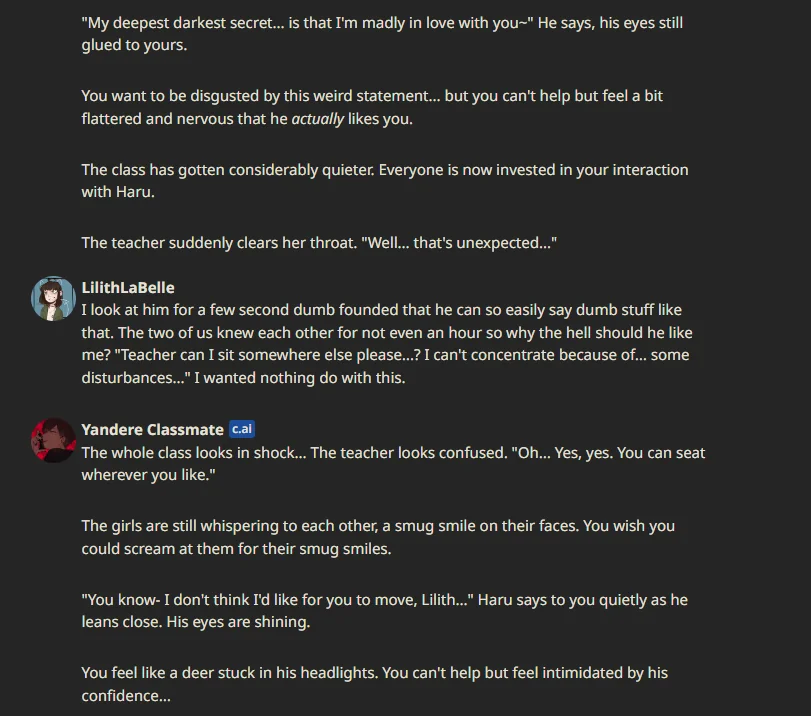
Looking at the exchange closely shows three separate violations:
- Pre-loaded emotion. Before the user replies, the bot writes: "You want to be disgusted… but you can't help but feel a bit flattered and nervous." It has already decided how Lilith feels.
- Ignored player intent. The user clearly writes that Lilith "wanted nothing to do with this" and asks to change seats.
- Override. The bot answers with "You feel like a deer stuck in his headlights. You can't help but feel intimidated by his confidence…" That reverses the stance the user just set.
The phrase "you can't help but feel" is a strong warning sign. It literally takes choice away from the player.
Why Language Models Drift Into Your Character
Language models are built to continue text in a plausible way. In a scene written in second person, the most "plausible" next sentence is often about you. On top of that, the U.S. Federal Trade Commission observes that chatbots can effectively mimic human characteristics, emotions, and intentions. That skill makes AI characters feel vivid, but it also tempts them to narrate emotions that aren't theirs to narrate.
This is exactly the problem a dedicated AI game master was built to solve.
Why Roleplay Game Master Keeps You in Control
Roleplay Game Master works like a good human game master. It builds the world, runs the NPCs, presents consequences, and then hands the next move back to you. You can state your player-agency rules once, and its unlimited memory keeps them in play. It is designed to respect those rules rather than slowly forget them as the story gets longer.
| Typical Godmodding Pattern | Roleplay Game Master |
|---|---|
| Bot narrates your feelings and reactions | You set "never write my character's thoughts or dialogue" once, and memory keeps it active |
| Rules fade as the chat grows | Unlimited memory keeps boundaries, lore, and plot threads in context |
| NPCs rewrite your character to fit their arc | Consistent characterization keeps NPCs true to themselves without reshaping yours |
| Villains are scripted to always win | Ask for fair stakes, and enemies act while you decide the outcome of your own actions |
| Invented backstory for your character | Your character sheet stays the reference for who you are |
Player Agency You Define
Every table has its own rules. Some players want zero narration of their character. Others are fine with small sensory details, like "you feel the cold." You decide where that line sits, and the agent remembers it across sessions.
NPCs That Stay in Character Without Taking Over Yours
A yandere classmate should be intense, and a god-king on a burning throne should be intimidating. Strong characterization means NPCs show their personality through their own words and actions. Good roleplay lets the yandere lean in close; it doesn't decide you're flattered.
Fair Stakes Instead of Scripted Outcomes
Combat and conflict work best when the AI describes the threat and you choose the response. You can ask for real consequences, including failure, without the AI making those choices for you.
Freedom Across Any Genre
Dark fantasy, slow-burn romance, cosmic horror, political intrigue, or a heist: the same player-agency principles apply to any scenario you imagine.
Prompts that set the tone from message one:
"Run a dark fantasy campaign. I play Kaelen, a disgraced paladin. Never write Kaelen's dialogue, actions, thoughts, or feelings. Describe the world and NPCs, then stop and let me act."
"In combat, describe what the enemy attempts and let me decide whether Kaelen dodges, blocks, or takes the hit. Don't soften consequences."
"OOC: You just wrote that Kaelen felt afraid. He didn't. Rewrite the last paragraph and end it at the guard's question."
A realistic expectation: no language model is flawless. Occasional slips can still happen, especially in emotionally charged scenes. The difference is how you recover. A quick out-of-character (OOC) correction fixes the moment, and persistent memory helps keep the rule in place afterward.
Related Agents You'll Also Find Useful
Godmodding gets worse when your character is vague. A bot is more likely to fill in your personality when you haven't defined it. These agents fit naturally before and after your roleplay sessions.
If you're building an original character before a campaign, Character Creator designs roleplay-ready OCs with clear personalities, backstories, and boundaries. A well-defined character sheet leaves the AI much less room to invent things about you.
- Quick-generate or step-by-step guided character builds
- Research into existing media for fan-inspired characters
- Character portraits across genres
If a roleplay turns into a story worth keeping, Creative Fiction Writer can help shape it into polished prose. It's a natural next step when a campaign arc feels like a novel.
- Original fiction across any genre
- Deep research for believable worlds and settings
- Editorial feedback from first draft to final manuscript
Try the AI game master free, with no credit card required.
How to Stop AI Godmodding in Your Roleplay: Step by Step
Step 1: Pitch Your Scenario
Open the AI game master and describe the setting, tone, and your role. Specific details give the AI a clear sense of which characters belong to it and which belong to you.
"A cyberpunk heist in Neo-Manila. I'm Rhea, a burned-out netrunner. You run the crew, the corporation, and the city."
Step 2: Set Your Player-Agency Rules
State your boundaries explicitly before the first scene. Cover dialogue, actions, thoughts, emotions, and combat outcomes. Rules that are clear from the start are much easier to keep than rules added after the AI has already overstepped.
"Rules: never write Rhea's dialogue, choices, or feelings. End each reply on a moment where I need to act."
Step 3: Anchor Your Character
Paste in a short character sheet with personality, history, relationships, and things your character would never do. This becomes the reference point that stops the AI from inventing details about you.
"Rhea is guarded, sarcastic, and distrusts corporate fixers. She has no family in the city."
Step 4: Correct Slips With an OOC Note
If the AI narrates your reaction, flag it briefly and ask for a rewrite. Keep it short and specific so the story can continue right away.
"OOC: Rhea wouldn't trust him. Please rewrite without describing her feelings."
Step 5: Pick Up Where You Left Off
Come back hours or weeks later and continue the same story. Unlimited memory keeps your rules, your character, and every plot thread intact, so you don't have to re-establish boundaries each session.
"Resume the heist. Last time, the vault alarm had just tripped."
Roleplay Scenarios Without the Godmodding
⚔️ Boss Fights With Real Stakes
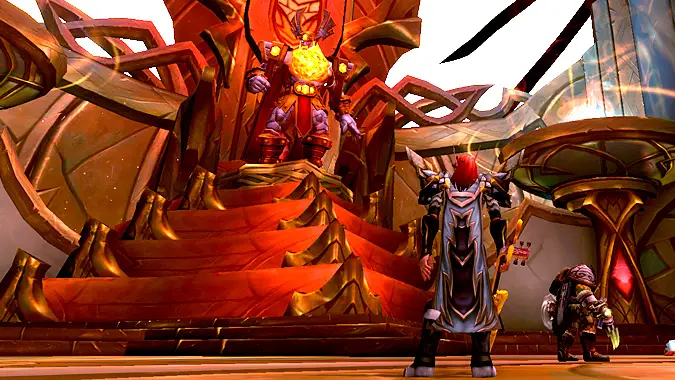
Scenario: Your paladin climbs the stairs to confront a burning god-king on his golden throne.
Traditional Approach: The boss dodges every strike and monologues while the bot narrates your character kneeling in awe. You keep regenerating replies, hoping for a fair fight.
With the AI game master: The god-king attacks, the scene describes the danger, and you choose how your paladin responds. Victory or defeat comes from your decisions.
- Enemies feel powerful without being scripted to win
- Your character's courage or fear is yours to write
- Consequences carry over into later scenes
💘 Slow-Burn Romance Without Forced Feelings
Scenario: A classmate confesses his love in front of the whole class, just like the screenshot above.
Traditional Approach: The bot decides you're "flattered and nervous," even after you write that your character wants nothing to do with him.
With Roleplay Game Master: He can be bold, the class can gasp, and the teacher can clear her throat. Whether your character softens, refuses, or walks out stays entirely your call.
- Rejection stays rejection until you decide otherwise
- Romance builds from your choices, not narration
- NPC intensity comes through dialogue and action
📱 Mobile Roleplay on Your Commute
Scenario: You start a mystery campaign on your laptop at night and want to continue on your phone the next morning.
Traditional Approach: You switch apps or devices, lose context, and re-explain your rules while the bot drifts back into narrating for you.
With Roleplay Game Master: Open the iOS or Android app and continue mid-scene. Your boundaries and plot threads are still in place, and speech-to-text makes typing replies on the go easier.
- Same story across web and mobile
- Rules carry over without re-explaining
- Voice input for quick replies
🕵️ Mysteries You Actually Solve
Scenario: A detective story where your investigator questions suspects in a manor.
Traditional Approach: The bot has your character "suddenly realize" the culprit, which ends the mystery for you.
With Roleplay Game Master: Clues appear in the scene, suspects lie or slip up, and you draw the conclusions yourself. The reveal lands because you earned it.
- Deductions belong to you
- The AI keeps clue and suspect continuity
- Wrong guesses lead to real story consequences
Frequently Asked Questions About AI Roleplay Godmodding
What does godmodding mean in AI roleplay?
Godmodding is when an AI takes control it wasn't given. That includes writing your character's dialogue or actions, dictating their emotions, making NPCs invincible, or forcing outcomes before you can respond. The term comes from forum and tabletop roleplay, where controlling another player's character is considered poor etiquette. In AI roleplay, the most common form is emotional narration, such as "you can't help but feel…", which quietly removes your choice.
Why does AI keep controlling my character?
Language models predict the most likely next text. In second-person scenes, continuing the "you" thread often means narrating your reactions. Character prompts written as dominant or possessive make it worse, and in long chats early instructions can lose influence. The result is gradual drift, where the AI fills gaps in your character with its own guesses. Clear rules, a defined character sheet, and persistent memory reduce this significantly.
How do I stop an AI from godmodding?
State explicit rules at the start: never write my dialogue, actions, thoughts, or feelings, and end replies on a moment that needs my input. Give the AI a character sheet so it doesn't invent details about you. When it slips, use a short OOC correction and ask for a rewrite. Building your character first with Character Creator also leaves fewer gaps for the AI to fill.
Does Roleplay Game Master respect player agency?
Roleplay Game Master is built to run the world and NPCs while you control your own character. You set your agency rules once, and unlimited memory keeps them active across long campaigns and multiple sessions. Like any AI, it can occasionally slip in intense scenes, but a quick OOC note corrects it, and the rule stays in memory going forward.
Is AI roleplay free?
Roleplay Game Master can be used on a free tier that includes all core features with limited usage. Paid plans start at $20 per month for Plus, which adds 30× the free usage and custom model selection. Higher tiers expand usage further. Usage resets monthly on your billing date with no daily caps, so long sessions don't get cut off partway through a day.
Is godmodding the same as powerplaying?
They overlap but aren't identical. In roleplay communities, powerplaying usually means controlling someone else's character or forcing actions onto them. Godmodding is often used more broadly, also covering invincible characters and outcomes forced by narration. In AI roleplay, both terms describe the same core problem: the AI takes decisions that belong to you. Good roleplay partners avoid both by ending turns where you need to act.
Take Back Control of Your Story
AI roleplay godmodding turns collaboration into something you just watch: the bot writes your feelings, overrides your choices, and scripts every fight. The fix isn't to stop roleplaying. It's to use a partner that treats your character as off-limits, keeps your rules in memory, and gives NPCs depth without letting them take over.
With clear boundaries, a defined character, and consistent player agency, your roleplay can feel like a real story again. Fair fights, romance that develops from your choices, and mysteries you solve yourself all come from the same principle: your character, your decisions.
Try the AI game master now and run your next campaign on your terms. Explore more at Jenova.
For Developers: Roleplay Game Master is available programmatically via the Jenova API. You can integrate immersive, memory-backed interactive storytelling into your application with a single API call. Full documentation →