AI Roleplay Dialogue Generator: In-Character Conversations Fast
2026-09-13
Roleplay Game Master helps you generate in-character roleplay dialogue by running persistent scenes where every speaker keeps their voice, motives, and history. While most game masters and fiction writers still type every line by hand—or maintain sprawling conversation trees—this AI produces branching, scenario-true speech as the scene unfolds. In September 2026, audiences spend their entertainment hours on interactive, participatory stories, not static scripts. A dedicated roleplay dialogue generator closes that gap: you set the character, stakes, and tone; the conversation stays consistent, reactive, and ready for the table, the page, or a game build.
- ✅ Unlimited session memory so characters do not reset mid-arc
- ✅ Open-ended scenes plus directed branches, insults, bargains, and confessions
- ✅ Any genre, setting, or intensity without a pre-built content pack
- ✅ Same experience on web, iOS, and Android
Hand-authored NPC talk still dominates tabletop prep and narrative games. To see why that workflow breaks, look at how conversation is actually designed—and where it collapses.
Quick Answer: What Is a Roleplay Dialogue Generator?
Roleplay Game Master is a roleplay dialogue generator that writes in-character conversations, tracks memory, and branches replies so scenes stay consistent as you play. You describe the speakers and stakes; it returns speech that sounds like those people, not a generic narrator.
Key capabilities:
- Persistent character voice across long scenes and return visits
- Branching replies that react to tone, honesty, and relationship
- Instant rewrites when a line feels off-voice or too on-the-nose
- Scenario freedom for tabletop, interactive fiction, language practice, and prose
The Problem With Hand-Written Roleplay Dialogue
Interactive stories now compete for a fixed pool of attention. Deloitte’s Digital Media Trends research found US consumers average six hours of media and entertainment time per day, split across streaming, social video, gaming, and audio—not growing in lockstep with new content.
Six hours per day — Average daily media and entertainment time among US consumers in Deloitte’s survey
Younger audiences already treat participatory, creator-led, and game-like media as the default. In the same study, 56% of Gen Z respondents said social content felt more relevant than traditional TV and movies. Games and interactive fiction sit in that same fight: if dialogue feels canned, players leave.
56% of Gen Z respondents — Reported that social media content feels more relevant than traditional TV shows and movies
But writing dialogue that actually responds is frustratingly difficult:
- Every extra player choice multiplies the tree
- Character voice drifts after a few scenes
- Relationship flags and tone checks become spreadsheet work
- Three canned options never match what a player would actually say
Dialogue Trees Explode Faster Than You Can Write Them
Classic adventure design still looks like a flowchart: apology or defiance, politeness check, relationship counter, then an END node. Interactive-fiction designers have long treated branching structure as both the appeal and the bottleneck. One extra honest reply is not one extra line. It is a new cluster of reactions, flags, and dead ends.
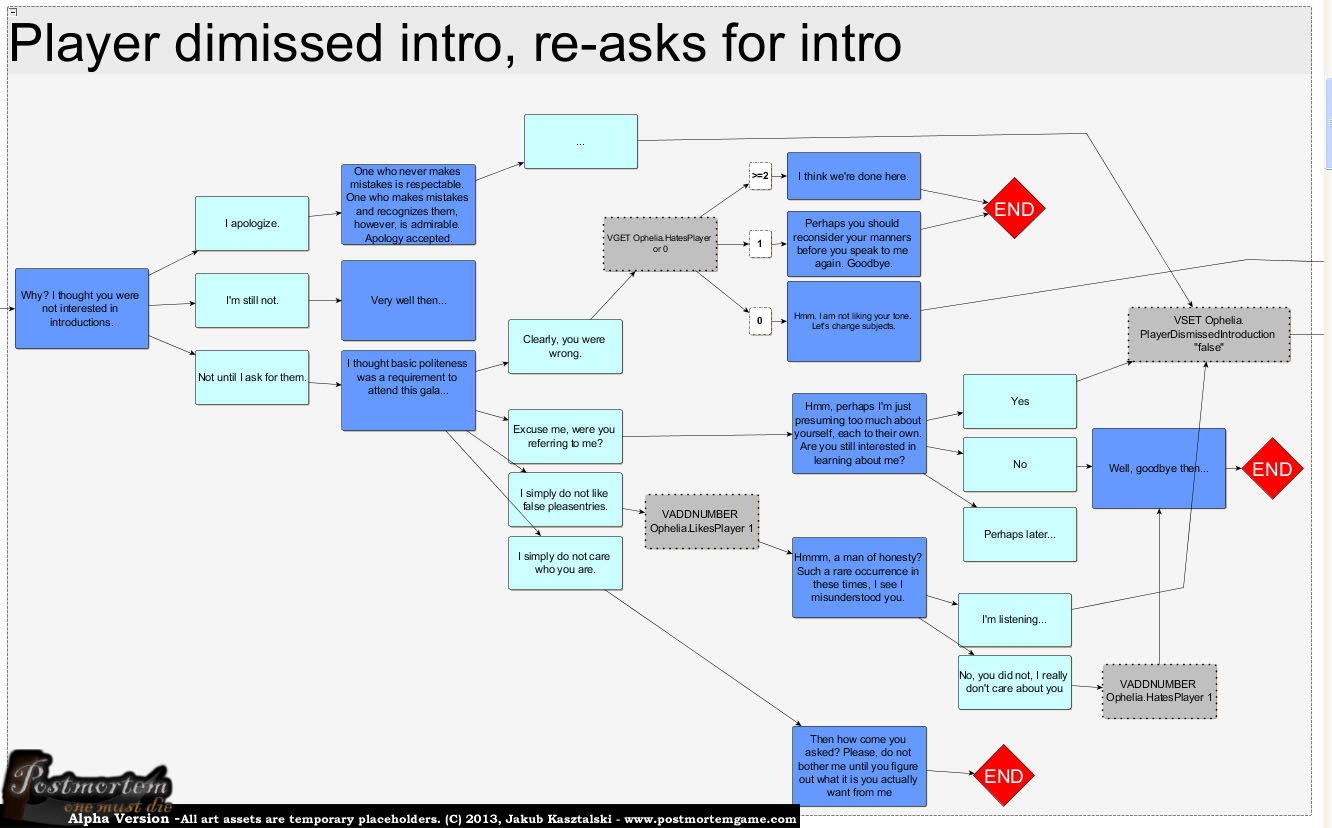
That map is honest about the cost. A single “player dismissed the intro” beat already fans into apologies, snubs, tone warnings, hate flags, and goodbye nodes. Notes from working designers keep returning to the same obstacle: authored dialogue does not scale with player freedom.
Canned Choices Starve Interactivity
A useful test of interactivity is how much new text you get per input, versus how many pre-written choices you present. Three buttons labeled “Nice / Rude / Ask again” feel like a menu. Players notice. Researchers working on character-based interactive storytelling have treated dialogue generation as its own problem for years, because a plot engine without a speaking character still feels hollow.
Voice Breaks the Moment You Leave the Page
Even linear writers stall on talk. Studies of how creative writers actually use AI show people already ask models to check “is this in character,” build character templates, and roleplay scenes—not because they want a machine to own the story, but because consistency is exhausting. When an informant, a bartender, and a villain start sharing one sarcastic rhythm, the scene dies.
This is exactly what a dedicated roleplay dialogue generator was built for.
Why Roleplay Game Master Works as a Dialogue Engine
Roleplay Game Master is a standalone roleplay partner: unlimited memory, stable characters, and complete scenario freedom. You are not filling a template of “warrior / mage / rogue.” You are running a conversation that can threaten, bargain, flirt, confess, or shut down—then remember what happened next session.
| Traditional Approach | Roleplay Game Master |
|---|---|
| Hand-drawn trees that double with every honest reply | Adaptive speech that branches in the moment |
| Voice notes in a wiki that nobody rereads | Persistent memory that keeps each speaker distinct |
| Hours of prep for one tavern scene | Playable lines in a single sitting |
| Three fixed options on a menu | Open replies plus directed beats you can request |
| Character sheets that do not talk | Characters who argue, grieve, and hold grudges |
Interactive entertainment research keeps finding the same payoff: when audiences participate in the story, engagement deepens and the experience sticks. Generated dialogue only helps if it stays specific. This tool is built for that specificity.
Keep Every Speaker in Character
Give it a dockside informant, a cyclopean alien diplomat, or a gala guest who already hates the player. Ask for subtext, accent, or social class. Then demand a rewrite when a line sounds like the narrator. Writers in long-running AI practice studies already use models this way—as a check on voice, not a replacement for taste. You stay the editor. The generator stays the tireless scene partner.
"You are a weary dockside informant in a rain-soaked noir city. I just asked about the missing cargo. Stay in character and give three replies: cooperative, evasive, and hostile. Note what each does to trust."
Branch Without Redrawing the Graph
You can still request structured choices when you need them for a game build. The difference is that you do not have to pre-draw every Ophelia-hates-player flag before anyone speaks. Ask for the polite path, the honest path, and the “I think we’re done here” path in one pass, then keep only the beats you will actually ship.
"The player dismissed her introduction, then asked for it anyway. Write her reply if she still has patience, if she is cold, and if she is done. One line of stage direction under each."
Direct Tone, Stakes, and Taboo
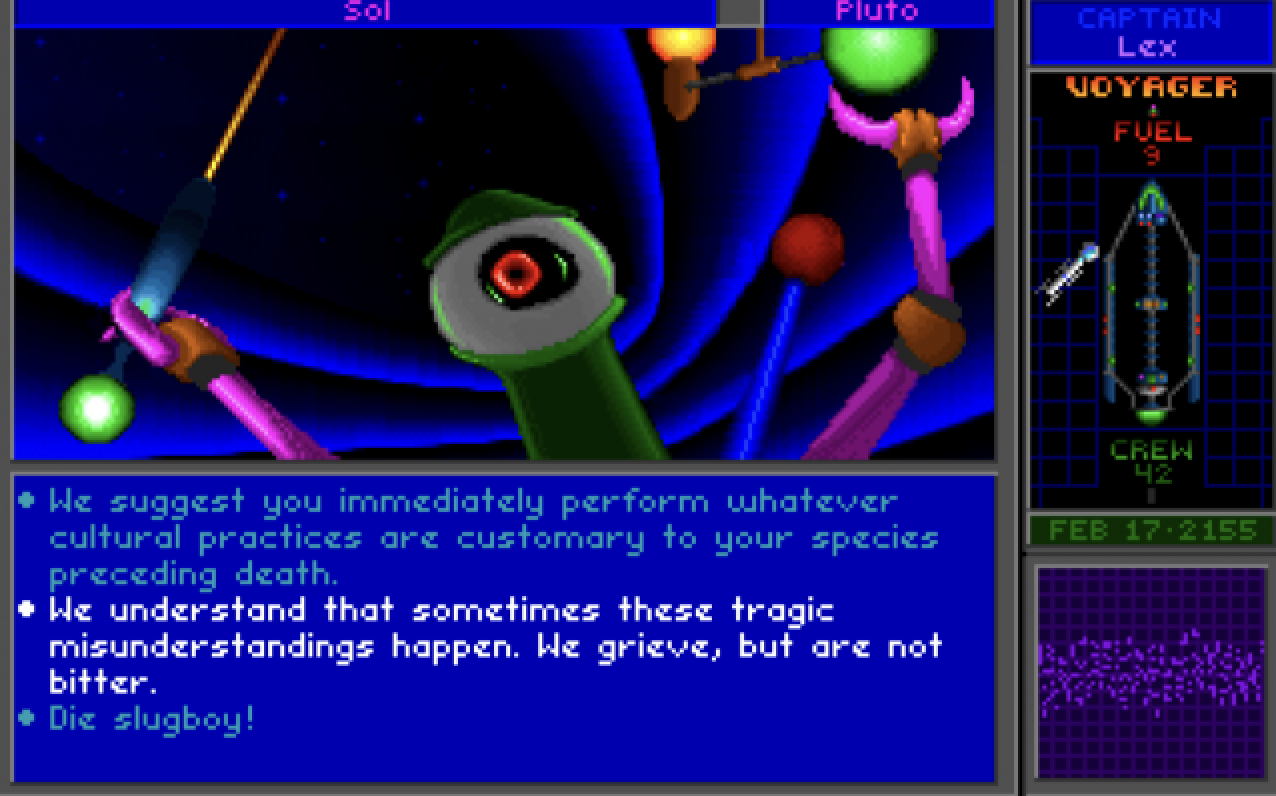
Personality-rich NPC talk is more than lore dumps. The best lines carry threat, humor, or cultural mismatch in the same breath—an alien that grieves the misunderstanding and still calls you slugboy. Prompt for that mix. Specify what the character will never say. The output should feel like a person under pressure, not a quest marker.
Stress-Test and Rewrite Fast
Research on AI-assisted fiction found imagination gains were largest for writers who struggled most with ideation, which is another way of saying: use the generator to get options on the page, then keep the line only if it sounds like your character. Duke faculty writing on classroom practice make the same cut: AI can help at the editing layer if the writer’s voice remains in charge.
"Here are six lines from my NPC merchant. Flag anything out of character, then rewrite the haggle so she sounds greedy but never cartoonish."
Related Agents You'll Also Find Useful
If you also need cinematic polish after the improvisation, Film Screenwriter can take a raw roleplay scene and shape it into dramatic structure, subtext, and shootable dialogue. Use it when table talk has to become a script.
If the conversation lives in panels instead of paragraphs, Comic Creator turns those lines into sequential art: balloon placement, page turns, and visual beats that match the voice you already generated.
If the goal is fluency rather than fiction, Learn English Through Roleplay uses the same immersive-scene muscle for idioms, grammar, and natural speech. Conversation is not a side activity in language study. Production practice has been shown to outperform comprehension-only practice on grammar and vocabulary tests, and imaginary rehearsed conversations are a standard study tactic. A roleplay partner that never drops character makes that rehearsal usable.
Try Roleplay Game Master free — no credit card required.
How to Generate Roleplay Dialogue in Minutes
Step 1: Name the Speakers and the Pressure State who is talking, what they want, and what happens if they fail. One concrete location beats a genre label. “Angry guard” is weak. “Night-shift gate sergeant who already wrote you up once this week” will talk.
"Scene: a frozen customs dock. You are Sergeant Hale, 20 years on the job. I am smuggling a sealed crate. You suspect me but have no proof. Open in character."
Step 2: Lock Voice Before You Lock Plot Give diction rules: short sentences, no slang, always answers a question with a question, never says the villain’s name. Writers who integrate AI well treat this as a decision point—they prompt when the vision is fuzzy and write through when it is not. Do the same.
"Stay in Hale’s voice: clipped, tired, no monologues. If I insult you, you go colder, not louder."
Step 3: Play the Line, Then Branch on Purpose Answer in character as the player, then ask for the NPC’s next move plus two or three forks. This is how you get a roleplay dialogue generator to behave like a living tree without drawing one. Keep the fork that matches your session. Discard the rest.
"I slide the crate two inches closer and smile. Give Hale’s reply, then three player lines: bribe, confess a half-truth, or walk away."
Step 4: Capture Continuity for the Next Session Paste the facts that must persist: who lied, who saw the crate, who is now an enemy. Unlimited memory only helps if you tell it what mattered. Next time, start from those facts instead of a blank tavern.
"Remember: Hale took no bribe, logged my name, and thinks the crate hums. Next scene is 48 hours later at the same dock. Pick up in character."
Roleplay Dialogue Generator Use Cases
🎲 Tabletop Session Prep in One Sitting
Scenario: You have a Friday game and no finished voice for the dockside informant who knows about the missing cargo.
Traditional Approach: A page of bullet motives, three canned greetings, and a panic rewrite at the table when a player asks something off-script.
Roleplay Game Master: You run the scene in advance, steal the best lines, and keep the rest as improvisation fuel.
- In-character greetings, threats, and tells you can read aloud
- Branches for bribe, intimidate, or walk away
- Continuity notes for the next session without a second wiki
🎮 Narrative Game Conversations Without a 40-Node Graph
Scenario: You are prototyping an NPC who should react to manners, honesty, and repeat visits—the gala guest who already decided the player is rude.
Traditional Approach: A flowchart, relationship integers, and days of copy for paths nobody will take.
This roleplay dialogue generator: You simulate the rude path, the apology path, and the “we’re done here” path, then paste only the lines your build needs.
- Faster first playable conversation
- Tone variants without redrawing the tree
- Test whether the character is actually distinct before you commit art
📱 Language Rehearsal on the Train
Scenario: You have 15 minutes on your phone and want spoken English that is not a textbook shop dialogue.
Traditional Approach: Flashcards and listening drills, with almost no production. That split matters: speaking practice is how learners integrate what they already studied.
Learn-by-playing: Run a hotel complaint, a job interview, or a sci-fi checkpoint scene in Learn English Through Roleplay on iOS or Android. The character does not break. Neither does the commute.
- Idioms attached to a moment you will remember
- Immediate replies instead of waiting on a tutor slot
- Full feature parity with desktop, including voice input
✍️ Fiction and Script Passes on Stubborn Scenes
Scenario: Two characters stall on a page because every line sounds like you.
Traditional Approach: Stare at the blank, then write six versions of the same polite disagreement.
The AI game master, then a craft pass: Improvise the argument in roleplay until someone finally says the cruel true thing. Lift that line into prose, or hand the scene to a screenplay-focused rewrite if you need act structure around it.
- Options when imagination stalls, which is where AI assistance has shown the clearest ideation lift
- In-character insults, jokes, and silences you would not have typed first
- You still cut, order, and own the final voice
FAQ
What is a roleplay dialogue generator?
A roleplay dialogue generator is an AI that writes spoken lines for characters in a scene, then continues those lines as you reply. Unlike a one-shot “write me NPC banter” prompt, a strong generator keeps memory, voice, and relationship state so the next line still belongs to the same person. Roleplay Game Master is built for that loop: you play, it answers in character, and the scene can run as long as you need.
Is Roleplay Game Master free?
Yes. You can use it on the free tier with all core features and limited monthly usage. Paid plans raise that usage ceiling if you run long campaigns or generate large batches of branches. There is no requirement to enter a credit card to try a scene. Start with one stubborn NPC and see whether the voice holds.
How is this different from a general chatbot?
General chat tools can improvise a scene. They are not dedicated to unlimited roleplay memory, character consistency, and complete creative freedom as the default job. A roleplay dialogue generator is for the writer or GM who will return to the same informant next week and expects that person to remember the crate, the insult, and the unpaid bribe.
Can it create branching NPC conversations for a game?
Yes. Ask for multiple replies keyed to tone, honesty, or relationship, then keep the lines you will implement. You still decide what your engine stores. The generator removes the blank-page cost of writing every fork by hand, which is the part that makes authored interactive dialogue so expensive.
Does a roleplay dialogue generator work on mobile?
Yes. Roleplay Game Master runs with full feature parity on web, iOS, and Android, including speech-to-text if you would rather play the scene out loud. That is the practical setup for GMs who prep on a phone and for learners who want conversation practice that is not stuck to a desk.
Will the characters stay accurate and consistent?
They stay consistent when you specify voice rules and pin the facts that matter. Memory is unlimited, but it is not telepathy—tell it who lied, who left, and which subject is forbidden. Then correct out-of-character lines the way you would correct a co-writer. That human edit step is how working writers already keep AI from flattening their voice.
Generate Roleplay Dialogue That Stays in Character
Hand-built conversation trees, drifting NPC voices, and three-button menus cannot keep up with players who expect a scene to answer them. A roleplay dialogue generator that remembers, branches, and stays in voice turns that bottleneck into a playable draft.
Roleplay Game Master gives you that draft on demand: informants who hedge, aliens who threaten with courtesy, and guests who walk away when you are rude. Write the pressure. Play the line. Keep what sounds true.
Try Roleplay Game Master now. Explore more at Jenova.
For Developers: Roleplay Game Master is available programmatically via the Jenova API — integrate in-character roleplay dialogue generation into your application with a single API call. Full documentation →