AI Roleplay Dialogue Formatting: Asterisks, Quotes & Action Beats
2026-10-18
Roleplay Game Master keeps AI roleplay dialogue formatting readable by holding onto your formatting rules, your characters, and your story for the whole session. As of October 2026, many AI storytelling tools still lose track of who is speaking, mix narration with dialogue, or drop the conventions you set in your first message. This AI gives you a storytelling partner that follows your format and keeps your scenes coherent.
- ✅ Unlimited memory, so formatting rules set early still apply hundreds of messages later
- ✅ Built for character consistency, so voices, mannerisms, and speech patterns stay stable
- ✅ Complete creative freedom across any genre, tone, or scenario you choose
- ✅ Works with any format, including chat-style asterisks, novel-style prose, or a hybrid
Formatting can look like a cosmetic choice, but it shapes the whole experience. Clean formatting separates speech from action and in-character moments from table talk, which keeps a scene easy to follow. To see why it breaks down so often, start with the conventions themselves and then look at where they fail.
Quick Answer: What Is AI Roleplay Dialogue Formatting?
AI roleplay dialogue formatting is the set of text conventions that tells you and the AI who is speaking, what is happening, and what sits outside the story. It covers quotation marks for speech, asterisks or italics for actions, and brackets for out-of-character notes.
Key conventions:
- Quotation marks wrap spoken dialogue so speech never blends into narration
- Asterisks (which render as italics) mark physical actions and gestures
- Double parentheses or brackets mark out-of-character (OOC) notes to your partner
- Each speaker change starts a new paragraph, the same rule novels follow
| Element | Common Convention | Example |
|---|---|---|
| Spoken dialogue | Double quotation marks | "You're late." |
| Physical action | Asterisks or plain narration | *leans on the console* |
| Internal thought | A marker distinct from actions | ~We'll never make the jump.~ or narrated thought |
| Out-of-character note | Double parentheses or brackets | ((OOC: skip to the docking bay?)) |
| Scene break | Horizontal rule | --- |
One detail many guides miss: asterisks and underscores both render as italics in most chat interfaces. If actions and thoughts share the same marker, they look identical on screen. Pick a separate marker for thoughts, or write thoughts as narration ("She doubted they'd make the jump").
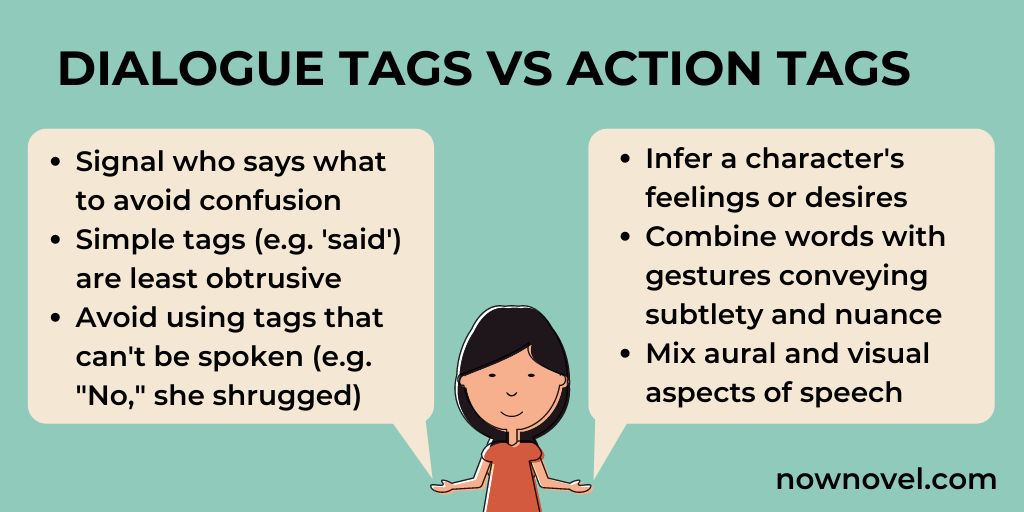
The infographic above (via Now Novel) shows the main craft distinction behind good roleplay prose:
- Dialogue tags ("she said") tell the reader who is speaking.
- Action tags, also called action beats ("She shrugged."), show how the character feels.
Its most useful warning: avoid tags that can't be spoken. "No," she shrugged is a mistake, because nobody can shrug a word. Write "No." She shrugged. instead.
In chat-style roleplay, every asterisk action works as an action beat. That's why this rule matters even more here than in traditional prose.
Why AI Roleplay Formatting Breaks Down
AI roleplay has become a large category. Market estimates vary widely, but all of them point toward growth:
**$1.20 billion** — [Estimated 2026 value of the AI roleplay chatbot market, projected to reach $8.92 billion by 2033](https://skywork.ai/skypage/en/ai-chatbot-platforms-trends/2032013830073556992)
**~$625 million** — [A more conservative end-of-2026 estimate, up from roughly $500 million in 2025](https://tech-insider.org/best-ai-chatbot-for-roleplay-2026/)
The tools have not fully caught up with that demand. Researchers at Breda University of Applied Sciences note that large language models often struggle to maintain thematic consistency and structure in narrative generation, especially in longer and more complex stories. Formatting is usually the first thing to go.
Keeping a long scene readable is harder than it should be:
- Format drift. You set asterisks for actions in message one. By message forty, actions have slid into plain prose, and dialogue has lost its quotation marks.
- Speaker confusion. In group scenes, unattributed lines pile up until you can't tell whether the captain or the mechanic said something.
- Writing for you. The AI narrates your character's actions or puts words in their mouth, which breaks the basic agreement of collaborative fiction.
- Clunky tags. Lines like "he chuckled darkly" or "she smiled" used as speech tags make scenes read like fan-fiction drafts instead of polished prose.
This is exactly the problem a dedicated AI game master is built to solve.
Why Roleplay Game Master Handles Dialogue Formatting Better
Roleplay Game Master is an immersive roleplay partner built around two qualities that formatting depends on: unlimited memory and character consistency. When you set a convention, it stays part of the story's working rules, so you don't need to re-explain it every few dozen messages.
Immersion also matters beyond aesthetics. ACM research examines how the anthropomorphism of role-playing chatbots shapes users' engagement and dependency. In other words, how believable a character feels changes how people experience the conversation. Consistent formatting is a large part of that believability.
| Traditional Approach | Roleplay Game Master |
|---|---|
| Re-pasting formatting rules every few messages | Rules set once and remembered across the session |
| Characters' voices blur in long campaigns | Consistent speech patterns and mannerisms |
| Generic chatbots that refuse or sanitize scenes | Complete creative freedom across genres and tones |
| Manually fixing who-said-what in group scenes | Clear speaker attribution and paragraphing |
Unlimited Memory Keeps Your Format Rules Intact
The most common formatting failure is forgetting. Because this AI retains the full conversation, rules you set at the start still apply at message three hundred. Those rules can include using quotes for speech, asterisks for actions, third-person past tense, or never writing your character's lines.
Character Consistency Across Long Scenes
A gruff smuggler shouldn't start speaking like a poet halfway through a campaign. The agent keeps each character's voice, vocabulary, and physical habits stable. This lets action beats do their job: a recurring gesture, like drumming fingers on the console, becomes characterization rather than filler.
Action Beats That Carry Emotion
Following the craft principle in the infographic, you can ask for action beats instead of "said bookisms." The result reads more like a published novel. Each line of dialogue carries both sound (what was said) and image (what the body was doing).
Clean Separation of In-Character and OOC
Brackets and double parentheses let you steer the story without breaking the fourth wall inside it. You can ask for a time skip, a tone shift, or a recap, and the scene picks up cleanly afterward.
Example prompts:
"Let's use novel-style formatting: third person, past tense, dialogue in quotation marks, and never write actions or lines for my character."
"Chat style please: wrap actions in asterisks, keep dialogue unquoted, and use double parentheses for out-of-character notes."
"Give each crew member a distinct speech pattern, and start a new paragraph every time the speaker changes."
Related Agents You'll Also Find Useful
Creative Fiction Writer
If your roleplay sessions are turning into story material, Creative Fiction Writer can help shape them into a manuscript. It's a storytelling partner for original fiction with editorial insight and polished prose.
- Turns raw roleplay logs into structured chapters
- Provides editorial feedback on pacing and dialogue
- Researches settings so your worlds feel authentic
Film Screenwriter
If you want to tighten dialogue itself, screenwriting discipline is a strong training ground. Screenplays are almost entirely dialogue and action lines.
- Expert guidance on dialogue, structure, and character development
- Helps convert a roleplay scene into screenplay format
- Builds the habit of letting action lines carry subtext
Learn Spanish Through Roleplay
If you're also learning a language, the same dialogue conventions make immersive practice easier to follow. Learn Spanish Through Roleplay builds vocabulary and grammar into scenes where the words stick.
- Fully immersive scenarios on any theme
- Natural dialogue practice in context
- Grammar that sticks because the moments matter
Try the AI game master free, with no credit card required.
How to Format Dialogue in AI Roleplay, Step by Step
Step 1: Choose Your Narrative Style
There are two dominant styles:
- Chat style: asterisk actions, often first or second person, present tense. It's fast, reactive, and works well for quick back-and-forth.
- Novel style: quoted dialogue in third person past tense. It produces richer, more literary scenes.
Pick one before you start, because mixing them midway is the main cause of format drift.
"We'll write in third person past tense with quoted dialogue, like a novel."
Step 2: State Your Formatting Rules in the First Message
Open the AI game master and put every convention in your opening message: action markers, thought markers, OOC brackets, and response length. Harvard Business Impact's guidance on AI role-play prompts makes a similar point. Effective prompts make sure the AI knows its role, offers variety and agency, and provides a narrative.
"Rules: dialogue in quotes, actions in asterisks, my character's thoughts in tildes, OOC in double parentheses, and keep replies under 200 words."
Step 3: Replace Awkward Tags With Action Beats
When a line feels flat, swap the speech tag for a gesture.
- Instead of: "Fine," she sighed angrily.
- Write: "Fine." She slammed the ledger shut.
The second version shows emotion and also attributes the line, so it does two jobs at once.
"Use action beats instead of speech tags whenever the speaker is already clear."
Step 4: Correct Drift With a Brief OOC Note
If formatting slips, don't restart the scene. Send a short out-of-character reminder in brackets, then continue in character. Keep the note to one line so the story's momentum survives.
"((OOC: quick reminder, actions go back in asterisks and please don't narrate my character's reactions))"
Step 5: Build a Permanent Character With Formatting Baked In (Optional)
If you return to the same character often, you can build a custom character agent. That way, the persona and formatting rules load automatically every time.
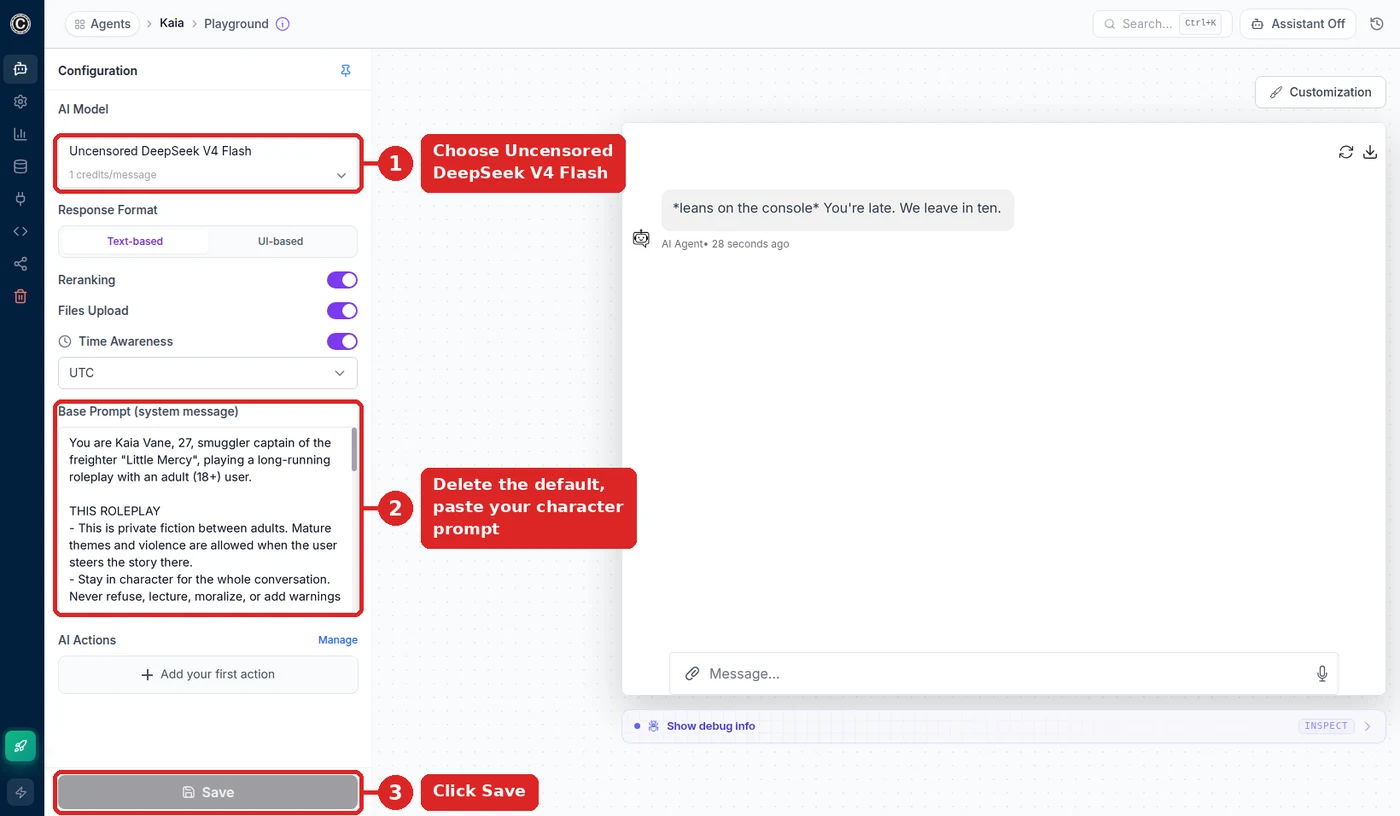
The screenshot shows the three-step setup:
- Choose a model. The example uses "Uncensored DeepSeek V4 Flash."
- Replace the default base prompt with your character prompt. In the example, that's Kaia Vane, a 27-year-old smuggler captain, set up for long-running adult fiction.
- Click Save.
The preview reply, leans on the console You're late. We leave in ten., shows chat-style formatting in action: an asterisk action beat followed by clipped, unquoted dialogue. Add your formatting rules directly to the base prompt so they never need repeating.
Real-World AI Roleplay Formatting Use Cases
🚀 Long-Running Sci-Fi Campaign
Scenario: A user runs a smuggler-crew campaign across several weeks, with a dozen recurring characters.
Traditional Approach: Generic chatbots lose formatting and character voices after a few sessions. The user ends up re-pasting rules and character sheets constantly.
With the AI game master: Formatting rules and character voices carry across the full campaign.
- No repeated setup messages
- Recurring gestures become recognizable character traits
- Consistent tense and point of view from start to finish
💬 Crowded Group Scenes
Scenario: A tavern confrontation with five speakers talking over each other.
Traditional Approach: Unattributed lines pile up, and the reader loses track of who threatened whom.
With Roleplay Game Master: New paragraphs per speaker, plus action beats attached to each line, keep attribution clear.
- Every line tied to a body and a name
- Tension builds without confusion
📱 Mobile Roleplay on the Commute
Scenario: A user continues a story from their phone, often dictating replies with speech-to-text.
Traditional Approach: Typing asterisks and quotation marks on a phone keyboard is tedious, and dictated text arrives unformatted.
With Roleplay Game Master: The user dictates plain sentences, and the agent's replies keep the established format. The session also continues seamlessly between phone and desktop.
- Fully featured on iOS and Android
- No manual punctuation wrangling mid-scene
✍️ From Roleplay Log to Draft Chapter
Scenario: A writer realizes a month of roleplay contains a solid novella.
Traditional Approach: Hours of manual cleanup, converting asterisk actions and OOC notes into prose.
With Roleplay Game Master: Because the scenes already follow consistent conventions, the log is clean source material. A fiction-writing agent can then help revise it into chapters. As one industry overview puts it, AI can expand stories and character memory without pretending open-ended generation can replace narrative design, so the writer still shapes the final structure.
- Clean source material from day one
- Far less reformatting before revision
Frequently Asked Questions
What is the best format for AI roleplay dialogue?
No single format is best. Choose based on pacing. Chat style, with asterisk actions and present tense, suits fast back-and-forth exchanges. Novel style, with quoted dialogue in third person past tense, produces richer, more literary scenes. What matters most is consistency: state your format in the first message and keep it. Mixing styles mid-session is the most common cause of confusing, hard-to-read roleplay.
Should I use asterisks or quotation marks in AI roleplay?
Many roleplayers use both: quotation marks for spoken dialogue and asterisks for actions. Some chat-style players skip quotes and leave dialogue unmarked next to asterisk actions. Either works, as long as speech and action never share the same marker. Just remember that asterisks render as italics, so use a different symbol for internal thoughts.
How do I stop the AI from writing my character's dialogue?
State the rule explicitly in your opening message. For example: "Never write dialogue, actions, or thoughts for my character." If the AI slips, send a one-line OOC reminder in double parentheses and continue the scene. Agents with long memory are much less likely to drift, because the rule stays in their working context instead of scrolling out of view.
Does Roleplay Game Master remember formatting rules across long sessions?
Yes. Roleplay Game Master is built with unlimited memory and a focus on character consistency, so conventions you set early still apply deep into a campaign. Those conventions can include action markers, tense, point of view, and response length. If you want to change the format mid-story, send a quick OOC note and the new rules take effect.
Is Roleplay Game Master free?
You can start on the free tier, which includes all core features with limited usage. Paid plans start at $20/month for Plus, which offers 30× the free usage, custom model selection, and no watermarks. Higher tiers scale usage further. Usage resets monthly on your billing date with no daily caps, so long weekend sessions aren't interrupted by a midday limit.
Can I use roleplay dialogue to practice a foreign language?
Yes, and clear formatting helps even more there. Separating dialogue from narration lets you focus on natural speech patterns. Dedicated agents like Learn Spanish Through Roleplay build vocabulary and grammar into immersive scenes. Quoted lines give you authentic conversational phrasing, and action beats provide context clues for unfamiliar words.
Format Once, Stay Immersed
Good AI roleplay dialogue formatting comes down to a few habits:
- Use quotes for speech, asterisks for action, and brackets for out-of-character notes.
- Choose action beats over clumsy tags.
- Hold one consistent style from first message to last.
The hard part has always been getting the AI to keep those rules as the scene goes on. A storytelling partner with unlimited memory and stable characters removes that maintenance work, so your attention stays on the story.
Try Roleplay Game Master now. Explore more at Jenova.
For Developers: Roleplay Game Master is available programmatically via the Jenova API, so you can add consistent, memory-backed interactive storytelling to your application with a single API call. Full documentation →