AI Roleplay Context Window: Fix Memory Loss & Character Drift
2026-10-19
Roleplay Game Master helps you run long, immersive AI roleplay without the story falling apart. It keeps characters, plot threads, and world rules consistent across sessions.
Anyone who has played past a few dozen exchanges knows the problem. The AI forgets a companion's name, brings back a villain you killed, or drops a character's voice. That is the AI roleplay context window: a hard cap on how much text the model can see at once.
As of October 2026, context windows are larger than ever. Research still shows that bigger windows alone don't fix memory loss. This AI is designed around unlimited memory and consistent characters, and you keep full creative control over the scenario.
- ✅ Designed for unlimited memory across long, multi-session campaigns
- ✅ Keeps character voice, relationships, and established facts consistent
- ✅ Any genre, tone, or scenario you can imagine
- ✅ Available on web, iOS, and Android with full feature parity
Your character forgets your backstory because of how language models process text, not because the AI is careless. To see why long roleplay degrades, and what actually fixes it, it helps to look at what happens inside the context window on every turn.
Quick Answer: What Is an AI Roleplay Context Window?
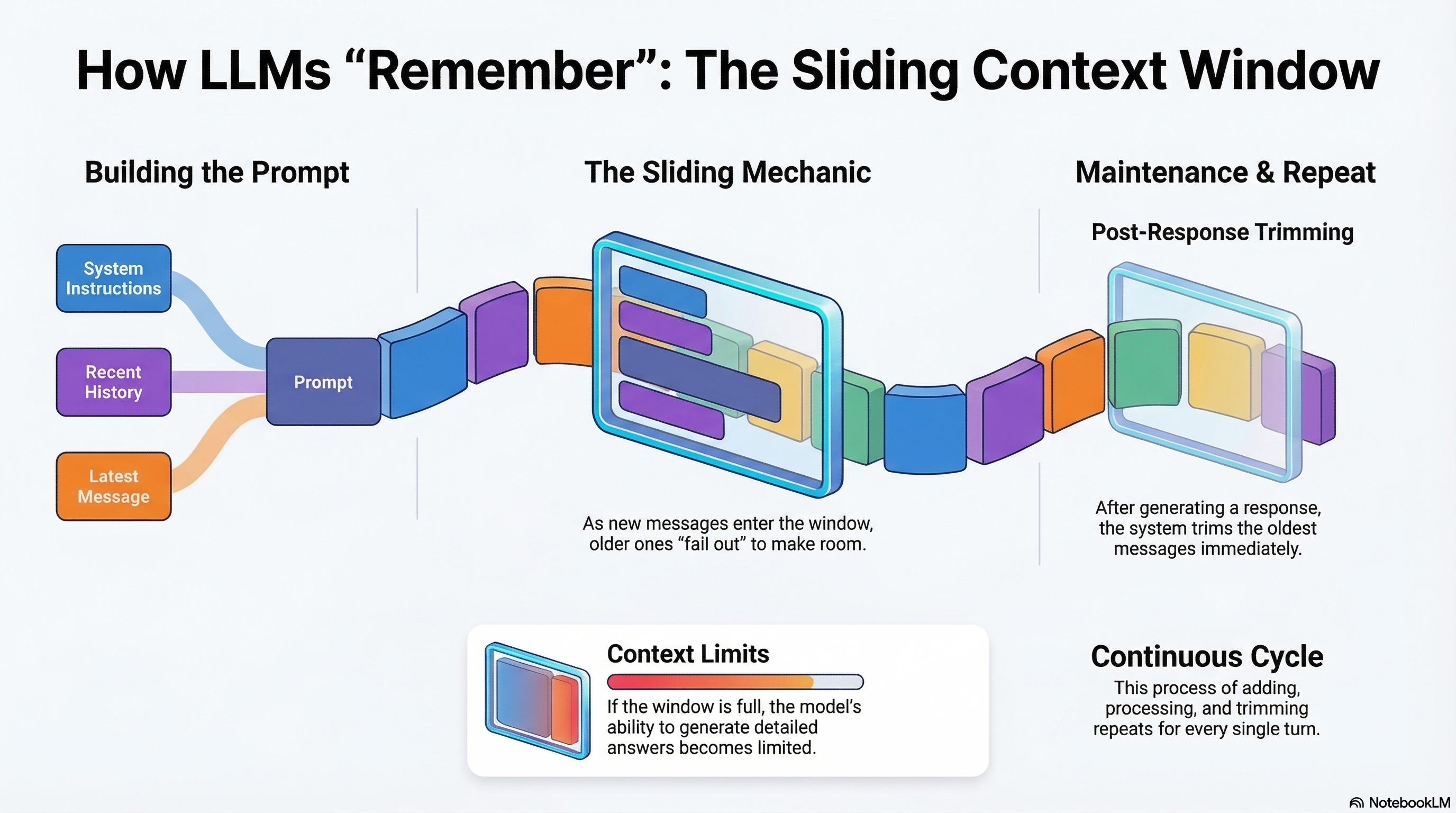
An AI roleplay context window is the maximum amount of text, measured in tokens, that a language model can read at once. It includes character instructions, recent story history, and your latest message. Anything outside it is invisible to the model. IBM Research describes it as the model's working memory, covering both your prompt and the text the model generates.
Key capabilities of Roleplay Game Master:
- Unlimited memory, so early scenes, promises, and plot hooks stay part of the story
- Consistent personalities, speech patterns, and relationships for every character
- Persistent memory across sessions, so you can resume a campaign days later
- Complete creative freedom across fantasy, sci-fi, horror, romance, mystery, and more
Why AI Roleplay Characters Forget: The Context Window Problem
AI roleplay has grown from a niche hobby into a major consumer category. Unlike quick Q&A, roleplay depends on accumulated history. Every scene builds on earlier ones, so memory is the product itself.
USD 2.24 billion: Estimated value of the global AI roleplay chatbot market in 2025, projected to reach USD 12.5 billion by 2035
16 visits per month: Average return frequency for users of mixed-use roleplay and companion platforms in the UK
4,000 → 128,000 tokens: Growth in typical context windows since ChatGPT launched. 128K tokens is roughly the length of a 250-page book
But keeping a long story coherent is frustratingly difficult:
- Older scenes slide out of view as new messages push them out of the window
- The middle of your story gets neglected, even when it technically fits
- Longer inputs degrade output quality, so a bigger window is not a full solution
- Memory is often sold as a premium add-on rather than treated as core to the experience
Older Scenes Slide Out of View
Most chat systems build each prompt from the same parts: system instructions, recent history, and your latest message. When the window fills, the oldest messages are trimmed to make room, as the diagram above shows.
In roleplay, those "oldest messages" are often the most important ones. They hold the character sheet, the world's magic rules, and the betrayal that started the whole arc.
The Middle of Your Story Gets the Least Attention
Even before anything is trimmed, models don't weigh all context equally. IBM researchers note that LLMs are more likely to pick up information at the start or end of a long prompt than information buried in the middle.
Databricks' long-context research calls this the "lost in the middle" problem. In a 300-message campaign, that is exactly where your second-act revelations live.
Bigger Windows Don't Automatically Mean Better Memory
You might assume that a model advertising hundreds of thousands of tokens remembers everything. Data says otherwise. In one controlled study, Llama-3.1-8B (with a claimed 128K window) lost 24.2% accuracy at 30K tokens even though it could perfectly recall all the relevant information.
Databricks found that most models have an effective context length well below their claimed maximum. For example, Llama-3.1-405b's performance started declining after 32K tokens.
Cost also forces platforms to trim aggressively. According to IBM, doubling a text sequence's length requires roughly four times the memory and compute to process it.
Memory Becomes a Paywall
The Ada Lovelace Institute's market analysis found that a common premium feature on companion apps is extra storage for remembering previous conversations. In other words, users pay recurring fees so their character doesn't forget them.
The same review found that 14 of 16 platforms claimed broad rights to use private chat logs for service improvement or model training.
This is exactly what Roleplay Game Master was built for.
Why Roleplay Game Master Keeps Long Stories Consistent
Roleplay Game Master is a dedicated AI storyteller and game master built for long-form, immersive roleplay. It treats your campaign's history as something to preserve rather than something to discard when space runs out.
The result is a story partner that still knows, fifty sessions in, that your rogue has a fear of deep water and owes a debt to the harbor master.
| Traditional AI Chat Roleplay | Roleplay Game Master |
|---|---|
| Early scenes silently fall out of the window | Built around unlimited memory for long campaigns |
| Characters drift in voice and personality over time | Designed for consistent characters from first scene to finale |
| Memory sold as a premium add-on | Core features included on the free tier |
| Chat logs may be used to train models | Your data is never used to train public AI models |
| Locked to one model's strengths and weaknesses | Custom model selection on paid plans |
The core issue is not raw window size. It is what gets kept. As the infographic below shows, well-designed AI systems treat context as a scarce resource. They decide what stays in the window, what gets summarized into persistent memory, and what gets evicted.
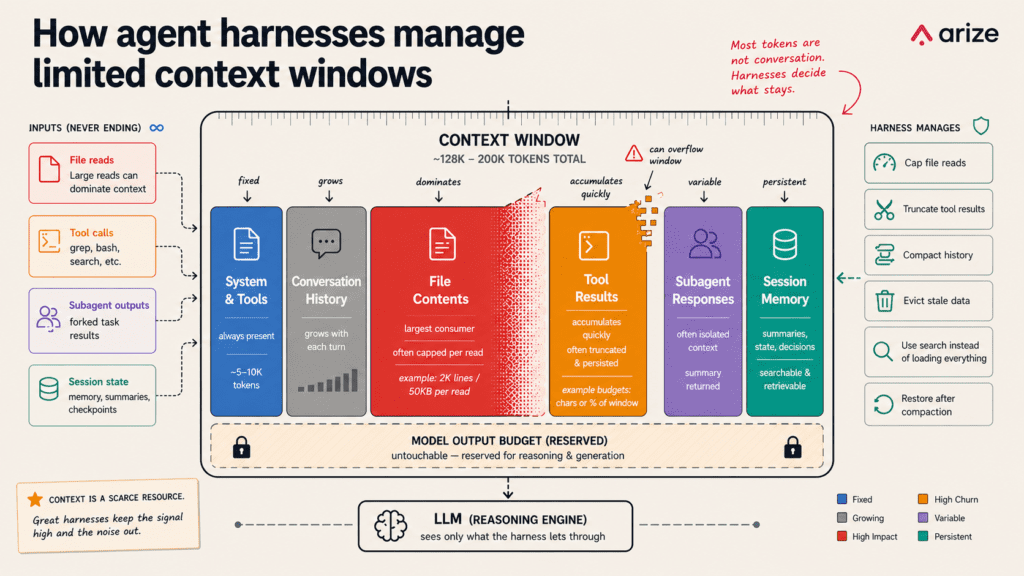
For roleplay, that means your world rules, character relationships, and key plot decisions should never be the first things discarded.
Unlimited Memory Across Sessions
Your campaign doesn't reset when you close the app. Persistent cross-session memory means you can step away for a week and come back to the same tavern, the same unresolved argument, and the same half-finished heist plan.
Character Consistency That Holds Up
Distinct speech patterns, motivations, and relationships stay intact across hundreds of exchanges. A sardonic mercenary stays sardonic. A shy apprentice grows more confident gradually instead of abruptly becoming a different person.
Complete Creative Freedom
Dark fantasy, cyberpunk noir, slow-burn romance, cosmic horror, political intrigue: you choose the setting, tone, and rules. The game master adapts pacing, narration, and NPC behavior to the story you want to tell.
Your Choice of Model
Paid plans unlock custom model selection across providers including OpenAI, Anthropic, Google, DeepSeek, and xAI. Some models write more lyrical prose, others handle complex plotting better. You can switch without starting over.
Private by Default
Your stories are encrypted in transit and at rest, never sold to advertisers, and never used to train public AI models. That matters when roleplay touches personal themes.
Try prompts like:
"Start a dark fantasy campaign in a plague-struck port city. I'm a disgraced alchemist trying to clear my name. Keep NPCs morally gray."
"Continue our heist story from last session. Remind me which crew members distrust each other before we start the vault scene."
"Run a slow-burn mystery where clues from the first chapter matter in the finale. Don't reveal the culprit until I accuse someone."
One honest caveat: no AI is infallible. If a detail is critical to your story, asking for an occasional recap is a good habit. It is also a fun way to see how much the game master is tracking.
Related Agents You'll Also Find Useful
If you're building long campaigns, these agents fit naturally into the same creative workflow.
Character Creator
If you're designing original characters before you play, Character Creator builds detailed profiles for roleplay, fiction, and OCs.
- Quick-generate or guided step-by-step character builds
- Research into existing media for fan-inspired characters
- Character portraits across genres
Creative Fiction Writer
If a roleplay campaign grows into something you want to publish, Creative Fiction Writer turns it into polished prose.
- Original fiction across any genre
- Deep research for authentic worlds
- Editorial feedback from first draft to final manuscript
The Mansion
If you want a ready-made scenario instead of building from scratch, The Mansion drops you into an interactive mystery.
- You wake with no memory of arriving
- Every room hides secrets and danger
- Your choices determine whether you uncover the truth and escape
Learn Spanish Through Roleplay
If you want your roleplay to double as language practice, Learn Spanish Through Roleplay teaches through fully immersive scenarios.
- Any theme, with complete creative freedom
- Vocabulary and grammar anchored to memorable story moments
- Practice that feels like play rather than drills
Try Roleplay Game Master free. No credit card required.
How to Run a Long AI Roleplay Without Losing the Plot
Step 1: Set the World and Your Role
Open your AI game master and describe the setting, tone, and who you're playing. Concrete details such as era, conflict, and stakes give the story a strong foundation.
"Sci-fi survival on a generation ship where the crew has forgotten Earth exists. I'm the ship's last engineer. Tone: tense, claustrophobic."
Step 2: Define Key Characters and Rules
Introduce your main NPCs, their relationships, and any world rules that must never break, such as how magic works or which factions are at war. These anchors guide character consistency for the rest of the campaign.
"The captain secretly knows the truth about Earth. The AI ship-mind is helpful but can't lie. Nobody can leave the ship. That's absolute."
Step 3: Play, Steer, and Improvise
Take actions, make choices, and let NPCs respond in character. You can steer pacing at any point by asking for more tension, a time skip, or a quieter character moment.
"I sneak into the captain's quarters during the night cycle. Slow this scene down. I want it to feel dangerous."
Step 4: Return Whenever You Want
Close the session and come back later on any device. Persistent memory means the story picks up where you left off, with relationships and unresolved threads intact.
"Pick up where we left off. What's happening on the bridge right now?"
Step 5: Request Recaps at Key Moments
Before a major arc or finale, ask for a summary of open plot threads and character relationships. This keeps you oriented and confirms that important details are in play.
"Before the mutiny scene, recap every character's loyalty and any secrets I've discovered."
Results & Use Cases
🐉 A Multi-Month Fantasy Campaign
Scenario: A player runs a sprawling fantasy campaign with a dozen recurring NPCs, three rival kingdoms, and a prophecy seeded in the first session.
Traditional Approach: Standard chatbots lose early lore as the window fills. The player ends up keeping a separate notes document and pasting summaries back in every session.
Roleplay Game Master: The prophecy, rivalries, and NPC personalities stay part of the story, so the finale pays off setup from months earlier.
- No manual lore documents to maintain
- Callbacks to early events feel earned, not forced
- NPCs keep their established personalities
📱 Roleplay on Your Commute
Scenario: A user plays short scenes on their phone during a train commute, then continues longer sessions on a laptop at home.
Traditional Approach: Switching devices or apps often means losing context or restarting scenes.
Roleplay Game Master: Full feature parity across web, iOS, and Android means the story syncs everywhere. Speech-to-text makes it easy to play hands-free.
- Seamless pickup across devices
- Voice input for quick turns on the go
- Same memory and settings everywhere
🗣️ Language Practice Through Story
Scenario: A learner wants Spanish practice that doesn't feel like flashcards.
Traditional Approach: Apps drill isolated vocabulary that rarely sticks, and generic chatbots forget the learner's level and earlier mistakes.
Learn Spanish Through Roleplay: A café mystery in Madrid becomes the classroom. New words anchor to plot moments the learner actually cares about.
- Vocabulary learned in emotional, memorable context
- Grammar practiced through natural dialogue
- Scenarios that continue across sessions
🕵️ A Mystery With Clues Planted Early
Scenario: A player wants a whodunit where a detail from chapter one cracks the case in chapter ten.
Traditional Approach: Mysteries break down when the AI forgets which clues it planted, which leaves contradictions or endings that come out of nowhere.
Roleplay Game Master: Clues, alibis, and red herrings stay consistent, so the reveal follows from evidence the player actually encountered.
- Fair-play mysteries with consistent clues
- NPC alibis that don't shift between scenes
- Satisfying, logical endings
Frequently Asked Questions
What is a context window in AI roleplay?
A context window is the maximum amount of text, measured in tokens, that an AI model can process at once. In roleplay, it holds the character instructions, recent story history, and your latest message. Anything outside the window is effectively invisible to the model. That's why characters can forget names, events, or personality traits from earlier in a long story unless the platform actively preserves that information.
Why does my AI roleplay character keep forgetting things?
Usually, older messages have been trimmed out of the context window to make room for new ones. Even within the window, research shows models attend less to information in the middle of long inputs. Performance can also degrade simply because the input is long. Platforms built for long-form roleplay manage memory deliberately, keeping key facts, relationships, and world rules available instead of discarding the oldest text first.
Does a bigger context window fix AI roleplay memory?
Not entirely. Larger windows help, but Databricks found that most models' effective context length is shorter than their advertised maximum. Separate research showed accuracy dropping substantially as input length grew, even with perfect recall of the relevant information. Long-term roleplay consistency depends on memory management that decides what stays in context, not just on raw window size.
Is Roleplay Game Master free to use?
Yes. Roleplay Game Master is available on Jenova's free tier, which includes all core features with limited usage. Paid plans start at $20/month for Plus, which adds 30× the free usage and custom model selection. Higher tiers are available for heavier use. Usage resets monthly on your billing date, with no daily caps.
Can I create custom characters for my roleplay?
Yes. You can describe characters directly to the game master at the start of any campaign. For deeper builds, Character Creator designs detailed profiles with personalities, backstories, and portraits that you can bring into your roleplay. It supports both quick generation and guided, step-by-step character design across genres.
Does AI roleplay work on mobile?
Yes. Jenova offers full feature parity across web, iOS, and Android, so roleplay sessions, memory, and settings sync across every device. Speech-to-text input lets you play scenes by voice, which is useful on a commute or whenever typing isn't convenient. You can start a campaign on your phone and continue it on desktop without losing context.
Conclusion
The AI roleplay context window explains nearly every frustrating moment in long-form AI storytelling: forgotten companions, revived villains, and characters who suddenly don't sound like themselves. Bigger windows help, but research is clear that size alone doesn't guarantee coherent memory. What matters is how a system decides what to keep.
For campaigns that span weeks, worlds that run on careful rules, and characters you want to stay recognizable, you need an AI storyteller built around long-term memory and character consistency from the start.
Try Roleplay Game Master now and run the long campaign you've been wanting to tell. Explore more at Jenova.
For Developers: Roleplay Game Master is available programmatically via the Jenova API. You can integrate long-memory interactive storytelling into your application with a single API call. Full documentation →