AI Roleplay Chat Migration: Move Characters, Lore & Story Memory
2026-10-19
Roleplay Game Master helps you continue a story after you move your characters off another platform. It gives you unlimited memory, consistent characters, and full creative freedom across genres. As of October 2026, AI roleplay chat migration has become urgent for many users. Platform shutdown risks, partial exports, and incompatible character formats leave long-running stories stuck in place. This AI game master gives you somewhere to rebuild them so the next chapter picks up where the last one ended.
- ✅ Unlimited memory: long arcs, side characters, and established lore stay available as the story grows
- ✅ Consistent characters: personalities, speech patterns, and relationships hold steady over hundreds of turns
- ✅ Any scenario, any genre: dark romance, fantasy campaigns, sci-fi, slice-of-life, or something entirely your own
- ✅ Works with your existing material: paste character definitions, persona notes, and story summaries straight into the chat
Moving a roleplay is more than copying a bio. It means keeping the voice, history, and emotional thread you spent months building. To see why migration is so hard, start with what the major platforms let you take with you and what they don't.
Quick Answer: What Is AI Roleplay Chat Migration?
AI roleplay chat migration is the process of moving your characters, personas, lore, and story continuity from one AI roleplay platform to another — by exporting what the old platform allows and rebuilding the rest on a new one. The goal is continuity, not just a copied bio.
Key capabilities to look for in a destination:
- Persistent, long-term memory so a rebuilt character remembers your shared history
- Faithful character voice when you supply a definition and example dialogue
- Support for pasted or uploaded source material, such as definitions, JSON exports, and summaries
- Open-ended scenarios that let you resume mid-scene instead of starting over
The Problem: Your Roleplay History Is Locked Where You Built It
AI companionship and roleplay now make up a large consumer category. That growth has outpaced the tools for moving your data between apps.
$36.8 billion — Global AI companion market size in 2025, with social interaction and companionship as the largest application segment
47% — Share of AI companion users who regularly use two or more different bots or personalities
38% — AI companion users who said they would feel a personal loss if they could no longer interact with AI
The risk is concrete. According to a migration guide summarizing the court filing and news coverage, Character Technologies filed for Chapter 11 on October 12, 2026. If no buyer keeps the service running, Character.AI may be wound down. Anything users have not exported should be treated as at risk.
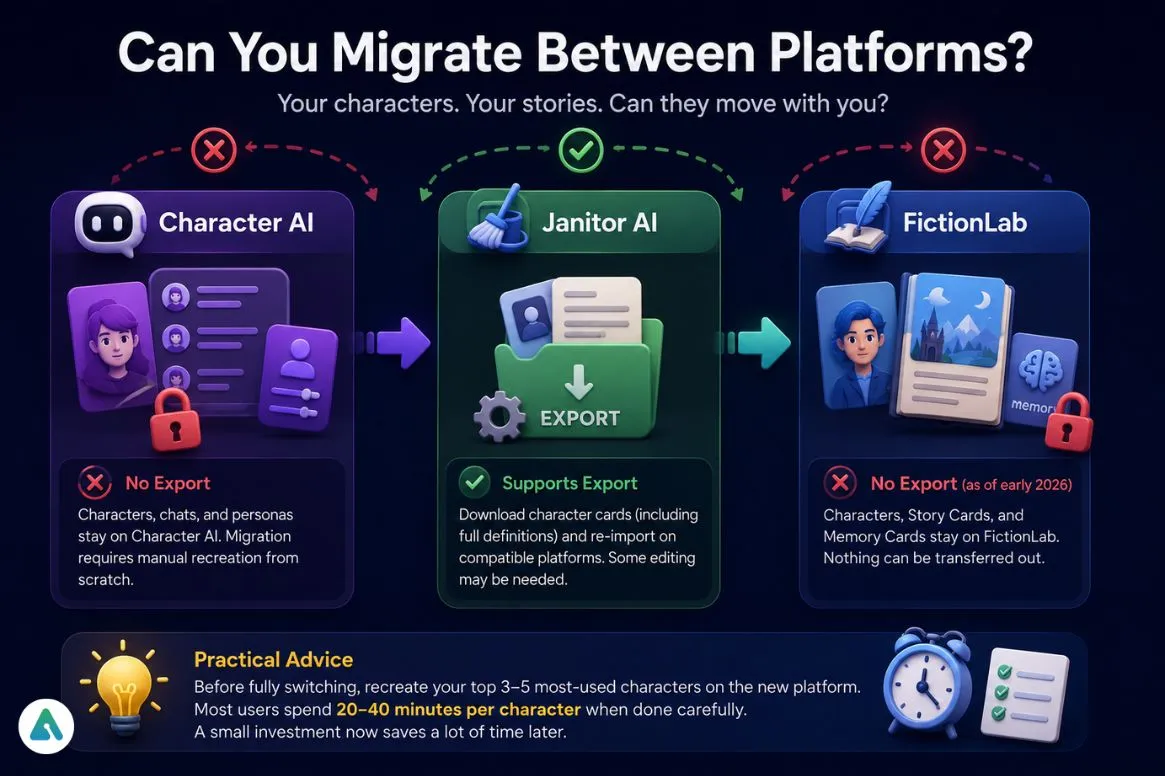
Researchers studying digital markets have long identified this pattern. Lock-in effects arise from high switching costs when data portability is absent, and the OECD notes that portability reduces switching costs and lock-in. Roleplay platforms add a twist: the most valuable data is not a file but a relationship. Moving it is frustratingly difficult:
- No universal character format. Janitor AI cards download as PNG or JSON files. Character.AI offers an account-wide data download, not a portable character card. Some platforms, like FictionLab in the infographic above, offer no outbound transfer at all.
- Exports are incomplete. Users report that very long chats may be cut off, personas and pinned memories may not be included consistently, and other creators' private definitions are never included.
- Memory doesn't travel. Even a perfect character card resets the relationship to day one unless you also carry over the story state.
- Rebuilding takes time. The infographic estimates 20–40 minutes per character for a careful manual rebuild. That adds up quickly across a full roster.
This is exactly what Roleplay Game Master was built for.
Why Roleplay Game Master Works for Migrated Stories
Most destination apps treat a migrated character like a brand-new bot. Roleplay Game Master treats it as a story already in progress. You give it the character definition, your persona, and a summary of where things stand. It then runs the scene with the memory and consistency that long-form roleplay needs.
| Traditional Approach | Roleplay Game Master |
|---|---|
| Paste a bio into a new bot and hope the voice matches | Supply definition plus example dialogue, and the character holds that voice across long sessions |
| Memory window forgets early plot points within days | Unlimited memory keeps established lore, relationships, and callbacks available |
| Restart the story from the greeting message | Resume mid-scene from a summary and the last stretch of dialogue |
| Separate bots for each character in an ensemble cast | One game master voices your whole cast and narrates the world around them |
| Content and genre limits that changed your story before | Creative freedom to explore the scenarios you actually want |
Memory That Carries the Relationship Forward
The biggest loss in any migration is shared history. That includes inside jokes, past arguments, the promise made three arcs ago. Roleplay Game Master keeps the full story in view, so the details you re-establish early stay put as the narrative grows.
Character Consistency Over Long Arcs
Voice drift is the most common complaint after switching apps. A character that was sardonic becomes generically polite, or a slow-burn romance suddenly skips ahead. The AI game master is built around consistency, so personality traits, speech patterns, and relationship pacing hold across sessions.
Full Scenario Control
You're not limited to one-on-one chats. The game master can run a party-based fantasy campaign, narrate a political intrigue with a dozen NPCs, or keep a quiet slice-of-life story going. It shifts tone when the plot calls for it.
Example prompts to start a migrated story:
"Here's my character's full definition and five lines of example dialogue from my old chats. Lock in this voice, then confirm how you'll portray her before we begin."
"Previously: we're three weeks into a heist in a cyberpunk megacity, my character just betrayed the crew, and the fixer doesn't know yet. Continue from the last scene I'm pasting below."
"I'm moving a fantasy campaign with four party members. I'll give you each one's sheet — voice all of them and narrate the world."
Related Agents You'll Also Find Useful
A migration is a good time to tidy up your roster, fill gaps in incomplete exports, or try something new.
Character Creator If your export lost key details, or you only have a name and greeting, Character Creator can rebuild a full profile with you.
- Quick-generate or guided builds for roleplay characters and OCs
- Research on source media for fandom-inspired characters
- Character portraits to replace avatars that didn't transfer
Creative Fiction Writer Hundreds of hours of roleplay often contain a real story. If you want to preserve an arc as polished prose, this storytelling partner can help shape it.
- Turns raw chat logs and summaries into structured fiction
- Editorial feedback on pacing, character arcs, and dialogue
- Supports any genre, from first draft to finished manuscript
Vesper Court Want a fresh story while you rebuild your old ones? Vesper Court drops you into a hidden vampire court with no memory of how you got there.
- Dark romance with blood intrigue and shifting alliances
- Every night changes the court's balance of power
- Ready to play with no setup required
Try Roleplay Game Master free — no credit card required.
How to Migrate Your AI Roleplay Chats: Step by Step
Step 1: Export Everything Your Old Platform Allows
Request your data before you do anything else, because exports take time. On Character.AI, look for Export Data under Settings → Legal & Privacy in the app. One user
, so don't wait until the last minute. On Janitor AI, download cards individually. Community tools such as the open-source janitor-exporter can also save chat history as TXT or JSONL.Step 2: Copy Character Definitions and Your Persona by Hand
Exports miss things, so manually copy each character's name, greeting, description, long-form definition, and example dialogue into a plain text file. Do the same for your persona and any pinned memories. These are the pieces people most often forget and most miss later.
Step 3: Write a "Previously On" Summary
Condense the story into 10–20 lines covering:
- Who the characters are
- Where the story is set
- Key events so far
- The tone
- The exact scene where you stopped
Then copy the last 20–30 lines of dialogue verbatim. A recent stretch of real dialogue is what brings the character's voice back.
Step 4: Load the Story Into Roleplay Game Master
Open your AI game master and paste the character sheet first, then the summary, then the recent dialogue. Ask it to confirm the voice before you resume.
"Below is my character sheet, my persona, a story summary, and our last 25 messages. Confirm the character's voice and the current scene, then continue exactly from the final line."
Step 5: Test and Tune the First Scene
Run a short exchange and correct anything that feels off right away, such as a nickname, a speech habit, or how fast a relationship should move. A few early corrections set the pattern for the rest of the story.
"She'd never apologize that directly — she deflects with sarcasm. Rewrite that last reply in her real voice and keep that in mind going forward."
Results & Use Cases
🧛 Rescuing a Long-Running Romance Arc
Scenario: A user has a year-long slow-burn romance on Character.AI and is worried about the platform's future after the bankruptcy filing.
Traditional Approach: Start a new bot elsewhere with only the public description, then spend weeks trying to recreate the relationship's tone from memory.
Roleplay Game Master: The user exports their data, copies the definition and persona, writes a summary of the relationship's key moments, and resumes mid-scene.
- The relationship history is re-established in a single session
- Callbacks to early events stay available as the story continues
- Pacing preferences carry over through explicit instructions
🗂️ Consolidating a Janitor AI Card Collection
Scenario: A creator has dozens of downloaded Janitor AI cards and wants their favorite ensemble cast running in one place.
Traditional Approach: Juggle separate bots for each character, re-explaining the shared setting every time.
Roleplay Game Master: The creator pastes the card definitions for five characters and lets the game master voice the whole cast in one ongoing world.
- One narrator keeps character interactions coherent
- Shared lore is established once instead of per bot
- Incomplete cards can be filled out first with the character design assistant
📱 Rebuilding a Story From Your Phone
Scenario: A user only has time to migrate during a daily commute and never sits at a desk.
Traditional Approach: Wait for a free weekend to rebuild everything on a laptop.
Roleplay Game Master: The user pastes their saved character notes into the mobile app and resumes the story between stops. Progress syncs across devices.
- Full feature parity on iOS, Android, and web
- Speech-to-text makes dictating long summaries practical
- The story continues seamlessly when they switch back to desktop
🎲 Turning a Migrated Campaign Into a Manuscript
Scenario: A longtime roleplayer realizes their fantasy campaign has the bones of a novel.
Traditional Approach: Manually comb through thousands of messages to reconstruct the plot.
Roleplay Game Master: The game master continues the campaign, while a dedicated fiction partner helps reshape the exported logs and summaries into chapters.
- Roleplay and writing run in parallel
- Story summaries double as an outline
- The original voice of each character carries into the prose
Frequently Asked Questions
Can I export my characters from Character.AI?
Character.AI offers an account-wide data export. Reports describe it as a ZIP of JSON files covering your profile, created characters, and messages. It is not a portable character card. According to user reports compiled in a migration guide, long chats may be truncated, and other creators' private definitions aren't included. Copy key fields by hand as a backup.
Can I import Janitor AI character cards into other platforms?
Yes. Janitor AI cards download as PNG or JSON files that many Tavern-compatible apps can read, and some platforms accept the PNG directly. Expect some editing after import. For apps without card import, open the JSON and paste the definition and example dialogue into the new character or chat.
Is Roleplay Game Master free?
Roleplay Game Master includes a free tier with all core features and limited usage, so you can test a migrated story before committing. Paid plans start with Plus at $20/month, which adds 30× the free usage and custom model selection. Higher tiers suit heavy daily roleplayers. Usage resets monthly with no daily caps.
Will my AI character remember our old story after migration?
Not automatically. No platform can read your old memories directly, so you supply them. Include a "Previously on" summary, your persona, standing facts, and the last 20–30 lines of dialogue. Once you've established that history, the game master's unlimited memory keeps it available as the story continues.
What happens to my chats if Character.AI shuts down?
Per the October 2026 filing summary, the platform stays online during the sale process. If no buyer continues the service, it may be wound down. User content lives only on Character.AI's servers, so treat anything you haven't exported as potentially lost. Request your export and copy key definitions now.
Does AI roleplay chat migration work on mobile?
Yes. Every step can be done on a phone: requesting exports, copying definitions, and pasting them into a new chat. Roleplay Game Master offers full feature parity on iOS, Android, and web, with settings and conversations synced across devices. Speech-to-text helps with dictating longer story summaries.
Conclusion
AI roleplay chat migration is harder than it should be. Formats don't match, exports leave out personas and memories, and a shutdown can arrive faster than expected. The fix is a deliberate process:
- Export what you can.
- Copy what exports miss.
- Summarize the story.
- Land somewhere built for long-form continuity.
Whether you're moving a single companion or an entire campaign, the right destination keeps the relationship, not just the character sheet. With unlimited memory, consistent character voices, and the freedom to run any scenario, your rebuilt story can pick up mid-scene instead of starting over.
Bring your first character over and continue the story — try Roleplay Game Master now. Explore more at Jenova.
For Developers: Roleplay Game Master is available programmatically via the Jenova API. You can integrate long-memory, character-consistent interactive storytelling into your application with a single API call. Full documentation →