AI Roleplay Chat Branching: Open-Ended Choices With Lasting Memory
2026-10-19
Roleplay Game Master brings AI roleplay chat branching to life without a script. Every message you send can open a new path, and the story remembers where you've been. Traditional branching narratives limit you to options a writer built in advance. This AI improvises consequences in real time while keeping characters, relationships, and world state consistent across long sessions.
As of October 2026, open-ended choice combined with durable memory is what separates true branching roleplay from a chatbot that forgets your decisions three scenes later.
- ✅ Unlimited conversation memory. Choices you make in chapter one still matter in chapter ten.
- ✅ Character consistency. Built to keep characters stable across long, multi-session campaigns.
- ✅ Any genre or scenario. Fantasy, sci-fi, noir mystery, horror, romance, or something you invent.
- ✅ Works everywhere. Full feature parity on web, iOS, and Android, with history synced across devices.
To see why this matters, look at how branching stories have traditionally been built. Then consider why so many AI chats still fail to deliver consequences that feel real. The gap between "you picked option B" and "the world changed because of what you did" is where most interactive stories fall short.
Quick Answer: What Is AI Roleplay Chat Branching?
AI roleplay chat branching is an interactive storytelling method where an AI generates new story paths in response to each player message, carrying consequences forward instead of selecting from pre-written options. Paired with persistent memory, every branch stays coherent with what came before.
Key capabilities:
- Free-text choices. Type any action, line of dialogue, or plan instead of picking from a fixed menu.
- Consequence tracking. Allies, enemies, injuries, and secrets persist as the story diverges.
- Consistent characters. Non-player characters keep their voices, motives, and grudges across every branch.
- Revisitable decision points. Ask the Game Master to replay a pivotal moment and explore the road not taken.
The Problem With Scripted Branches and Forgetful Chatbots
Branching narratives have shaped interactive fiction for decades, from Choose Your Own Adventure books to RPG dialogue trees. In traditional authoring tools, though, every branch is built by hand.
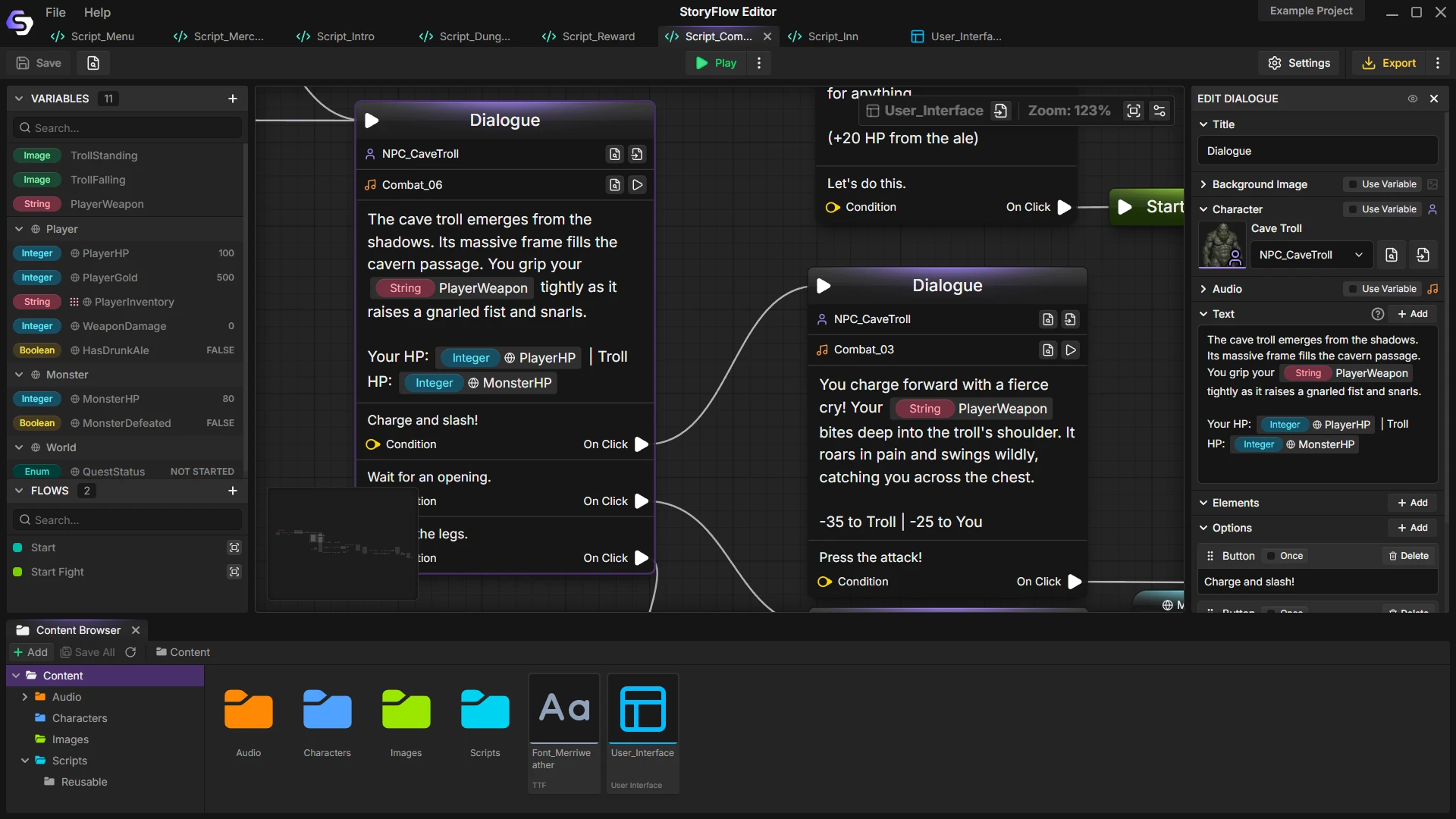
The visual editor above shows a single cave troll encounter. It needs:
- Separate dialogue nodes for each attack option, including "Charge and slash!" and "Wait for an opening"
- Tracked variables such as PlayerHP and MonsterHP
- Hand-written outcomes like "-35 to Troll | -25 to You"
Every choice the player sees is one a designer wrote, wired up, and tested. Demand for richer interactivity keeps rising anyway:
90% of game developers — already use generative AI in their workflows, including dialogue writing support, according to a Google Cloud survey of 615 developers
89% of developers — report that AI is changing what players expect from games
49% of US adults — now use AI chatbots
Players are also skeptical of AI that feels careless. A Quantic Foundry survey of nearly 2 million players found that over 85% hold a negative attitude toward generative AI in video games. The bar is coherence, not novelty.
Delivering branching that feels meaningful is difficult for several reasons:
- Combinatorial explosion. Hand-authored stories "branch statically at predetermined paths," and most branches must converge at a finite number of leaf nodes to stay producible. Your "choice" often funnels back to the same outcome.
- Information gaps. Writers struggle to ensure players get all the necessary information no matter which options they choose. The result is plot holes on less-traveled paths.
- The illusion of choice. Design analysis identifies the illusion of choice as one of the fastest ways to break immersion.
- AI chats that lose the thread. Open-ended AI fiction tools often rely entirely on the user to move the story along. Without durable memory, a betrayal you set up an hour ago simply evaporates.
This is exactly what Roleplay Game Master was built for.
Why Roleplay Game Master Handles Branching Differently
Roleplay Game Master treats every message as a decision point. You don't choose from three dialogue buttons. You describe what you do, and the narrative responds.
Because the agent retains unlimited conversation memory, the branch you create stays part of the world. The guard you bribed remembers the bribe. The city you burned stays burned.
| Traditional Branching Approach | Roleplay Game Master |
|---|---|
| Choices limited to pre-written options | Any action you can describe becomes a valid choice |
| Branches converge to a few fixed endings | Outcomes emerge from your specific decisions |
| Every branch requires authoring and testing | Branches are generated live as you play |
| Generic chatbots forget earlier decisions | Unlimited memory keeps consequences in play |
| Characters reset or drift between scenes | Designed to keep characters consistent |
Every Message Is a Branch Point
Academic work on LLM-driven fiction shows that modern language models can generate coherent, well-structured alternate storylines when the plot structure is tracked. That research generated branch trees ahead of time, at roughly a minute per branch.
Roleplay Game Master branches on demand. Your decision produces the next scene immediately, so you never wait for a tree to be built.
Memory That Makes Consequences Stick
Game design analysis of The Walking Dead highlights explicit feedback like "Clementine will remember that" as a way to signal that a choice registered.
With persistent memory, you don't need a flashing notification. The consequence shows up later in the story itself, in a character's tone, a closed door, or a debt called in.
Characters Who Stay in Character
Branching only works if the people in the story react believably. A cynical mercenary shouldn't become cheerful because the plot changed direction.
Roleplay Game Master is built to hold voice, motivation, and relationship history steady even as the storyline diverges sharply.
Structure When You Want It
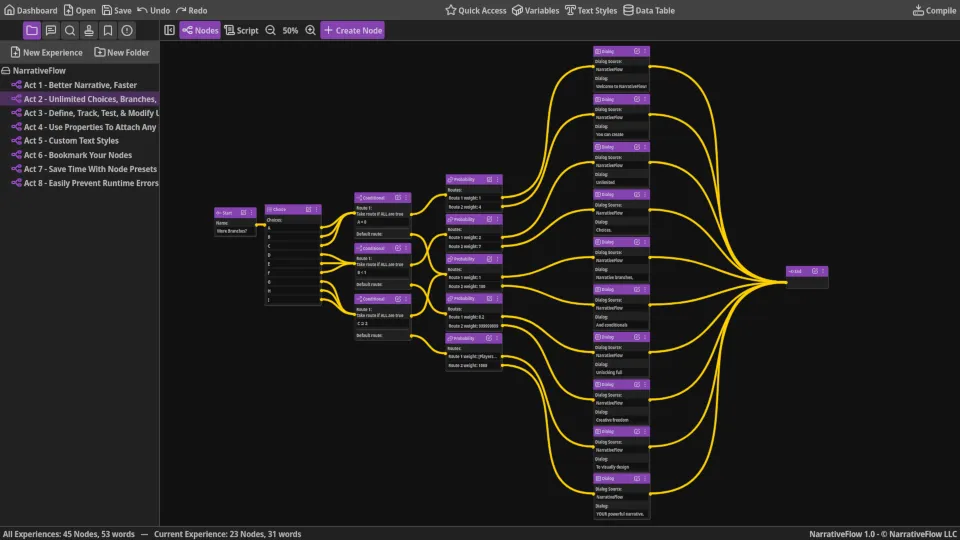
The node graph above illustrates the authoring cost of traditional branching. The status bar shows the experience uses 23 nodes to deliver 31 words of story text. Choice nodes feed conditional checks and probability weights, which then converge on a single ending.
Roleplay Game Master can still give you structure: tracked stats, explicit decision points, and storylet-style events that unlock based on your history, similar to the quality-based narrative approach pioneered by Failbetter Games. The difference is that you request it in plain language rather than wiring it node by node.
Example prompts:
"Run a dark fantasy campaign where every major choice affects my reputation with three rival factions. Show my standing after each chapter."
"Start a noir mystery in 1940s Los Angeles. Give me open-ended choices, but track which suspects trust me and let that change what they reveal."
"Go back to the moment before I opened the vault and let me make a different decision. Keep everything else that happened before it."
Related Agents You'll Also Find Useful
If branching roleplay is part of a larger creative workflow, these agents cover the adjacent steps.
Character Creator
Strong branches start with well-defined characters. Character Creator builds detailed protagonists, NPCs, and original characters you can drop straight into a roleplay.
- Quick-generate or guided step-by-step character builds
- Media research for characters inspired by existing genres
- Character portraits across art styles
Game Designer Assistant
If you're designing a branching game rather than playing one, this agent helps you plan the structure behind the story.
- Brainstorming and systems analysis for narrative mechanics
- Design documentation for dialogue and quest structures
- Concept art and genre-specific market insight
Creative Fiction Writer
When a roleplay session produces a storyline worth keeping, this agent helps turn it into polished prose.
- Original fiction across any genre
- Editorial feedback on structure and pacing
- Drafting support from first draft to final manuscript
Vesper Court
For a ready-made branching experience, Vesper Court drops you into a hidden vampire court with no memory of how you arrived.
- Dark romance and blood intrigue
- Choices that reshape alliances night by night
- A fully built premise you can start immediately
Try Roleplay Game Master free, with no credit card required.
How AI Roleplay Chat Branching Works, Step by Step
Step 1: Set the Scene
Open Roleplay Game Master and describe the world, genre, and tone you want. The more specific the premise, the richer the early branches.
"A sci-fi survival story aboard a generation ship where the AI running life support has started lying to the crew."
Step 2: Define Your Character
Tell the Game Master who you're playing, including skills, flaws, and goals. These traits shape which branches open up. A smooth-talking engineer will find different paths than a paranoid security chief.
"I'm Mira, the ship's junior botanist. I'm quiet, observant, and secretly sabotaged the last crew vote."
Step 3: Make Choices in Your Own Words
Act freely instead of waiting for a menu. You can speak to characters, attempt risky actions, or lay long-term plans. The narrative adapts to whatever you choose.
"I quietly reroute water from the hydroponics bay to see whether the AI reports it."
Step 4: Revisit a Decision Point
Curious how another path would have played out? Ask the Game Master to replay a pivotal moment with a different choice. You can explore the alternate branch while keeping earlier events intact.
"Rewind to the crew meeting. This time, I confess to the sabotage."
Step 5: Pick Up Where You Left Off
Return hours or days later on any device. Unlimited memory means your relationships, secrets, and unresolved threads are waiting exactly where you left them.
Results and Use Cases
🎲 Solo Campaigns Between Tabletop Sessions
Scenario: A Dungeons & Dragons player wants to explore their character's backstory between weekly group sessions.
Traditional Approach: Waiting for the group, or playing pre-built adventure modules with fixed branches.
Roleplay Game Master: A personal campaign where backstory choices create threads the player can carry back to the table.
- Plays on your schedule, with no group coordination
- Branches respond to your specific character
- Memory keeps a coherent personal timeline
🛠️ Prototyping Branching Dialogue for an Indie Game
Scenario: A solo developer needs to test whether a branching quest feels meaningful before building it in a node editor.
Traditional Approach: Hours of wiring dialogue nodes, variables, and conditions just to find out whether a scene works.
Roleplay Game Master: The developer plays the quest conversationally, notes which choices felt weighty, then documents the strongest structure with Game Designer Assistant.
- Tests narrative feel before committing engineering time
- Surfaces player choices the designer hadn't anticipated
- Reduces wasted authoring on weak branches
📱 Story Sessions on a Commute
Scenario: A reader wants a few minutes of interactive fiction on a train ride, continued from last night's session on a laptop.
Traditional Approach: Mobile story apps with limited choices that rarely sync progress between devices.
Roleplay Game Master: The session continues seamlessly on iOS or Android, with voice input for hands-light play.
- Full feature parity with the web version
- Speech-to-text for quick, natural replies
- History synced across every device
✍️ Stress-Testing a Novel's Plot
Scenario: A novelist is stuck on whether her protagonist should betray her mentor in Act Two.
Traditional Approach: Drafting both versions in full, which can take weeks of rewriting.
Roleplay Game Master: She roleplays both branches as her protagonist, sees how each one reshapes later scenes, and refines the stronger path with Creative Fiction Writer.
- Explores alternate plotlines in an afternoon
- Tests character motivation under pressure
- Turns improvised scenes into usable draft material
Frequently Asked Questions
What is branching in AI roleplay chat?
Branching in AI roleplay chat means the story splits in different directions based on what you say or do. Traditional branching games offer fixed options written in advance. AI branching generates new paths from free-text input, so the number of possible directions is effectively open-ended. The quality depends on memory: without it, branches lose their consequences quickly.
Is Roleplay Game Master free to use?
Yes. Roleplay Game Master is available on the free tier with all core features and limited usage. Paid plans start at $20 per month for 30× the free usage plus custom model selection. Higher tiers scale up from there. Usage resets monthly with no daily caps.
How is AI roleplay branching different from a choose-your-own-adventure game?
Choose-your-own-adventure games give you a handful of pre-written options, and branches eventually converge on a limited set of endings. AI roleplay branching accepts any action you describe and generates consequences on the spot. You aren't limited to what an author anticipated, and the story can diverge in directions no one scripted.
Can I go back and take a different branch?
Yes, conversationally. You can ask the Game Master to replay a specific decision point with a different choice while keeping earlier events intact. This works through the narrative itself rather than through save slots. For the clearest results, describe precisely which moment you want to revisit and what you'd like to do differently.
Will the AI remember my choices across sessions?
Yes. Unlimited conversation memory means relationships, injuries, alliances, and unresolved plot threads persist between sessions. You can return days later and continue without re-explaining your story. Your data is encrypted and never used to train public AI models.
Does AI roleplay chat branching work on mobile?
It does. Roleplay Game Master runs on web, iOS, and Android with full feature parity. Speech-to-text lets you speak your choices instead of typing, and your story history syncs automatically across devices.
Conclusion
Traditional branching stories ask writers to anticipate every choice and wire each one by hand. In practice, that means a few branches that converge on familiar endings. Generic AI chats remove the limits on choice but often forget what happened, which makes consequences feel hollow.
AI roleplay chat branching works when open-ended choice meets lasting memory: interactive stories where your decisions shape the world and stay shaped. Whether you're running a solo campaign, prototyping branching game dialogue, or testing a plot twist, the right roleplay AI turns every reply into a meaningful fork in the road.
Try Roleplay Game Master now. Explore more at Jenova.
For Developers: Roleplay Game Master is available programmatically via the Jenova API. You can integrate memory-backed branching roleplay into your game or interactive fiction app with a single API call. Full documentation →