AI Roleplay Breaking Character: Why It Happens & How to Fix It
2026-10-18
Roleplay Game Master helps you run long, immersive stories without the AI dropping its persona, forgetting your world, or stepping out of the scene to remind you it's a chatbot. It combines unlimited memory with consistent characterization. Your grizzled innkeeper stays gruff, your villain remembers the betrayal from three sessions ago, and your story rules hold.
AI roleplay breaking character is still one of the most common frustrations for roleplayers in October 2026. Most fixes are workarounds such as resets, rerolls, or pasted reminders. This AI was built to prevent the break from happening in the first place.
✅ Designed for long-form, multi-session stories with persistent memory of characters, events, and relationships
✅ Keeps voice, motivation, and world facts stable across scenes, time skips, and genre shifts
✅ Gives you full creative freedom across fantasy, horror, romance, mystery, sci-fi, and anything else you can imagine
✅ Works the same on web, iOS, and Android, so a scene started on your laptop continues on your phone
Most roleplayers have had a story fall apart mid-scene. The knight suddenly speaks like a customer service agent, the plot contradicts itself, or the AI ignores an out-of-character (OOC) note entirely. To see why this happens, it helps to look at how AI characters break and why many common fixes fail.
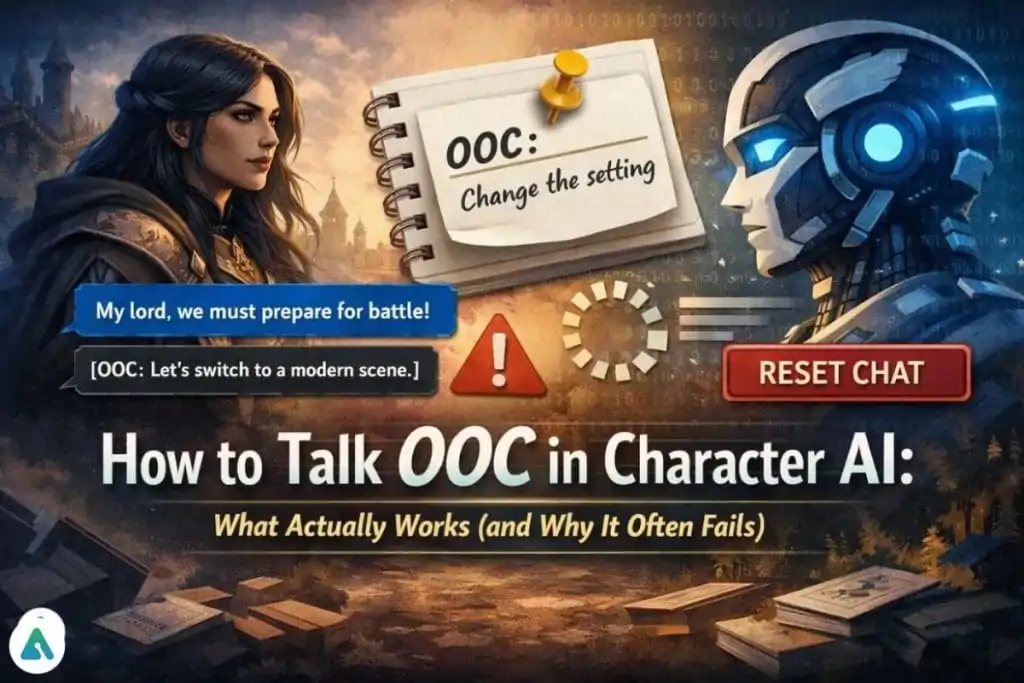
Quick Answer: What Is AI Roleplay Breaking Character?
AI roleplay breaking character happens when a chatbot drops its assigned persona mid-story. It may speak as an AI, forget established facts, or drift in voice. The term also covers a user deliberately stepping out of the story with an OOC note to steer it.
Key capabilities of a roleplay agent built to prevent unwanted breaks:
- Persistent memory of characters, events, and relationship changes across long sessions
- Stable narrator framing that keeps each character's voice consistent
- Clean handling of OOC instructions, followed by a smooth return to the scene
- Grounded world facts that don't contradict earlier chapters
Why AI Roleplay Breaks Character
Language models don't "become" a character. They predict text based on instructions and the conversation so far. Research on persona-grounded agents shows that simply prompting an LLM to assume a role does not guarantee the desired in-character behavior. Role prompting also depends heavily on how well the role is represented in the model's training data.
0.519 → 0.571 — Benchmark score improvement when researchers replaced basic role prompting with structured character cards and scene contracts (2025)
Under 300 tokens — Recommended system prompt length for roleplay, because LLMs start deprioritizing instructions buried in long lists
Roughly a quarter to a third — Reduction in repeated outputs when researchers deactivated neurons linked to repetition loops
1,401 characters from 395 books — Size of the LIFECHOICE dataset, which found LLMs show promise but still have room to improve at persona-driven decisions
But keeping an AI in character over a long story is harder than it looks:
- Fragile persona framing. Prompts written as "You are [Character]" are more prone to fourth-wall breaks than author-style framing, where the AI acts as a skilled writer giving voice to the character.
- Memory that quietly resets. A relationship that develops across hundreds of messages cannot depend only on the most recent exchange. When older context falls away, characters forget promises, injuries, and grudges.
- Repetition and voice drift. Repetition loops flatten a character's distinct personality into the same phrases and reactions over and over.
- Conflicting or locked instructions. If one instruction says "write in third person" and another says "speak in first person," the model flip-flops unpredictably. Many consumer character apps also lock the system prompt layer entirely, which leaves users little control.
- Clumsy OOC handling. The AI may ignore your bracketed note, or it may follow the note and then stay out of character for the rest of the chat.
These failures come from how the AI is set up, not from your writing. Fixing them requires memory, framing, and narrative discipline built in from the start.
Why Roleplay Game Master Keeps the Story Intact
Roleplay Game Master is a dedicated roleplay partner built to address the failure modes above. It doesn't depend on you pasting reminders every twenty messages. It holds the story state itself, including who each character is, what has happened, and the tone and rules of your world.
| Traditional Approach | Roleplay Game Master |
|---|---|
| Characters forget earlier events once the chat gets long | Unlimited memory keeps past scenes, choices, and relationships available |
| Voice drifts into generic assistant phrasing | Characters keep consistent mannerisms, worldview, and speech patterns |
| OOC notes get ignored, or the AI never returns to the scene | Step out to redirect, then drop straight back into the narrative |
| Restarting the chat to change genre or setting | Shift scenes, time periods, or tone mid-story without losing continuity |
| Pasting character sheets and recaps manually | The story state is carried forward automatically |
Memory That Survives Long Campaigns
Long campaigns break most chatbots because consequences disappear. With persistent memory, the merchant you cheated in chapter two remembers you in chapter twelve. A slow-burn alliance also keeps building instead of resetting to "strangers" every session.
A Narrator That Holds Every Voice
Testing across long sessions shows that an author-style framing produces the most stable characterization. In this setup, the AI acts as a storyteller voicing multiple characters rather than "being" one of them. Recent research reaches a similar conclusion: frameworks that turn textual character profiles into structured state improve consistency and believability. Roleplay Game Master is designed around this principle, so a cast of five keeps five distinct voices.
Freedom to Step Out and Back In
Breaking character on purpose is a legitimate tool, as long as the AI handles it cleanly. You can pause to adjust pacing, retcon a detail, or jump forward in time. The game master then resumes in-world, without a paragraph of meta-commentary.
"OOC: Let's skip ahead three days. The party has reached the coastal town. Keep the innkeeper suspicious of strangers."
"Run a gothic horror mystery set in a fog-bound fishing village. I play a visiting journalist. Keep every NPC's story consistent, even when they lie."
"OOC: Make Captain Vael colder toward me after what happened at the docks. She shouldn't forgive that quickly."
No AI is flawless. Over very long stories, small inconsistencies can still appear. When one does, a one-line OOC correction fixes it, and the correction carries forward instead of being forgotten two messages later.
Related Agents You'll Also Find Useful
If you roleplay seriously, these agents fit naturally into the same workflow.
Character Creator Strong roleplay starts with well-defined characters. If you're building an original character (OC) before a campaign, this agent can produce a detailed profile that the story can stay faithful to.
- Quick-generate or guided builds for roleplay, fiction, and OCs
- Research on existing media for fan characters
- Character portraits across genres
Creative Fiction Writer Some roleplays grow into stories worth keeping. If you want to turn a campaign into polished prose, this agent handles the move from interactive play to manuscript.
- Original fiction in any genre
- Editorial feedback on structure, pacing, and voice
- Support from first draft to final manuscript
Learn Spanish Through Roleplay If you're also learning a language, immersive scenes are an effective way to practice. Vocabulary and grammar stick better when they're tied to a story you care about.
- Fully immersive scenarios on any theme
- Practice grammar and natural speech in context
- Memorable moments that reinforce what you learn
You can try the roleplay agent on the Free tier, which includes all core features.
How to Keep AI Roleplay in Character, Step by Step
Step 1: Set the Premise, Tone, and Your Role Open with a clear setup that covers genre, setting, your character, and the feel you want. A specific opening gives the AI a stable anchor to return to throughout the story.
"Dark fantasy, low magic. I'm a disgraced royal cartographer hiding in a border town. Grim, grounded tone, no comic relief."
Step 2: Define the Characters and World Rules That Matter List the details that must never change, such as a character's secret, a magic system's limit, or a political rivalry. Keeping character data separate from the action works better than burying it mid-scene.
"Rules: magic costs memories. The innkeeper, Marta, lost her son to the guard and distrusts anyone in uniform."
Step 3: Play In-Character and Let the Story Build Start a session with your AI game master and stay in the scene. Ask questions as your character would. The AI answers in-world and keeps established facts separate from rumor.
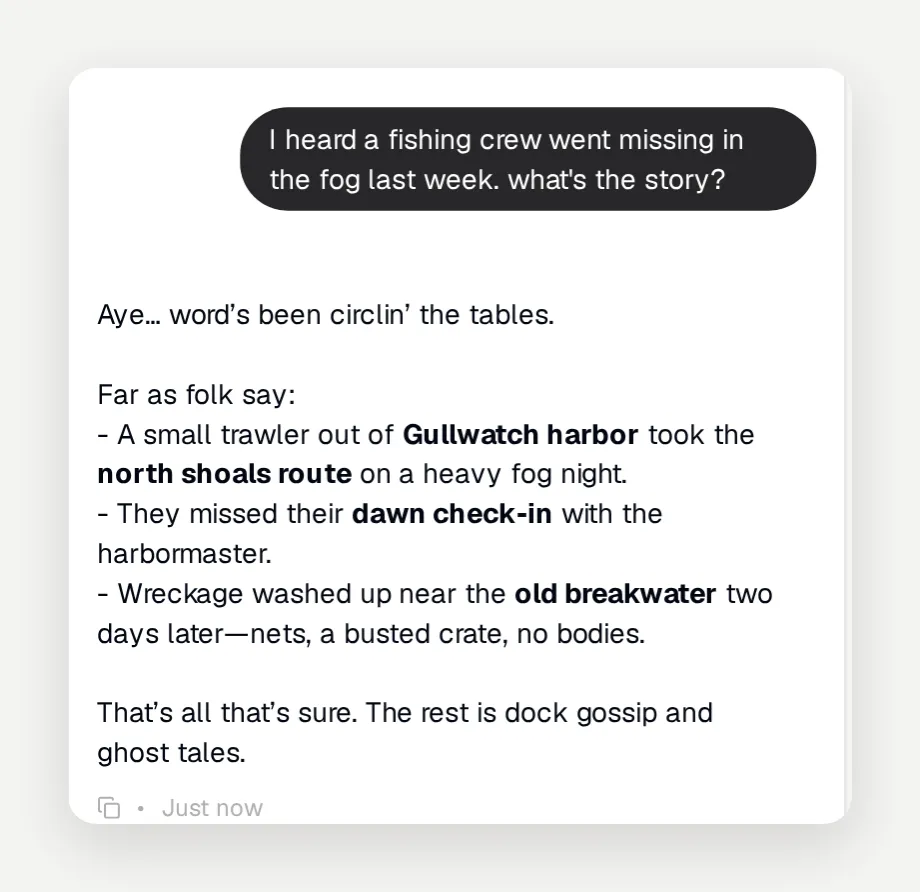
In the example above, the character answers a question about a missing fishing crew entirely in voice. It separates what's confirmed (the trawler's route, the missed dawn check-in, wreckage at the old breakwater) from "dock gossip and ghost tales." Holding that kind of distinction is what keeps a mystery solvable rather than contradictory.
Step 4: Break Character on Purpose, Cleanly When you need to steer, mark the note clearly and keep it short. Give one instruction per note so the AI doesn't confuse direction with dialogue.
"OOC: Introduce a rival investigator in the next scene. Back to the story."
Step 5: Correct Drift Immediately If a detail slips, fix it in one line rather than rerolling repeatedly. A quick correction updates the story state and keeps the scene moving.
"OOC: Marta wouldn't smile at a guard. Rewrite that last reply with her hostile."
OOC Habits That Work on Any AI Chatbot
- Use consistent markers. Write
OOC:or put the note in brackets, and use the same format every time. - Signal your return. End with "Back to the scene" so the AI knows to resume narration.
- Avoid contradictory setups. Mismatched instructions across fields cause unpredictable flip-flopping.
- Prefer author framing. Asking the AI to act as a storyteller voicing a character holds up better than telling it that it is the character.
- Keep core rules short. Long instruction lists dilute the rules that matter most.
Real Roleplay Scenarios Where Consistency Matters
🏰 A Months-Long Fantasy Campaign
Scenario: A player runs a political fantasy campaign across dozens of sessions, with shifting alliances among four noble houses.
Traditional Approach: The player keeps a separate notes document and pastes recaps at the start of every session. Character voices still blur together after a few hundred messages.
Roleplay Game Master: Alliances, betrayals, and debts carry forward automatically, and each house keeps its own agenda.
- No manual recaps between sessions
- Betrayals have lasting consequences
- Distinct voices for every noble and courtier
🔍 A Fog-Bound Mystery With Clues to Track
Scenario: A horror-mystery player investigates disappearances in a fishing village where NPCs lie, hide evidence, and spread rumors.
Traditional Approach: Generic chatbots contradict earlier clues, which makes the mystery unsolvable or trivially obvious.
With the AI game master: Facts stay fixed while rumors vary. Liars stay consistent in their lies, so deduction actually works.
- Clues remain stable across scenes
- NPCs keep their own motives and secrets
- The ending fits the evidence
📱 Roleplaying on Your Phone Between Classes
Scenario: A student continues a romance storyline in short bursts on a phone throughout the day.
Traditional Approach: Switching devices or apps means lost context, or rebuilding the scene from memory.
The same story on mobile: Pick up on iOS or Android exactly where you left off on the web, with relationships and tone intact.
- Full feature parity across devices
- Speech-to-text for hands-free scene writing
- No context lost between sessions
🎭 Changing Genres Without Restarting
Scenario: A medieval adventure takes a turn, and the player wants the same characters reimagined in a modern city.
Traditional Approach: Hit "reset chat" and lose the established personalities, or fight an AI that keeps reverting to the old setting.
With a clean OOC shift: One note moves the cast to a new setting while preserving who they are and how they relate to each other.
- Personalities survive the setting change
- No lost history
- The AI returns to the story immediately
Frequently Asked Questions
Why does AI break character during roleplay?
AI roleplay usually breaks character for one of four reasons. The persona is framed weakly, older messages fall out of the model's context, the model falls into repetition loops, or instructions conflict with each other. The AI predicts text rather than truly inhabiting a role, so without memory and stable framing it drifts back toward generic assistant behavior. Dedicated roleplay agents reduce this by keeping story state persistent and using author-style narration.
What does OOC mean in AI roleplay, and how do I use it?
OOC stands for "out of character." It's a note where you speak as yourself rather than as your character, usually to steer the plot, fix an error, or change the setting. Write OOC: or use brackets, keep it to one instruction, and end with "back to the scene" so the AI resumes narration rather than staying in meta mode.
Is Roleplay Game Master free?
Yes. It's available on the Free tier, which includes all core features with limited usage. Heavy roleplayers can upgrade to Plus at $20/month for 30× the free usage, or to higher tiers for more. Usage resets monthly on your billing date with no daily caps, so long weekend sessions aren't cut short.
Can I create my own characters for AI roleplay?
Yes. You can describe characters directly at the start of a session. For deeper OCs, Character Creator builds detailed profiles covering personality, backstory, speech patterns, and even portraits. A clearly defined character is much easier for any AI to keep consistent, because the details that matter most are stated upfront.
Does AI roleplay work on mobile?
It does. The roleplay agent has full feature parity across web, iOS, and Android, and your stories sync across devices. You can start a scene on your laptop and continue it on your phone without losing context. Built-in speech-to-text also lets you dictate dialogue or actions when typing isn't convenient.
Is my roleplay content private?
Your conversations are encrypted in transit and at rest. They are never used to train public AI models and are not sold or shared with advertisers. For many roleplayers, especially those writing personal or mature storylines, this matters as much as the quality of the storytelling itself.
Keep the Story Going
AI roleplay breaking character isn't inevitable. It's a symptom of weak framing, short memory, and poor OOC handling. Fix those, and the experience changes: characters keep their voices, consequences persist, and you can step out of the story to steer it without breaking it. Whether you're running a sprawling fantasy campaign, a tight mystery, or a slow-burn romance, consistent AI storytelling is what makes the world feel real.
Try Roleplay Game Master now and run the long-form story you've been trying to keep together. Explore more at Jenova.
For Developers: Roleplay Game Master is available programmatically via the Jenova API. You can integrate persistent, character-consistent interactive storytelling into your game or app with a single API call. Full documentation →