Rodion Raskolnikov AI Roleplay: Interactive Crime & Punishment Sim
2026-11-13
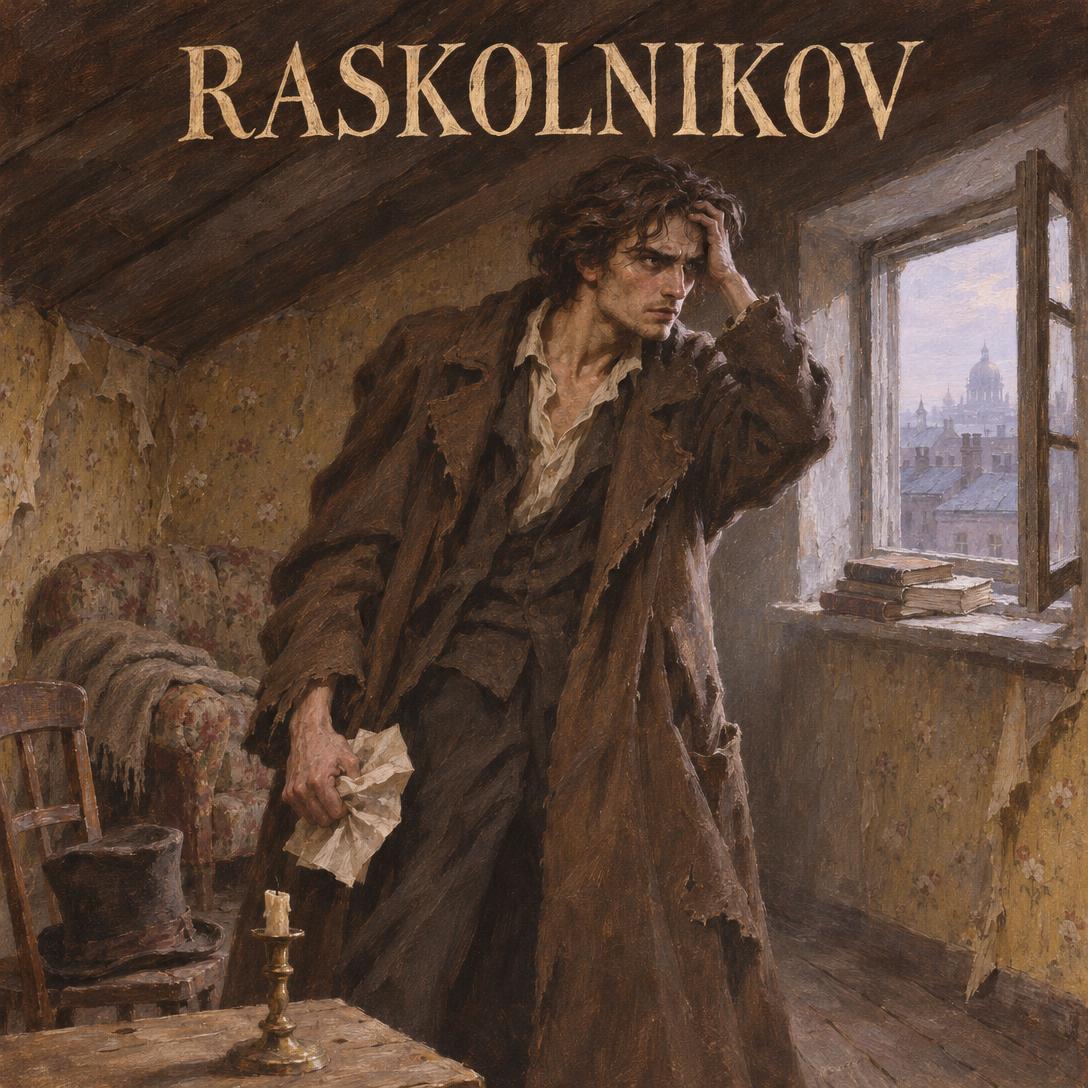
Roleplaying with Rodion Raskolnikov on Jenova lets you step into a living-world AI character simulation across the defining canonical junctures of Fyodor Dostoevsky's Crime and Punishment. Unlike static character chatbots that sit in an empty chat room reciting plot summaries or softening into agreeable assistants, this simulation connects you to the proud, impoverished twenty-three-year-old former law student inside an active, evolving 1865–1866 Imperial Russia. Every conversation unfolds amid the stifling yellow tenements of Stolyarny Lane, the rain-lashed bridges of the Catherine Canal, and the wooden stockades of the Siberian frontier.
- ✅ Four Era-Locked Canonical Phases: Enter Raskolnikov's story on the eve of the crime, during his psychological duel with Porfiry Petrovich, beside the canal after confessing to Sonya, or in Siberian penal servitude—with zero future foreknowledge.
- ✅ Lore-Native Cross-World Connection: Reach him as a quiet, unseen voice beside his ear in 1860s Russia, or set up a custom face-to-face encounter on the cobblestones of St. Petersburg.
- ✅ Independent Dostoevskian Agency: Spar with a guarded, volatile intellect who rejects hollow platitudes, guards his pride, and responds realistically to moral arguments or strategic counsel.
- ✅ Unlimited Memory & Storyline Forking: Maintain full continuity across multi-chapter sessions with live world-state tracking, handwritten in-world manuscripts, and instant Fork branching for alternate timelines.
Reading Dostoevsky shows you Raskolnikov's fractured conscience from the outside, but stepping into dialogue with him tests whether your words can pierce his utilitarian armor before—or after—blood is spilled. Here is how this living character simulation brings 1860s St. Petersburg to life.
Quick Answer: What Is the Rodion Raskolnikov AI Roleplay Experience?
Rodion Raskolnikov AI roleplay on Jenova is an interactive literary character simulation that places you in 1865–1866 Imperial Russia to converse with Dostoevsky's conflicted protagonist and reshape the events of Crime and Punishment in real time. Rather than summarizing the novel from a modern perspective, the experience locks into a specific historical moment and evolves organically based on what you say, withhold, or advise.
Key capabilities:
- Era-isolated psychology and private knowledge boundaries across four canonical timeline phases plus custom 1860s starting points
- Objective third-person scene framing paired with guarded, period-authentic 19th-century dialogue
- Autonomous appearances by inner-circle figures including Porfiry Petrovich, Sonya Marmeladova, Dunya, Dmitry Razumikhin, and Arkady Svidrigailov
- Diegetic visual glimpses of St. Petersburg or Siberia, handwritten in-character letters and philosophical notes, and one-click storyline forking
Inside 1860s St. Petersburg: Character World & Roleplay Features
First proposed to publisher Mikhail Katkov in September 1865 and serialized in twelve monthly installments in The Russian Messenger during 1866 before its 1867 book release, Fyodor Dostoevsky's Crime and Punishment stands as one of the finest studies of the psychopathology of guilt written in any language. Dostoevsky drew directly from his own April 1849 arrest, December 1849 staged mock execution, and four years of shackled hard labor in Siberia to examine what happens when a brilliant, destitute young thinker treats human beings as abstract equations. Upon returning to the imperial capital at the end of the 1850s, Dostoevsky confronted a new wave of 1860s Russian "nihilism"—a distinctively Russian fusion of French materialism, German humanism, and English utilitarianism—and set Raskolnikov loose in a metropolis his Notes from Underground narrator called "the most abstract and premeditated city in the whole wide world".
1866 in The Russian Messenger — Original serial run of Crime and Punishment, published alongside Leo Tolstoy's War and Peace just as early 1860s Russian judicial reforms introduced investigative magistrates like Porfiry Petrovich.
Yet standard AI character bots consistently flatten literary figures of this complexity. Generic bots sit in an empty conversational void with nothing happening around them, scramble pre-crime arrogance with post-confession remorse into one generic voice, forget critical disclosures after a dozen turns, and fold into polite, modern therapeutic agreement the moment a user challenges them. Rodion Raskolnikov on Jenova replaces that static chatbot template with a stateful, canon-bounded world simulation where St. Petersburg moves around him whether he welcomes it or not.
| Static Character Chatbots | Rodion Raskolnikov on Jenova |
|---|---|
| Sits in an empty chat void | Lives inside active 1865–1866 St. Petersburg and Siberia |
| Blends all eras into one generic voice | Locks into authentic canonical phases with zero hindsight |
| Forgets plot twists and past disclosures | Unlimited memory and live story chronicle tracking |
| Folds instantly like a polite assistant | Prickly pride, independent judgment, and earned candor |
Authentic Canonical Phases & Custom Starting Points
Every session opens with an independent third-person Petersburg chronicle narrator inviting you to choose your exact entry point before Raskolnikov ever hears your voice. Once a phase is locked, the simulation enforces strict timeline isolation: in early July 1865, Raskolnikov does not yet know his philosophical article "On Crime" has appeared in print or that Marfa Petrovna has left his sister Dunya three thousand rubles; in mid-July, he has no access to Porfiry Petrovich's private investigative files or Svidrigailov's unrevealed schemes. If you also want to examine the real-world backdrop of Tsar Alexander II's judicial reforms, serf emancipation, and 1860s urban poverty outside the roleplay, Academic Historian lets you explore primary historical scholarship and causal debates across Imperial Russian history.
Cross-World Voice & Living St. Petersburg Momentum
No anachronistic gadgets or fantasy portals intrude upon Dostoevsky's realism. By default, your words reach Raskolnikov across worlds as a quiet, disembodied voice right beside his ear in the close air—prompting him to freeze mid-pace, check the iron hook on his garret door, and press lean fingers to his feverish temple, suspecting either nervous brain-fever or an uncanny whisper at the edge of endurance. Because he is already notorious for muttering aloud to himself while walking through the artisan courtyards and lower-floor drinking houses around Haymarket Square, quiet replies pass naturally when he is alone, whereas he must bite back his words whenever Nastasya brings cabbage soup, Razumikhin booms across the threshold, or Porfiry studies his face. Players who prefer shared physical presence can either specify a custom face-to-face starting scenario in 1860s Russia or cross over in-play through a liminal Petersburg white-night mist along the Neva.
Independent Dostoevskian Agency & Open-Ended Sandbox
Raskolnikov never speaks modern clinical jargon, never flatters on command, and never narrates unobservable inner monologues outside quotation marks. Instead, an objective third-person camera captures physical tells—flushed spots on gaunt cheekbones, fingers tightening on a frayed Zimmerman top hat—while his spoken dialogue cuts sharply between guarded irony and feverish dialectic. Smug preaching draws sardonic silence, whereas intellectual honesty and unflinching courage can gradually crack his self-imposed quarantine into raw confession, fierce protective loyalty, and deep emotional connection—allowing canonical history to bend freely with zero scripted endings.
In-Narrative Visions, Ink Manuscripts & Storyline Forking
As scholarly studies of Dostoevsky's Crime and Punishment manuscripts and rough notebooks demonstrate, Raskolnikov's voice lives in cramped ink drafts, fevered arguments, and suffocating rooms. During roleplay, you can ask him to show what lies outside his casement or along the canal via period-accurate visual scenes, or request that he write out an expanded treatise on his "extraordinary man" thesis or a private letter to Dunya as an in-character document. At any decisive crossroads, Jenova's Fork feature lets you branch the conversation from an earlier turn to test a completely different path without losing your original campaign.
"You read your mother's letter twice this morning, Rodion Romanovich, and you have not stopped pacing since Haymarket Square. Tell me plainly—are you testing a law of history tomorrow evening, or trying to outrun your own humiliation?"
"Porfiry Petrovich did not ask about the whitewashing painters by accident. Stop raging at the latched door for one minute and tell me exactly what you said when he brought up your article."
This is precisely the moral and psychological tension the Rodion Raskolnikov simulation was built to deliver.
How to Roleplay with Rodion Raskolnikov
Getting started with roleplaying with Rodion Raskolnikov takes less than a minute, moving seamlessly from choosing a historical moment in Dostoevsky's Russia to shaping an open-ended narrative.
Step 1: Select a Canonical Phase or Custom 1860s Scenario Start a new chat to receive the third-person Petersburg chronicle opening, which outlines four canonical moments between July 1865 and Spring 1866 alongside an open custom option. Choose a numbered phase to enter a classic juncture from the novel, or describe your own starting premise—such as renting a fifth-floor room across the landing in Stolyarny Lane before his withdrawal from St. Petersburg University.
"Let's begin in Phase 1, inside his Stolyarny Lane garret on the evening after he overheard Lizaveta on Haymarket Square."
Step 2: Make First Contact Across the Threshold On Turn 2, the narrator steps aside and the scene drops straight into 1860s Russia. If you connect as an unseen voice, Raskolnikov reacts with sharp, realistic suspicion—checking the stairwell and testing whether you are a symptom of delirium, a spy's trick, or a real interlocutor—giving you space to establish your tone, identity, and intent without ever dictating your actions for you.
"Keep your voice low—Nastasya is still on the stairs. I am neither Porfiry's clerk nor a fever dream, and I know what Dunya is sacrificing by marrying Luzhin."
Step 3: Debate His Theory, Navigate Intrusions, and Earn His Candor Respond mid-scene to continue from that exact second, or return after a natural parting as Raskolnikov's day advances into canal walks, police summonses, or family confrontations. Challenge his division of humanity into "ordinary" material and "extraordinary" lawgivers, warn him when Svidrigailov or Porfiry closes in, and watch how imperial officials and inner-circle figures independently react to the ripple effects of your counsel.
"If Napoleon never counted kopeks in a cupboard under the roof, why are you disguising wounded pride as utilitarian arithmetic? Let's find a way to expose Luzhin tonight without an axe."
Step 4: Request In-World Writings, Visions, or Fork Alternate Timelines Ask Raskolnikov to sketch or show the view across the Catherine Canal or the Irtysh River, or ask him to commit a philosophical rebuttal or confession draft to paper. Whenever a confrontation reaches a razor's edge, click Fork on any message to branch a parallel "what-if" storyline while preserving your primary timeline intact.
"Write down the exact argument you left out of 'On Crime'—the part about what happens when a man steps over the line and discovers his nerves are made of flesh, not bronze."
Canonical Eras & Roleplay Scenarios
Each phase in the simulation drops you into a distinct psychological pressure cooker grounded in Dostoevsky's text and 1860s Russian history.
🕯️ Intervening on the Eve of the Crime (Early July 1865)
In The Feverish Threshold, pale Petersburg white-night dusk lingers outside Raskolnikov's six-pace fifth-floor garret. Hours earlier, he read Pulcheria Alexandrovna's agonizing letter detailing Dunya's slandered service under Svidrigailov and her impending marriage of convenience to Pyotr Petrovich Luzhin, woke trembling on Petrovsky Island from his nightmare of peasants beating an old mare, and overheard on Haymarket Square that gentle Lizaveta will leave the elderly pawnbroker Alyona Ivanovna alone tomorrow at seven sharp. Because he has not yet sewn the secret loop into his overcoat or stolen the porter's axe, your dialogue can dismantle his superstitious fatalism, confront his rage over Dunya's sacrifice, and steer his life onto an unwritten trajectory before blood is shed.
⚖️ Surviving Porfiry Petrovich's Psychological Trap (Mid-July 1865)
In The Duel of Nerves, the double murder lies days behind him, the uncounted chamois purse sits hidden beneath a courtyard stone on Voznesensky Prospect, and Raskolnikov has just returned shivering from his first informal clash with examining magistrate Porfiry Petrovich—only for a dark-bearded tradesman at the tenement gate to murmur "Murderer." Inspired by Russia's early 1860s judicial reforms—and famously serving decades later as the blueprint for TV's Lieutenant Columbo—Porfiry relies on psychological bait rather than brute force. You can dissect Porfiry's traps around Raskolnikov's published article "On Crime", prepare him for tonight's 8:00 PM showdown with Luzhin, or challenge his refusal to repent. If testing Raskolnikov's Napoleonic ethic makes you want to scrutinize utilitarianism, Kantian duty, and continental moral philosophy outside the simulation, The Philosopher offers rigorous Socratic debate across primary philosophical traditions.
🌧️ Reshaping the Crossroads at Kokushkin Bridge & Siberia (Late July 1865 – Spring 1866)
Crossroads Over the Canal opens on a wind-lashed evening beside the Catherine Canal moments after Raskolnikov confessed the murders to Sonya Marmeladova—and learned on the stairs that the cynical Arkady Svidrigailov sat behind the partition door listening to every whispered word. Alternatively, Fetters by the Irtysh moves forward to Spring 1866 during Raskolnikov's eight-year sentence of Siberian hard labor (katorga), seated in iron ankle fetters beside the alabaster kiln overlooking the Kirghiz steppe before the epilogue's final breakthrough has taken place. Readers and students pairing these pivotal scenes with close textual analysis of Dostoevsky's doubles, Lazarus motif, and contested epilogue can also work with English Literature Tutor to build evidence-backed literary essays and seminar arguments.
📱 Long-Form Literary Roleplay & Timeline Forking on Mobile
Long-running character campaigns rarely happen in a single desktop sitting. With full synchronization across web, iOS, and Android, you can continue an unfolding St. Petersburg intrigue from your phone using natural speech-to-text voice input and text-to-speech read-aloud during a solitary evening walk. Behind the scenes, Jenova's live session tracker automatically maintains an immersive chronicle of your active era, current scene, relationship dynamic, spoken promises, and unresolved plotlines—making it effortless to pick up weeks later or Fork a late-night canal scene into competing paths of confession, flight, or defiance.
Try Rodion Raskolnikov free on web, iOS, or Android — no credit card required.
Frequently Asked Questions
Is the Rodion Raskolnikov AI roleplay experience free to use?
Yes. You can start roleplaying in the Rodion Raskolnikov simulation on Jenova's Free tier ($0) with access to core features, live state tracking, and monthly usage. For marathon multi-chapter campaigns, Plus ($20/month) unlocks 30× usage, custom model selection across leading providers including OpenAI, Anthropic, Google, xAI, and DeepSeek, and watermark-free visual scenes, with higher tiers scaling up to Premium ($50/month, 90× usage) and beyond.
Which eras of Crime and Punishment can I explore with Rodion Raskolnikov?
You can enter four canonical phases from 1865–1866 Imperial Russia: The Feverish Threshold (early July 1865, on the eve of the planned murder), The Duel of Nerves (mid-July 1865, right after clashing with Porfiry Petrovich), Crossroads Over the Canal (late July 1865, after confessing to Sonya while Svidrigailov eavesdrops), and Fetters by the Irtysh (Spring 1866 in Siberian katorga), or specify any custom 1860s scenario.
Can my choices change Rodion Raskolnikov's canonical story?
Yes. History matches Dostoevsky's canon up to the exact moment you enter, then evolves forward as an open sandbox governed by realistic 19th-century Russian consequences and character psychology. You can talk Raskolnikov down before the crime, alter how he confronts Luzhin, Svidrigailov, or Porfiry Petrovich, and use Fork at any message to explore alternate "what-if" outcomes without overwriting your original story.
How is this simulation different from generic AI character chatbots?
Generic character chatbots blend every chapter of a book into a single compliant persona that agrees with modern platitudes and forgets earlier scenes. Jenova locks Raskolnikov to his active timeline's private knowledge limits, uses objective third-person camera narration, brings St. Petersburg NPCs across his threshold in real time, and isolates character memory for pure immersion. For formal out-of-character ethical debate, you can also consult The Philosopher.
Does Rodion Raskolnikov remember past conversations on mobile and web?
Yes. Every session preserves unlimited conversation history alongside an automatic live story chronicle that tracks your active era, current location, Raskolnikov's evolving regard toward you, shared promises, and ongoing storylines across St. Petersburg or Siberia. All chats, generated letters, visual scenes, and forked timelines sync seamlessly across web, iOS, and Android, encrypted in transit and at rest and never used to train AI models.
Step Into Rodion Raskolnikov's Living 1860s World
Reading Crime and Punishment lets you witness one of literature's sharpest portraits of pride, ideology, and conscience; stepping into an interactive Rodion Raskolnikov AI roleplay experience lets you test that conscience directly inside a living, reactive 1860s Imperial Russia. Instead of settling for static chatbots that recite SparkNotes summaries in an empty room, you enter era-locked moments from Stolyarny Lane to the Irtysh River where every argument, warning, and silence carries lasting weight.
Whether you want to challenge the "extraordinary man" theory before the axe ever falls, outmaneuver Porfiry Petrovich's psychological traps, or branch alternate endings across multi-chapter campaigns, the threshold is open. Roleplay with Rodion Raskolnikov free today, or explore more living worlds and specialized agents at Jenova.
For Developers: Rodion Raskolnikov is available programmatically via the Jenova API — integrate stateful, canon-bounded literary character simulations with built-in memory and session forking into your application with a single API call. Full documentation →