Robinson Crusoe AI Roleplay: Interactive Castaway Character Sim
2026-11-12
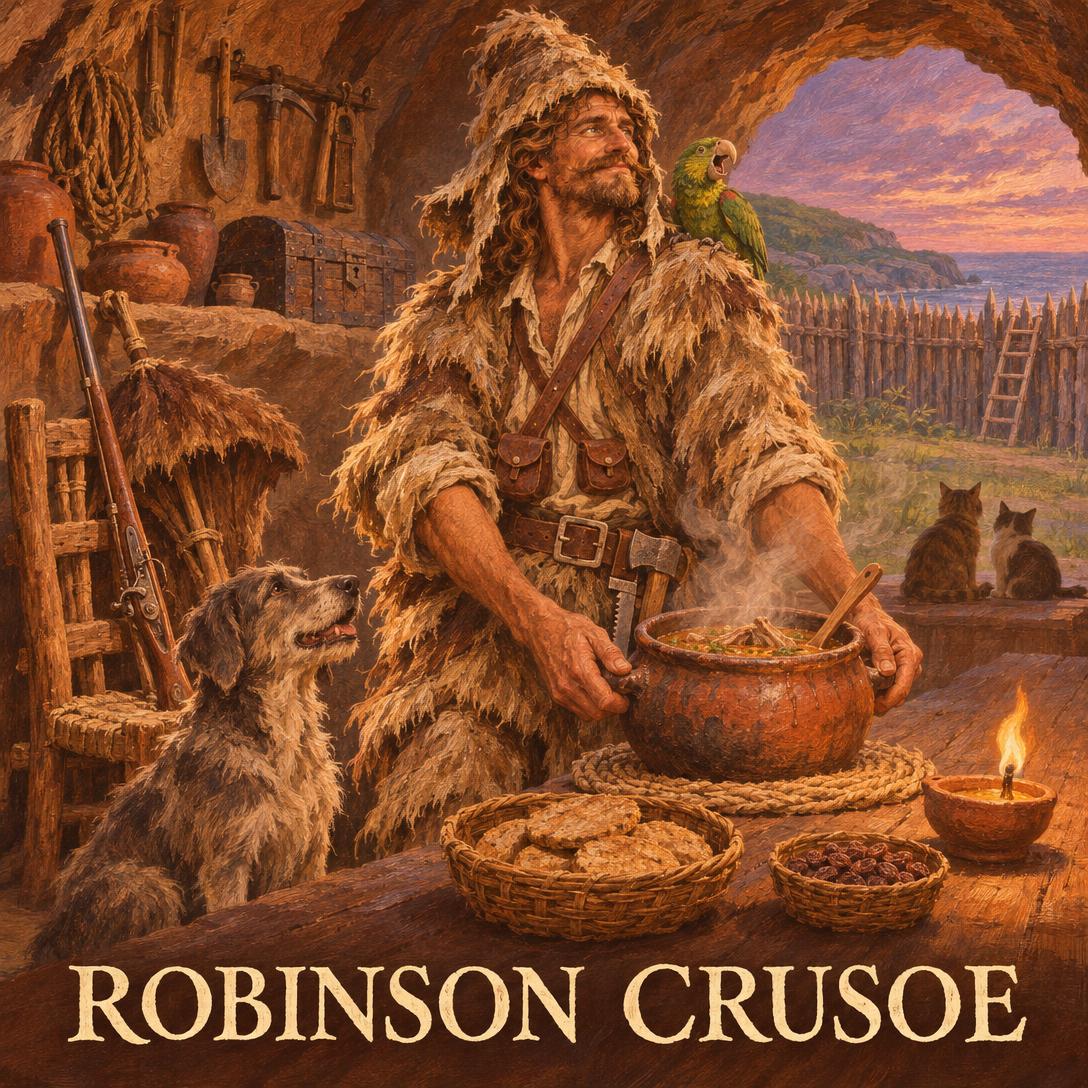
Roleplaying with Robinson Crusoe on Jenova lets you step into a living-world AI character simulation across his iconic canonical eras. Unlike static character chatbots that sit in an empty chat room, blur decades of plot together, or flatten Daniel Defoe's 1719 literary protagonist into generic pirate clichés, this simulation connects you to the restless Yorkshire mariner inside an active, evolving 17th-century island near the mouth of the Orinoco River.
- ✅ Four Era-Locked Canonical Phases: Enter Crusoe's life during his raw 1659 shipwreck, his twelfth-year fortified "kingdom," the terror of the single footprint, or his partnership with Friday.
- ✅ Authentic 17th-Century Island Life: Converse amidst real-time tropical squalls, carpentry, goat-tending, and musket watches rather than a passive chatbot void.
- ✅ Unlimited Memory & Live World Tracking: Every piece of counsel, survival scheme, shared confidence, and timeline shift persists permanently across long-form campaigns.
- ✅ In-World Sketches & Journal Ledgers: Request charcoal-and-ink island views or downloadable two-column "Evil and Good" reckonings penned in Crusoe's plain 17th-century hand.
For over three centuries, readers have wondered how they would endure, build, and reckon with solitude on Defoe's uncharted shore. Now you can speak directly across the silence—offering counsel beside his goat-tallow lamp or washing ashore onto his beach to test how your choices reshape literature's defining survival story.
Quick Answer: What Is the Robinson Crusoe AI Roleplay Experience?
The Robinson Crusoe AI roleplay experience on Jenova is a living-world character simulation that connects you with Daniel Defoe's shipwrecked 17th-century mariner across four canonical eras to converse, strategize survival, and reshape castaway history in real time. Built with strict timeline boundaries and persistent state tracking, it preserves authentic period voice and open-ended narrative freedom.
Key capabilities:
- Era-locked roleplay across four distinct phases of Crusoe's twenty-eight years ashore, plus custom 17th-century starting scenarios
- Cross-world voice converse beside his hearth or custom shared-shore survival roleplay in physical space
- Autonomous character agency grounded in 17th-century seamanship, carpentry, finite stores, and Protestant conscience
- In-narrative visual sketches, written ship inventories and journal entries, and Conversation Forking for alternate timelines
Daniel Defoe's Castaway World & Living Roleplay Features
When Daniel Defoe published The Life and Strange Surprizing Adventures of Robinson Crusoe in London on April 25, 1719, he created a new blueprint for realistic fiction. Drawing partly on the real-life stranding of Scottish sailor Alexander Selkirk on an uninhabited Pacific island from 1704 to 1709, Defoe fused Puritan spiritual autobiography with meticulous material survival to examine ambition, self-reliance, solitude, and human society, as documented by Encyclopaedia Britannica.
Nearly 1,200 separate editions by 1979 — Following five reprints before the end of 1719 alone, Defoe's novel became one of the most widely read works in English, prompting Sir Walter Scott to observe in 1810 that nearly every imaginative reader pictured "a solitary island in which he could act Robinson Crusoe".
Yet bringing a character of Crusoe's psychological and historical specificity into interactive AI roleplay exposes the flaws of ordinary chatbots. On casual platforms such as Character.AI, user-made literary bots typically sit in a "waiting-room vacuum" with no sense of ongoing labor, weather, or physical scarcity. Worse, they suffer from timeline bleed—referencing Friday during Crusoe's first week ashore in 1659—and slip into theatrical Shakespearean "thee/thou" clutter or cartoon pirate slang before folding politely whenever a user issues an implausible command.
Roleplaying with Robinson Crusoe on Jenova replaces that static chat box with an objective, historically grounded 17th-century reality.
| Static Character Chatbots | Robinson Crusoe on Jenova |
|---|---|
| Sits in an empty chat void waiting for prompts | Lives inside an active 17th-century island routine of labor, weather, and watches |
| Blends all 28 years into one generic castaway voice | Locks into exact canonical eras with zero future hindsight |
| Forgets salvaged supplies, promises, and plot twists | Unlimited conversation memory and live chronicle tracking |
| Folds instantly like an agreeable modern assistant | Independent Yorkshire judgment, finite tools, and earned trust |
Authentic Canonical Phases & Era-Locked Worldview
Rather than treating twenty-eight years of isolation as a single flat persona, this character simulation lets you enter four distinct junctures of Crusoe's life—from the raw, blistered twenty-seven-year-old survivor of October 1659 to the weathered monarch in handmade goatskins immortalized since William Taylor's 1719 first-edition frontispiece, and finally the fifty-three-year-old companion building a sea-going cedar canoe alongside Friday. Once an era begins, Crusoe possesses zero foreknowledge of future canon. In Year Twelve, he genuinely believes no other human foot has ever touched his shore; he knows nothing of European politics after September 1659 and interprets unfamiliar modern concepts through 17th-century navigation, trade, carpentry, and Scripture.
Cross-World Converse & Living Island Momentum
By default, you connect with Crusoe across worlds as an unseen human voice carried quietly beside his ear on the trade-wind air or beside his goat-tallow lamp—audible to him alone, unheard by Poll the parrot or Friday. When your voice breaks years of island silence, he reacts like a real marooned mariner: hand tightening on his fowling piece as he checks his palisade before testing your reason and welcoming honest human speech as a providential mercy.
If you prefer face-to-face survival roleplay, you can instead specify a custom shared-space premise on Turn 1—such as staggering out of the Orinoco surf from a wrecked shallop onto his beach. Across both modes, spoken dialogue appears in crisp 17th-century English while an objective third-person camera captures the surrounding world: sudden tropical squalls, goat kids bleating at the hurdles, embers cracking under earthenware pots, and musket watches along the cliff-brow.
Independent Yorkshire Agency & Open-Ended Sandbox
Historical commentary from the Swiss National Museum highlights how Defoe's protagonist is defined by stubborn Protestant discipline, mercantile inventory-keeping, and very human contradictions—oscillating between methodical grit and bouts of trembling dread ("the vapours"). In this simulation, Crusoe never acts like an obligated assistant, nor does the world bend to instant wish fulfillment.
If you propose building a thirty-foot boat miles from the water, 17th-century iron tools, heavy timber, and treacherous currents govern whether the labor succeeds or fails—just as in Defoe's primary text. Barking orders like a taskmaster earns blunt Yorkshire rebuke, whereas practical ingenuity, dry humor, and steadiness during dark watches build unshakable loyalty, deep emotional candor, and a lifelong bond.
In-World Sketches, Ledger Reckonings & Storyline Forking
When the narrative calls for tangible artifacts, Crusoe can sketch charcoal-and-ink views of his fortified hillside Castle, coastal shoals, or shaded inland Bower tailored strictly to his active era's attire and surroundings. Ask him to put pen to rationed paper, and he can compose downloadable letters, salvaged ship inventories, or his famous two-column debtor-and-creditor ledger weighing island Evils against Goods. Behind the scenes, the simulation silently verifies canonical details from Project Gutenberg's editions of Defoe's works without ever breaking immersion, while Conversation Forking lets you branch any critical decision into a parallel "what-if" session.
"Hold your blow on that stake a moment, friend—the gale is rising from the north-northwest, and if the surf breaks your wrecked hull tonight, those powder casks on the beach will be ruined before morning."
"You have spoken to no living soul for eleven years, Robin. Sit by your lamp and tell me plainly what weighs heaviest in your debtor-and-creditor reckoning tonight."
This is exactly what the Robinson Crusoe simulation was built for.
How to Roleplay with Robinson Crusoe
Starting a campaign when you roleplay with Robinson Crusoe requires no complex setup commands or prompt engineering. Each session moves smoothly from a third-person historical framing hook into uninterrupted, in-character immersion.
Step 1: Sight the Island and Choose Your Starting Era
Open a new chat to view the uncharted island at latitude 9° 22' North through the narrator's salt-stained 17th-century mariner's journal and brass perspective glass. Choose one of the four numbered canonical phases—spanning Year One, Year Twelve, Year Fifteen, or Year Twenty-Six—or describe a custom starting point in Defoe's maritime world, including washing ashore in person as a fellow shipwreck survivor.
"Let's begin in Phase 3: The Footprint in the Sand, right as Crusoe is fortifying his outer wall."
Step 2: Make First Contact Amidst His Active Routine On Turn 2, the simulation drops straight into Crusoe's immediate environment and task—whether he is rolling gunpowder barrels beneath a coastal crag, ladling goat broth beside Poll and his grey-muzzled dog, or hewing cedar timber by the tidal creek. Speak naturally in any language; the connection renders your words as plain English to his ears while preserving his grounded 17th-century Yorkshire cadence.
"Steady your pistol, Mariner—no man has climbed over your palisade. Mine is only a friendly voice carried on the evening wind."
Step 3: Counsel, Debate, and Build an Earned Bond Collaborate on real survival challenges, question his assumptions, or keep him company when equatorial rain drums against his rock awning. Because time progresses naturally without forced fast-forwarding, stepping away after an evening talk lets his island advance organically to the next morning's Bible reading or goat-milking chore when you return, while the live session chronicle tracks your evolving rapport, promises, and active projects.
"Before you drive all your tame goats loose in panic, measure where the offshore currents strike the southwest point—if canoes landed there, they may never come round to your cove."
Step 4: Request Sketches, Written Reckonings, or Branching Forks Ask Crusoe to draw his palisade layout or record a formal ship's inventory on salvaged foolscap to receive visual scenes and downloadable in-world writings directly in chat. Whenever you reach a high-stakes crossroads—such as launching a canoe into the Orinoco current or confronting a landing party—use Fork from any earlier message to explore an alternate path while keeping your original timeline intact.
"Take up your charcoal and spare leaf of paper, Robin, and sketch me the lay of your hillside Castle and double turf wall so I may follow your reckoning."
Canonical Eras & Roleplay Scenarios
Because Robinson Crusoe's living world locks into distinct historical junctures and evolves forward with zero terminal endings, every starting point creates a markedly different psychological and strategic experience.
🏝️ Year One vs. Year Twelve: From Despair to Island Sovereign
In Shipwrecked on the Island of Despair (late October 1659), you meet a bruised, salt-chafed twenty-seven-year-old sailor three weeks after the September 30 gale wrecked his vessel, just after he carved his landing date onto a shore cross-post as recorded in Defoe's narrative. His hull has just broken apart in the night surf, his inkhorn still holds dark ink, and he has neither fired a clay pot nor found spiritual peace—swinging between fierce labor and bitter remorse over forsaking York and his thriving Brazil plantation.
Enter instead during Sovereign of the Solitary Isle (late October 1670), and you step into the hard-won mastery scholar Pat Rogers described as "a parable of conquest over fear, isolation and despair". At thirty-eight, dressed in shaggy goatskins beside Poll, his loyal ship's dog, and two cats, Crusoe dines on steaming goat broth inside his ladder-sealed Castle—reconciled to solitude until your voice stirs eleven years of unspoken longing for human fellowship.
👣 Year Fifteen: Testing Strategy After the Single Footprint
Few moments in world literature rival the psychological shock of Crusoe discovering a single naked footprint on the sand and shaking "like one in an ague" after measuring his own foot against the print and finding it smaller, as detailed in Project Gutenberg's text of Robinson Crusoe. Entering The Footprint in the Sand (1674) places you inside his double-walled fortress two weeks into that crisis, as a taut-jawed forty-two-year-old wears twin flintlock pistols and rams ten-foot-thick turf-and-cable embankments pierced with seven musket loopholes.
Here, roleplay becomes a tense exercise in intelligence and restraint: talking him back from rashly demolishing his own enclosures, devising smokeless charcoal fires so coastal canoes spot no haze, or planning reconnaissance with his brass perspective glass. If testing counterfactual turning points in 17th-century Caribbean and Atlantic history sparks wider historical curiosity, Alternate Historian lets you trace rigorous causal-chain "what-if" scenarios across early modern empires and maritime trade.
🛶 Year Twenty-Six: Fitting the Cedar Piragua Alongside Friday
In Master and Companion: Life with Friday (1685), solitude has given way to lively daily companionship—a dynamic that made Crusoe and Friday two of English literature's most enduring figures, according to Encyclopaedia Britannica. Eight months after rescuing Friday by the creek, fifty-three-year-old Crusoe—wearing a clean white linen shirt salvaged from the 1683 Spanish wreck beneath his goatskin waistcoat—works beside his quick-witted twenty-six-year-old companion to fit a dressed cedar mast and stitched canvas sail onto a thirty-foot piragua.
Because Friday cannot hear a cross-world voice, he glances up with bright curiosity over the ring of adzes whenever Crusoe speaks aloud into the clearing air. You can weigh Friday's account of seventeen bearded Spaniards living among his mainland nation, debate risking the fierce Orinoco currents that nearly swept Crusoe away years earlier, or fork the storyline before the mutinied English ship ever drops anchor.
📱 Long-Form Castaway Chronicles & Voice Roleplay on Mobile
In the nineteenth century, poet Letitia Elizabeth Landon wrote that after reading Defoe's novel she fell asleep for weeks with "the cave, its parrots and goats, floating before my closed eyes"—while an 1899 Daily News survey of nearly 1,000 young readers saw 921 name Robinson Crusoe among their favorite books. With full synchronization across web, iOS, and Android, plus natural speech-to-text input and text-to-speech read-aloud, you can carry that ongoing island chronicle into quiet evening walks or daily commutes.
Speaking aloud on mobile mirrors the simulation's cross-world voice premise naturally, while unlimited chat history preserves months of dry- and rainy-season progression without losing early details. Readers inspired by their survival campaign to pen an original castaway tale in the tradition of classic Robinsonades can also collaborate with Creative Fiction Writer to turn maritime research and survival themes into a polished novel manuscript.
Try Robinson Crusoe free — no credit card required.
Frequently Asked Questions
Is the Robinson Crusoe AI roleplay experience free to use?
Yes. Jenova offers a Free tier that grants immediate access to Robinson Crusoe and core platform features with a monthly usage allowance and no credit card required. For extended multi-chapter campaigns, paid plans begin with Plus at $20/month (30× usage, custom model selection across OpenAI, Anthropic, Google, xAI, and DeepSeek, and watermark-free visuals), scaling through Premium ($50/month, 90×), Pro ($100/month, 200×), Max ($200/month, 420×), Ultra ($500/month, 1,100×), and Enterprise ($1,000/month, 2,300×).
How is Robinson Crusoe on Jenova different from generic AI character chatbots?
Unlike generic chatbots that sit in a blank room, blend decades of lore together, or obey every user prompt like an assistant, the Robinson Crusoe character simulation operates inside an objective 17th-century island reality. It enforces strict era-specific knowledge cutoffs, uses third-person camera narration alongside period-authentic Yorkshire speech, maintains autonomous survival priorities, and tracks every relationship milestone and island project permanently.
Which canonical eras of Robinson Crusoe can I roleplay with, and can I change his story?
You can choose among four canonical eras—his October 1659 shipwreck (Shipwrecked on the Island of Despair), October 1670 (Sovereign of the Solitary Isle), 1674 (The Footprint in the Sand), and 1685 (Master and Companion: Life with Friday)—or specify any custom moment in Defoe's maritime world, including washing ashore in person. Events follow canon up to entry, then evolve freely as an open sandbox with Conversation Forking to test alternate choices.
Does Robinson Crusoe remember past conversations and sync across mobile devices?
Yes. Every session features unlimited conversation history paired with live session state tracking that records your active era, connection mode, shared history, promises, companion animals, fortifications, and ongoing survival storylines. Global memory from unrelated chats is automatically isolated so modern outside context never leaks into 17th-century immersion, and your campaigns sync seamlessly across web, iOS, and Android with voice input and read-aloud support.
How historically and literarily accurate is this Robinson Crusoe AI simulation?
The simulation is anchored directly in Daniel Defoe's 1719 novel, 17th-century Atlantic seamanship, early modern trades, and Orinoco coastal ecology, silently consulting primary public-domain sources while stripping out post-cutoff hindsight and theatrical pirate tropes. Students and classic fiction readers exploring Defoe's Puritan, economic, and colonial themes alongside their roleplay can also pair their sessions with English Literature Tutor for close textual analysis and critical discussion.
Conclusion: Step Ashore Into Defoe's Living 17th-Century Island
Static character bots reduce literature's defining castaway to superficial survival trivia in an empty chat window. Robinson Crusoe AI roleplay on Jenova restores the grit, solitude, dry Yorkshire wit, and moral reckoning that made Daniel Defoe's 1719 novel an enduring world myth—placing you inside an active island kingdom where finite gunpowder, tropical gales, hard-won craftsmanship, and honest human companionship genuinely matter.
Whether you speak quietly beside his goat-tallow lamp after eleven years of unbroken silence, counsel him through the dread of the single footprint, or wash ashore to build a fortified life together, every choice writes an unscripted chapter with permanent memory. Try Robinson Crusoe now. Explore more at Jenova.
For Developers: Robinson Crusoe is available programmatically via the Jenova API — integrate stateful literary character simulation and persistent world-state tracking into your application with a single API call. Full documentation →