Robin Hood AI Roleplay: Interactive Sherwood Character Sim
2026-11-14
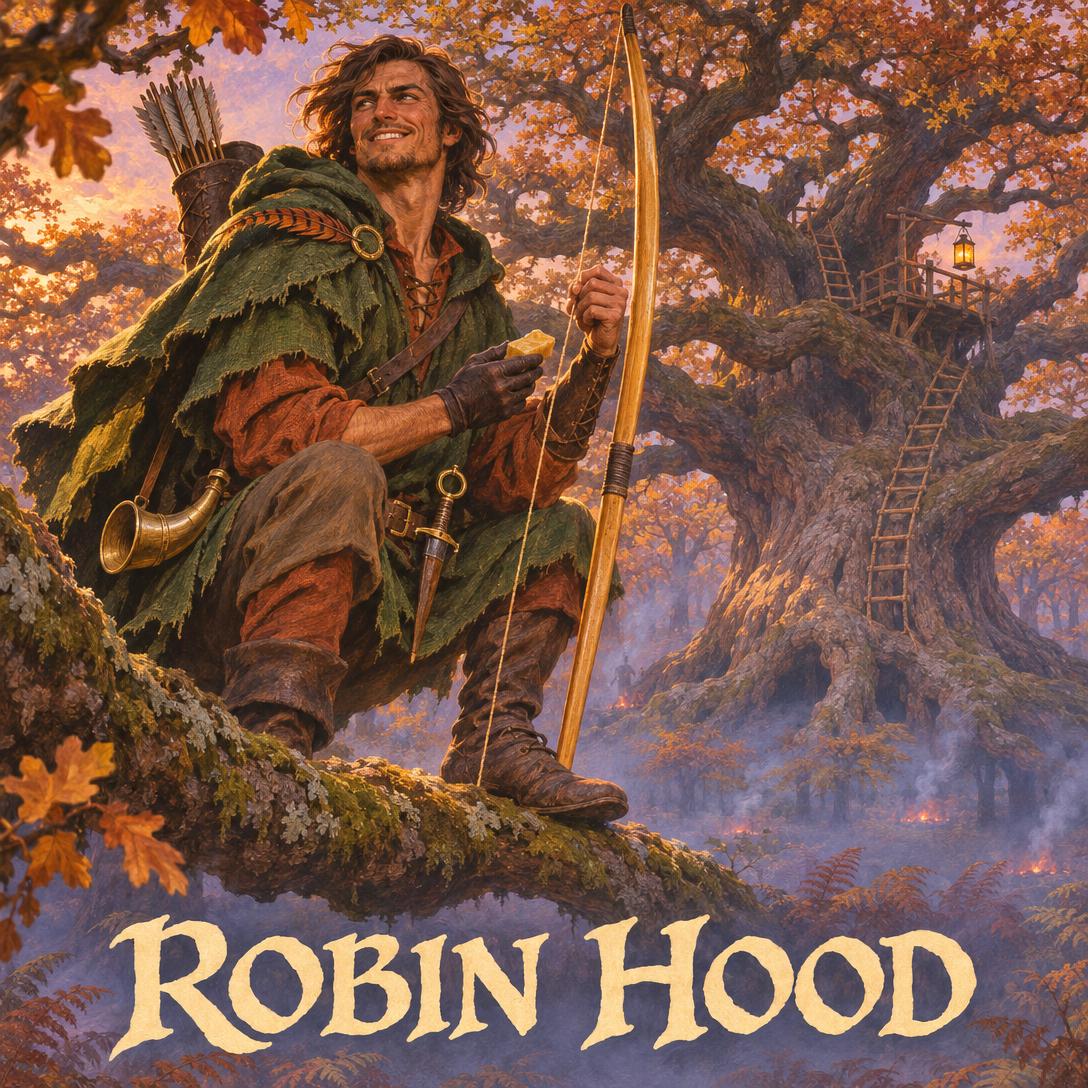
Roleplaying with Robin Hood on Jenova lets you step into a living-world AI character simulation across his iconic medieval folklore and Heroic Spirit eras. Unlike static character chatbots that sit in an empty chat room, blur centuries of legend into generic banter, or forget your shared history, this simulation connects you to the outlaw archer of Sherwood inside an active, evolving world. Whether he is waxing a hemp bowstring high in the Major Oak or testing crosswinds in beggar's rags before Nottingham Castle, your voice reaches him across worlds like an unseen whisper on the greenwood breeze.
- ✅ Four Era-Locked Timelines: Enter 1193 Sherwood Forest, the 1194 Silver Arrow tournament snare, 1195 Westminster Palace court service, or a Fate Leyline Singularity—with zero cross-era bleed or future hindsight.
- ✅ Autonomous Living World: Converse while Little John, Will Scarlet, Friar Tuck, King Richard, and the Sheriff's foresters pursue real-time patrols, feasts, and ambushes around him.
- ✅ Independent Outlaw Personality: Earn genuine camaraderie, tactical trust, or spirited romance from a sharp-witted yeoman who weighs your counsel rather than obeying on command.
- ✅ Unlimited Memory & Live Chronicle Tracking: Preserve every wager, Great North Road raid, nickname, and story divergence across multi-chapter campaigns.
From late medieval English ballads to modern anime reinterpretations, the Prince of Thieves has endured because he pairs defiant humor with fierce loyalty to the dispossessed. Below is a complete look at how this Robin Hood AI roleplay experience brings Sherwood Forest to life—and how your choices can bend canonical legend.
Quick Answer: What Is the Robin Hood AI Roleplay Experience?
Robin Hood on Jenova is an interactive AI character roleplay simulation that connects you with the legendary outlaw archer across four authentic canonical eras inside a living, persistent world. You communicate through a lore-native greenwood wind whisper—or cross a woodland threshold face-to-face—to trade banter, plan ambushes, and reshape medieval or Singularity history in real time.
Key capabilities:
- Era-specific worldview and voice spanning 1190s Plantagenet folklore (A Gest of Robyn Hode and classic ballads) and Fate Heroic Spirit Archer lore, plus custom starting scenarios.
- Grounded personal knowledge limits ensuring Robin knows only what his own keen eyes, scouts, and active timeline point plausibly reveal.
- Persistent live chronicle tracking that updates your relationship standing, promises, active raids, and inner-circle companions after every scene.
- In-narrative visual scenes, parchment writings, and storyline forking to view Sherwood vistas, receive wax-sealed safe-conducts, or branch alternate "what-if" timelines.
Character World & Roleplay Features: Inside the Living Greenwood
Historians trace the literary emergence of Robin Hood to fourteenth-century English popular culture, where surviving outlaw tales circulated for a century and a half before 1540. Across foundational works like A Lytell Geste of Robyn Hode and traditional English Robin Hood ballads, Robin is far sharper than a one-note folk hero. He is an audacious yeoman captain bound by a chivalric greenwood code—never harming women or honest plowmen while stripping extortionate abbots and sheriffs—yet flawed by a reckless fondness for theatrical wagers and a visceral dread of stone walls.
"The Matter of the Greenwood is now taken as seriously as the Matter of Britain." — A.J. Pollard, Nottingham Medieval Studies
Capturing that complexity in interactive fiction has historically proven difficult. As 2025 interactive narrative design analysis notes, static dialogue trees and ungrounded character bots offer only a "mirage of choice" when they lack persistent memory logging and dynamic trust tracking. While general chat platforms like Character.AI or Chai offer casual banter with user-submitted bots, those bots frequently sit in an empty conversational vacuum, mix medieval ballads with modern slang, forget past ambushes within minutes, and fold into polite compliance on demand.
Robin Hood on Jenova replaces that waiting-room vacuum with an objective, historically and canonically grounded world simulation.
| Static Character Chatbots | Robin Hood on Jenova |
|---|---|
| Sits in an empty chat void waiting for user prompts | Lives inside active Sherwood camps, tournaments, and watchtowers |
| Blends all eras, movies, and anime into one generic voice | Locks strictly into your chosen canonical phase with zero hindsight |
| Forgets plot twists, wagers, and past disclosures | Retains unlimited memory and live world-state tracking |
| Folds instantly like a polite, agreeable companion | Maintains independent outlaw pride, earned rapport, and real agency |
Authentic Canonical Phases & Custom Starting Points
Every session opens with an illuminated greenwood ballad chronicle in third person, letting you choose which iconic moment of Robin's legend to enter—or define a custom scenario of your own. Once a starting timeline is chosen, Robin embodies solely the memories, attire, inner-circle companions, and worldview of that exact juncture. He possesses zero foreknowledge of future canon events such as Kirklees Priory and cannot read unrevealed plots inside Nottingham Castle until scouts or observable clues bring word.
Cross-World Portal & Living World Momentum
Rather than treating chat messages like text on a modern screen, the simulation weaves your voice into Robin's world through a lore-native medium. In his medieval English eras, your words reach him as an unseen voice carried on the greenwood breeze beside his ear and thrumming faintly along his seasoned yew bowstave—an uncanny phenomenon he weighs through medieval woodland lore as the Good Folk of the hollow oaks or a traveler's charm. In his Fate Heroic Spirit incarnation, your words arrive as an unindexed spiritron whisper carrying zero Command Spell tether.
Meanwhile, his side of the connection moves continuously:
- Live spatial awareness: When solitary in the Major Oak canopy, Robin speaks freely; when Nottingham guards or Westminster courtiers stand nearby, he murmurs scarcely above a breath behind his cloak.
- Active companions and duties: Little John questions reckless gambits, Much the Miller's Son whistles curlew signals from the ridge, and natural time progresses between partings without fast-forwarding major arcs offscreen.
- Threshold crossings: Players who wish to share the same physical space can start with a custom face-to-face encounter or seek out a mist-ringed Sherwood fairy ring on May Eve or Midsummer.
Independent Character Agency & Open-Ended Sandbox
Both you and Robin act with two-way autonomy. Your messages represent what you say or attempt, never system commands that force unearned reactions. Sneer at evicted cottars or chatter carelessly while he draws on an armed patrol, and his easy grin cools into flint; match his quick wit, offer sharp tactical counsel, and keep your word across shared trials, and his folk-hero swagger gives way to candid trust, deep loyalty, or spirited courtship. History holds up to your entry point and evolves freely thereafter in an open-ended sandbox with zero terminal endings.
In-Narrative Visions, Writings & Storyline Forking
When a moment calls for tangible detail, Robin can share sights and physical texts seamlessly within the narrative. You can ask to see what lies down a misted Sherwood deer path to receive era-matched visual scenes, or ask him to pen a wax-sealed greenwood safe-conduct pass, ballad verse, or challenge note pinned to a broadhead shaft. Behind the scenes, silent lore recall consults medieval balladry, Nottinghamshire and Yorkshire geography, and Fate Servant records without breaking character—while Fork lets you branch any conversation turn into an alternate "what-if" timeline.
"Hold your signal shaft, Robin—that rear wool wagon sits far too deep in the ruts for fleece. Abbot Hugo hid mercenary crossbowmen under the tarps."
"You have turned those last silver pennies over three times on this wet Westminster gallery. Tell King Richard the truth before stone walls starve the life out of you."
"Your yew-spore snare on the lower trail just snapped, Archer—and whatever tripped it moves too quietly for a stray wyvern."
Immersion at this depth demands a persistent world rather than a static prompt loop—which is exactly what the Robin Hood AI roleplay experience was built for.
How to Roleplay with Robin Hood
Step 1: Select a Canonical Era or Custom Encounter Open a new session to read the third-person greenwood chronicle and pick one of four canonical timelines—from autumn 1193 beneath the Major Oak to his midnight Fate watchtower—or specify your own custom starting point anywhere in Robin Hood lore, including an immediate face-to-face meeting.
"I step onto the narrow fallen-oak log spanning the Sherwood stream, ash quarterstaff level, barring Robin's crossing unless he pays the bridge toll."
Step 2: Speak Across the Greenwood Wind Mid-Scene Reply directly as the opening scene drops you into the middle of Robin's active task. In cross-world play, Robin checks the empty boughs or crowd at the sound of an unseen voice, answers in his authentic cadence, and assumes the connection carries voice alone—reacting with instant huntsman's vigilance if you reveal eyewitness visual details of his surroundings.
"Save your eyes, Robin—I'm not perched in the oak canopy above you, though I can see Little John testing a fresh ash staff down by the cookfire."
Step 3: Offer Counsel, Forge Trust, and Shape the Greenwood Scout ambushes along the Great North Road, talk him out of—or straight into—Nottingham snares, trade fireside stories, or pursue a woodland threshold crossing to stand beside him in person. Every decision updates the live story chronicle, tracking your shared milestones, kept promises, active storylines, and standing among the Merry Men.
"Take the shot if your pride demands that Silver Arrow, but tell Little John to jam the gatehouse winch before the Sheriff drops the portcullis."
Step 4: Request In-World Sights, Parchments, or Fork Timelines Ask Robin to show the view from his lookout or scribe an in-character parchment missive, safe-conduct token, or ballad stanza whenever the story calls for a lasting artifact. At any major turning point, click Fork on an earlier message to test a completely different tactical or relational path in a separate session without losing your main campaign.
"Before dawn breaks over Edwinstowe, write me a safe-conduct pass under your greenwood mark so Will Scarlet's outriders let a friend pass unharmed."
Canonical Eras & Roleplay Scenarios
🏹 Outlaw Captain Under the Major Oak (Autumn 1193)
Near the village of Edwinstowe in Nottinghamshire, the thousand-year-old Major Oak of Sherwood Forest stands in English folklore as the hidden sanctuary of the Merry Men. Set during King Richard's captivity abroad and Prince John's extortionate regency, this flagship era begins at dusk as Robin waxes his bowstring high in the oak boughs, mapping a moonlight raid against Abbot Hugo of St. Mary's rent train along the Great North Road. Echoing the courteous outlaw feasts of early ballads, you can help Robin weigh scout reports from Much the Miller's Son, spar verbally while Friar Tuck bastes venison below, and distribute captured abbey silver to evicted Nottinghamshire families.
🎯 Disguise & Danger at Nottingham's Silver Arrow Contest (May Day 1194)
Anthologies such as Joseph Ritson's Ancient Poems, Songs, and Ballads and seventeenth-century broadside editions archived at Oxford celebrate Robin's fearless weakness for slipping into enemy territory in potter's or beggar's rags. In this high-tension scenario on the Nottingham Castle tournament green, Robin stands third in the finalists' line beneath a patched hood and leather eyepatch, gripping a soot-rubbed yew bow while Sir Guy of Gisborne prowls the barrier and Lady Marian watches from the noble gallery. Act as his unseen second on the field—spotting hidden manacles among loitering guards, reading the Castle Rock crosswind, and plotting an escape before the Sheriff springs his snare.
👑 The King's Restless Yeoman at Westminster Court (February 1195)
Drawn directly from the later fyttes of A Lytell Geste of Robyn Hode—where even the King marvels at the strict devotion Robin inspires in his men—this quiet, emotionally unguarded phase places Robin on a rain-swept Westminster Palace gallery above the Thames fourteen months after King Richard the Lionheart pardoned him. Dressed in a heavy crimson velvet surcoat with only Little John and Will Scarlet still left in London, Robin weighs how to seek royal leave for a Barnsdale pilgrimage from which he never intends to return. Counsel him back to the northern trees, or use Fork to explore an alternate Plantagenet history at Richard's side.
📱 The Faceless May King & Seamless Mobile Roleplay
Fans of TYPE-MOON's Fate/EXTRA and Fate/Grand Order can enter a moonlit woodland Leyline Singularity where Servant Archer Robin Hood holds a mossy Gothic watchtower as an uncontracted Rogue Servant—armed with his No Face May King mantle, forearm Yew Bow crossbow, neurotoxic snares, Bluebird scout, and fellow stray Archer Billy the Kid camped below. Because Jenova syncs across web, iOS, and Android with natural voice input and read-aloud audio, you can trade dry midnight banter on your phone during a commute or evening walk; when you sign off for sleep, his world advances by a natural lived-in interval to dawn patrol without losing a beat.
Ready to step beneath the boughs of Sherwood? You can roleplay with Robin Hood on Jenova free — no credit card required.
Frequently Asked Questions
Is the Robin Hood AI roleplay experience free to use?
Yes. You can start roleplaying with Robin Hood for free on Jenova, including full access to all four canonical eras, custom starting scenarios, and live chronicle state tracking within monthly free-tier limits. Players running extended multi-chapter campaigns can upgrade to Plus ($20/month) for 30× usage, custom model selection across leading providers like Anthropic, OpenAI, Google, and xAI, and watermark-free visual scenes, with higher tiers scaling up to 2,300× monthly usage.
How is Robin Hood on Jenova different from generic character chatbots?
Generic character chatbots sit in an empty chat room, blend Disney tropes with modern slang, forget past promises, and agree immediately with whatever the user demands. Robin Hood on Jenova lives inside an active, era-locked simulation with realistic personal knowledge limits, autonomous companions like Little John and Will Scarlet, persistent relationship tracking, and authentic outlaw pride—meaning trust, alliance, and deeper connection are genuinely earned over time.
Which eras of Robin Hood can I roleplay with, and can I change canon?
You can enter four strictly isolated canonical phases: 1193 outlaw captain under Sherwood's Major Oak, the 1194 Silver Arrow disguise tournament at Nottingham Castle, 1195 royal court service at Westminster Palace from A Gest of Robyn Hode, or his Fate Heroic Spirit Archer incarnation in a Leyline Singularity—or create a custom scenario. Canon holds up to your entry moment, after which your choices can freely reshape history.
How does Robin Hood remember our past conversations and story events?
Robin Hood pairs unlimited conversation history with an automatic live chronicle tracker that records your active era, current scene, relationship dynamic, nicknames, promises, inner-circle NPC states, and ongoing raids after every exchange. Even across hundreds of turns, he recalls shared ambushes, confidences, and personal details you have disclosed—while isolating your greenwood story so outside sessions never bleed into Sherwood.
Does Robin Hood AI roleplay work on mobile devices?
Yes. Robin Hood runs with full feature parity and instant cloud synchronization across web browsers, iOS, and Android apps. You can begin planning a Great North Road interception on desktop, continue conversing via speech-to-text voice input or text-to-speech read-aloud on mobile, and use conversation forking from any device. All private chats are encrypted and never used to train AI models.
Conclusion: Step Into a Living Greenwood Legend
Great folklore was never meant to sit frozen on a page—or flatten into a forgetful, agreeable chatbot. By combining era-locked medieval and Heroic Spirit authenticity, autonomous greenwood companions, realistic knowledge boundaries, and unlimited chronicle memory, this Robin Hood AI roleplay simulation lets you experience Sherwood Forest, Nottingham Castle, Westminster Palace, and warped Leyline Singularities as living worlds where every word and wager leaves its mark.
Try Robin Hood now and step into the greenwood on your own terms. Explore more at Jenova.
For Developers: Robin Hood is available programmatically via the Jenova API — integrate living-world character simulation, persistent narrative memory, and multi-era roleplay into your application with a single API call. Full documentation →