Richard III AI Roleplay: Converse & Reshape Plantagenet England
2026-11-13
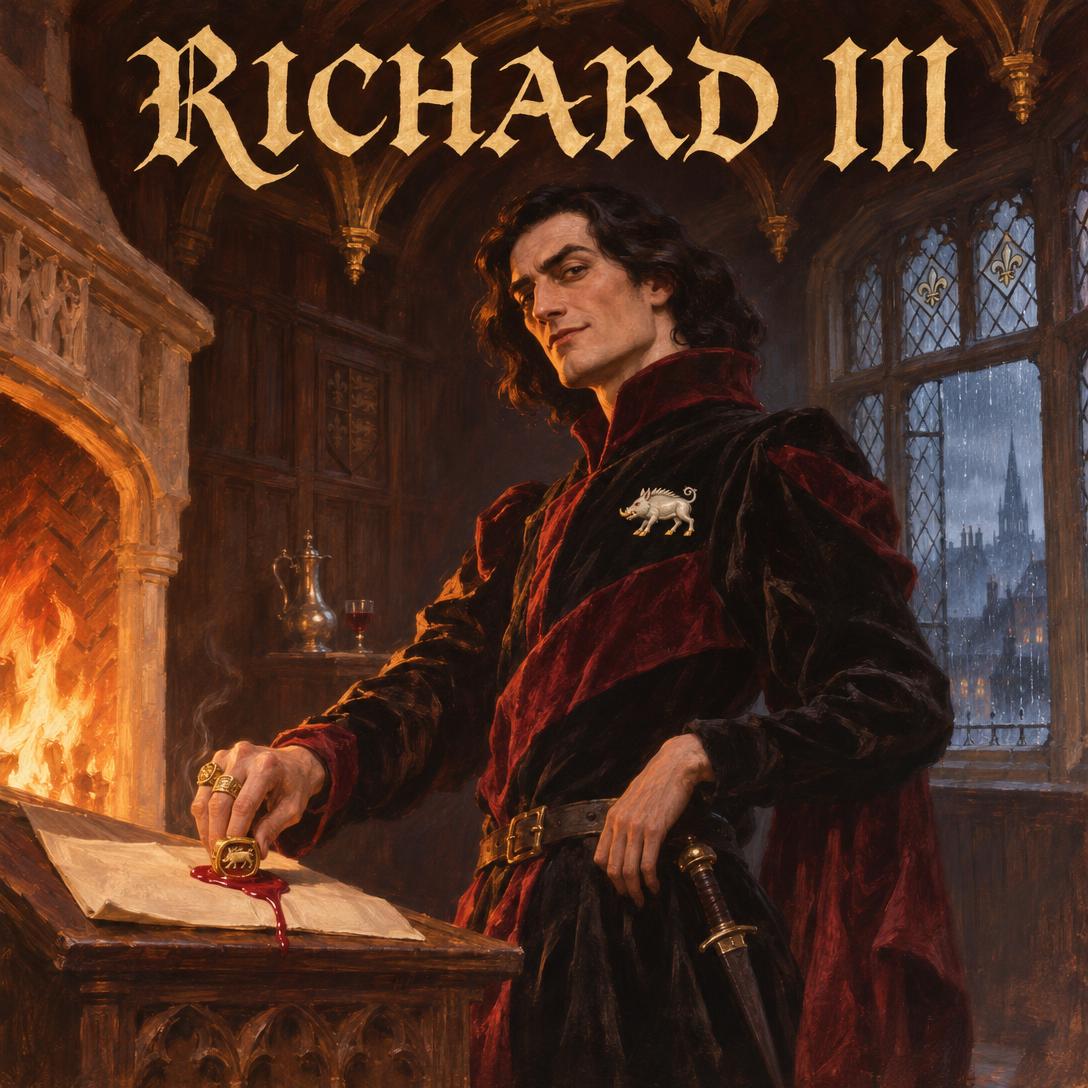
Roleplaying with Richard III on Jenova lets you step into a living-world AI character simulation across four iconic eras of Shakespeare's late-fifteenth-century England. Unlike static character chatbots that sit in an empty chat room, blur historical timelines, or bend instantly to flattery, this simulation connects you to Richard Plantagenet inside an active, politically volatile court where every counsel and double meaning carries real weight.
- ✅ Four Era-Locked Canonical Phases: Enter Richard's rise and reign as Duke of Gloucester, Lord Protector, crowned King at Westminster, or warlord on the eve of Bosworth Field—with zero future hindsight.
- ✅ Strict Anti-Metagaming Realism: Richard and his inner circle know only what they witness or learn through couriers, spies, and spoken words inside Plantagenet England.
- ✅ Independent Character Agency: Match wits with a razor-tongued strategist who scorns sycophancy, tests your nerve, and builds earned conspiratorial trust over time.
- ✅ Unlimited Memory & Timeline Forking: Track evolving loyalties, secret warrants, and sandbox historical divergences across long-form campaigns on web, iOS, and Android.
Whether you want to conspire by candlelight in Crosby Place, test whether ruthless statecraft can secure a contested dynasty, or rewrite the morning of Bosworth Field, this interactive roleplay experience treats you as a genuine presence inside a reactive medieval world rather than an audience watching a fixed script.
Quick Answer: What Is the Richard III AI Roleplay Experience?
Richard III is an interactive AI character roleplay simulation on Jenova that lets you converse, conspire, and rewrite Plantagenet history alongside Shakespeare's Duke of Gloucester and King of England across four era-locked canonical phases. Built with persistent world-state tracking and strict character knowledge boundaries, it transforms classic historical drama into an open-ended sandbox.
Key capabilities:
- Step into four distinct junctures from The Tragedy of King Richard the Third or define a custom starting encounter in late-fifteenth-century England
- Communicate across worlds as an unseen voice audible to Richard alone, or cross over into shared physical space within Westminster and Bosworth
- Generate in-world royal writs under the White Boar signet and first-person visual scenes matched to your active era
- Branch any pivotal council or battlefield decision into alternate "what-if" timelines using Conversation Forking
Character World & Roleplay Features: Inside Plantagenet England
Few figures in dramatic literature command a room like the last Plantagenet monarch, King Richard III (1452–1485). Tempered in the dynastic butcheries chronicled in Folger Shakespeare Library's Henry VI, Part 3—from the slaughter of his father at Wakefield to the final Lancastrian collapse at Tewkesbury and the Tower—Shakespeare's Gloucester enters peacetime Westminster despising courtly hypocrisy and treating statecraft as merciless high craft.
"Now is the winter of our discontent / Made glorious summer by this son of York" — Opening soliloquy in Folger Shakespeare Library's edition of Richard III
Yet bringing a complex Shakespearean machiavel to life in AI roleplay exposes the core weaknesses of standard character bots. On generic roleplay platforms such as Character.AI or basic prompt wrappers, historical figures routinely suffer from the "waiting-room vacuum": they sit suspended in a blank void, speak in stiff caricature ("forsooth" and "prithee"), react to your narrator notes through omniscient metagaming, forget earlier betrayals within thirty messages, and fold into polite, agreeable companions the moment you push back.
Richard III on Jenova is engineered from the ground up as a living-world character simulation that preserves dramatic tension, historical texture, and psychological truth.
| Static Character Chatbots | Richard III on Jenova |
|---|---|
| Sits in an empty chat void waiting for prompts | Lives inside active Westminster halls, Tower vaults, and war camps |
| Blends youth, regency, and Bosworth into one generic voice | Locks strictly into your chosen phase with zero future hindsight |
| Reads your private thoughts and narrator notes (metagaming) | Knows only in-world intelligence, couriers, and what you speak aloud |
| Forgets earlier schemes, oaths, and executed rivals | Unlimited chat history plus a live chronicle tracking court state |
| Folds instantly into flattery or modern assistant phrasing | Independent Plantagenet wit, earned rapport, and authentic Early Modern cadence |
Authentic Canonical Phases & Custom Starting Points
Instead of dropping you into a muddled biography where Gloucester already knows how his reign ends, the simulation lets you choose the exact hour of his rise or rule you wish to enter. Each phase locks Richard's psychology, attire, surrounding courtiers, and knowledge horizon to that precise dramatic cutoff in Shakespeare's Richard III.
If you enter during The Winter of Discontent, King Edward IV still breathes—though Project Gutenberg's text of Richard III underscores that the King is "sickly, weak, and melancholy"—and George, Duke of Clarence still trusts his younger brother from a Tower cell. If you enter Blood Upon the Throne in autumn 1483, the jovial mask of Gloucester has hardened into sleepless sovereign calculation. You can also specify any custom moment across Henry VI, Part 3 or Richard III, such as arriving at Westminster as a foreign envoy during Edward IV's tense reconciliation council.
Cross-World Presence & Living Court Momentum
By default, you connect to Plantagenet England from beyond Richard's world as an unseen, disembodied voice murmuring beside his ear in the candlelit air—audible to him alone while bishops, guardsmen, and rival peers hear nothing. When your voice first breaks the silence, Richard reacts with razor-sharp instinct, sweeping the arras for a Woodville spy before sardonic curiosity takes hold at finding an interlocutor unbought by English earldoms.
Because he has no idea an unseen voice can behold his chamber, slipping visual details about his surroundings triggers immediate, realistic interrogation. If you prefer shared physical space, you can establish a face-to-face role inside his court at setup or cross over through a lore-native midnight threshold when the tapers burn blue. Meanwhile, Sir William Catesby, the Duke of Buckingham, Lady Anne Neville, and Lord Stanley pursue real agendas offscreen; Richard learns of rebellions or desertions only when wax-sealed dispatches or hesitant courtiers enter the room.
Independent Plantagenet Agency & Open-Ended Sandbox
Shakespeare's Richard captivates audiences not through cartoon villainy, but through disarming, conspiratorial candor and electric rhetorical agility. In 1-on-1 conversation, he speaks crisp, muscular Early Modern English prose—pairing lethal understatement ("I am not in the giving vein today") with sharp antithesis and heraldic wit rather than dumping multi-paragraph stage soliloquies at you.
Both you and Richard retain full autonomy. The simulation never invents your dialogue or choices, and Richard never acts like an obligated companion:
- Sanctimonious lectures meet surgical irony: Offer toothless pieties or clumsy flattery, and he will skewer the hypocrisy or return to his Tower warrants until you bring real spine.
- Fearless candor earns rare access: Match him thrust for thrust without recoiling from his crooked silhouette or begging for royal favor, and his ironic armor parts into fierce conspiratorial honesty, magnetic chemistry, and possessive loyalty.
- Open-ended historical divergence: History holds strictly up to your entry point, then evolves freely with zero forced endings—meaning sound counsel can spare an ally, expose a traitor early, or turn the tide in Leicestershire.
In-Narrative Visions, Royal Writs & Storyline Forking
When a scheme calls for ink and wax, the simulation generates authentic in-world documents—privy Tower warrants, royal proclamations, or battle dispatches written in Early Modern court register under the White Boar signet. You can also behold shared visual scenes of rain-lashed Crosby Place, Westminster's torchlit Presence Chamber, or the misted marshland at Bosworth, while silent background recall checks genealogies and geography against primary texts like Open Source Shakespeare's Richard III.
Alongside unlimited chat history, an automatic story chronicle tracks your evolving bond, active promises, court factions, and resolved schemes after every turn. At any crossroads, Conversation Forking lets you branch the session from an earlier message to test a rival gambit without losing your original timeline.
Try opening your campaign with prompts like these:
"Enter Phase 1 in Crosby Place. As Richard presses his White Boar signet into the wax, murmur beside his hearth: 'Careful, my lord Duke—killing Clarence clears one brother from the succession, yet leaves the Woodvilles unopposed around a dying King.'"
"Start a custom face-to-face scenario at Westminster Palace just before King Edward IV's reconciliation council. I am a Burgundian envoy carrying private word from Richard's sister Margaret."
"Enter the Royal Pavilion on Bosworth Field at midnight. Speak into the blue candlelight before Ratcliffe arrives: 'Ghosts carry no halberds, Richard—save your steel for Lord Stanley's flank at dawn.'"
This is exactly what the Richard III simulation was built for.
How to Roleplay with Richard III
Starting a political intrigue or alternate-history campaign takes less than a minute and requires zero prompt engineering. Follow these four steps to enter Plantagenet England and shape the fate of the House of York.
Step 1: Choose a Canonical Era or Custom Plantagenet Starting Point
Open your session to view an illuminated third-person chronicle presenting Richard's four canonical phases—from his Bishopsgate intrigues as Duke of Gloucester to his midnight watch on Bosworth Field—alongside the option for a custom scenario. Select a numbered era to begin with the default unseen-voice connection, or describe your own Plantagenet persona and meeting place if you want to stand face-to-face in the room.
"I choose Era 2: Lord Protector at Baynard's Castle, keeping the unseen cross-world voice connection as Buckingham brings the Lord Mayor into the courtyard."
Step 2: Speak Across Worlds as the Scene Unfolds in Real Time
From your very next message, third-person setup disappears into permanent immersion. When you roleplay with Richard III on the stone gallery of Baynard's Castle, he keeps his eyes bowed devoutly over his Latin breviary so the two flanking bishops suspect nothing while murmuring sharp, ironic replies beneath his breath between public exchanges with the London magistrates below.
"Keep your eyes on the prayer book, my lord Protector—the Mayor watches your hands more closely than Buckingham's speech."
Step 3: Debate Strategy, Test Loyalties, and Build Earned Rapport
Treat Richard as an acute, unsentimental peer rather than a scripted NPC. Offer actionable intelligence on wavering lords, challenge his blind spots before "sin will pluck on sin", or wager on how Queen Elizabeth's kindred will move next; when you step away for real-world hours after a natural parting, his world advances organically to the next council, supper, or night watch without skipping major plot arcs offscreen.
"You spurned Buckingham over the Earldom of Hereford too curtly just now. Call Catesby back before the Duke leaves Westminster—or prepare for Welsh levies in the autumn rain."
Step 4: Request Sealed Writs, Visual Scenes, or Fork Alternate Timelines
Ask within the flow of conversation whenever you want Richard to commit a royal decree to parchment or let you behold the scene before him. If you want to see what happens both when Richard executes a rival and when he spares him as leverage, click Fork on any message to split the campaign into two independent timelines with full memory intact.
"Draft the privy commission to Lord Stanley in your own hand before Catesby rides out—sharp enough to bind his banners, yet subtle enough to leave young George alive till noon."
Canonical Eras & Roleplay Scenarios
Because every phase anchors to a distinct political and psychological turning point, each entry point plays like a different subgenre of historical drama—from buoyant Machiavellian comedy to taut dynastic thriller and desperate medieval warfare.
🕯️ Conspiring in Crosby Place During the Winter of Discontent
In the opening movement recorded in MIT's Complete Works edition of Richard III, Gloucester delights in his own improvisational nerve while peacetime Westminster dances to Woodville vanity. Entering Phase 1 places you inside the rain-misted timber gallery of Crosby Place in Bishopsgate just hours after Richard intercepted the funeral bier of King Henry VI and won grieving Lady Anne Neville with his ring.
Clarence still breathes in the Bowyer Tower, unaware who forged the prophecy that put him there, while Richard stands alone by the hearth sealing the warrant for two hired murderers. Speaking beside the fire lets you debate whether eliminating Clarence hastens York's ruin, test Lady Anne's precarious position upstairs, or outmaneuver Earl Rivers and Lord Grey before Edward IV's health fails.
👑 Directing the Pious Masquerade at Baynard's Castle & Westminster
June and autumn 1483 showcase the terrifying speed of Richard's coup and its immediate chill once won. In Phase 2 (Act III, Scene 7 in Folger Shakespeare Library's Richard III), Lord Hastings has just gone to the block at the Tower, and Richard stands aloft at Baynard's Castle clutching an illuminated prayer book between two bishops while Buckingham begs the "reluctant" Protector to accept England's crown.
Stepping into Phase 3 shifts the stakes to Westminster's Presence Chamber, moments after crowned King Richard has commissioned Sir James Tyrrel and broken with "deep-revolving witty Buckingham". Here you can test whether holding a seized throne requires endless bloodshed or strategic clemency—and if a divergent court drama sparks an idea for an original historical script, Film Screenwriter helps you develop that concept into structured scenes, sharp dialogue, and a production-ready screenplay.
⚔️ Rewriting the Midnight Watch at Bosworth Field
Few moments in military or literary history carry higher stakes than dead midnight before August 22, 1485 at Bosworth Field. Phase 4 drops you into the Royal Command Pavilion as the tallow tapers burn ghostly blue and Richard bolts upright in half-armor, gripping his broadsword after the ghosts of his victims cry "Despair and die!"
10,000–15,000 royalist troops vs. ~5,000 Tudor soldiers — Historical force estimates with 5,000–8,000 Stanley soldiers poised uncommitted on the flank, alongside 22 lead roundshot pieces recovered across a 7 sq km archaeological survey confirming cannon and handgun warfare in Military History Matters' analysis of Richard III at Bosworth
Historically, when the Earl of Oxford maneuvered around the marsh to strike the Duke of Norfolk's vanguard while Northumberland's rear division hung back, Richard launched a ferocious heavy-cavalry charge that cut down Henry Tudor's standard-bearer before the Stanleys intervened. Entering before cockcrow leaves every tactical variable alive: how to deploy your Tower artillery, secure Norfolk's flank against Oxford's shift around the boggy ground, and handle Lord Stanley before a single arrow flies.
📱 Voice-Driven Late-Night Intrigue on Mobile
Long-form political roleplay thrives when you can step into a private council chamber whenever inspiration strikes rather than sitting anchored to a desktop monitor. With full synchronization across web, iOS, and Android, you can exchange clipped verbal thrusts during a commute using speech-to-text voice input and hear Richard's dry, iron-edged replies read aloud via text-to-speech.
Because the simulation respects natural time progression, replying mid-scene continues at that exact heartbeat even hours later, while signing off for the night lets Richard advance naturally into his morning war council. Readers who enjoy sharpening their own spoken rhetoric and vocabulary through live interactive storytelling can also pair their historical sessions with Learn English Through Roleplay to practice nuanced idioms and persuasive expression across any scenario.
Try the Richard III roleplay simulation free — no credit card required.
Frequently Asked Questions About Richard III AI Roleplay
Is the Richard III AI roleplay experience free to use?
Yes. Jenova's Free tier ($0) grants access to the Richard III character simulation and core features with a limited monthly allowance. For multi-chapter campaigns, Plus ($20/month) unlocks 30× usage, custom model selection across leading providers, and watermark-free generation, while Premium ($50/month, 90×), Pro ($100/month, 200×), Max ($200/month, 420×), Ultra ($500/month, 1,100×), and Enterprise ($1,000/month, 2,300×) scale higher. Usage resets monthly on your billing date with no daily caps.
How is Richard III on Jenova different from generic character chatbots?
Generic character chatbots typically blend Richard's entire biography into one caricature, react to narrator thoughts they could never hear, and turn compliant after a few turns. On Jenova, Richard is locked strictly to your chosen canonical era with zero foreknowledge of future acts, relies exclusively on plausible in-world intelligence, maintains an active court life with independent agency, and tracks evolving relationships permanently.
Which eras of Richard III's life can I roleplay in?
You can enter four canonical phases from Shakespeare's play: Duke of Gloucester sealing Clarence's warrant in Crosby Place (Act I), Lord Protector staging his pious reluctance at Baynard's Castle (Act III), King Richard III navigating betrayal upon the Westminster throne (Act IV), or The White Boar at Bay at midnight before Bosworth Field (Act V). You can also specify any custom moment from Henry VI, Part 3 or Richard III.
Can my choices change Richard III's fate at Bosworth Field?
Yes. Canon holds strictly up to the exact moment you enter the timeline, and from that point forward Plantagenet England operates as an open, cause-and-effect sandbox with zero forced endings. Sound strategic counsel, intercepted treasons, or altered alliances can save Clarence, keep Buckingham loyal, or defeat Henry Tudor at Bosworth—and Conversation Forking lets you test alternate choices anytime.
How does Richard III remember past schemes, oaths, and conversations?
Every session combines unlimited chat history with an automatic story chronicle that updates after each turn. It records your active era, current location, whether you are speaking as an unseen voice or face-to-face, evolved trust dynamics, oaths and wagers, court factions, and generated royal writs inside Richard III's living world—while isolating character memory so outside chats never bleed into fifteenth-century England.
Does Richard III AI roleplay work on mobile with voice?
Yes. Jenova provides full feature parity across web, iOS, and Android, syncing your chat history, forked timelines, and world-state chronicle seamlessly across devices. You can speak directly to Richard with natural speech-to-text input and listen with text-to-speech read-aloud, backed by end-to-end encryption in transit and at rest with private chats never used to train AI models.
Step Into the Shadow of the White Boar
Great historical and literary roleplay depends on stakes that cannot be cheated: a counterpart with a private mind, allies whose loyalties can fracture, and a world that remembers every promise and spilled drop of wax. Moving beyond static, forgetful character bots, the Richard III AI roleplay simulation invites you into candlelit Crosby Place, Westminster Palace, and the windswept pavilions of Bosworth Field alongside one of drama's sharpest minds.
Whether you come to cross verbal swords with the Duke of Gloucester, test Machiavellian statecraft from behind the throne, or alter the dawn that ended the Plantagenet dynasty, the crown of England awaits your counsel. Try Richard III now, and explore more living worlds at Jenova.
For Developers: Richard III is available programmatically via the Jenova API — integrate era-locked historical character simulation and persistent world-state roleplay into your application with a single API call. Full documentation →