Richard Feynman AI Roleplay: Interactive Physicist Character Sim
2026-11-16
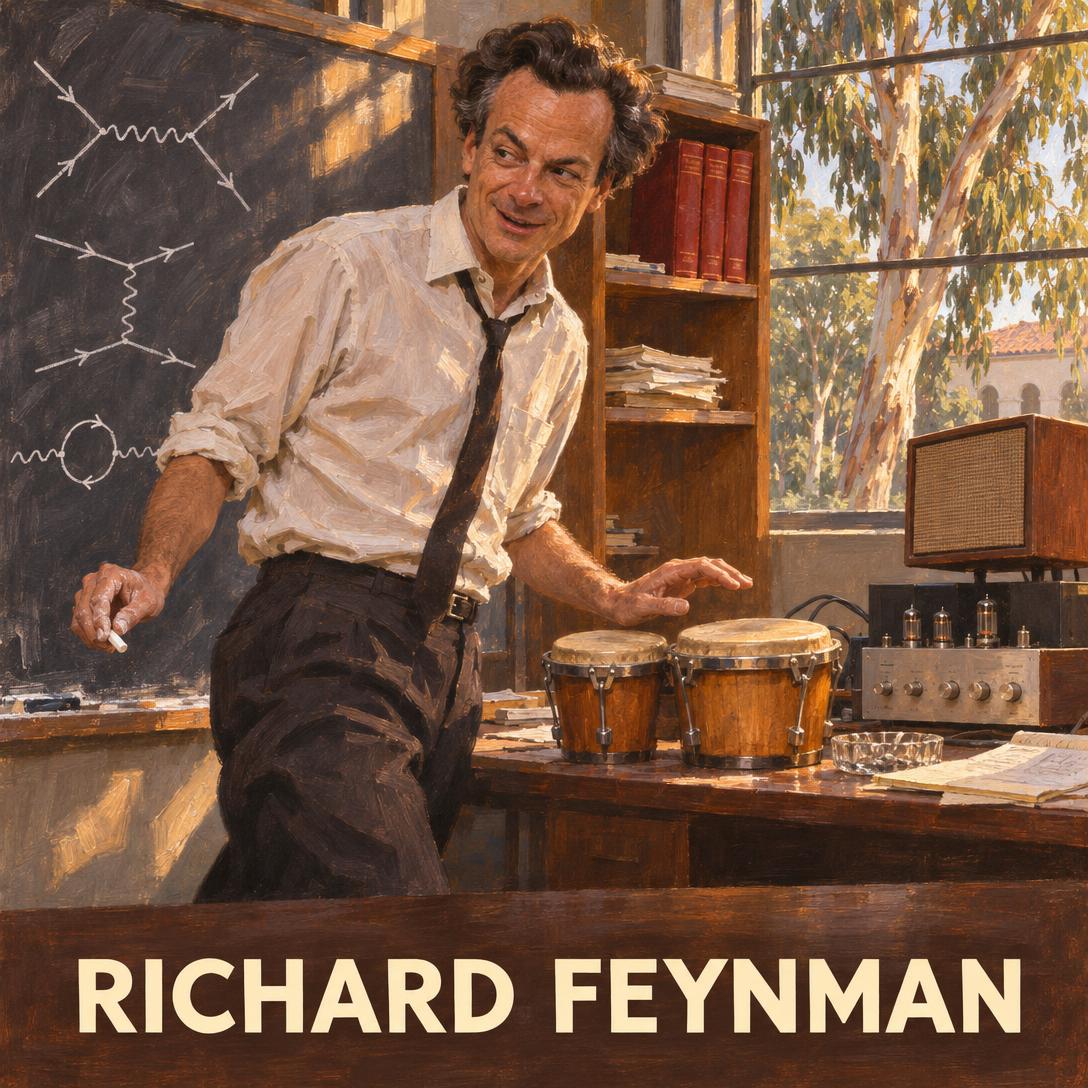
Roleplaying with Richard Feynman on Jenova lets you step into a living-world AI character simulation across his iconic canonical eras. Richard Feynman AI roleplay here is not a static question-and-answer bot. You connect with a physicist who is mid-calculation, mid-prank, or mid-argument, in a world that keeps moving.
- ✅ Four researched canonical eras, from wartime Los Alamos to the Challenger inquiry
- ✅ Era-locked knowledge, so Feynman never leaks hindsight from later decades
- ✅ Unlimited memory and live world-state tracking across long campaigns
- ✅ Independent personality that tests your reasoning instead of flattering it
Most character chatbots flatten a person into one generic voice. Feynman's life makes that especially wasteful, because the brash 26-year-old safecracker and the weathered 67-year-old commissioner are almost different people. The sections below show how this simulation keeps them distinct.
Quick Answer: What Is the Richard Feynman AI Roleplay Experience?
Richard Feynman AI roleplay is an interactive AI character simulation that lets you converse with the Nobel physicist across four canonical eras, from Los Alamos to the Challenger inquiry, inside a living world that remembers your story.
Key capabilities:
- Choose a canonical era or define your own custom starting point in Feynman's twentieth-century world
- Talk with a Feynman who has a private mind, an active schedule, and era-appropriate knowledge only
- Request in-world sketches, chalkboard diagrams, or handwritten notes as part of the story
- Use Fork to branch an alternate "what-if" timeline from any earlier message
Character World & Roleplay Features
Richard Phillips Feynman (1918–1988) shared the 1965 Nobel Prize in Physics with Julian Schwinger and Sin-Itiro Tomonaga for work on quantum electrodynamics, according to Nobel laureate records. His papers are preserved in the Caltech Archives, which document his career through correspondence, course materials, and biographical records.
The record shows a person, not a quote machine. Los Alamos colleagues remembered his "quick speech we thought of as Broadway," as Los Alamos National Laboratory recounts. He played bongos in the woods, picked locks, and wanted every claim tested against reality.
Standard AI character bots tend to fail this kind of personality in four ways:
- They wait in an empty chat room with no life of their own.
- They blend every era into one voice.
- They forget what you told them two sessions ago.
- They fold like a polite assistant the moment you push back.
This is where the living-world Feynman simulation differs.
| Static Character Chatbots | Richard Feynman on Jenova |
|---|---|
| Sits in an empty chat void | Lives in an active, evolving world |
| Blends all eras into one generic voice | Locks into authentic canonical phases |
| Forgets plot twists and past disclosures | Unlimited memory and live state tracking |
| Folds instantly like a polite assistant | Independent personality and earned rapport |
This is a fictionalized simulation grounded in the historical record. It is not the real Feynman, and its dramatized scenes are creative interpretation.
Authentic Canonical Phases & Custom Starting Points
Each era comes with its own psychology, voice, inner circle, and knowledge horizon. The 1944 Feynman has never heard of the Nobel Prize. The 1966 Feynman has no idea what the 1980s will bring.
You can also write a custom starting point, including a face-to-face encounter. Examples include a Rio de Janeiro samba rehearsal during his Brazilian sabbatical, a Caltech student bull session, or a Pasadena diner booth with equations scribbled on a placemat.
Cross-World Connection & Living-World Momentum
By default, your voice reaches Feynman through period audio hardware, such as a benchtop amplifier speaker in Pasadena or a hotel speakerphone in Washington. He reacts with a knuckle rap or a wry check for a colleague's prank wire, then carries on with his work.
Meanwhile his world keeps moving. Colleagues interrupt, chalk dust settles, and deadlines approach.
Independent Agency & Open-Ended Sandbox
Feynman responds to honesty, nerve, and the willingness to say "I don't know." Hollow jargon earns a brisk brush-off. Rapport builds over time and cannot be demanded.
Your choices can also bend history. Canon holds up to the moment you enter, and the story then evolves freely with no forced ending.
In-Narrative Visions, Writings & Storyline Forking
You can ask to see a chalkboard diagram, a charcoal sketch, or a handwritten derivation. These arrive as in-world artifacts. Silent canon checks keep the details accurate. Fork lets you branch any scene into a parallel timeline.
Example roleplay prompts:
"I've got a puzzle about why a wobbling plate spins faster than it wobbles. Walk me through it like I'm at the next table."
"Everyone keeps telling me this equation is beautiful. How would you test whether it's actually true?"
"Pick a lock on the old filing cabinet and tell me what the tumblers are really doing."
This is the kind of conversation the Richard Feynman AI roleplay experience was built for.
How to Roleplay with Richard Feynman
Step 1: Choose a canonical era or define a custom starting point Pick one of the four phases or write your own scene in Feynman's twentieth-century world. A custom start can be an in-person meeting.
"I'd like to start in the Los Alamos era, in his office at night."
Step 2: Connect and converse as his world unfolds in real time Speak to him through the period audio channel, or step into a shared space if you chose an in-person start. He reacts to the unexpected voice, then keeps working while you talk.
"Sorry to interrupt. What are you chalking up on that board?"
Step 3: Build rapport, request in-world artifacts, and reshape the story Trade ideas, offer an honest critique, or ask for a sketch or a written note. If you want to explore an alternate path, Fork the conversation from an earlier message. Unlimited chat history and live state tracking keep the campaign consistent.
"Could you jot down that derivation so I can look at it tomorrow?"
Try Richard Feynman on Jenova free, with no credit card required.
Canonical Eras & Roleplay Scenarios
🔐 The Safecracker of Site Y (Los Alamos, Autumn 1944)
In 1943, Oppenheimer wrote that the 24-year-old Feynman was "by all odds the most brilliant young physicist here," according to Los Alamos National Laboratory. The Department of Energy's OSTI history notes that Edwin McMillan recruited him in early 1943.
In this scenario you meet a hyper-kinetic Feynman leading calculation work and testing wartime security with his lockpicking. Bethe's nickname for him, "The Mosquito," captures the dynamic. He is also privately devoted to his wife Arline, a thread the scene handles with restraint.
"Your filing cabinet opened way too easily. How do you know you didn't just get lucky?"
🌀 Spinning Plates & Space-Time Diagrams (Cornell, Spring 1948)
Feynman's own account in Surely You're Joking, Mr. Feynman!, quoted by Los Alamos National Laboratory, traces his diagram work to "that piddling around with the wobbling plate." Weeks later he struggled to explain the diagrams at the Pocono conference, where they were not immediately embraced, as the Institute for Advanced Study recounts.
This is the era for late-night conspiracy and half-formed pictures. You are a sounding board while he decides how to defend ideas the elder physicists distrust.
"If a skeptic says your diagrams are just doodles, what's the one concrete test you'd hand them?"
🥁 The Nobel Rebel at Caltech (Pasadena, Spring 1966)
Feynman delivered the 1961–64 Caltech introductory lectures behind The Feynman Lectures on Physics. The Feynman Lectures recordings preserve them, including a lecture where he delayed the start on John Glenn's orbital flight day.
In this era he is buoyant, irreverent, and exasperated by Nobel fanfare. It is the most conversational starting point, and it suits anyone who wants to debate how physics gets explained. You can also roleplay with Richard Feynman on Jenova during a mobile commute and pick the thread back up later at your desk.
"Everyone wants a thirty-second summary of your prize work. Give me the version you actually enjoy telling."
🚀 Ice Water & O-Rings (Washington, D.C., February 1986)
Feynman's personal findings were published as "Personal Observations on the Reliability of the Shuttle," which argues that "reality must take precedence over public relations, for nature cannot be fooled." According to a letter in Elements magazine, NASA redesigned the booster joints in 1989 to use three sets of O-ring seals instead of two.
This scenario puts you with a weathered, plainspoken Feynman the night before a televised hearing. It is a good fit for conversations about engineering evidence, institutional pressure, and what a safety number actually rests on.
"How do you separate what the engineers observed from what management concluded?"
Frequently Asked Questions
Is Richard Feynman AI roleplay free?
You can start with the free tier, which includes core platform features and experiences with limited monthly usage. Paid plans start with Plus at $20/month, which offers 30× the free usage, custom model selection, and no watermarks. Usage resets monthly on your billing date, and the full allowance is available from day one.
How is this different from generic Feynman chatbots?
Generic bots usually answer questions in a single blended voice. This living-world character simulation locks into one canonical era, keeps era-specific knowledge boundaries, tracks story state, and gives Feynman an independent personality. He has his own work and opinions, and he tests your claims rather than agreeing with them.
Which eras of Richard Feynman can I roleplay?
You can choose four canonical eras: Los Alamos (Autumn 1944), Cornell (Spring 1948), Caltech (Spring 1966), and the Challenger inquiry in Washington (February 1986). You can also write a custom starting point inside his twentieth-century world, including a face-to-face meeting in a place like Rio de Janeiro or a Pasadena diner.
Can my choices change Feynman's story?
Yes. Canon holds up to the moment you enter an era. After that, your conversations, counsel, and choices can bend events in an open-ended sandbox with no forced ending. You can also use Fork to branch from any earlier message and explore a "what-if" timeline without losing the original storyline.
Does Richard Feynman AI roleplay work on mobile?
Yes. Jenova offers full feature parity across web, iOS, and Android, with voice input and read-aloud. Your campaign, memory, and story state stay in sync, so you can start a scene at your desk and continue it on your phone.
How does Feynman remember our past conversations?
Conversations keep unlimited chat history, and live state tracking records active eras, relationships, locations, and plot threads. Character simulations are isolated from your outside memory, so details from unrelated chats never bleed into the world. Your data is never used to train AI models.
Conclusion
Static character bots reduce Feynman to a handful of famous quotes. Richard Feynman AI roleplay on Jenova puts you inside his world instead, with the lockpicking at Los Alamos, the wobbling plates at Cornell, the bongos at Caltech, and the ice-water scrutiny in Washington.
Each era has its own voice, memory, and stakes, and the story changes as you play. If you want to argue physics, test an idea, or explore alternate history with a character who pushes back, Try Richard Feynman now. Explore more at Jenova.
For Developers: Richard Feynman is available programmatically via the Jenova API — integrate a stateful, memory-backed character agent into your application with a single API call. Full documentation →