AI Recommendation Letter Assistant: Write Stronger Letters Faster
2026-08-20
An AI recommendation letter assistant helps you turn scattered notes about a student or colleague into a polished, personalized letter in minutes instead of hours. While most educators and managers write recommendations after the workday ends — squeezing them between grading, meetings, and family time — an AI assistant handles structure, tone, and phrasing so you can focus on the specifics only you know.
✅ Turns bullet-point observations into full narrative letters ✅ Adapts tone for colleges, scholarships, jobs, and graduate programs ✅ Keeps each letter distinct instead of recycling the same template ✅ Delivers export-ready documents in standard business letter format
The pressure is real. Recommendation letters carry significant weight in admissions decisions, yet the people writing them are already stretched past capacity. To understand why an AI writing assistant has become a practical necessity rather than a convenience, it helps to look at what recommendation season actually costs the people who staff it.
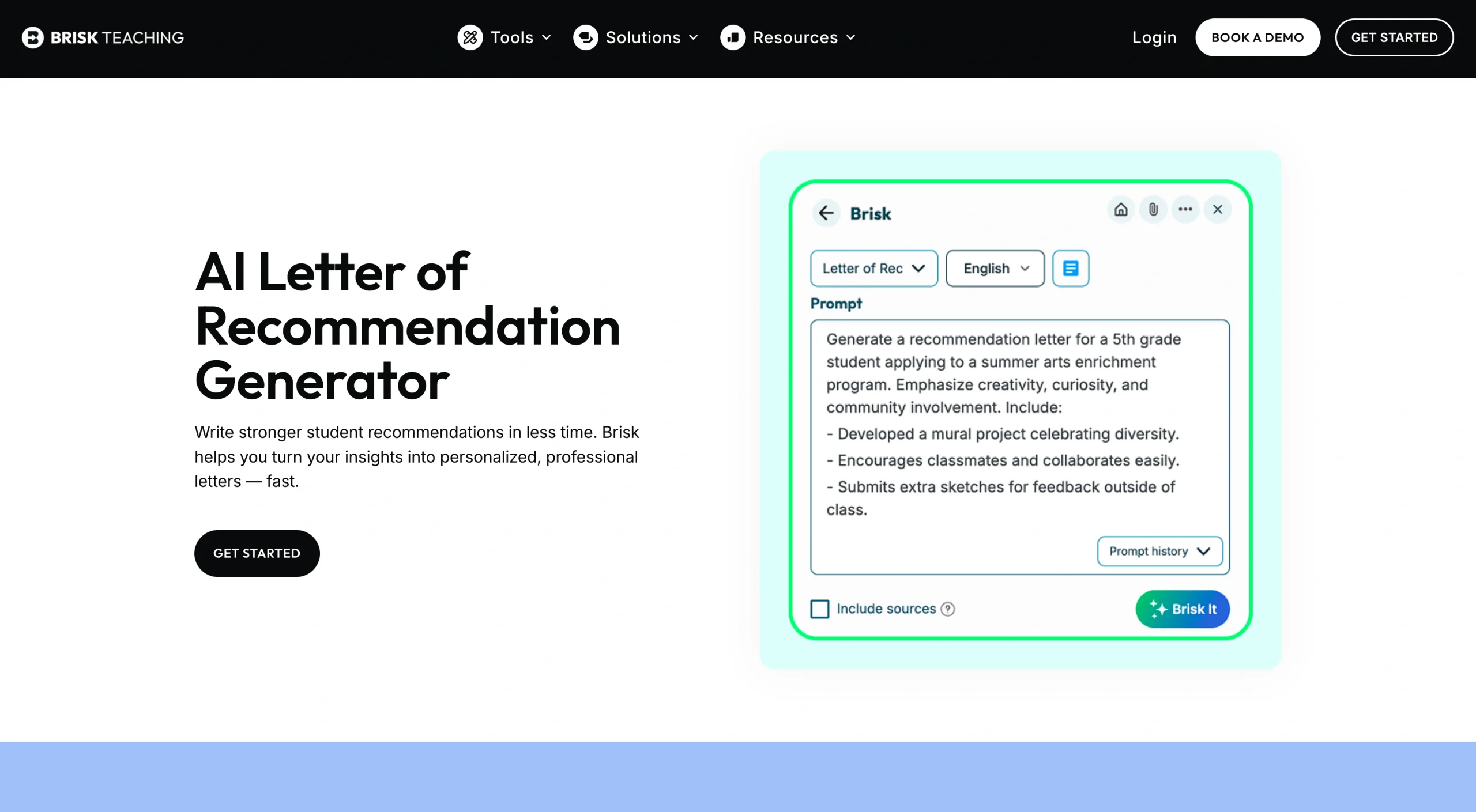
Quick Answer: What Is an AI Recommendation Letter Assistant?
An AI recommendation letter assistant is a writing tool that converts your notes about a student, employee, or colleague into a complete, personalized recommendation letter — handling structure, tone, and phrasing while you supply the specific evidence.
Key capabilities:
- Drafts full letters from short bullet points, anecdotes, or a résumé
- Adjusts formality and emphasis for the specific recipient (admissions committee, hiring manager, scholarship board)
- Varies language across multiple letters so no two read identically
- Formats output as a professional business letter with proper salutation, body, and closing
- Revises on request — shorten, strengthen a specific claim, or shift the emphasis
The Problem: Recommendation Letters Cost More Time Than Anyone Budgets
Recommendation letters are one of the few high-stakes documents that are simultaneously mandatory and unpaid. The person writing them is usually a teacher, counselor, or manager with no allocated hours for the task.
The scale of the burden is well documented:
More than 60% of teachers reported burnout in 2024, citing heavy workloads and insufficient support as key factors — TNTP, Teachers' Time Use: A Review of the Literature
Around 80% of colleges and universities consider recommendation letters an important component of a college application, according to a National Association for College Admission Counseling survey — Georgetown University FEED
In 13 U.S. states, the average student-to-counselor ratio exceeds 500:1; just four states have a ratio below 250:1 — Georgetown University FEED
But writing these letters well is frustratingly difficult:
- Volume collides with deadlines. Requests cluster into a few weeks each fall, and every one carries a hard submission date.
- Blank-page paralysis. Knowing a student is excellent is not the same as knowing how to open a letter about them.
- Template drift. When you write ten letters in a week, they start sounding identical — and admissions readers notice.
- Unequal quality across schools. Counselors with lighter caseloads produce detailed letters; overloaded ones submit short ones or none at all.
- Unconscious bias in phrasing. Word choice patterns can systematically advantage some applicants over others.
Volume Arrives All at Once
Recommendation requests are not evenly distributed across the year. They pile up ahead of early-decision and regular-decision deadlines, arriving from students who all need letters in the same two-week window. A teacher handling a dozen requests is looking at a significant block of unpaid evening and weekend work during the busiest stretch of the academic calendar.
The Quality Gap Is an Equity Problem
The Georgetown analysis is blunt about this: students at under-resourced schools receive weaker letters not because they are weaker students, but because the adults writing for them have no time. As one admissions perspective in the report put it, "a disadvantaged student is further disadvantaged" when their letters are too brief or lacking in detail. A tool that reduces drafting time from ninety minutes to fifteen directly narrows that gap.
Sameness Undermines Credibility
Admissions readers evaluate hundreds of letters per cycle. A letter built from a reusable template — same opening, same three adjectives, same closing — signals low effort and dilutes the endorsement. Genuine differentiation requires rewriting from scratch each time, which is exactly what makes the task expensive.
Bias Hides in Word Choice
Research on recommendation letters has repeatedly flagged how descriptive language varies by the writer's unconscious assumptions — some candidates get "brilliant" and "analytical," others get "hardworking" and "pleasant." Catching those patterns manually, across a stack of letters written at 11 p.m., is nearly impossible.
This is exactly what a dedicated AI writing assistant was built for.
Why Use an AI Recommendation Letter Assistant
An AI recommendation letter assistant does not replace your judgment about the person — it replaces the mechanical labor of turning that judgment into prose. You supply the evidence; the assistant supplies structure, transitions, professional register, and formatting.
| Writing Letters Manually | With an AI Recommendation Letter Assistant |
|---|---|
| 60–90 minutes per letter from blank page | Complete first draft in a few minutes from bullet notes |
| Letters blur together after the third or fourth | Each letter varied in structure, phrasing, and emphasis |
| One generic version sent to every institution | Tailored angle per recipient — college, scholarship, employer |
| Formatting fixed manually every time | Standard business letter structure applied automatically |
| Bias in phrasing goes unnoticed | Language can be reviewed and rebalanced on request |
| Revisions mean rewriting whole paragraphs | Targeted revisions on a single sentence or section |
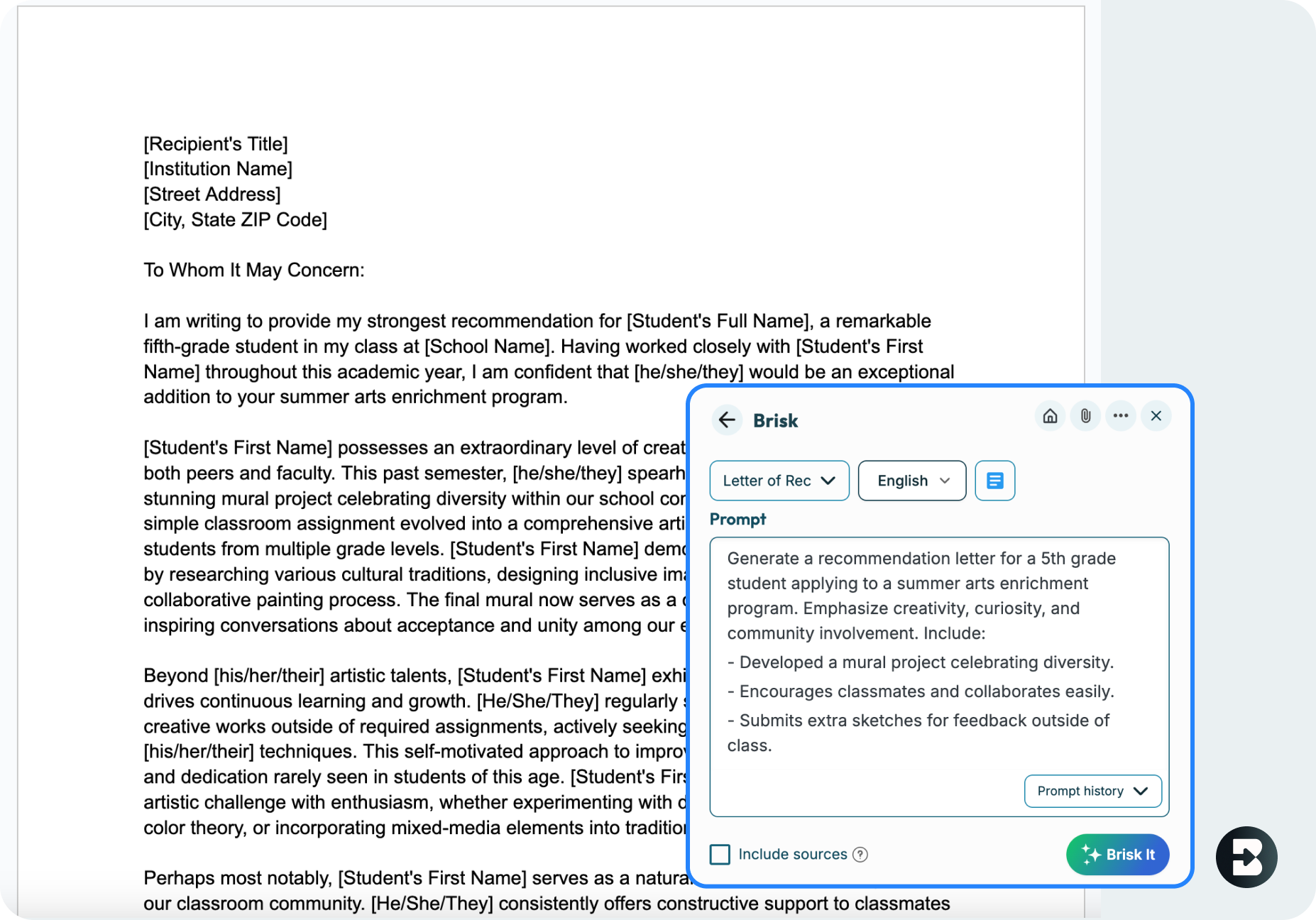
Notes In, Narrative Out
The core mechanic is simple: you provide fragments, the assistant produces a letter. Three bullet points about a mural project, a note that the student mentors classmates, and an observation about self-directed work become three developed paragraphs with connective tissue and specific framing.
"Write a recommendation letter for a high school junior applying to a summer engineering program. She rebuilt our robotics team's drivetrain after two failed competitions, taught herself CAD over one summer, and now runs the team's onboarding sessions for freshmen."
Recipient-Aware Tone
A letter to a selective university reads differently from a letter to a scholarship committee or a hiring manager. Specify the destination and the assistant adjusts emphasis — academic potential for admissions, reliability and impact for employment, financial need and character for scholarships.
"Rewrite this for a merit scholarship committee — emphasize leadership and community contribution over test performance."
Differentiation Across a Batch
Writing eight letters in one sitting is where templates take over. An AI assistant can vary the opening structure, the ordering of evidence, and the vocabulary across each letter, so a reader comparing two applicants from the same school sees two genuinely different documents.
Targeted Revision
Instead of rewriting a paragraph to fix one weak claim, you can ask for a surgical change.
"The second paragraph feels generic. Rewrite it around the specific incident where he stayed after class for six weeks to help a struggling classmate pass chemistry."
Consistent Professional Formatting
Recipient block, date line, salutation, signature block, contact details — the boilerplate that eats ten minutes per letter gets applied automatically, in the format the receiving institution expects.
Related Agents You'll Also Find Useful
Recommendation letters rarely arrive alone. They sit inside a larger application or hiring workflow, and these agents cover the adjacent steps.
College Admissions Consultant
If you're advising the student who needs the letter — or you're the student coordinating the request — this agent handles the strategy around the application as a whole. It's the natural companion when a recommendation is one piece of a much larger submission.
- School selection and list-building tailored to the applicant's profile
- Personal essay crafting and iterative feedback
- Application timeline management across multiple deadlines
Resume & Cover Letter Writer
Recommendation letters for jobs and internships work best when they align with the candidate's own materials. This agent produces ATS-optimized résumés and cover letters that reinforce the same narrative your letter supports.
- Researches target companies before writing
- Tailors positioning to the specific role
- Produces documents formatted for applicant tracking systems
Word Doc Generator
Once your letter is written, it needs to leave the chat as a real document. This agent converts finished text into professionally formatted Word files with industry-standard conventions applied automatically.
- Business letter formatting with correct margins and spacing
- Letterhead-ready output for institutional stationery
- Handles résumés, proposals, and academic documents in the same workflow
MBA Admissions Consultant
Business school recommendations follow their own conventions — competency grids, 360-degree feedback prompts, and specific question formats that differ from undergraduate letters. This agent knows what business school committees actually read for.
- Profile review against target program benchmarks
- Application and essay review
- Interview preparation and practice
Try Jenova free — no credit card required.
How It Works
Step 1: Gather Your Raw Material
Collect whatever you already have — a résumé, a class roster note, two remembered anecdotes, the program the person is applying to. You do not need polished sentences. Fragments are enough.
"Marcus, AP Biology, second period. Consistently asks the follow-up question nobody else thought of. Ran a peer tutoring group. Applying to nursing programs."
Step 2: Specify the Recipient and Purpose
Tell the assistant who will read the letter and what decision they're making. A nursing program, a research internship, and a scholarship board each need a different center of gravity.
"This is for direct-entry BSN nursing programs. Emphasize clinical reasoning, empathy under pressure, and the peer tutoring leadership."
Step 3: Generate the First Draft
The assistant produces a complete letter with an opening that establishes your relationship to the candidate, body paragraphs built around your evidence, and a closing endorsement with contact details.
Step 4: Revise Where It Matters
Read for accuracy first. Anything the AI inferred rather than received from you should be corrected or cut. Then sharpen the paragraphs that feel soft.
"Cut the third paragraph entirely. Expand the tutoring section — he ran it twice a week for a full year and six of his eight students moved up a letter grade."
Step 5: Export and Send
Send the finished text to the Word Doc Generator for a formatted document on your letterhead, or download directly from the chat as PDF, Word, or TXT using the download button on the message.
Results & Use Cases
📚 The High School Teacher in Recommendation Season
Scenario: An AP English teacher receives fourteen recommendation requests in the three weeks before early-decision deadlines.
Traditional Approach: Roughly 60–90 minutes per letter, done at night and on weekends — a full unpaid workweek absorbed into an already overloaded term.
AI Recommendation Letter Assistant: Ten to fifteen minutes per letter, spent on the part that requires the teacher's actual expertise: recalling and selecting the right specific evidence.
- Each letter varied in structure so the batch doesn't read as templated
- Notes from the gradebook and class observations become full narrative paragraphs
- Deadline pressure absorbed without sacrificing letter quality for later requesters
💼 The Manager Writing for a Departing Employee
Scenario: A team lead is asked for a LinkedIn recommendation, a formal reference letter, and a graduate school recommendation for the same employee — three documents, three audiences.
Traditional Approach: Write one letter and lightly modify it twice, producing three documents that all read like the same generic endorsement.
AI Recommendation Letter Assistant: Three genuinely distinct documents from one set of source notes, each weighted for its reader.
- Grad school version emphasizes analytical rigor and research contribution
- Employment reference emphasizes reliability, ownership, and measurable results
- Public recommendation stays short, warm, and shareable
- Pairs naturally with the Resume & Cover Letter Writer for a coherent application package
📱 The Counselor Working From a Phone Between Meetings
Scenario: A school counselor with a 400-student caseload has fifteen minutes between appointments and three overdue letters.
Traditional Approach: The letters wait until evening, then the weekend, then the deadline — and the last student gets a rushed three-paragraph note.
AI Recommendation Letter Assistant: Draft a letter from a phone during a gap in the schedule, review it that evening, submit on time.
- Full feature parity across web, iOS, and Android
- Speech-to-text input for dictating notes while walking between rooms
- Persistent memory keeps context on students discussed in earlier sessions
- All settings and chat history sync across devices
🎓 The Graduate Advisor Managing Long-Term Relationships
Scenario: A professor writes for the same doctoral students repeatedly over several years — fellowship applications, conference nominations, postdoc placements.
Traditional Approach: Dig through old email to find the last letter, then rewrite it from scratch because circumstances have changed.
AI Recommendation Letter Assistant: Unlimited chat history and persistent cross-session memory mean the context from every prior letter is still available.
- Prior letters and student details remain accessible across sessions
- New letters build on established narrative rather than restarting
- Attach the student's CV or publication list as a knowledge base for grounded detail
- Works alongside the College Admissions Consultant when advising on the broader application
Frequently Asked Questions
Is an AI recommendation letter assistant free to use?
Yes. Jenova's free tier includes all core features with limited monthly usage, which is enough for occasional letter writing. Heavier users during application season can upgrade for expanded usage and custom model selection. Check the "Subscribe" option in the menu for current plan details.
Is it ethical to use AI to write a recommendation letter?
Using AI as a drafting tool is comparable to using a template or asking a colleague to review your phrasing — the substance, judgment, and endorsement remain yours. The ethical line is accuracy: never sign a letter containing claims you cannot personally verify. UNESCO's guidance on AI in education emphasizes using these tools as a thought partner rather than a shortcut, and that framing applies directly here.
Will the letter sound generic or obviously AI-written?
Only if you give it generic input. The quality of the output tracks directly with the specificity of what you provide. "Great student, hard worker" produces a forgettable letter. "Rebuilt the drivetrain after two failed competitions and now trains the freshmen" produces a memorable one. Always revise the draft — the specific details are what admissions readers remember.
How do I protect student privacy when using AI tools?
Share only what's necessary and avoid entering identifiers like Social Security numbers, health records, or full student ID numbers. The NEA's guidance on student and educator data privacy recommends understanding FERPA and COPPA obligations, reviewing what data a tool collects, and informing administrators about the tools you use. Jenova does not use your data to train public AI models, and data is encrypted in transit and at rest.
Can it write letters for jobs and scholarships, not just college?
Yes. Specify the recipient and purpose and the assistant adjusts structure and emphasis accordingly — employment references, graduate program recommendations, scholarship endorsements, professional licensing references, and immigration character references all follow different conventions. For job-related documents, pair it with the Resume & Cover Letter Writer.
Can I turn the finished letter into a proper document?
Yes. Any response can be downloaded as PDF, Word, TXT, or CSV using the download button beneath the message. For letterhead-ready formatting with correct business letter conventions applied automatically, route the text through the Word Doc Generator.
Conclusion
Recommendation letters matter — roughly 80% of colleges treat them as an important part of an application — but the people writing them are operating under burnout rates above 60% and counselor caseloads that exceed 500 students in more than a dozen states. That mismatch produces exactly the outcome nobody wants: rushed, generic letters that fail the students who need strong advocacy most.
An AI recommendation letter assistant resolves the mismatch by taking over the part of the task that doesn't require you — structure, transitions, formatting, tone calibration — and leaving you the part that does: knowing the person and choosing the right evidence. A letter that used to take ninety minutes takes fifteen, and it's often better, because your time goes into specificity rather than sentence construction.
Start with your next request. Drop in your notes, name the recipient, and revise the draft until it says what you actually mean.
Explore more at Jenova, and pair your letter writing with the College Admissions Consultant or MBA Admissions Consultant for full application support.
For Developers: Recommendation letter generation is available programmatically via the Jenova API — integrate personalized letter drafting into your edtech, HR, or admissions application with a single API call. Full documentation →